Table of Contents >> Show >> Hide
- What Does “Quitting Without Notice” Actually Mean?
- Is Two Weeks’ Notice Legally Required?
- When Quitting Without Notice May Be Acceptable
- When Quitting Without Notice Is Usually a Bad Idea
- Professional Consequences of Quitting Without Notice
- How to Quit Without Notice Professionally
- How to Explain Quitting Without Notice in a Future Interview
- Should Employers Expect Notice If They Do Not Give Notice?
- A Practical Decision Checklist
- Alternatives to Quitting Without Notice
- Experiences and Real-World Lessons About Quitting Without Notice
- Conclusion: So, Is Quitting Without Notice Acceptable?
Quitting a job without notice is one of those workplace topics that can turn a calm break room into a courtroom drama with stale coffee. Some people believe two weeks’ notice is a sacred professional ritual. Others argue that if companies can lay people off without warning, employees should not feel guilty about walking away when a job becomes unbearable. So, is quitting without notice acceptable? The honest answer is: sometimes, but not always.
In the United States, many workers are employed “at will,” meaning an employee can usually leave a job at any time, for any legal reason, unless a contract, union agreement, or specific policy says otherwise. But “legal” and “wise” are not always the same thing. You may be allowed to quit immediately, but the bigger question is whether doing so protects your health, your finances, your reputation, and your future references.
This guide breaks down when quitting without notice may be understandable, when it may backfire, how to resign professionally if you must leave immediately, and what real-world workers can learn from messy exits, toxic bosses, surprise job offers, and workplaces that treat “team player” like a magical spell for unpaid emotional labor.
What Does “Quitting Without Notice” Actually Mean?
Quitting without notice means ending your employment immediately or with less notice than your employer expects. In many workplaces, the traditional standard is two weeks’ notice. In some senior, specialized, or contract-based roles, the expected notice period may be longer. For hourly, part-time, seasonal, or entry-level roles, the expectation may be more flexible, though managers may still prefer advance warning.
There are different versions of quitting without notice. One person may send a same-day resignation email because they are dealing with a medical emergency. Another may stop showing up without communicating at all. A third may tell a manager, “Today will be my last day,” and hand over passwords, notes, and unfinished tasks before leaving. These are not the same thing. The more communication and professionalism you provide, the less damage you usually create.
Is Two Weeks’ Notice Legally Required?
For many U.S. employees, two weeks’ notice is not legally required. It is a professional custom, not a universal law. However, there are important exceptions. If you signed an employment contract, work under a collective bargaining agreement, received a bonus tied to notice requirements, or work in a role with specific resignation terms, leaving without notice may have consequences.
Some company handbooks say employees are expected to give notice to remain eligible for rehire or certain benefits. A handbook is not always the same as a contract, but it can still affect how your employer records your departure. In practical terms, quitting without notice may not land you in legal trouble, but it can affect references, final scheduling, bonus eligibility, unused vacation payout depending on state law and policy, and whether the company ever wants to see your cheerful face again.
When Quitting Without Notice May Be Acceptable
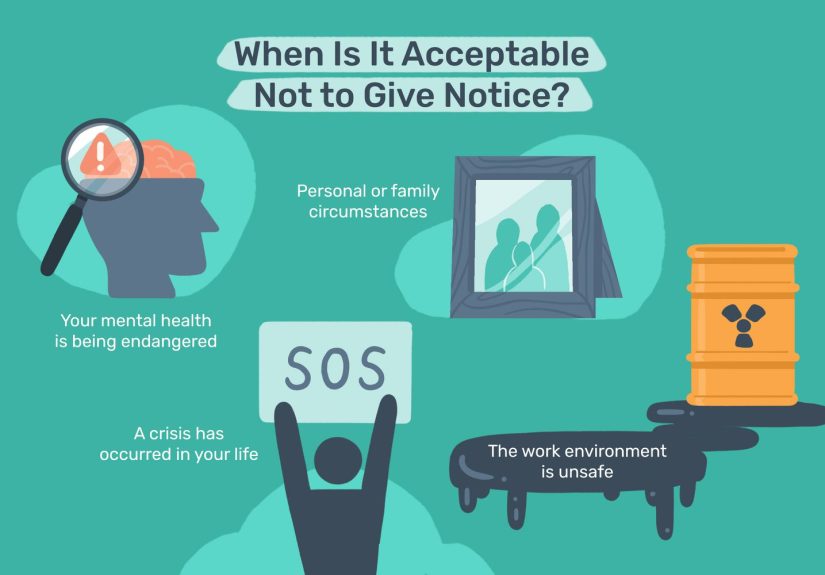
Quitting without notice is generally best reserved for serious situations. Not every bad Monday qualifies. If your boss uses too many “circle back” emails, that may be annoying, but it is not automatically an emergency exit. Still, there are circumstances where leaving immediately can be reasonable, responsible, or even necessary.
1. The Workplace Is Unsafe
If your job exposes you to serious physical danger, unsafe equipment, violent threats, hazardous conditions, or instructions that put your health at risk, quitting without notice may be justified. Workers have the right to a safe workplace, and no paycheck is worth being placed in immediate danger. Ideally, document the unsafe condition, report it through the proper channels when possible, and keep copies of communications.
2. You Are Being Harassed or Abused
A workplace that includes harassment, intimidation, threats, discrimination, or emotional abuse can become impossible to remain in, even for two more weeks. If continuing to work would seriously harm your mental or physical well-being, leaving quickly may be the healthiest choice. In these cases, keep records of what happened, including dates, names, messages, and any reports made to HR or management.
3. You Are Being Asked to Do Something Illegal or Unethical
If an employer asks you to falsify records, lie to customers, ignore safety rules, hide violations, or participate in something illegal, quitting immediately can be a form of self-protection. A resignation letter does not need to become a courtroom speech. A simple, factual statement such as “I am resigning effective immediately and will return company property today” is often better than writing a dramatic novel titled My Boss and the Spreadsheet of Doom.
4. You Are Not Being Paid Properly
If your employer repeatedly fails to pay wages, delays paychecks, makes improper deductions, or avoids overtime obligations, immediate resignation may be understandable. Workers should also check state labor department rules because final paycheck deadlines vary by state. Federal law does not require immediate final payment in every case, but some states do have stricter timelines.
5. A Personal or Family Emergency Requires It
Life does not always check your calendar before throwing a crisis through the window. A sudden illness, family emergency, caregiving situation, housing crisis, or major personal event may make it impossible to continue working through a notice period. In these situations, a short, respectful message can help preserve dignity and reduce confusion.
6. The Employer Has Already Made Notice Pointless
Some employers immediately walk employees out after they give notice, especially in roles involving confidential data, client accounts, sensitive systems, or competitor concerns. If a company has a known practice of ending employment the same day notice is given, workers may reasonably plan around that reality. Still, giving notice may remain the better professional move if you can afford the risk.
When Quitting Without Notice Is Usually a Bad Idea
There are also plenty of situations where quitting without notice can create more problems than it solves. Leaving suddenly may feel satisfying for about seven minutes. After that, you may be left with awkward references, unpaid bills, angry coworkers, and the realization that your dramatic exit did not come with background music.
You Are Simply Frustrated
Every job has terrible days. A rude meeting, an annoying coworker, or a manager who says “urgent” about everything does not always justify quitting on the spot. If the problem is temporary, it may be wiser to take a night, cool down, review your options, and resign with notice once you have a plan.
You Need the Reference
If your current employer is important to your career history, leaving without notice may hurt your future job search. Even if a company only confirms job title and dates of employment, former managers and coworkers may still become informal references. Industries are smaller than they look, especially when LinkedIn turns everyone into a professional detective.
Your Coworkers Will Carry the Burden
Sometimes the employer deserves no extra loyalty, but your coworkers may still be the ones stuck with your unfinished work. If you are leaving a toxic manager behind, try not to accidentally hand your teammates a flaming spreadsheet bouquet. A short transition note, shared file list, or project update can go a long way.
You Have Contractual Obligations
If you signed a contract requiring notice, leaving immediately may create financial or legal risk. This is especially important for executives, contractors, healthcare workers, educators, commissioned sales employees, and employees who received relocation assistance, tuition reimbursement, or signing bonuses. Review documents before resigning if possible.
Professional Consequences of Quitting Without Notice
Quitting without notice can affect your career in several ways. The most obvious consequence is reputation. Managers may view it as unreliable, even if your reason was valid. Coworkers may remember the extra workload. Recruiters may ask why your departure happened so abruptly. None of this means your career is ruined, but it does mean you should be prepared to explain the decision calmly.
Another consequence is rehire eligibility. Many companies mark employees who leave without notice as ineligible for rehire. This may not matter if you never want to return, but it can matter during background checks, reference checks, or future applications to related companies.
There may also be financial consequences. Depending on state law and company policy, your final paycheck, unused vacation payout, bonus eligibility, commission timing, or benefits may be affected. You should save copies of pay stubs, employment agreements, bonus plans, and resignation communications.
How to Quit Without Notice Professionally
If you must quit without notice, the goal is to make the exit as clean as possible. You do not need to over-explain, apologize for having boundaries, or write a resignation letter that sounds like a medieval confession. Keep it brief, respectful, and clear.
Use a Simple Resignation Message
Here is a professional example:
Subject: Resignation Effective Immediately
Dear [Manager Name],
I am resigning from my position as [Job Title], effective immediately. Due to personal circumstances, I am unable to continue working through a notice period. I appreciate the opportunity to have worked with the team. I will return company property and provide any necessary information to help with the transition.
Sincerely,
[Your Name]
This message is short, mature, and legally boring in the best possible way. It does not attack anyone, confess too much, or include emotional fireworks. Professional resignation letters should not read like group chat screenshots.
Offer a Mini Transition Plan
If possible, include passwords through secure company-approved channels, project notes, client status updates, deadlines, and where important files are located. Do not take company data with you. Do not delete files. Do not sabotage systems. Leave like an adult, even if the workplace made you feel like starring in a revenge movie.
Return Company Property
Laptops, badges, uniforms, tools, phones, keys, credit cards, and documents should be returned promptly. Ask for written confirmation if needed. This protects both sides and reduces the chance of later accusations.
Ask About Final Pay and Benefits
Request information about your final paycheck, unused paid time off, health insurance continuation, retirement accounts, commissions, expense reimbursements, and tax documents. Keep the tone practical. The goal is not to win an argument; it is to leave with your money, records, and sanity intact.
How to Explain Quitting Without Notice in a Future Interview
If a future employer asks why you left suddenly, avoid turning the interview into a documentary about workplace villainy. Be honest, but strategic. Focus on professionalism and what you learned.
For example, you might say: “I left my previous role sooner than expected because the situation was no longer workable, and I made the decision that was best for my health and long-term stability. I handled the resignation professionally and made sure the company had the information needed for transition. I am now focused on finding a role where I can contribute consistently and grow.”
If the issue involved safety, harassment, or illegal conduct, you can keep the explanation brief: “There were serious workplace concerns that made it necessary for me to leave immediately. I documented the situation and handled the resignation as professionally as possible.” You do not need to overshare. A job interview is not a therapy couch with fluorescent lighting.
Should Employers Expect Notice If They Do Not Give Notice?
This is the heart of the debate. Many workers feel the two-week notice tradition is unfair because employers can often terminate employees with little or no warning. That frustration is understandable. A company may call it “business needs” when it cuts jobs, but call an employee “unprofessional” for leaving quickly. The double standard is not exactly subtle.
Still, your decision should be based on your own goals, not just your employer’s behavior. Giving notice can protect your reputation, references, and relationships. Quitting without notice can protect your health, safety, and boundaries. The right choice depends on the situation.
A Practical Decision Checklist
Before quitting without notice, ask yourself these questions:
- Am I in immediate danger or experiencing serious harm?
- Did I sign a contract requiring a notice period?
- Can I afford a gap in income?
- Will leaving immediately affect my final pay, bonus, commission, or benefits?
- Do I need this employer as a reference?
- Can I give even a few days of notice instead of none?
- Can I provide a transition document to reduce damage?
If the answer involves safety, harassment, unpaid wages, illegal requests, or a serious personal emergency, quitting immediately may be reasonable. If the answer is mostly “I am angry today,” pause before turning your resignation into a workplace weather event.
Alternatives to Quitting Without Notice
If you are unsure, consider alternatives. You might give shorter notice, such as three days or one week. You might request medical leave, personal leave, reduced hours, remote work, or reassignment. You might report concerns to HR, a manager above your manager, an ethics hotline, or a government agency. These options will not fix every situation, but they can give you more protection and documentation.
Another option is to give notice but prepare financially in case the employer ends your employment immediately. Some companies accept notice gracefully. Others respond like you personally canceled their birthday. Before giving notice, remove personal files from company devices, save copies of your own pay records, and make sure you have contact information for benefits and payroll.
Experiences and Real-World Lessons About Quitting Without Notice
Real-life resignation stories usually fall into a few familiar patterns. The first is the emergency exit. A worker is dealing with an unsafe environment, escalating harassment, or a manager who treats boundaries like optional office décor. In these cases, quitting without notice often feels less like a career move and more like getting oxygen after holding your breath too long. The lesson is simple: when a job becomes harmful, protecting yourself may matter more than protecting a company’s schedule.
The second pattern is the regretful exit. Someone quits in the heat of the moment after a bad meeting, a denied raise, or one too many “quick calls” that somehow eats half the afternoon. At first, the exit feels powerful. Then reality arrives wearing sensible shoes: bills, job applications, awkward explanations, and the coworker who texts, “Did you really just leave us with the quarterly report?” The lesson here is not that employees should tolerate disrespect forever. It is that timing matters. A planned resignation usually gives you more control than an explosive one.
The third pattern is the opportunity exit. A new employer needs someone to start immediately, and the worker is tempted to leave the old job overnight. This can be acceptable in some cases, especially if the old job was temporary, low-responsibility, or already unstable. But it can also create a reputation problem. A strong new employer will usually respect a candidate who wants to exit professionally. If a company pressures you to abandon your current job recklessly, that may be a tiny red flag wearing a tiny corporate polo.
The fourth pattern is the quiet boundary exit. A worker gives a short resignation, returns equipment, sends a transition note, and refuses to engage in drama. No grand speech. No angry essay. No “you will regret losing me” email at 11:47 p.m. This is often the best version of quitting without notice. It protects the worker’s boundary while minimizing unnecessary damage.
Many employees who have quit without notice say the emotional relief was immediate, especially when the job was toxic. However, they also often recommend documenting everything, saving money first if possible, and communicating clearly. The best exits are not always long, but they are usually intentional. Even when a workplace does not deserve your loyalty, your future self deserves your careful planning.
The most useful experience-based advice is this: do not confuse professionalism with self-sacrifice. Professionalism means communicating clearly, acting ethically, and avoiding unnecessary harm. It does not mean staying in a dangerous, abusive, or unpaid situation just to keep a manager comfortable. At the same time, self-respect does not require chaos. You can leave immediately and still be organized, concise, and calm.
Conclusion: So, Is Quitting Without Notice Acceptable?
Quitting without notice can be acceptable when your safety, health, pay, ethics, or personal emergency requires immediate action. It is less acceptable when it is driven only by frustration, boredom, or a desire to make a dramatic exit. In most cases, giving notice remains the better professional choice because it helps protect your reputation, relationships, and future opportunities.
But work is a two-way agreement, not a lifetime oath carved into a conference room table. If a workplace becomes unsafe, abusive, illegal, or impossible to continue, you are allowed to prioritize your well-being. The smartest approach is to know your rights, review your obligations, document important details, communicate clearly, and leave in a way that protects both your present peace and your future career.