Table of Contents >> Show >> Hide
- What Is the Constant of Proportionality?
- How to Know If a Relationship Is Proportional
- How to Find the Constant of Proportionality from an Equation
- How to Find the Constant of Proportionality from a Table
- How to Find the Constant of Proportionality from a Graph
- How to Find the Constant of Proportionality from a Word Problem
- Common Mistakes When Finding the Constant of Proportionality
- Step-by-Step Method for Any Problem
- Practice Problems: Find the Constant of Proportionality
- Real-Life Examples of the Constant of Proportionality
- Experience-Based Tips for Learning the Constant of Proportionality
- Conclusion
Finding the constant of proportionality sounds like something a math wizard would whisper dramatically before drawing a triangle in the air. Luckily, it is much friendlier than it sounds. In plain English, the constant of proportionality is the number that connects two quantities in a proportional relationship. If one quantity changes, the other changes at a steady rate. No drama. No secret handshake. Just a reliable number doing its job.
The main idea is simple: when two values are proportional, you can write their relationship as y = kx. In that equation, k is the constant of proportionality. It tells you how much y changes for every 1 unit of x. You may also hear it called the unit rate, especially in middle school math, because it often answers the question, “How much for one?”
For example, if 4 notebooks cost $12, then each notebook costs $3. That $3 is the constant of proportionality. It connects the number of notebooks to the total cost. Buy more notebooks, pay more money. Buy zero notebooks, pay zero money. Beautifully predictable, unlike your printer when homework is due.
What Is the Constant of Proportionality?
The constant of proportionality is the fixed ratio between two proportional quantities. In most school problems, the relationship is written like this:
y = kx
Here, x is the independent value, y is the dependent value, and k is the constant of proportionality. To find k, divide y by x:
k = y / x
That formula is the golden key. If a table, graph, equation, or word problem gives you matching values for x and y, you can usually find the constant of proportionality by dividing the output by the input.
How to Know If a Relationship Is Proportional
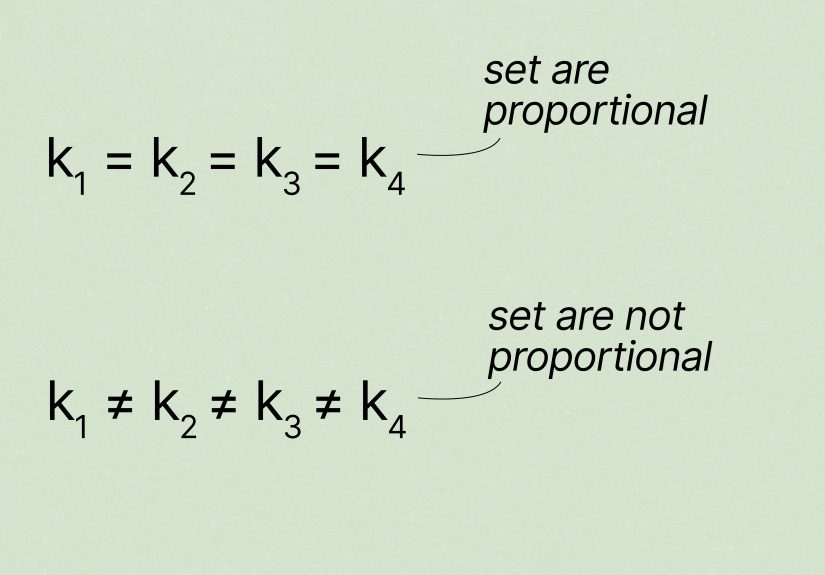
Before you find the constant, make sure the relationship is actually proportional. A relationship is proportional when the ratio y / x stays the same for every pair of values. On a graph, a proportional relationship appears as a straight line that passes through the origin, or (0, 0).
Here is the quick test:
- The ratio
y / xmust be the same for each pair. - The equation must be able to fit the form
y = kx. - The graph must be a straight line through
(0, 0). - There should be no added or subtracted number, such as
y = 3x + 2.
That last point is important. The equation y = 3x is proportional because the constant is 3. But y = 3x + 2 is not proportional because the extra + 2 changes the relationship. It is like adding surprise fees to a bill. Mathematically suspicious.
How to Find the Constant of Proportionality from an Equation
If the equation is already written in the form y = kx, finding the constant of proportionality is almost too easy. Just identify the number multiplied by x.
Example 1
y = 6x
The constant of proportionality is 6. This means that for every increase of 1 in x, y increases by 6.
Example 2
y = 0.75x
The constant of proportionality is 0.75. Decimals are allowed. Fractions are allowed. Math is surprisingly inclusive.
Example 3
y = x / 4
This can be rewritten as y = 1/4x, so the constant of proportionality is 1/4.
How to Find the Constant of Proportionality from a Table
Tables are one of the most common places to find proportional relationships. To find the constant, choose any matching pair of x and y, then divide y by x.
| x | y | y / x |
|---|---|---|
| 2 | 10 | 10 / 2 = 5 |
| 4 | 20 | 20 / 4 = 5 |
| 6 | 30 | 30 / 6 = 5 |
Because the ratio is always 5, the constant of proportionality is 5. The equation is:
y = 5x
What If the Ratios Are Not the Same?
If the ratios are different, the relationship is not proportional. For example:
| x | y | y / x |
|---|---|---|
| 1 | 4 | 4 |
| 2 | 9 | 4.5 |
| 3 | 12 | 4 |
The ratios are not all equal, so there is no single constant of proportionality. The table tried to join the proportionality club, but the bouncer checked the ratios.
How to Find the Constant of Proportionality from a Graph
On a graph, the constant of proportionality is the slope of a proportional relationship. Since proportional graphs pass through the origin, you can choose any clear point on the line and use:
k = y / x
Example
Suppose a line passes through (0, 0) and (3, 12). Use the point (3, 12):
k = 12 / 3 = 4
The constant of proportionality is 4, and the equation is:
y = 4x
Remember, do not use (0, 0) to divide because 0 / 0 is undefined. The origin is useful for confirming proportionality, but it is not your best buddy for calculating k.
How to Find the Constant of Proportionality from a Word Problem
Word problems often hide the constant of proportionality inside real-life situations: price per item, miles per hour, pages per minute, dollars per pound, or points per game. Your job is to identify the two quantities and divide.
Example 1: Unit Price
A store sells 5 pounds of apples for $15. What is the constant of proportionality?
Let x be pounds of apples and y be total cost.
k = 15 / 5 = 3
The constant of proportionality is 3, meaning the apples cost $3 per pound. The equation is:
y = 3x
Example 2: Speed
A cyclist travels 24 miles in 2 hours. What is the constant of proportionality?
Let x be hours and y be miles.
k = 24 / 2 = 12
The constant of proportionality is 12, so the cyclist travels 12 miles per hour.
Common Mistakes When Finding the Constant of Proportionality
1. Dividing in the Wrong Order
The formula is usually k = y / x, not x / y. If the problem defines the equation differently, read carefully. But in standard y = kx problems, divide the dependent value by the independent value.
2. Using a Non-Proportional Relationship
If the graph does not pass through the origin or the ratios in a table are not equal, there is no constant of proportionality. You may still have a linear relationship, but it is not proportional.
3. Forgetting Units
The number alone is not always enough. If k = 60 in a speed problem, say 60 miles per hour. If k = 4 in a price problem, say $4 per item. Units turn a random number into a meaningful answer.
4. Thinking the Constant Must Be a Whole Number
The constant of proportionality can be a whole number, fraction, decimal, or negative number, depending on the situation. If y = 0.5x, the constant is 0.5. No need to panic just because a decimal walked into the room.
Step-by-Step Method for Any Problem
Use this simple process whenever you need to find the constant of proportionality:
- Identify the two quantities.
- Decide which value is
xand which value isy. - Check whether the relationship is proportional.
- Use the formula
k = y / x. - Write the equation as
y = kx. - Add units if the problem involves real-world measurements.
This method works for equations, tables, graphs, diagrams, and word problems. It is basically the Swiss Army knife of proportional relationship problems, except less pointy and more likely to appear on a quiz.
Practice Problems: Find the Constant of Proportionality
Problem 1
Find the constant of proportionality in y = 8x.
Answer: k = 8
Problem 2
A table shows that when x = 3, y = 21. Find k.
Solution: k = 21 / 3 = 7
Answer: k = 7
Problem 3
A graph passes through the point (5, 30) and the origin. Find the constant of proportionality.
Solution: k = 30 / 5 = 6
Answer: k = 6
Problem 4
A recipe uses 12 cups of flour for 4 batches of bread. What is the constant of proportionality?
Solution: k = 12 / 4 = 3
Answer: 3 cups of flour per batch
Problem 5
Does this table show a proportional relationship?
| x | y |
|---|---|
| 2 | 14 |
| 4 | 28 |
| 6 | 42 |
Solution: 14 / 2 = 7, 28 / 4 = 7, and 42 / 6 = 7.
Answer: Yes. The constant of proportionality is 7.
Problem 6
Does this equation represent a proportional relationship: y = 5x + 1?
Answer: No. It has an added + 1, so it is not in the form y = kx.
Problem 7
A car travels 180 miles in 3 hours. What is the constant of proportionality?
Solution: k = 180 / 3 = 60
Answer: 60 miles per hour
Real-Life Examples of the Constant of Proportionality
The constant of proportionality is not just a classroom creature living in worksheets. It appears all over everyday life.
Shopping
If 6 granola bars cost $9, the constant of proportionality is 9 / 6 = 1.5. That means each granola bar costs $1.50.
Travel
If a train travels 150 miles in 2.5 hours, the constant of proportionality is 150 / 2.5 = 60. The train travels 60 miles per hour.
Printing
If a printer produces 40 pages in 5 minutes, the constant is 40 / 5 = 8. The printer prints 8 pages per minute, assuming it does not stop to “think about its life choices.”
Recipes
If 2 cups of rice serve 4 people, the constant can be 2 / 4 = 0.5 cup per person. This helps you scale the recipe up or down without accidentally feeding a small village.
Experience-Based Tips for Learning the Constant of Proportionality
One of the best ways to understand the constant of proportionality is to connect it to situations you already know. Many students struggle with this topic at first because it looks like a formula problem, but it is really a relationship problem. Once you start asking, “How much for one?” or “How many per one unit?” the idea becomes much easier.
In my experience explaining this topic, tables are often the best place to begin. A table lets you see whether the same pattern repeats. For example, if 2 tickets cost $18, 4 tickets cost $36, and 6 tickets cost $54, students can quickly notice that each ticket costs $9. The constant is not hiding very well. It is standing right there wearing a name tag that says “unit rate.”
Graphs can feel trickier, especially if the line has several points and the grid is small. A useful habit is to choose a point where both coordinates are easy to read. If the graph passes through (4, 20), divide 20 by 4. Do not pick a point halfway between grid lines unless you enjoy unnecessary suffering. Math already has enough personality; no need to invite chaos.
Word problems become easier when you label the units. If a problem says, “A dog eats 10 cups of food in 5 days,” write the units before solving: cups divided by days. That gives 10 / 5 = 2 cups per day. The answer is not just 2. It is 2 cups per day. Units help you avoid mixing up the order of division.
Another helpful strategy is to compare the constant of proportionality to a price tag, speedometer, or recipe card. A price tag tells you dollars per item. A speedometer tells you miles per hour. A recipe tells you cups per batch or tablespoons per serving. These are all constants of proportionality when the relationship stays proportional.
Students also improve faster when they check their answer by multiplying. After finding k, plug it back into y = kx. If k = 4 and x = 7, then y should be 28. If the table says something else, either the relationship is not proportional or your calculation needs a second look. This quick check is like proofreading your math before it walks out the door with mismatched socks.
The biggest mindset shift is realizing that proportional relationships are predictable. The constant does not change. That is why it is called constant. Once you find it, you can use it to write an equation, predict missing values, compare rates, and solve real-world problems. Whether you are calculating grocery prices, travel speed, recipe amounts, or pages read per hour, the same idea keeps showing up: divide one matching value by the other, then use the result wisely.
Conclusion
To find the constant of proportionality, use the formula k = y / x. In an equation like y = kx, the constant is the number multiplied by x. In a table, divide each y value by its matching x value and check that the ratio stays the same. On a graph, choose a clear point on a line that passes through the origin and divide the y-coordinate by the x-coordinate. In word problems, look for the unit rate: cost per item, miles per hour, cups per batch, or pages per minute.
The constant of proportionality may sound fancy, but it is simply the steady number that keeps a proportional relationship organized. Once you understand that, problems become less mysterious and much more manageable. Math may still wear a serious face, but this topic is really just division with a job title.