Table of Contents >> Show >> Hide
- Why Driving to the Basket Matters
- How to Drive to the Basket: 14 Steps
- Step 1: Start in a Real Triple-Threat Stance
- Step 2: Read Your Defender Before You Dribble
- Step 3: Win the First Step
- Step 4: Use a Setup Move
- Step 5: Go North-South, Not on a Scenic Tour
- Step 6: Keep the Ball Tight and Protected
- Step 7: Keep Your Eyes Up
- Step 8: Attack the Defender’s Hip
- Step 9: Take Efficient Gather Steps
- Step 10: Finish With Either Hand
- Step 11: Learn More Than One Finish
- Step 12: Expect Contact and Stay Composed
- Step 13: Know When to Kick It Out
- Step 14: Practice Game-Speed Drives, Not Lazy Rehearsals
- Common Mistakes That Kill a Drive
- Simple Drills to Improve Your Drives
- Experience and Lessons From Learning to Drive to the Basket
- Final Thoughts
If you want to become the kind of player who makes defenders panic, you need to learn how to drive to the basket with purpose. Not random dribbles. Not “I hope this works” chaos. Not the classic pickup move where you dribble seven times, run into traffic, and then look shocked that three defenders appeared like they were summoned by basketball magic.
A great drive to the basket is part skill, part timing, part courage, and part reading the floor before it turns into bumper cars. The best slashers do not just run fast at the rim. They set up the defender, attack the gap, protect the ball, finish under pressure, and know when to pass if the defense collapses.
This guide breaks the move down into 14 practical steps so you can drive smarter, finish better, and stop turning good scoring chances into accidental highlight reels for the defense. Whether you are a beginner learning the basics or a more experienced player trying to get downhill more efficiently, these steps will help.
Why Driving to the Basket Matters
Driving to the basket puts real pressure on a defense. A strong drive can create a layup, a bank shot, a floater, a foul, a drop-off pass, or an open kick-out three. In other words, one good attack can create five different headaches for the other team. That is why coaches love players who can get into the paint without losing control.
Driving also makes the rest of your offense work better. Once defenders know you can beat them off the dribble, they start backing up, leaning the wrong way, or calling for help too early. That opens up jumpers, cuts, and passing lanes. Basically, a dangerous driver does not just score. A dangerous driver makes the whole floor feel smaller for the defense.
How to Drive to the Basket: 14 Steps
Step 1: Start in a Real Triple-Threat Stance
Before the drive even begins, get into a strong triple-threat position. Bend your knees, keep your chest up, and hold the ball like you actually might shoot, pass, or dribble. If you stand upright like you are waiting for a bus, your defender gets to relax. Do not give them that luxury.
A balanced stance matters because it lets you explode in either direction. Your first move should not look predictable. When you catch the ball on the wing, for example, your defender should have to guess whether you are about to shoot, jab, or attack.
Step 2: Read Your Defender Before You Dribble
A lot of players make the mistake of deciding to drive before they look at the defense. Smart players do the opposite. Study the defender’s feet, hips, and distance. Are they crowding you? Backing off? Sitting on your strong hand? Opening one side of their body?
If the defender is too high, there may be room to go by. If they are overplaying one side, the opposite lane may be open. If help defense is already lurking in the paint, you may need a change of direction or a quick pass instead of a straight-line charge into a forest of arms.
Step 3: Win the First Step
The first step is the engine of the drive. If it is slow, wide, or lazy, the defender recovers. If it is sharp and explosive, you gain an angle. Use a quick push off your back foot and attack with conviction. No half-drives. No “maybe I’ll go, maybe I’ll write a poem about going.”
Your goal is to get your shoulder past the defender’s hip. Once your body gets an edge, the defender is in chase mode, and that changes everything. You are not trying to look fancy on the first step. You are trying to win space.
Step 4: Use a Setup Move
Good drives are usually sold before they start. A jab step, shot fake, hesitation, or rocker step can make the defender shift just enough to open the lane. One small reaction from them creates one big opportunity for you.
For example, if you catch on the right wing and give a hard jab baseline, the defender may slide that way. The instant they move, you can rip the ball through and attack middle. That little fake is often the difference between a clean lane and a bad shot over help defense.
Step 5: Go North-South, Not on a Scenic Tour
Once you attack, get downhill. Drive with direct purpose toward the basket. Young players often dribble east-west, taking wide, looping routes that let defenders recover and help defenders load up. The shortest useful path to the rim is usually the smartest one.
This does not mean every drive must be perfectly straight. It does mean you should avoid wasting dribbles. Attack the gap. Take space. Make the defense react fast. If your route looks like you are trying to trace a figure eight, the defense is grateful.
Step 6: Keep the Ball Tight and Protected
As you drive, keep the ball low enough to control but strong enough to protect. Pound the dribble when needed. Use your off arm and shoulder legally to shield the defender. The ball should not be floating way out to the side like it is asking to be stolen.
Imagine driving right-handed from the top of the key. Your right hand handles the ball, your left side helps protect it, and your torso stays between the defender and the dribble line when possible. Good drivers make the defender fight through the body, not reach directly into the ball.
Step 7: Keep Your Eyes Up
Driving blind is a wonderful way to discover where the charge circle is. Keep your eyes up so you can see help defenders, cutters, and open teammates. Great drivers are not just dribbling; they are gathering information.
When your head stays up, you can notice the weak-side defender stepping in, the corner shooter becoming available, or the big rotating late. That turns your drive from a solo mission into a playmaking opportunity. Eyes down equals panic. Eyes up equals options.
Step 8: Attack the Defender’s Hip
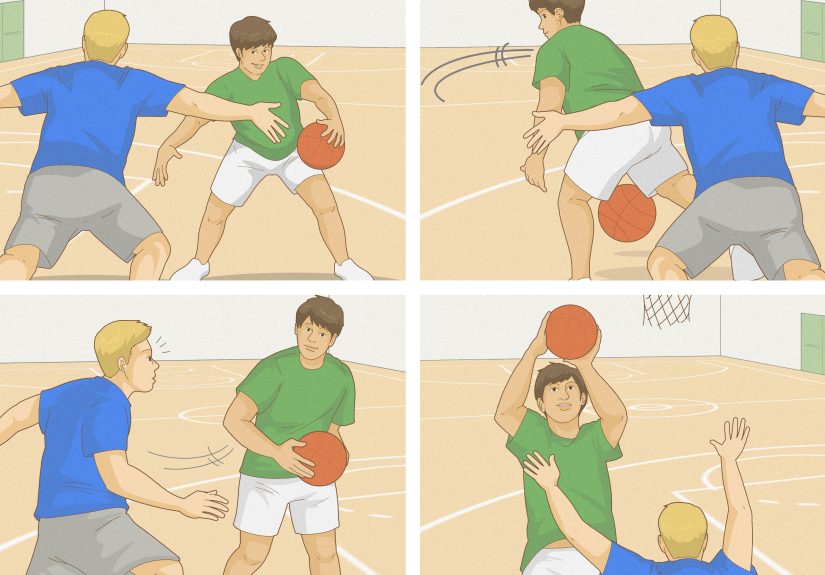
Instead of trying to go through the middle of the defender’s body, attack one hip. That creates a cleaner angle and makes it harder for them to recover squarely. Pick the hip that is vulnerable and force the defender to turn.
If a defender opens their stance to take away your right hand, drive left and get your shoulder near their left hip. Once they turn their hips, you own the advantage. Basketball is full of tiny angle battles, and this is one of the biggest.
Step 9: Take Efficient Gather Steps
As you get near the rim, your footwork matters more than ever. Gather under control. Do not rush into a wild launch just because the basket is close enough to look friendly. Close does not mean easy.
On a basic layup, think about clean, balanced steps into the finish. On some drives, a jump stop helps you avoid a charge or stay strong through contact. On others, a long outside-leg step can help you extend around a shot blocker. Great finishing starts with calm feet.
Step 10: Finish With Either Hand
If you only trust one hand, defenders will learn your habits faster than your teammates learn your group chat jokes. Become comfortable finishing with both hands on both sides of the rim. That gives you more angles and fewer excuses.
A right-handed player driving left may need a left-hand layup to keep the ball away from a trailing defender. A right-side attack may still finish left-handed if a shot blocker is waiting on the inside. Versatility near the rim is a real superpower.
Step 11: Learn More Than One Finish
A straight layup is great, but it cannot be your only answer. You should also develop a floater, a reverse layup, a power finish, a short bank shot, and a stride stop into a pivot finish. Different defenders require different solutions.
For example, if a taller help defender is waiting directly under the rim, a floater or short runner may be better than driving chest-first into a blocked shot. If the help rotates early from the front, a reverse finish on the other side of the basket may be your best friend.
Step 12: Expect Contact and Stay Composed
Real drives are rarely clean. You may get bumped, brushed, or nudged off line. That is why you need body control. Stay strong through your core, keep your balance, and finish through legal contact instead of reacting like the basket personally offended you.
Players who expect contact tend to finish better. They do not rush the release. They do not throw the ball somewhere into the atmosphere. They stay composed, use the backboard when appropriate, and focus on the target.
Step 13: Know When to Kick It Out
Driving to the basket does not always mean forcing a shot. If two defenders collapse and the corner is wide open, the best basketball play may be the pass. The drive did its job by bending the defense. Take the reward.
This is where spacing matters. If your teammates react well to penetration, you will often have a dump-off pass to a cutter, a dish to the dunker spot, or a kick-out to the wing or corner. Great drivers score when they should and pass when they must.
Step 14: Practice Game-Speed Drives, Not Lazy Rehearsals
You will not become a better slasher by doing soft, sleepy layups with no defender and no urgency. Practice at game speed. Use cones, chairs, live defenders, closeout drills, one-dribble attack drills, and finishing-through-contact work.
A strong training routine might include chair attacks from the wing, Mikan drill variations for both hands, one-on-one from 15 feet, euro-step reps, and closeout reads where you shoot, drive, or counter based on the defender’s position. Practice the decisions, not just the motion.
Common Mistakes That Kill a Drive
- Dribbling too high and too loose
- Driving without reading help defense
- Starting upright instead of low and balanced
- Taking extra dribbles and losing the angle
- Only finishing with one hand
- Jumping without a plan
- Ignoring open teammates once the defense collapses
If any of those sound familiar, congratulations: you are human and have probably played basketball before. The fix is not magic. It is reps, awareness, and better decision-making.
Simple Drills to Improve Your Drives
Chair Attack Drill
Set up a chair or cone on the wing. Attack it with one hard setup move and two explosive dribbles to the rim. Alternate hands and angles. Focus on winning the first step and finishing under control.
1-on-1 From the Wing
Start 12 to 15 feet from the basket with a live defender. You get limited dribbles, which forces you to be direct. This teaches you to attack a real body instead of a polite imaginary defender who always arrives late.
Mikan and Reverse Mikan
These build rhythm, footwork, touch, and comfort finishing with both hands. They are not glamorous, but they work. Basketball improvement is often annoyingly loyal to fundamentals.
Closeout Read Drill
Have a partner pass the ball to you and then close out. If they are late, shoot. If they rush and take away the shot, drive. If they cut off the first lane, counter and finish. This drill teaches real reads instead of robotic reps.
Experience and Lessons From Learning to Drive to the Basket
One of the funniest things about learning to drive to the basket is how confident players feel before they actually know how to do it. Most beginners think driving means dribbling very hard in the direction of the hoop and hoping athletic destiny takes over. Then they meet a decent on-ball defender, a help-side big, and the backboard all in the same three-second disaster.
That is usually when the real learning starts.
Many players first improve as drivers when they realize speed alone is not enough. You can be quick and still get cut off if your angle is bad. You can be strong and still lose the ball if your dribble is loose. You can beat the first defender and still fail if you never learned how to finish through contact or use your off hand. The drive is not one skill. It is a chain of skills that must work together.
A common experience for developing players is discovering that the best drives often feel quieter than expected. Not slower, but cleaner. The move is efficient. The first step is sharp. The dribble is compact. The gather is under control. There is no wasted motion, no panicked flailing, and no last-second prayer tossed toward the glass like a message in a bottle. It feels almost simple. That is usually a sign the fundamentals are improving.
Another big lesson comes from pickup games and live practice: defenders adjust. The move that worked twice in a row stops working when the defense starts sitting on it. That is why experience matters. Players learn to set up their drives with different rhythms. Sometimes it is a jab step. Sometimes it is a hesitation. Sometimes it is a hard catch on the move. Sometimes the right decision is not to drive at all, but to shot fake, swing the ball, relocate, and attack the next closeout.
Players also learn that finishing in traffic is partly about bravery. Not reckless bravery. Smart bravery. You have to be willing to attack gaps, absorb bumps, and stay focused when bodies are flying around you. Younger players often pull away from contact and flip the ball too early. With experience, they learn to stay on line, use the rim as protection, and finish strong without rushing.
One of the most valuable experiences is learning how much easier driving becomes when the floor is spaced well. If teammates cut with purpose and move after penetration, the lane opens up. If teammates stand still and bring extra defenders to the ball, the drive gets crowded fast. That teaches players something important: good offense is connected. A great drive is rarely just about the driver.
Over time, the best lesson is this: driving to the basket is less about showing off and more about creating an advantage. Sometimes that advantage ends with your layup. Sometimes it ends with a drop-off pass. Sometimes it forces a foul. Sometimes it creates an open jumper for someone else. Once players understand that, their drives become more mature, more efficient, and much harder to stop.
Final Thoughts
If you want to drive to the basket well, build the move from the ground up. Start with stance, reading the defender, and winning the first step. Add ball protection, direct angles, efficient footwork, and multiple finishes. Then practice the move at real speed until it becomes part of your game instead of a random emergency option.
The goal is not to look flashy every time. The goal is to be effective. Beat your defender. Pressure the rim. Make the defense react. Finish the play or create a better one. Do that consistently, and your drive becomes one of the most valuable weapons on the court.