Table of Contents >> Show >> Hide
- The Basic Job of Any Telescope: Catch More Light
- Why Space Telescopes Are So Powerful
- How the Hubble Space Telescope Works
- How the James Webb Space Telescope Works
- Hubble vs. Webb: They Are Teammates, Not Rivals
- How X-Ray Telescopes Like Chandra Work
- How Radio Telescopes Work
- How Ground-Based Optical Telescopes Fight the Atmosphere
- How Survey Telescopes Like Rubin Work
- How Infrared Telescopes Like Spitzer Helped Pave the Way
- How Gamma-Ray Telescopes Like Fermi Work
- From Light to Data: How Telescope Images Are Made
- Why Different Telescopes See Different Universes
- Real-World Experience: What Learning About Telescopes Feels Like
- Conclusion: Telescopes Turn Ancient Light Into Modern Knowledge
Telescopes are time machines with better manners. They do not roar, flash, or demand a dramatic movie soundtrack. They simply collect faint light that has crossed millions, billions, or even more than 13 billion years of space, then turn it into information humans can understand. That information may become a stunning image of a nebula, a spectrum revealing water vapor in an exoplanet atmosphere, or a clue about how galaxies grew from cosmic baby pictures into the enormous star cities we see today.
When people ask how the James Webb Space Telescope, Hubble Space Telescope, and other telescopes work, the simplest answer is this: telescopes collect radiation from space, focus it, measure it with instruments, and send the data to scientists. The fun part is that not all telescopes collect the same kind of light. Hubble sees mostly visible, ultraviolet, and some near-infrared light. James Webb specializes in infrared light. Chandra studies X-rays. Fermi detects gamma rays. Radio telescopes listen to long radio waves from cold gas, pulsars, black holes, and galaxies. Together, they give astronomy a full set of cosmic senses instead of just one pair of eyes.
The Basic Job of Any Telescope: Catch More Light
A telescope is basically a light bucket with a brainy assistant attached. The bigger the bucket, the more light it can collect. Since many objects in space are extremely faint, collecting more light is the difference between seeing “nothing much here” and discovering a galaxy whose light began traveling before Earth had complex life.
Most familiar telescopes use mirrors or lenses to gather and focus light. Modern professional telescopes usually rely on mirrors because large mirrors can be made lighter and supported more easily than huge lenses. The primary mirror gathers incoming light and reflects it toward a secondary mirror or a focal point. At that point, cameras, spectrographs, and detectors record the information.
Resolution: Why Bigger Mirrors Matter
A telescope’s power is not only about brightness. It is also about resolution, which means how finely it can separate small details. A larger mirror can gather more light and produce sharper images, especially when it is above Earth’s atmosphere or corrected by advanced technology on the ground. This is why telescope engineers obsess over mirror size, mirror smoothness, alignment, temperature control, and pointing accuracy. In astronomy, “close enough” is not a lifestyle; it is a problem to be solved.
Why Space Telescopes Are So Powerful
Earth’s atmosphere is wonderful for breathing and terrible for some kinds of astronomy. Air bends and blurs visible light, blocks most ultraviolet light, absorbs many infrared wavelengths, and prevents X-rays and gamma rays from reaching the ground. This is why space telescopes matter. Put a telescope above the atmosphere, and suddenly the universe looks much cleaner.
That does not mean ground-based telescopes are outdated. Far from it. Giant observatories on mountaintops use enormous mirrors, adaptive optics, and specialized instruments to make breathtaking discoveries. Radio telescopes work well from the ground because many radio waves can pass through the atmosphere. The real magic happens when different telescopes, on Earth and in space, team up like a cosmic detective squad.
How the Hubble Space Telescope Works
The Hubble Space Telescope launched in 1990 and became one of the most famous scientific instruments ever built. It orbits above Earth’s atmosphere, which gives it a clearer view than most ground-based optical telescopes. Hubble’s optical system uses a 2.4-meter primary mirror to collect light and direct it into scientific instruments.
Hubble observes mainly visible light, ultraviolet light, and a small slice of near-infrared light. That range makes it excellent for studying star-forming regions, galaxies, planets, nebulae, supernova remnants, and the expansion of the universe. Many of the iconic space images people knowthe Pillars of Creation, deep fields packed with galaxies, and colorful planetary nebulaecame from Hubble data.
Hubble’s Mirrors and Instruments
Inside Hubble, light enters through the front opening and reflects off the primary mirror. It then bounces to a smaller secondary mirror, which sends the light back through a hole in the primary mirror toward the telescope’s instruments. Those instruments include cameras and spectrographs. Cameras create images. Spectrographs split light into wavelengths, allowing scientists to study temperature, chemical composition, motion, density, and other properties of cosmic objects.
Think of spectroscopy as cosmic barcode scanning. A star, planet, galaxy, or gas cloud leaves patterns in its light. Those patterns reveal what the object is made of and how it is moving. A pretty image may bring the “wow,” but a spectrum often brings the scientific receipt.
Why Hubble Needed Servicing
Hubble is also famous for its rough beginning. After launch, scientists discovered that its primary mirror had a flaw that blurred its images. Astronauts later installed corrective optics, and Hubble became the legendary observatory we know today. Over the years, Space Shuttle servicing missions upgraded its instruments, replaced parts, and extended its life. In other words, Hubble got the most expensive pair of glasses in historyand they worked beautifully.
How the James Webb Space Telescope Works
The James Webb Space Telescope, often called Webb or JWST, is designed to observe the universe mainly in infrared light. Infrared astronomy is powerful because it can reveal objects hidden behind dust, detect cool objects that do not glow strongly in visible light, and observe light from the early universe that has been stretched into infrared wavelengths by cosmic expansion.
Webb’s primary mirror is 6.5 meters across, much larger than Hubble’s. Because a single mirror that size could not fit inside its launch rocket, Webb uses 18 hexagonal mirror segments. After launch, these segments unfolded and were carefully aligned so they work together like one giant mirror. This alignment process depends on wavefront sensing and control, a precise method of measuring and correcting tiny optical errors.
Webb’s Golden Mirror
Webb’s mirrors are made of beryllium and coated with a thin layer of gold. Gold is excellent at reflecting infrared light, which is exactly what Webb was built to collect. The mirror gathers infrared radiation from distant stars, galaxies, exoplanets, and nebulae, then sends it to Webb’s instruments.
Those instruments include NIRCam, NIRSpec, MIRI, and FGS/NIRISS. NIRCam captures near-infrared images and helps with mirror alignment. NIRSpec can study the spectra of more than 100 objects at once. MIRI observes mid-infrared light, useful for seeing cool dust, distant galaxies, and planet-forming disks. FGS helps Webb stay locked on target, while NIRISS supports specialized imaging and spectroscopy.
Why Webb Needs a Giant Sunshield
Infrared telescopes must be cold because warm objects glow in infrared light. If Webb were warm, it would blind itself with its own heat. To avoid that awkward situation, Webb uses a five-layer sunshield roughly the size of a tennis court. The shield blocks heat and light from the Sun, Earth, and Moon, keeping the telescope side extremely cold and stable.
Webb operates near the Sun-Earth L2 point, about 1.5 million kilometers from Earth. This location helps keep the Sun, Earth, and Moon on the same side of the observatory, making the sunshield more effective. It is like Webb found the universe’s best shady parking spot and refused to give it up.
Hubble vs. Webb: They Are Teammates, Not Rivals
People often compare Hubble and Webb as if they are competing superheroes. In reality, they are designed for different but overlapping missions. Hubble excels at visible and ultraviolet observations. Webb excels at infrared observations. Hubble can show glowing gas and sharp optical structures. Webb can peer through dust and study redshifted light from the early universe.
For example, a dusty star-forming nebula may look dark or partly hidden in visible light, while Webb’s infrared instruments can reveal newborn stars tucked inside. A distant galaxy may be faint in Hubble’s visible view but clearer in Webb’s infrared view because its light has been stretched by the expansion of the universe. Together, the two telescopes give scientists a richer, more complete picture.
How X-Ray Telescopes Like Chandra Work
X-rays are high-energy radiation produced by extremely hot and energetic environments: gas around black holes, exploded stars, galaxy clusters, and neutron stars. But X-rays do not bounce off mirrors the way visible light does. If they hit a normal mirror directly, they tend to pass into it or get absorbed. Not very helpful.
Chandra solves this by using grazing-incidence mirrors. X-rays skim the mirror surfaces at shallow angles, a bit like a stone skipping across water. The mirrors guide the X-rays toward detectors, where instruments measure their position and energy. This lets scientists map million-degree gas, study black hole activity, and examine the violent aftermath of stellar explosions.
How Radio Telescopes Work
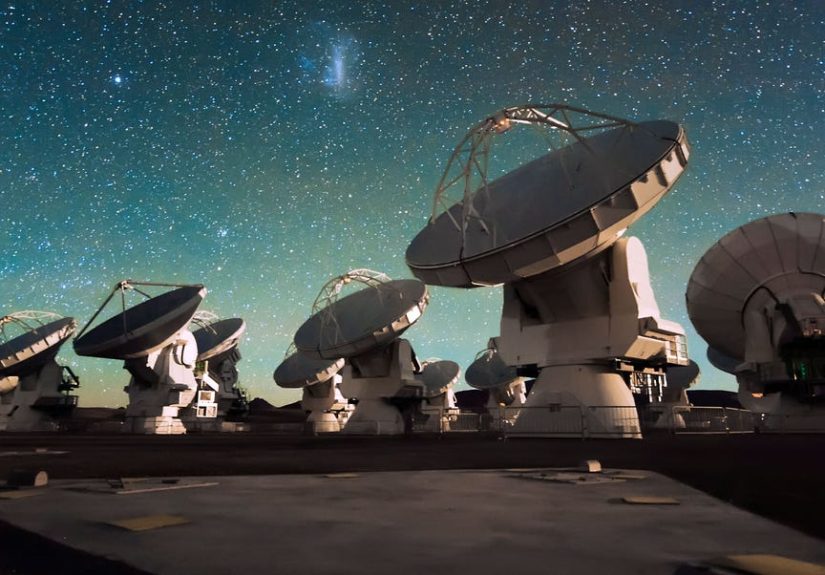
Radio telescopes collect radio waves, which are much longer than visible light waves. A radio telescope often looks like a giant dish because it must gather very weak radio signals from space and focus them onto a receiver. Those signals are amplified and processed into data that astronomers can analyze.
Radio astronomy is especially useful for studying cold hydrogen gas, molecules in space, pulsars, active galaxies, and the cosmic microwave background. Radio telescopes can also work during the day and through clouds, which makes them delightfully practical. The universe does not stop being interesting just because the weather is rude.
Interferometry: Many Telescopes Acting Like One
One of radio astronomy’s greatest tricks is interferometry. Multiple antennas spread across large distances can combine their signals to act like a much larger telescope. The farther apart the antennas, the sharper the resolution. This technique has produced some of the most detailed astronomical measurements ever made, including observations of black hole environments.
How Ground-Based Optical Telescopes Fight the Atmosphere
Ground-based observatories such as the Keck Observatory use large mirrors and advanced instruments to study the universe from high, dry locations. But Earth’s atmosphere still causes stars to twinkle, which may be charming on a camping trip but annoying in precision astronomy.
Adaptive optics helps solve this problem. A system measures atmospheric distortion in real time, often using a natural guide star or an artificial laser guide star. Then a deformable mirror changes shape many times per second to cancel out the distortion. The result is a much sharper image. It is like giving a telescope lightning-fast contact lenses.
How Survey Telescopes Like Rubin Work
Some telescopes are designed not to stare deeply at one object but to scan huge areas of sky again and again. The Vera C. Rubin Observatory is built for this kind of work. Its Simonyi Survey Telescope uses a wide-field optical design and a massive digital camera to capture repeated images of the southern sky.
This repeated survey approach helps astronomers detect change: asteroids moving across the sky, supernovae appearing in distant galaxies, variable stars pulsing, and other transient events. Instead of asking, “What does this one object look like?” survey telescopes ask, “What changed tonight?” In modern astronomy, that question can generate millions of alerts and a mountain of data.
How Infrared Telescopes Like Spitzer Helped Pave the Way
Before Webb, NASA’s Spitzer Space Telescope was one of the great infrared observatories. Spitzer used an ultra-sensitive infrared telescope to study asteroids, comets, planets, star-forming regions, and distant galaxies. Like Webb, it needed careful thermal control because infrared detectors must avoid heat contamination.
Spitzer made major contributions to exoplanet science, including observations of light from planets outside our solar system. Its discoveries helped prepare the scientific road for Webb’s more powerful infrared studies of exoplanet atmospheres, early galaxies, and dusty cosmic regions.
How Gamma-Ray Telescopes Like Fermi Work
Gamma rays are even more energetic than X-rays, and they cannot be focused with normal mirrors. Instead, gamma-ray telescopes use detectors that register the effects of gamma rays when they interact with matter. NASA’s Fermi Gamma-ray Space Telescope studies some of the most energetic events in the universe, including gamma-ray bursts, pulsars, solar flares, and jets from supermassive black holes.
Fermi’s instruments detect high-energy particles and flashes, measure their energy, and help scientists reconstruct where they came from. This is astronomy at its most extreme. If visible-light astronomy is reading a candlelit letter, gamma-ray astronomy is investigating a cosmic fireworks factory with a very serious clipboard.
From Light to Data: How Telescope Images Are Made
A telescope image is not usually a simple snapshot like one from a phone. Space telescope data often arrives as numbers. Detectors measure brightness through different filters, and scientists process the data to remove noise, correct instrument effects, align exposures, and combine wavelengths.
Color is often assigned to represent different filters or wavelengths. Sometimes those colors approximate what human eyes might see. Other times they are used to show invisible wavelengths, such as infrared or X-rays, in a way our eyes can understand. This is not “fake” in the dishonest sense. It is translation. The universe speaks in radiation; scientists translate it into images and measurements.
Why Different Telescopes See Different Universes
Every wavelength tells a different part of the story. Visible light shows stars and glowing gas. Ultraviolet light reveals hot young stars and energetic regions. Infrared light sees through dust and detects cooler objects. Radio waves trace cold gas and magnetic activity. X-rays reveal extremely hot gas and compact objects. Gamma rays expose the most energetic processes known.
This is why astronomers love multiwavelength observations. A galaxy observed only in visible light is like a song heard through one small speaker. Add infrared, radio, X-ray, and gamma-ray data, and suddenly the bass, vocals, drums, and weird space synthesizer all come through.
Real-World Experience: What Learning About Telescopes Feels Like
The first time many people look through a small backyard telescope, they expect Hubble-style fireworks. Then they see Saturn as a tiny glowing oval with rings and immediately forgive the universe for not arriving in ultra-high definition. That moment is powerful because it teaches the first rule of astronomy: space is real, and your eyes are only the opening act.
Learning how the James Webb, Hubble, and other telescopes work adds a new layer of appreciation. Suddenly, a Webb image is not just “a pretty space picture.” It becomes the result of a giant segmented mirror unfolding in space, a sunshield holding back heat, instruments cooled to extreme temperatures, and engineers aligning mirror segments with astonishing precision. The image becomes a story of physics, patience, software, and human stubbornness in the best possible way.
Hubble images can feel different. They often look more familiar because Hubble works strongly in visible light. Its pictures of galaxies and nebulae resemble what we imagine space should look like, though processed and enhanced for scientific clarity. Knowing that Hubble orbits above the atmosphere makes those images even more impressive. It is not just zooming in; it is escaping the blur of Earth’s air.
Radio telescopes offer another kind of experience. They do not look like classic telescopes, and they do not produce ordinary pictures at first. A radio dish may seem like it is simply staring quietly at the sky, but it is collecting whispers from hydrogen clouds, pulsars, and galaxies. Understanding that a radio telescope can observe during the day or through clouds changes the way you think about astronomy. The sky is not “closed” just because it is blue or cloudy. Some telescopes are still working, quietly collecting the universe’s low-frequency gossip.
Reading about X-ray and gamma-ray telescopes can feel almost like entering science fiction. These instruments study places no human could survive: gas heated to millions of degrees, stars that have exploded, black holes pulling matter into violent disks, and bursts of energy from across cosmic history. They remind us that the universe is not only beautiful. It is also energetic, extreme, and occasionally very dramaticbasically the theater kid of physics.
A practical way to understand telescopes is to compare them to senses. Hubble gives us sharp optical sight. Webb gives us infrared night vision. Chandra gives us high-energy medical imaging for the cosmos. Radio telescopes provide hearing for long-wavelength signals. Fermi detects the universe’s most intense outbursts. No single telescope can explain everything, just as no single sense can describe an entire room.
For students, writers, amateur astronomers, or curious readers, the most rewarding experience is realizing that telescope technology is not separate from discovery. The engineering determines the science. A bigger mirror, colder detector, better orbit, sharper adaptive optics system, or wider survey camera can reveal things that were previously invisible. Every improvement in telescope design is like giving humanity a new question to ask.
And that may be the most exciting part. Telescopes are not finished. Webb did not replace Hubble. Rubin will not replace Webb. Radio arrays do not replace optical observatories. Each new instrument adds another chapter to a story that began when humans first looked up and wondered what those lights were. The difference now is that our “looking up” involves gold-coated mirrors, cryogenic instruments, supercomputers, precision guidance systems, and enough data to make a laptop quietly reconsider its career choices.
Conclusion: Telescopes Turn Ancient Light Into Modern Knowledge
The James Webb Space Telescope, Hubble Space Telescope, and other observatories work by collecting different forms of electromagnetic radiation and transforming them into images, spectra, and measurements. Webb uses infrared light to see distant galaxies, hidden stars, and cool cosmic objects. Hubble captures visible, ultraviolet, and near-infrared light from above Earth’s atmosphere. Chandra studies X-rays from extreme environments. Radio telescopes detect long-wavelength signals from cold gas and energetic objects. Fermi observes gamma rays from the universe’s most powerful events.
Together, these telescopes show that the universe is not one picture but many layers of information. Some layers are visible to human eyes. Most are not. Telescopes expand our senses, stretch our imagination, and remind us that light is more than brightnessit is history, chemistry, motion, temperature, and time.