Table of Contents >> Show >> Hide
- Why Pandas Make the Perfect Drawing Challenge
- Pick Your Panda Style: Cute, Classic, or “National Geographic Energy”
- Supplies That Make Panda Drawing Easier
- Step-by-Step: Easy Cartoon Panda (Beginner-Friendly)
- Step-by-Step: Sitting Panda With Bamboo (More Realistic, Still Doable)
- Shading & Texture Tips: How to Make Your Panda Look Soft (Not Muddy)
- Common Panda Drawing Mistakes (And Quick Fixes)
- The Hey Pandas Challenge: Rules, Prompts, and Fun Variations
- Make It Shareable: How to Present Your Panda Like a Pro
- What This Challenge Actually Builds (Besides Pandas)
- Extra: of Panda-Drawing Experiences (Because the Internet Loves a Story)
- Conclusion: Your Panda Is Ready for the Spotlight
Welcome to the coziest art challenge on the internet: drawing a panda. Not a “maybe I’ll doodle later” panda.
A real, committed, I-showed-up-with-a-pencil panda. The kind with the iconic eye patches, the squishy body,
and the confident energy of an animal that can spend half the day eating and still be everyone’s favorite.
This challenge is for everyonekids, adults, “I can only draw stick figures” people, and even the brave souls
who think shading is a government conspiracy. You can go cute cartoon, semi-realistic, or full fluffy masterpiece.
The only rule is simple: draw a panda, share it, and be kind to your inner art goblin while you’re at it.
Why Pandas Make the Perfect Drawing Challenge
Pandas are basically built for artists. They’re made of friendly shapes (circles and ovals), have high-contrast
“built-in design,” and look adorable whether your lines are crisp or… emotionally expressive.
Quick panda facts (for better drawings and better jokes)
- They’re bamboo specialists. Giant pandas eat mostly bamboo, which is why you’ll often see them sitting like little meditation potatoes with a snack.
- They live in mountainous bamboo forests. Wild giant pandas are native to remote mountain regions in China, where the forests are cool, wet, and full of bamboo.
- That black-and-white look has a purpose. Research suggests the coloration helps with camouflage and communicationso yes, your panda’s outfit is both stylish and functional.
- They can climb. Pandas may look like plush toys, but they can climb trees and handle themselves surprisingly well.
Artist takeaway: if you nail the silhouette (big head, round body, chunky limbs) and the pattern
(ears, eye patches, arms/legs, shoulder band), you’re already 80% of the way to “Yep, that’s a panda.”
Pick Your Panda Style: Cute, Classic, or “National Geographic Energy”
Option A: Cute cartoon panda (fast, friendly, shareable)
Cartoon pandas are perfect for beginners because you can exaggerate the features: bigger head, simpler paws,
rounder belly, and expressive eyes. If your panda ends up looking like it’s asking for a bedtime story, you’re
doing it right.
Option B: Semi-realistic panda (the “I want fluff” route)
Semi-realistic pandas focus on proportion and texture. You’ll still use simple shapes underneath, but you’ll
add fur edges, subtle shading, and a more natural poselike sitting, eating bamboo, or flopping dramatically
across a branch.
Option C: Realistic panda portrait (bring snacks, you’ll be here awhile)
This is the “I came to blend graphite and chew bubblegum” level. You’ll pay attention to values, fur direction,
and soft transitions. Worth it if you love detail, but absolutely not required for this challenge.
Supplies That Make Panda Drawing Easier
You can draw a panda with literally anything that makes a markpencil, pen, marker, digital brush, crayon,
the back of a receipt while waiting for your coffee. Still, these tools make life smoother:
- Pencil (HB or 2B) for sketching shapes and adjusting proportions.
- Eraser (kneaded if you have one) to lift graphite without tearing paper.
- Black marker or darker pencil for bold patches and clean contrast.
- Optional gray pencil/marker if you want soft fur shading.
- Digital artists: one sketch brush, one ink brush, one soft shading brush is plenty.
Step-by-Step: Easy Cartoon Panda (Beginner-Friendly)
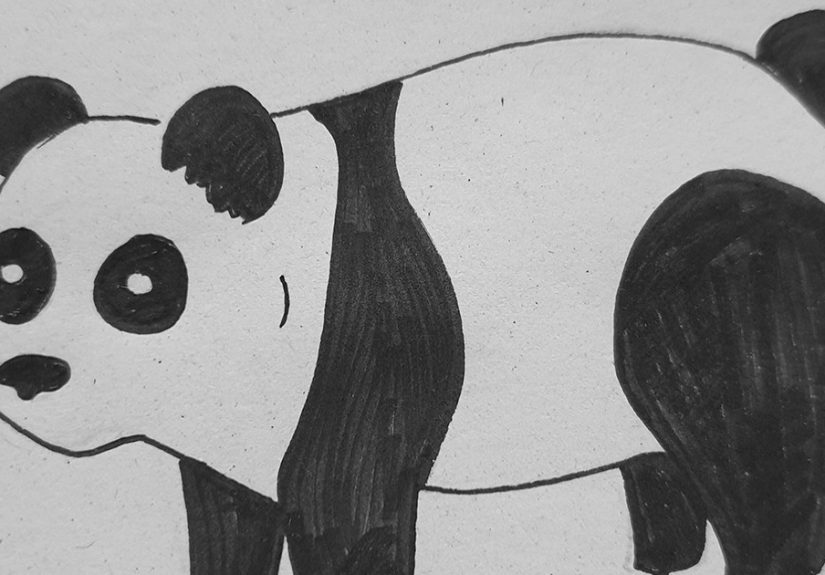
This version is designed for success. It’s the “I finished a panda in one sitting and I feel powerful” method.
- Draw a circle for the head. If it’s lopsided, congratulationsyou’ve drawn a panda with personality.
- Add two small circles for ears on top, slightly to the sides.
- Draw an oval under the head for the body, overlapping a little.
- Place two eye patch ovals tilted slightly inward, like your panda is quietly judging your browser tabs.
- Add small eyes inside the patches (dots, ovals, or shiny anime sparklesyour call).
- Draw arms and legs as rounded shapes. Think “soft mittens” and “tiny boots.”
- Color the patches, ears, arms, and legs black, leaving the face and belly white.
- Optional: add blush circles on the cheeks for maximum cuteness.
Cartoon panda upgrade ideas
- Give it a bamboo stick, a donut, or a tiny mug of “bamboo tea.”
- Add a hoodie, a scarf, or a backpack like it’s headed to art class.
- Change the expression: sleepy, surprised, smug, delighted, or “I saw the group chat.”
Step-by-Step: Sitting Panda With Bamboo (More Realistic, Still Doable)
This is the classic pose: panda sitting with hind legs forward, holding bamboo like it pays rent. It’s also a
great way to practice proportion and shading without spiraling into perfectionism.
1) Build the pose with simple shapes
- Head: sketch a circle.
- Body: add a larger oval underneath.
- Hips/legs: draw two wide ovals at the bottom for the thighs.
- Arms: add two rounded “bean” shapes coming forward (like it’s hugging the bamboo).
2) Place the panda features
- Ears: round and slightly fuzzy at the edges.
- Eye patches: oval-ish, but not identical twinsmore like siblings who share a look.
- Nose: a rounded triangle or soft oval.
- Mouth: a small curve under the nose (keep it subtle for realism).
3) Add the panda pattern
The pattern is what makes your drawing instantly readable. Darken the ears, eye patches, arms, legs, and the
shoulder area. Keep the face and belly lighter. If your panda starts to look like a raccoon in a bear costume,
widen the face area and soften the eye patches.
4) Draw the bamboo (simple but convincing)
- Use long, straight-ish segments with slight curves.
- Add ring lines at intervals (bamboo nodes).
- Attach thin leaves in clustersdon’t overthink the leaf count; nobody’s grading your botany.
5) Shade for fluff
Shade lightly in the white fur areas to show form: under the chin, around the belly curve, under the arms,
and behind the legs. Use soft strokes that follow the fur direction. The goal is “plush,” not “smoky pancake.”
Shading & Texture Tips: How to Make Your Panda Look Soft (Not Muddy)
Pandas have strong contrast, but that doesn’t mean everything black should be a flat void. Even in the dark
patches, you can show gentle value changes:
- Leave tiny highlights on the nose and eyes.
- Use layered strokes instead of pressing hard immediately.
- Blend sparinglyover-blending can erase fur texture.
- Keep edges varied: some sharp (nose), some soft (fur).
Common Panda Drawing Mistakes (And Quick Fixes)
“My panda looks like a raccoon.”
Make the head rounder, increase the white space around the muzzle, and soften the angle of the eye patches.
Pandas read “big, calm face,” raccoons read “tiny masked bandit.”
“The body looks too skinny.”
Round it out. Panda proportions are cozy. Thicker limbs and a wider belly will instantly make it feel right.
“The patches look uneven.”
Uneven is normal, but if it feels distracting, align the patches by checking their height relative to the nose
and ears. Think “balanced,” not “perfect mirror image.”
The Hey Pandas Challenge: Rules, Prompts, and Fun Variations
Here’s a simple way to run the challenge so it feels like a game instead of homework:
Challenge rules (keep it light)
- Time limit: 10 minutes, 30 minutes, or “until my snack is done.”
- One panda minimum. More pandas is allowed and encouraged.
- No trash-talking your art. You can roast the process, not yourself.
- Share your result with a caption: what style you chose and what was hardest.
Prompt ideas (pick one if you’re stuck)
- Panda eating bamboo like it’s reviewing a fine wine
- Panda astronaut floating with a bamboo “oxygen tank”
- Panda librarian shushing the whole forest
- Panda barista making a latte with leaf art
- Panda superhero whose power is naps
- Panda in a hoodie holding a sketchbook (meta panda!)
- Panda doing yoga, absolutely failing, still adorable
- Baby panda tumbling forward like a fuzzy bowling ball
- Panda on a rainy day with a tiny umbrella
- Panda as a video game character select screen
Make It Shareable: How to Present Your Panda Like a Pro
If you’re posting your art online, presentation can make a huge differenceeven if the drawing is a quick doodle.
Try these:
- Take a clean photo in daylight (near a window) to reduce shadows.
- Crop tightly so the panda is the star.
- Add a one-line story (example: “This panda is late for bamboo brunch.”).
- Include alt text if you can (example: “Cartoon panda sitting and holding bamboo, smiling.”).
What This Challenge Actually Builds (Besides Pandas)
A silly art prompt can sneakily improve real skills:
- Observation: noticing shapes and patterns in real animals.
- Confidence: finishing a drawing without endless restarting.
- Consistency: repeating a subject helps your brain build a “drawing shortcut.”
- Style: learning what kind of panda feels like your panda.
And honestly? There’s something healing about drawing a creature that looks like it was designed by someone
who loves naps and snacks.
Extra: of Panda-Drawing Experiences (Because the Internet Loves a Story)
The best part of a “draw a panda” challenge isn’t the final imageit’s the chaos, the laughter, and the weirdly
wholesome pride that shows up in the middle. Someone starts with, “I can’t draw,” and ten minutes later they’re
holding up a panda that looks like it belongs on a sticker. Another person insists they’re going realistic, then
ends up with a round cartoon panda anywayand somehow it’s perfect. Panda energy is forgiving like that.
In group challenges, you’ll notice a funny pattern: everybody begins with the same plan (“I’m doing a simple panda”),
and then the creativity kicks the door down. One person adds a bamboo hat. Someone else gives the panda sunglasses.
Another artist draws a panda with a tiny backpack labeled “emotional support snacks.” A serious, shaded panda portrait
appears right next to a doodle panda made of four circles and pure confidence. Both get the same reaction: “AWW.”
Teachers and parents love panda prompts because they’re structured but flexible. Kids can follow a step-by-step
guide and still make it their ownchanging expressions, adding backgrounds, or turning the bamboo into a magic wand.
Adults often treat it like a mini brain break: a quick sketch between meetings, a doodle while watching TV, a calm
moment that doesn’t demand perfection. Even digital artists who usually work on complex pieces enjoy the reset of
drawing something simple with bold shapes and strong contrast.
The most relatable “experience” moment is the eye patches. People either nail them immediately or spend ten minutes
negotiating with two stubborn ovals. Too big? Your panda looks startled. Too small? Now it looks like it’s wearing
tiny goggles. Slightly crooked? Congratulations, you’ve invented a panda with an opinion. And when someone finally
gets the patches to feel balanced, the victory is disproportionate in the best waylike unlocking an achievement.
Over time, repeating the challenge turns into visible progress. On day one, the panda might be a head floating over
a potato body. On day two, the arms suddenly wrap around the bamboo convincingly. By day three, you’re shading the
belly curve and adding little fur edges on the ears. That’s the quiet magic of a friendly subject: it rewards
repetition without feeling like a grind. The panda becomes your practice buddypatient, recognizable, and always
cute enough to share.
So if you’re joining this “Hey Pandas” challenge, take a screenshot of your first attempt. Save it. Date it.
Then draw another panda latertomorrow, next week, whenever. Your future self will look back and realize something
important: you didn’t just draw a panda. You built a tiny habit of making things, and that’s the real flex.
Conclusion: Your Panda Is Ready for the Spotlight
Whether you drew a simple panda face, a full-body bamboo muncher, or a dramatic fluffy masterpiece, you completed
the challengeand that matters. Art isn’t a talent lottery; it’s a practice. And today, your practice just
happened to be adorable.
Now go share your panda. Give it a name. Tell us what style you chose. And if you want a bonus round, draw the same
panda again in a different mood: happy panda, sleepy panda, “I dropped my bamboo” panda. The world can handle more
pandas. The world needs more pandas.