Table of Contents >> Show >> Hide
- Why This Story Went Viral
- The Daughter’s Point of View: “Why Should My Relationship Be Treated Like It Does Not Matter?”
- The Mother’s Point of View: “Do Parents Have To Give Up Love For Their Children?”
- Is the Daughter Wrong for Embarrassing Her Mom?
- Why Blended Family Dynamics Are So Sensitive
- What the Family Should Have Done Differently
- Healthy Boundaries for a Situation Like This
- What This Story Says About Respect Between Parents and Adult Children
- So, Who Was Really Wrong?
- Real-Life Experiences and Lessons From Similar Family Conflicts
- Conclusion
Family drama has a special talent for showing up at the worst possible time. One minute, a young couple is enjoying a steady four-year relationship. The next, they discover that their parents have been quietly dating each other, and suddenly the family tree looks like it was assembled during a power outage.
The viral story behind the title “Couple Of 4 Years Find Out Their Parents Are Dating, The Daughter Gets Called A Jerk For Embarrassing Her Mom In Front Of Family” touches a nerve because it is not just about romance. It is about boundaries, respect, timing, embarrassment, adult choices, and the very awkward question nobody wants to ask at dinner: what happens when your boyfriend might become your stepbrother?
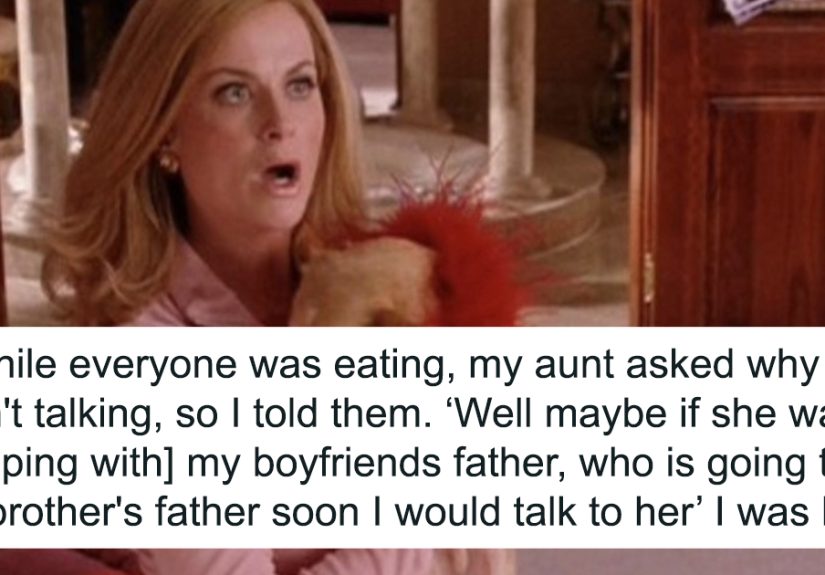
At the center of the story is a young woman who had been dating her boyfriend for four years. Their connection was not casual. They had known each other since childhood, lived near one another, and built a relationship long before their parents became romantically involved. Then she reportedly walked in on her mother kissing her boyfriend’s father. As if that were not enough emotional confetti for one day, she later learned the parents had been seeing each other for months and were already discussing marriage.
Understandably, she did not respond with calm jazz music and a tray of lemon bars. She was shocked, hurt, and embarrassed. During a family dinner, the situation exploded. Her mother reportedly dismissed the daughter’s relationship as a “young” romance and implied that the daughter should step aside because the adult relationship mattered more. The daughter reacted strongly, the family accused her of being cruel, and the internet did what the internet does best: formed a courtroom, appointed itself judge, and handed out opinions with the confidence of a GPS that has never been wrong.
Why This Story Went Viral
This family conflict spread widely because it combines several emotional triggers in one messy package. First, there is the shock factor. A parent dating the parent of your long-term partner is unusual enough to make most people blink twice. Second, there is the loyalty issue. The daughter felt that her relationship came first, and she believed her mother should have considered how the new romance would affect her. Third, there is the public embarrassment. Once private pain becomes a dinner-table argument, everyone suddenly has an opinion, including relatives who may not understand the full emotional picture.
The situation is also fascinating because nobody is technically doing something simple to judge. The parents are adults. They are allowed to date. The young couple is also allowed to keep dating. There is no biological relationship between the couple, and in many places there is no automatic legal barrier to unrelated stepsiblings being in a relationship. But legality is not the same as emotional comfort. Something can be allowed and still feel strange, painful, or socially complicated.
The Daughter’s Point of View: “Why Should My Relationship Be Treated Like It Does Not Matter?”
From the daughter’s perspective, the most painful part was not just that her mother found love. It was that her mother seemed to treat the daughter’s long-term relationship as disposable. A four-year relationship, especially one that began after years of knowing each other, is not the same as a two-week crush on someone who lent you a pencil in biology class.
When a parent dismisses a young adult’s relationship as “not serious,” it can feel deeply invalidating. Young love does not always last, but neither does adult love. Age does not come with a lifetime warranty, and maturity is not automatically downloaded on your 40th birthday. The daughter’s anger likely came from feeling ignored, replaced, and pressured to accept a huge family change without being given time to process it.
There is also the identity problem. If her mother married her boyfriend’s father, the daughter would have to explain a relationship that sounds like a riddle: “This is my boyfriend, and also possibly my stepbrother.” Even if everyone involved is unrelated by blood, family labels matter. They shape holidays, introductions, future weddings, and the way outsiders react.
The Mother’s Point of View: “Do Parents Have To Give Up Love For Their Children?”
The mother’s side is not impossible to understand. Adults who divorce or spend years single often want companionship again. Dating after divorce can feel hopeful, scary, and deeply personal. Parents are not only parents; they are also human beings with emotional needs, loneliness, dreams, and the right to build a life beyond raising children.
That said, the issue is not simply whether the mother had the right to date. The issue is how she handled the emotional fallout. If she knew her daughter had been in a committed relationship with this man’s son for years, secrecy was always going to create a bigger explosion later. A careful conversation early on would likely have been kinder than letting the daughter discover the relationship by accident.
The mother also weakened her position by reportedly minimizing the daughter’s relationship. Saying, in effect, “My love matters more because I am older” is not a conflict-resolution strategy. It is emotional gasoline. A better approach would have been: “I understand this is shocking. I did not plan to hurt you. Let’s talk about what boundaries would make this less uncomfortable.” That sentence alone could have saved everyone at dinner from needing emotional seatbelts.
Is the Daughter Wrong for Embarrassing Her Mom?
This is where the story becomes more complicated. Was the daughter wrong to feel upset? No. Her reaction was understandable. Was a family dinner the best stage for the confrontation? Probably not. Public arguments rarely produce thoughtful understanding. They produce defensive relatives, crying parents, awkward cousins staring at mashed potatoes, and one person who suddenly remembers they “left something in the car.”
Embarrassing someone in front of family can make the original issue harder to solve. When people feel publicly attacked, they often stop listening and start protecting their image. The daughter may have had valid concerns, but the delivery gave relatives a reason to focus on her tone rather than the problem itself.
Still, calling her a jerk oversimplifies the situation. She was not reacting to a minor inconvenience. She was reacting to a major family shift that could permanently affect her romantic relationship, her holidays, her relationship with her mother, and her future family structure. Emotional shock does not excuse every word, but it does explain why the conversation became heated.
Why Blended Family Dynamics Are So Sensitive
Blended families are common in the United States, but common does not mean easy. When adults form new relationships after divorce or single parenthood, children and young adults often need time to adjust. Even when everyone is kind and well-intentioned, new roles can trigger loyalty conflicts, jealousy, grief, and confusion.
One of the biggest challenges in blended families is that relationships do not all begin at the same time. A parent and child may have decades of shared history. A new romantic partner may be recent. Stepchildren may be expected to accept a new family structure before they feel emotionally ready. In this story, the awkwardness is multiplied because the daughter and boyfriend had their own relationship first. The parents’ romance did not happen in a vacuum; it landed directly on top of an existing couple.
The “Stepsibling” Label Changes the Emotional Weather
Even if two people are unrelated, the word “stepsibling” can change how others perceive the relationship. It brings social discomfort because family categories are powerful. People hear “siblings” and assume a boundary, even when the actual history is different. That is why the daughter’s discomfort makes sense. She was not suddenly related to her boyfriend, but the family label could make the relationship feel strange to explain and harder to maintain.
Holiday Awkwardness Is a Real Concern
Imagine the young couple breaks up, but their parents stay together. Suddenly, the ex-boyfriend is still at Thanksgiving. He is passing the gravy. His dad is helping carve the turkey. Someone asks if everyone wants pie. The daughter silently wonders whether pumpkin pie can be used as a flotation device to escape the room.
That is not a silly concern. Romantic relationships can end. Family ties, especially through marriage, can keep people connected long after a breakup. The daughter was thinking ahead, and while her reaction may have been emotional, the practical concern was real.
What the Family Should Have Done Differently
The cleanest solution would have been early honesty. Once the mother and boyfriend’s father realized their connection was becoming serious, they should have spoken privately with the young couple. Not to ask permission like teenagers borrowing the car, but to acknowledge the impact.
A respectful conversation might have sounded like this: “We know this may feel strange because you two have been together for years. We care about each other, but we also care about how this affects you. We are not asking you to break up. We want to talk about boundaries.”
That type of conversation would not guarantee happiness, but it would show respect. The daughter and her boyfriend would still need time to process the news, but they would not feel blindsided or dismissed.
Healthy Boundaries for a Situation Like This
When two related families become romantically entangled in unexpected ways, boundaries are not optional; they are the emotional traffic lights keeping everyone from crashing into each other.
1. No One Should Demand a Breakup
The parents should not demand that the young couple break up, and the young couple should not demand that the parents end their relationship. People can express discomfort without controlling another adult’s choices. The key is to separate feelings from commands.
2. Stop Ranking Whose Love Is “More Real”
Comparing relationships by age is a losing game. A parent’s relationship is not automatically deeper because the parent is older. A young couple’s relationship is not automatically permanent because it has lasted four years. Both relationships deserve to be discussed honestly without turning love into a competitive sport.
3. Keep Family Labels Flexible
If the parents eventually marry, everyone may need language that reduces discomfort. The young couple does not have to introduce themselves as stepsiblings. They can explain the timeline simply if needed: “We were dating years before our parents got together.” Simple, factual, no dramatic violin music required.
4. Private Conversations Should Come Before Public Announcements
Family dinner is not the ideal place to unveil emotionally explosive news. Sensitive conversations deserve privacy, time, and fewer side dishes. Announcing major romantic news in front of extended family can make the affected person feel trapped, especially if relatives immediately take sides.
5. Consider Family Counseling
When family members feel stuck, a neutral therapist can help everyone talk without turning the room into a courtroom. Counseling can be especially useful when loyalty conflicts, divorce history, stepfamily concerns, or unresolved resentment are involved.
What This Story Says About Respect Between Parents and Adult Children
One of the biggest lessons from this viral conflict is that adult children still need respect. Turning 18 or 19 does not magically make family changes painless. Parents may not need permission to date, but they should still communicate with care when their choices directly affect their children’s lives.
At the same time, adult children also need to recognize that parents are allowed to have personal lives. A parent finding love after divorce is not a betrayal by itself. The betrayal comes when the parent hides the relationship, dismisses the child’s feelings, or expects the child to make all the sacrifices.
Respect has to move in both directions. The mother deserved the dignity of having a romantic life. The daughter deserved the dignity of being taken seriously.
So, Who Was Really Wrong?
The fairest answer is that the mother handled the situation poorly, and the daughter reacted messily. The mother’s biggest mistake was dismissing a four-year relationship and appearing to prioritize her own romance without acknowledging the emotional consequences. The daughter’s mistake was letting the confrontation become public and harsh enough that relatives focused on her behavior rather than her pain.
But if we are weighing the deeper issue, the daughter’s hurt is easier to understand. She did not create the awkward situation. She discovered it. She was then apparently expected to accept it quickly, quietly, and politely. That is a lot to ask from someone who just learned that her future family map may need a warning label.
Real-Life Experiences and Lessons From Similar Family Conflicts
Stories like this may sound rare, but the emotions behind them are surprisingly common. Many people have experienced a parent dating someone who complicates the family structure. It might be a parent dating a close family friend, a best friend’s parent, an ex’s relative, or someone connected to the child’s social circle. The exact details vary, but the emotional themes are familiar: shock, embarrassment, loyalty, fear of judgment, and the feeling that adults made decisions without considering the younger people affected.
One common experience is the feeling of being “the last to know.” When family members hide a relationship, they may think they are avoiding drama. In reality, secrecy often makes the eventual reveal feel like a betrayal. The person who finds out may wonder, “How long has everyone known?” or “Was I being laughed at behind my back?” Even if nobody intended harm, the secrecy can damage trust.
Another familiar experience is pressure to “be mature” immediately. Families often ask the most affected person to stay calm because the situation is uncomfortable for everyone else. But maturity does not mean having no feelings. A mature response can still include anger, sadness, and requests for boundaries. The goal is not to erase emotion; it is to express it without causing permanent damage.
People in similar situations often say the hardest part is not the relationship itself, but the lack of acknowledgment. A simple apology can make a major difference. For example, a parent saying, “I should have told you sooner, and I understand why this hurts,” can lower tension. Without that acknowledgment, the adult child may feel forced to defend their own reality.
There is also the problem of public family pressure. When relatives take sides too quickly, the person who is hurt may feel isolated. In the viral story, the daughter was called a jerk for embarrassing her mother. But family members may have focused on the visible outburst rather than the private buildup. This happens often in real life. The person who finally reacts is judged more harshly than the people who quietly created the situation.
A helpful lesson is to separate the issue into parts. First, is the relationship allowed? In this case, the parents are adults and can make their own choices. Second, was the situation handled respectfully? That is where criticism becomes fair. Third, what boundaries are needed now? This is the part that actually moves the family forward.
For young couples facing similar dynamics, it helps to have a private conversation together before responding to the family. They should ask: Are we still committed? What makes us uncomfortable? What family events are we willing to attend? How will we explain this to others if needed? Having a shared plan prevents the couple from being pulled apart by pressure from both households.
For parents, the experience offers a clear reminder: your happiness matters, but timing and communication matter too. If your new relationship directly affects your child’s emotional world, do not hide behind “I am an adult.” Being an adult means taking responsibility for the impact of your choices, not pretending there is no impact because the choice is technically yours to make.
For extended family, the best role is not judge, jury, and group-chat prosecutor. The better role is listener. Before labeling someone dramatic, ask what they were afraid of losing. Often, anger is just fear wearing boots.
In the end, this story is not only about a mother dating her daughter’s boyfriend’s dad. It is about what happens when love arrives without a plan, when family roles shift overnight, and when people forget that being right is less important than being respectful. Everyone in the story wanted their relationship to matter. The real challenge was making space for more than one relationship without treating anyone like an obstacle.
Conclusion
The viral family drama about a couple of four years discovering that their parents are dating is funny from a distance, uncomfortable up close, and emotionally complicated from every angle. The parents may have the right to date, but the daughter also had the right to feel shocked and hurt. The real problem was not simply the romance; it was the secrecy, the dismissal, and the pressure placed on the younger couple to absorb the awkwardness without complaint.
Healthy families do not avoid uncomfortable conversations. They handle them with honesty, timing, empathy, and enough humility to admit when they made things harder than necessary. In this case, everyone would benefit from fewer public confrontations, more private listening, and a shared understanding that love should not require someone else to feel erased.
Note: This article is an original rewrite and analysis for web publication. It is based on publicly discussed story details and broader real-world guidance about blended families, dating after divorce, stepfamily adjustment, and family communication. No copied source text or unnecessary citation markers are included in the article body.