Table of Contents >> Show >> Hide
- First: Not All Mold on Cheese Is “Bad”
- The Quick Answer: It Depends on the Type of Cheese
- Why Cutting Works for Hard Cheese (But Not Soft)
- So… How Do You Safely Salvage Hard Cheese?
- What If You Ate Moldy Cheese by Accident?
- Special Cases: Blue Cheese, Brie, and Other “Moldy on Purpose” Cheeses
- How to Keep Cheese From Getting Moldy So Fast
- A Cheese-by-Cheese Cheat Sheet (With Real Examples)
- Moldy Cheese Myths (Because the Internet Is a Place)
- Real-World “Moldy Cheese” Experiences (What People Commonly Run Into)
- Bottom Line: When in Doubt, TossBut Hard Cheese Can Often Be Saved
You open the fridge, reach for your beloved block of cheddar, and there it is: a fuzzy green patch that looks like it
auditioned for a tiny sweater commercial. Your brain immediately starts negotiating. “It’s artisan now.”
“It’s basically blue cheese.” “I paid good money for thismold can’t just move in rent-free.”
Here’s the truth: sometimes you can save moldy cheese, and sometimes you absolutely should not.
The difference comes down to moisture, texture, and how easily mold can spread below the surface.
This guide will help you decidequickly, safely, and without turning your kitchen into a science fair exhibit.
First: Not All Mold on Cheese Is “Bad”
Mold is a type of fungus, and certain cheeses are literally designed to be moldy on purpose. Think:
blue cheeses (like Gorgonzola or Roquefort) with blue-green veins, and bloomy-rind cheeses
(like Brie and Camembert) with that white, velvety coat. In those cases, the mold is part of the cheese’s intended flavor,
texture, and vibe.
The problem is the random mold that shows up uninvitedoften green, black, pink, or gray fuzz that wasn’t listed on the label.
That’s when you need to make a call, because mold can send microscopic “roots” (hyphae) into food. On some cheeses, those roots
don’t travel far. On others, they can spread quickly and invisibly.
The Quick Answer: It Depends on the Type of Cheese
Use this as your fast decision tool. When in doubt, choose safety over optimismcheese is wonderful, but it’s not worth a stomach rebellion.
| Cheese Type | If You See Unwanted Mold… | Why |
|---|---|---|
| Hard / Extra-Hard (Cheddar, Parmesan, Swiss) | Usually salvageable: cut it off generously | Lower moisture slows mold’s ability to penetrate deeply |
| Semi-Soft / Semi-Hard (Colby, Gouda, Monterey Jack) | Often salvageable: cut it off generously | Still relatively firm; mold typically stays more surface-level |
| Soft (Cream cheese, cottage cheese, ricotta) | Toss the whole thing | High moisture lets mold and bacteria spread quickly below the surface |
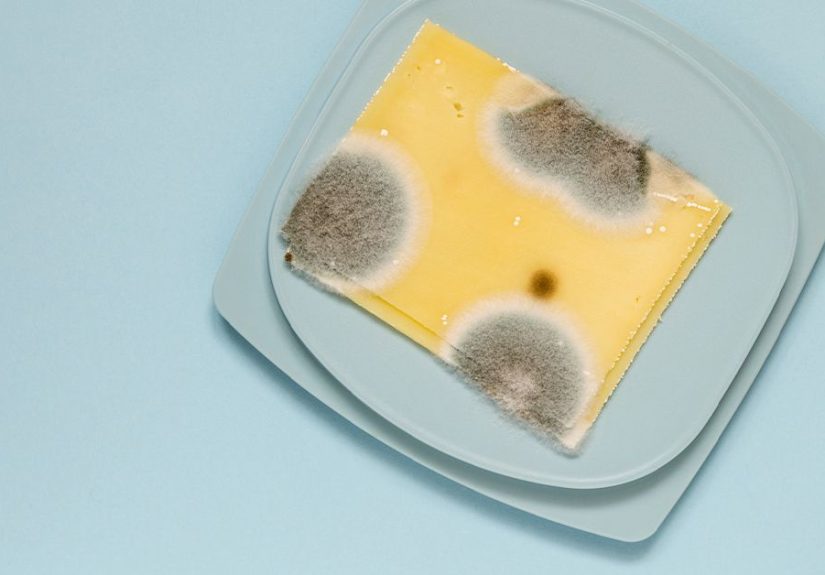
| Crumbled / Shredded / Sliced (any kind) | Toss the whole package | More surface area = easier spread; hard to trim safely |
| Blue & Mold-Ripened (blue cheeses, Brie, Camembert) | Depends: normal mold is fine; new/odd mold = caution | These cheeses are made with specific molds, but extra mold can still signal spoilage |
Why Cutting Works for Hard Cheese (But Not Soft)
Mold loves moisture. Soft cheeses hold more water, which makes it easy for mold to spread through the interior before you see much on the surface.
Hard cheeses are drier and denser, so mold usually has a harder time traveling far. That’s why food-safety guidance often says you can
trim mold off hard cheesebut should discard soft cheese at the first sign of mold.
One important nuance: mold isn’t the only concern. When food spoils, you can also get unwanted bacteria along for the ride.
Some people can handle a tiny accidental exposure without much trouble, but others (especially those at higher risk) should be more cautious.
So… How Do You Safely Salvage Hard Cheese?
If you’ve got a hard or semi-hard block (not shredded, not sliced) and the mold is limited, here’s the safest way to rescue it.
Step-by-step: The “One-Inch Rule” Trim
- Don’t taste-test first. This is not the moment for “just a little nibble.”
- Use a clean knife. You want to avoid dragging mold across the cheese.
- Cut off at least 1 inch around and below the mold spot. Think of it as building a safety buffer, not a minimalist haircut.
- Keep the knife out of the mold itself while trimming, so you don’t smear spores into the “good” part.
- Wrap the remaining cheese in fresh material (new paper/foil/container). Don’t rewrap in the same old wrap that hosted Mold City.
- Eat it soon. If mold showed up once, the clock is ticking on qualityeven if safety is handled.
When trimming is NOT worth it
- The mold is widespread (multiple spots or a large area).
- The cheese is shredded, crumbled, or sliced (too much surface area to trim reliably).
- You see black, dark gray, or pink/orange mold (treat as a “nope” signal).
- There’s an off smell beyond the cheese’s normal funkthink sharp “spoiled” notes, not just “aged.”
- The texture is slimy or unusually wet on a cheese that shouldn’t be.
What If You Ate Moldy Cheese by Accident?
If you accidentally ate a small amount of mold from cheese, many healthy people won’t have serious issuesthough it can cause stomach upset in some.
The bigger concern is when someone is more vulnerable to foodborne illness or has allergies or respiratory sensitivity to mold.
Be extra cautious if you are:
- Pregnant
- Older adult
- Immunocompromised (for any reason)
- Very young child
- Someone with significant mold allergies or asthma
Also note that soft cheeses (especially those made with unpasteurized milk) can carry a higher risk of certain foodborne germs,
including Listeria. This is why public health guidance is especially careful around soft cheeses for higher-risk groups.
If you feel unwell after eating questionable dairy, or symptoms are severe or persistent, it’s smart to contact a healthcare professional.
(And yes, you can absolutely say, “I may have made a questionable cheese decision.” They’ve heard worse.)
Special Cases: Blue Cheese, Brie, and Other “Moldy on Purpose” Cheeses
Here’s where people get tripped up. “But Brie has mold!” True. “So mold must be fine!” Not exactly.
Mold-ripened cheeses typically use specific, controlled molds that are safe and expected.
The problem is when you see additional mold growth that looks different from what’s normal for that cheese.
Blue cheese (Gorgonzola, Roquefort, Stilton)
- Normal: blue/green veining and that classic “blue cheese aroma.”
- Questionable: fuzzy growth on the surface that’s black, pink, or unusually thick and spreading.
- Practical rule: if it looks dramatically different than when you opened it, or tastes “off,” toss it.
Brie/Camembert (bloomy rind)
- Normal: white rind that can darken slightly with age; interior gets softer over time.
- Questionable: patches of green, black, or pink fuzz; strong ammonia smell that feels “too much.”
- Practical rule: if it’s developing new colors or odd fuzz, play it safe and discard.
How to Keep Cheese From Getting Moldy So Fast
Mold thrives when cheese is exposed to oxygen and the wrong kind of moisture. The goal is to let cheese stay pleasantly humid
(so it doesn’t crack and dry out) without trapping sweaty condensation like a gym sock in a zip bag.
Smarter cheese storage habits
-
Wrap it in breathable paper first (cheese paper, wax paper, or parchment), then loosely cover with foil or place in a container.
This helps reduce surface moisture while limiting air exposure. - Avoid tight plastic wrap alone for many cheesesplastic can trap moisture and speed spoilage.
- Store in the warmest part of the fridge (often the deli drawer/cheese drawer), not right by the back wall where things freeze.
- Keep it clean: use a clean knife each time, don’t touch cheese with sandwich fingers, and rewrap properly.
- Buy in sizes you’ll finishthe best anti-mold strategy is simply eating your cheese like it’s your job.
A Cheese-by-Cheese Cheat Sheet (With Real Examples)
Hard & extra-hard cheeses (often salvageable)
- Cheddar: small spot? trim generously; rewrap fresh.
- Parmesan: usually trim-and-save if mold is limited.
- Swiss: trim-and-save if firm and not overly moist.
Semi-soft / semi-hard cheeses (often salvageable if in a block)
- Gouda (firm): trim-and-save if it’s a solid wedge.
- Monterey Jack: trim-and-save if it’s a block; toss if sliced/shredded.
- Mozzarella: fresh mozzarella is softtoss if moldy.
Soft, spreadable, or fresh cheeses (toss)
- Cream cheese: toss the entire container.
- Cottage cheese: toss the entire container.
- Ricotta: toss the entire container.
Pre-sliced, shredded, or crumbled (toss)
- Shredded mozzarella: one moldy patch = treat the whole bag as compromised.
- Sliced sandwich cheese: mold spreads across slices; toss the package.
- Crumbled feta: toss the container.
Moldy Cheese Myths (Because the Internet Is a Place)
Myth: “Just scrape it off.”
Scraping is not trimming. Scraping removes what you can see, not what may be spreading beneath the surface.
If you’re saving hard cheese, cut it off with a generous buffer.
Myth: “If it’s aged, it’s basically immortal.”
Aging is controlled. Random mold is not. Aged cheese can still spoilespecially once it’s opened, handled, and stored in a normal home fridge.
Myth: “Mold = penicillin = medicine.”
No. Please do not attempt to self-prescribe refrigerator fungi.
500-word experience section
Real-World “Moldy Cheese” Experiences (What People Commonly Run Into)
Most moldy-cheese drama doesn’t happen in a fancy cheese cave. It happens on a Tuesday night when someone’s trying to make grilled cheese and discovers
the cheddar has started a side hustle as a terrarium. The most common experience is also the most confusing: the mold spot is small, the rest of the
block looks fine, and throwing away the whole thing feels like a personal attack on your grocery budget.
In many households, the “first mold encounter” happens with a block of cheddar or Monterey Jack. People notice a tiny green dot near the
cut edgeoften where the cheese was handled and rewrapped. The typical outcome (when the cheese is firm and mold is limited) is a successful rescue:
trim a generous section, rewrap in fresh paper/foil, and the cheese tastes totally normal the next day. What people often report, though, is that the
texture near the mold can be a little drier or crumbly, which is a quality issue more than a safety one. This is why “eat it soon” mattersonce
mold shows up, the cheese is basically telling you it would like to be finished promptly, thank you.
Another super common scenario: shredded cheese. Someone opens a bag of shredded mozzarella or Mexican blend, sees one fuzzy corner,
and wonders if they can “just pick out the bad bits.” In real kitchens, this almost always ends with the whole bag getting tossedand honestly,
that’s the right move. People who have tried the “pick around it” strategy often describe the remaining shreds as smelling off or clumping oddly,
which makes sense: shredded cheese has tons of surface area, and mold can spread without announcing itself in one neat spot.
Soft cheeses create the most emotional damage because they feel expensive and “special.” Think Brie for a party or a tub of cream cheese
that was supposed to become cheesecake someday (RIP, dreams). With Brie, people often notice new colorsgreen or gray fuzz that wasn’t there when it
was purchased. The usual experience is uncertainty: “Isn’t Brie supposed to be moldy?” Yes, but not like that. If the mold looks unfamiliar,
unusually fuzzy, or is spreading fast, most people decide to discard itespecially because soft cheeses don’t trim safely.
There’s also the “I ate it before I noticed” moment. Someone takes a bite of a sandwich, realizes the cheese slice had a tiny mold spot folded under,
and immediately starts Googling with one hand while drinking water with the other. The common outcome: usually nothing major happens, but people often
feel anxious (which is fair). The practical lesson many take away is to do a quick visual check, store cheese better, and avoid keeping opened packages
for weeks. Mold isn’t always a catastrophebut it’s a strong hint that your fridge routine could use a small upgrade.
Finally, a surprisingly helpful “experience hack” people learn: storing cheese in breathable wrap instead of tight plastic often reduces
repeat mold incidents. Households that switch to parchment/wax paper + a loose cover frequently report fewer fuzzy surprises and better flavor.
In other words, cheese likes to breathe a littlejust not enough to invite random spores to move in.
Bottom Line: When in Doubt, TossBut Hard Cheese Can Often Be Saved
If the cheese is hard and in a block, a small mold spot is usually a trim-and-save situationcut generously, rewrap cleanly, and finish soon.
If the cheese is soft, shredded, crumbled, or sliced, mold is your cue to discard the whole thing. And if the mold is dark, widespread,
or the cheese smells/tastes “wrong,” don’t negotiate with it. Your future self will thank you.