Table of Contents >> Show >> Hide
- Why the Video Landed Like a Robot-Sized Talent Show Finale
- The Routine Was Cute. The Engineering Was Not.
- Why Boston Dynamics Keeps Making Robots Dance
- From Viral Celebrity to Actual Work
- The Bigger Question: Are We Falling for Motion?
- What the Dancing Bots Actually Reveal About the Future
- Extended Perspective: The Experience of Watching Dancing Robots in the Wild
- Conclusion
- SEO Tags
There are few things on the modern internet more reliable than this formula: take a machine built by some of the world’s smartest engineers, make it do something deeply unnecessary, and watch humanity collectively lose its mind. That is more or less what happened when Boston Dynamics released its now-famous robot dance routine set to “Do You Love Me.” The video was funny, uncanny, strangely charming, and just theatrical enough to feel like a cybernetic cousin of Napoleon Dynamite stepping onto a school stage and silently daring the crowd not to clap.
But the real story is more interesting than the meme. Those dancing robots were not just showing off for the algorithm. They were demonstrating balance, control, timing, coordination, and repeatability at a level that says a lot about where robotics has been and where it is headed next. Behind the goofy delight of a robot doing the mashed potato was a serious message: machines are getting better at moving through the world in ways that look less mechanical and more fluid, expressive, and, yes, weirdly lovable.
This is why the Boston Dynamics routine stuck. It worked as entertainment, but it also worked as a public demo of robotics progress. The company did not simply build a robot that could dance. It built a robot that could make millions of people feel something while dancing. In a field often obsessed with utility, precision, and safety margins, that emotional reaction matters more than it seems. A robot that makes people laugh is still a robot that has entered the culture.
Why the Video Landed Like a Robot-Sized Talent Show Finale
The title comparison to Napoleon Dynamite is not just there for extra seasoning. It actually fits. Napoleon’s famous dance scene became iconic because it mixed awkwardness, sincerity, surprise, and total commitment. It was not slick in the polished, pop-star sense. It was mesmerizing because it was earnest. That same flavor hangs over Boston Dynamics’ dancing bots. They are not graceful in the way a trained human dancer is graceful. They are compelling because they are almost graceful, obviously engineered, and somehow still full of personality.
That tension is what makes the clip memorable. The robots do not smile. They do not wink at the camera. They are not “performing” in any emotional sense. Yet the choreography invites us to treat them like performers anyway. The song choice practically begs for projection. The moment a machine appears to move with rhythm, timing, and flair, our brains rush in and start writing little stories. Suddenly Atlas is not just a humanoid robot. Atlas is the class president underdog who might just win over the gymnasium crowd.
Boston Dynamics understood that reaction better than many tech companies understand their own products. Rather than hiding the machines behind sterile industrial demos, the company let the robots do something delightfully unserious. The result was a master class in public-facing robotics. Instead of saying, “Look at our actuators, perception stack, and locomotion control,” they essentially said, “Look, the robot has better stage presence than most wedding guests.” That is a very effective marketing strategy.
The Routine Was Cute. The Engineering Was Not.
Dance as a Stress Test
The funny thing about a robot dance video is that it looks like fluff right up until you understand what it took to produce. Reports about the making of the routine described a long development process involving choreography, simulation, programming, repeated testing, and even midstream upgrades so the robots would have enough strength and energy to finish the routine cleanly. In other words, this was not a gimmick taped together in a weekend. It was an engineering workout wearing jazz hands.
That matters because dance is ruthless. A warehouse task can sometimes be broken into controlled motions with constrained variables. Dance demands continuous balance, dynamic motion, timing, transitions, and consistency. Every little bounce, pivot, recovery, and torso swing becomes a challenge in control systems. A robot can look stable when moving from point A to point B in a lab. It looks different when it is asked to shimmy with confidence and not face-plant in front of the internet.
Boston Dynamics has openly suggested that these performances helped push both hardware and software development. That makes sense. A dance routine is a compact, public way to test how well the robot handles motion sequences that are expressive rather than merely functional. It is one thing to say a machine can remain upright. It is another to make it turn, step, bounce, recover, and stay in sync with music like it has somewhere to be after the encore.
What the Cast of Robots Revealed
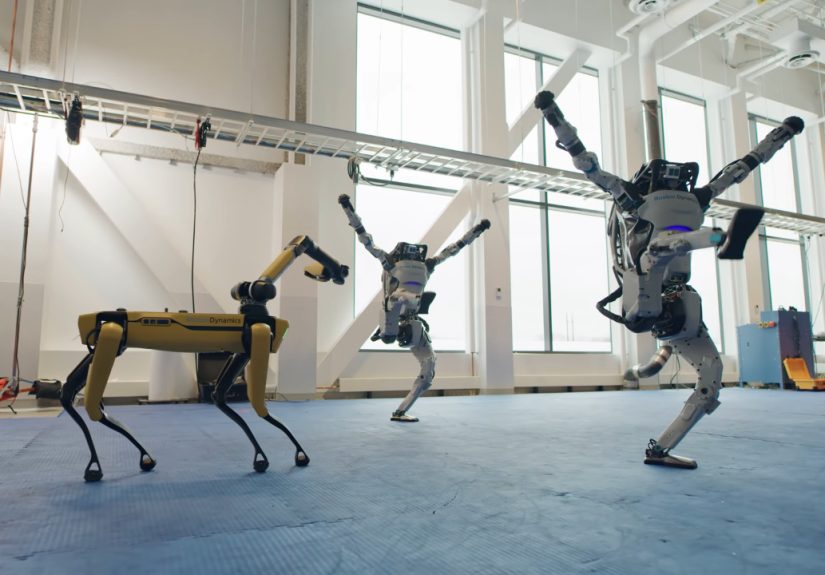
The famous “Do You Love Me” video was not a one-bot show. It featured two Atlas humanoids, one Spot quadruped, and Handle, the wheeled warehouse robot that looked like an ostrich that took a robotics elective and never looked back. That lineup mattered because each machine represented a different flavor of mobility and application.
Atlas was the star because humanoid movement is the easiest for humans to read emotionally. When Atlas sways, hops, or twists, people instantly compare it to themselves. Spot, meanwhile, brought another kind of charm. The dog-like form makes it legible in a different way. It does not seem human, but it does seem familiar, which is why Spot often lands somewhere between “adorable future helper” and “the machine from a science-fiction movie that definitely knows my location.”
Then there was Handle, rolling through the frame on two wheels and reminding everyone that Boston Dynamics was not only building internet-famous stunt performers. It was also building machines aimed at logistics and material handling. That contrast is part of the company’s long-running trick. A cute dance clip pulls in attention, and hidden inside the spectacle is a very serious pitch about robot mobility, real-world usefulness, and commercial promise.
Why Boston Dynamics Keeps Making Robots Dance
Because It Changes the Public Mood
Robots have a public relations problem. In movies, they either help save humanity or quietly prepare to eliminate it after scanning our weaknesses. There is not a lot of middle ground. Boston Dynamics has spent years operating inside that tension. Its machines are undeniably impressive, but they also trigger unease. A robot dog walking across rough terrain can inspire awe and a mild desire to update your emergency plan at the same time.
Dance softens that edge. It gives the public a way to encounter robots through play rather than threat. Instead of watching a machine climb over rubble or move through industrial space, viewers watch it do something silly, rhythmic, and familiar. The machine suddenly feels less like a cold tool and more like an object we can understand, even if only through analogy. It is hard to panic about robot domination while one of them appears to be doing the twist.
That does not mean the charm is fake. It means the emotional frame changes. Public acceptance is a real issue for robotics companies, especially when machines are meant to work near people in factories, warehouses, public infrastructure, or inspection environments. Familiarity matters. Trust matters. Sometimes the shortest path to trust is not a white paper. Sometimes it is a robot with excellent comic timing.
Because Dance Builds Better Robots
There is also a less cuddly reason Boston Dynamics keeps returning to performance: dance is useful for the engineers. The company has discussed how earlier demonstrations such as dance routines and parkour sequences helped develop systems for dynamic motion. Later work expanded beyond blind choreography toward perception-driven movement and more practical manipulation tasks. In plain English, the party tricks helped lay groundwork for real jobs.
That distinction is important. A choreographed dance can be repeated in a controlled setup. A useful robot must eventually respond to messy reality. It has to perceive objects, adapt to changes, recover from errors, and make decisions in spaces that are not lovingly arranged for a camera. Boston Dynamics’ later messaging around Atlas reflects that shift. The old hydraulic Atlas became famous for backflips, leaps, and dance clips. The newer fully electric Atlas is being framed as a machine for industrial work, material handling, and flexible automation.
So no, dancing is not the end goal. It is more like a flashy elective that unexpectedly prepares you for a serious career. The robots may have learned their stage moves first, but the long-term ambition is clearly not Broadway. It is the factory floor.
From Viral Celebrity to Actual Work
For a long time, critics joked that Boston Dynamics was the internet’s favorite robot-video studio rather than a company with practical products. That joke became harder to sustain as Spot moved into real deployments for industrial inspections, hazardous-site monitoring, public safety support, and other remote tasks that benefit from mobile sensing. In other words, the dog learned some real tricks after all.
The company’s broader commercial story sharpened after Hyundai acquired a controlling interest in Boston Dynamics in 2021. That deal signaled something important: the robots were not just viral mascots for internet attention. They were becoming part of a larger industrial strategy. Hyundai saw robotics as a serious business area, and Boston Dynamics became a more obvious piece of that future.
The evolution of Atlas reinforces the same message. In 2024, Boston Dynamics retired the hydraulic Atlas and unveiled a fully electric successor aimed more directly at real-world industrial applications. That transition was symbolic. The dance-floor superstar had grown up. Or at least grown employable. The new goal is not just to amaze viewers with an acrobatic demo but to prove that humanoid robots can do useful work with repeatability, autonomy, and enough reliability that businesses will actually pay for them.
That is the underlying genius of the dance era. Boston Dynamics used spectacle to win attention, then tried to convert that attention into trust, and finally into commercial relevance. It is a much smarter progression than it first appears. A lot of companies can say their product is revolutionary. Fewer can make millions of people watch that revolution shimmy to Motown first.
The Bigger Question: Are We Falling for Motion?
Probably, yes. And that is not entirely a bad thing. Humans are built to respond to movement. We infer intention from posture, confidence from rhythm, and emotion from timing, even when we know perfectly well we are looking at machinery. When a robot dances, it hacks a very old part of human perception. We see coordination and start assigning character. We see timing and start imagining desire. We hear “Do You Love Me” and suddenly the robot looks like it is asking.
Of course, it is not asking. There is no tiny synthetic heartbreak inside Spot. Atlas is not waiting nervously by the refresh button to see whether the comments are supportive. The machines are executing programmed behaviors. But the emotional reaction they trigger is still real, and that reaction matters because it shapes how society talks about robots. It influences fear, excitement, policy conversations, investment narratives, and public tolerance for machines moving into shared spaces.
This is where the Napoleon Dynamite angle becomes especially sharp. That movie scene worked because the audience inside the story finally saw something authentic and committed, even if it was awkward. Boston Dynamics’ robots create a similar effect, but with an extra philosophical wrinkle: the authenticity is ours, not theirs. We are the ones bringing meaning to the performance. We are the ones deciding that a pile of motors, sensors, and control software looks somehow brave for dancing in public.
What the Dancing Bots Actually Reveal About the Future
If you strip away the memes, the music, and the reflexive “this is either adorable or the beginning of the end” discourse, the lesson is pretty straightforward. Movement matters. Reliable, dynamic, adaptable movement is one of the hardest problems in robotics, and Boston Dynamics has spent years proving that it can make machines move in ways that feel startlingly alive.
The second lesson is that cultural acceptance matters almost as much as technical capability. A machine that works beautifully but terrifies everyone will face friction. A machine that people understand, or at least enjoy watching, has a smoother path into the world. That does not solve ethical concerns. It does not answer questions about labor, surveillance, safety, or weaponization. But it does change the opening mood of the conversation.
And the third lesson is this: today’s silly demo can be tomorrow’s serious product roadmap. The same company that gave us robot dance videos has also been steadily repositioning its machines toward industrial inspection, warehouse tasks, and humanoid automation. The dance floor and the factory floor are not opposite worlds. In Boston Dynamics’ case, one has been a very useful rehearsal for the other.
Extended Perspective: The Experience of Watching Dancing Robots in the Wild
Watching Boston Dynamics’ robots dance is a surprisingly layered experience, which is probably why the clips stay in your brain long after you close the tab. The first reaction is usually laughter. Not cruel laughter, but startled delight. There is something inherently comic about a machine that looks engineered for disaster response or industrial labor suddenly deciding, at least from the viewer’s point of view, that now is the time for choreography. It feels like catching a forklift doing karaoke.
Then the second reaction arrives, and it is usually unease. The movement is too good. Not perfectly human, which would almost be easier to categorize, but close enough to trigger that little mental alarm that says, “Hold on, I was not emotionally prepared for a robot to have rhythm.” This is where the internet splits into camps. One side wants to adopt Spot immediately and teach it party tricks. The other side starts mentally storyboarding the opening act of a cautionary science-fiction film. Both sides, to be fair, are reacting to the same thing: the machines no longer look clumsy.
After that comes admiration. Once the novelty settles down, it becomes hard not to appreciate the sheer technical discipline underneath the performance. Even viewers who know nothing about robotics can tell that balance, timing, and coordination at this level are hard. A machine that can recover from dynamic motion, keep its center of mass where it needs to be, and transition smoothly between moves is doing something deeply difficult. You do not need a graduate seminar in control theory to recognize skill when you see it. The body understands it before the brain catches up.
There is also an oddly social experience to these videos. People do not tend to watch them in silence and move on. They send them to friends. They argue about whether the robots are cute or terrifying. They compare them to movie scenes, to talent shows, to animated characters, to that one guy at a wedding who somehow knows all the moves and makes everyone else question their life choices. The clips become conversation starters, which is exactly what good public technology demos are supposed to do. They turn a technical milestone into a shared cultural moment.
And perhaps the strangest part is the aftertaste. Once the laughter fades, you start thinking about where all this leads. If a robot can dance convincingly, what other forms of physical fluency are around the corner? If people can feel affection toward a machine after a two-minute routine, how will they respond when that machine is helping inspect a plant, move components in a factory, or operate in spaces too dangerous for human workers? The dance becomes a gateway thought experiment. It starts as a joke and ends as a glimpse of a future workplace, a future public square, and maybe a future emotional vocabulary for living with machines.
That is why these performances linger. They are not just entertaining because the bots move well. They are entertaining because they make the future feel close enough to tease, but not yet close enough to settle. The experience is equal parts comedy sketch, engineering demo, and social Rorschach test. You laugh, you flinch, you admire, and then you start wondering whether you are watching a novelty act or the opening number of a very long technological era. The honest answer is probably both.
Conclusion
Boston Dynamics’ dancing bots did more than chase views. They gave robotics a rare cultural moment that was funny, technically impressive, and surprisingly revealing. The comparison to Napoleon Dynamite works because both performances win people over the same way: through total commitment, unexpected grace, and the kind of awkward sincerity that somehow becomes triumphant. Underneath the jokes, though, the dance routine was a preview of something serious. These machines were not merely begging for our love. They were auditioning for our attention, our trust, and eventually a place in the working world. Judging by the applause, they nailed the callback.