Table of Contents >> Show >> Hide
- Who Is Elizabeth Sagan?
- How Books Become Installations
- Why 30 Book Installations Feel Like More Than 30 Pretty Pictures
- The Beauty of Combining Two Hobbies
- Bookstagram, But Make It Architectural
- The Role of Collaboration and Community
- Why Physical Books Still Matter in a Digital Age
- What Makes These Installations So Shareable?
- Lessons for Artists, Photographers, and Book Lovers
- Experience Section: What It Feels Like to Create Book Installations
- Conclusion: A Love Letter Built From Books
Note: This publication-ready article is based on publicly available information about Elizabeth Sagan, Bookstagram culture, book art, installation art, and contemporary visual storytelling.
Some people collect books. Some people photograph books. And then there are the glorious overachievers who look at a living-room floor, a mountain of novels, and a camera angle from the ceiling and think, “Yes, today I shall become a dragon.” That is the delightful creative zone where bibliophile and photographer Elizabeth Sagan has built her recognizable world: a place where books are not just read, stacked, reviewed, or used as emergency coasters, but transformed into large-scale visual installations.
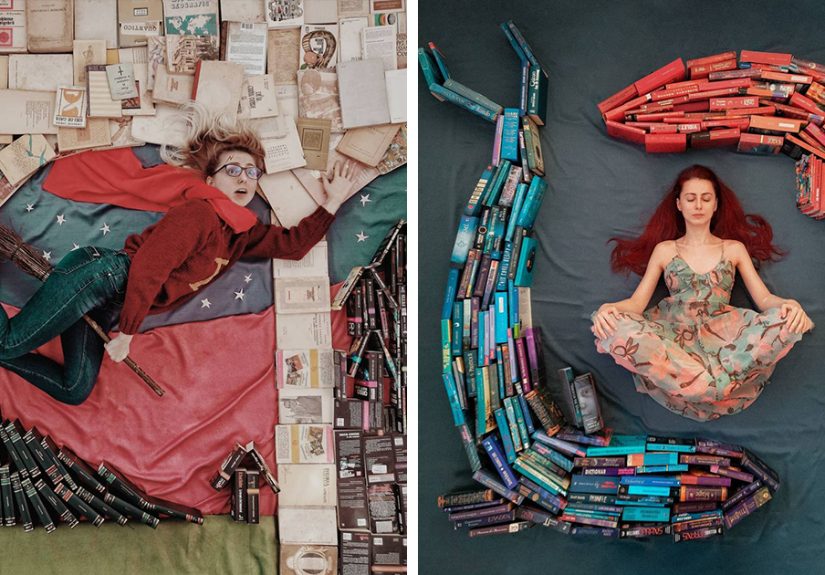
The title “Bibliophile And Photographer Combines Two Hobbies In 30 Impressive Installations” sounds like a simple internet-friendly headline, but the idea behind it is much richer. Sagan’s work sits at the intersection of reading culture, photography, performance, book art, and social media storytelling. Her installations use physical books as color, texture, architecture, costume, landscape, and sometimes full-blown weather system. In one image, books may become wings. In another, they turn into a throne, a mythical creature, a magical symbol, or a cinematic tribute. The effect is part gallery, part literary love letter, and part “please do not step on that paperback, it has emotional value.”
What makes these book installations impressive is not only the number of books involved. It is the way they remind viewers that reading is already a visual act. Every reader builds worlds in their head. Sagan simply drags those worlds out of the imagination, arranges them carefully on the floor, climbs into the middle, and photographs the result from above. Suddenly, a private hobby becomes a public spectacleand somehow, the books still feel like the stars of the show.
Who Is Elizabeth Sagan?
Elizabeth Sagan is widely known in the online reading community as a Bookstagrammer, photographer, writer, and creator of intricate book-based images. Her rise began with a familiar habit among passionate readers: sharing favorite books online. But instead of stopping at cozy flat lays, latte foam, and the classic “book beside a candle” setup, she pushed the format into theatrical territory.
Her photographs often feature her own body positioned among hundreds of books, with covers arranged by color, shape, and theme. The result is a kind of living illustration. The viewer does not just see a person who likes books; the viewer sees a person being swallowed, lifted, protected, crowned, or transformed by them. That dramatic quality explains why her work has traveled so well across the internet. It is immediately understandable, emotionally warm, and visually bold enough to make a scrolling thumb pause mid-doom-scroll.
Sagan’s creative process also reflects the larger Bookstagram movement, where readers use photography, captions, hashtags, and community interaction to make reading feel social. For decades, reading was often framed as a solitary hobby. Bookstagram did not destroy that solitude; it simply gave it better lighting. Through creators like Sagan, the book becomes both an object of reading and a prop in a shared cultural performance.
How Books Become Installations
Installation art is usually associated with galleries, museums, and immersive spaces, but the basic idea is simple: objects are arranged in a way that changes how we experience a space. Sagan’s installations do exactly that, except the gallery floor might be a home studio, the materials are novels, and the audience arrives through a screen.
Her work depends on several visual principles. First, there is scale. A single book on a table says, “I am reading.” A hundred books arranged in spirals, wings, or waves say, “The library has achieved sentience.” Scale turns the everyday into the extraordinary.
Second, there is color. Book covers become a palette. Blues can suggest water, night, or melancholy. Reds can become fire, danger, romance, or power. Golds and whites create light, magic, and elegance. In this sense, the book cover stops being packaging and becomes a brushstroke. The viewer may not even read the titles at first; the eye reads the colors, shapes, and movement.
Third, there is perspective. Many of Sagan’s images are best understood from above. This overhead viewpoint flattens the scene into a graphic composition, making books behave almost like tiles in a mosaic. What may look chaotic from floor level becomes beautifully organized through the camera. It is a reminder that art often depends not only on what is present, but where the viewer stands.
Why 30 Book Installations Feel Like More Than 30 Pretty Pictures
A gallery of 30 impressive book installations is not just a collection of eye candy for readers, although yes, the eye candy is definitely wearing literary glasses. These images work because each one suggests a small story. The books may form armor, wings, celestial shapes, comic-book references, fantasy creatures, or symbols from beloved fictional worlds. The installation becomes a visual summary of the feeling a story leaves behind.
Some of Sagan’s most recognized ideas draw inspiration from fantasy, mythology, superheroes, and popular culture. She has created images that evoke powerful women, magical worlds, epic battles, and iconic characters. The appeal is not merely in recognizing the reference; it is in seeing literature treated as a living material. When books become the feathers of a wing or the curve of a wave, they seem to say, “We were never just paper. We were always portals.”
That is why her work resonates beyond the usual book-loving crowd. A viewer does not need to have read every title in the installation to understand the emotion. The images communicate freedom, adventure, curiosity, humor, escape, and obsessionthe healthy kind, mostly, unless your floor has disappeared under hardcovers.
The Beauty of Combining Two Hobbies
The phrase “combines two hobbies” sounds casual, but it captures something important about creativity. Many original ideas do not come from inventing an entirely new passion. They come from letting two existing passions collide and seeing what survives the crash.
Reading gives Sagan her themes, moods, and symbols. Photography gives her composition, lighting, timing, and audience. Installation gives the project physical presence. Performance gives it personality. Social media gives it reach. None of these elements works alone in quite the same way. A stack of books is charming, but static. A portrait is personal, but may not feel literary. A book review is informative, but not necessarily visual. Put them together, and suddenly the image becomes a story about stories.
This is also why the work feels accessible. Viewers may not have a museum studio or a warehouse full of sculptural materials, but many readers understand the urge to arrange books by mood, color, size, or emotional damage inflicted by chapter twenty-seven. The installations feel ambitious, yet rooted in a familiar love: the joy of being surrounded by books.
Bookstagram, But Make It Architectural
Bookstagram has often been associated with beautiful shelves, reading corners, seasonal displays, and carefully styled photos. Sagan’s work expands that language. Her images do not simply present a book as an object to buy or review. They create an environment where books act like architecture.
In many images, the body becomes part of the structure. Sagan may appear as the central figure, the heroine, the dreamer, the warrior, or the tiny human bravely trusting that the book arrangement will not collapse into a very literary avalanche. This body-and-book relationship matters. It shows reading as an embodied experience. We do not just consume stories with our eyes; we carry them in posture, memory, imagination, and identity.
That is why her photographs feel different from ordinary product shots. They are not just saying, “Here is a book.” They are saying, “Here is what a book can do to a person.” It can enlarge the world, give shape to emotion, offer a costume for courage, or build a temporary universe on the floor before dinner.
The Role of Collaboration and Community
Sagan’s creative world is also tied to collaboration, especially with fellow Bookstagrammer James Trevino. Their shared projects and community-focused platforms have helped elevate book photography from a niche hobby into a recognizable visual genre. This matters because internet art is rarely only about one creator producing in isolation. It grows through interaction: followers respond, other creators imitate or remix ideas, and communities build new expectations for what “book content” can look like.
Book communities online are powerful because they turn recommendations into relationships. A person might arrive for a fantasy novel suggestion and stay because the visual storytelling makes books feel exciting again. In a digital environment where attention is expensive and patience is apparently sold separately, Sagan’s installations offer a persuasive argument for physical books: they are tactile, colorful, sculptural, and emotionally charged.
Why Physical Books Still Matter in a Digital Age
E-books and audiobooks are convenient, valuable, and beloved by many readers. But Sagan’s work proves that physical books still have a unique visual power. A printed book has weight, spine, texture, cover design, aging, and presence. When arranged in large numbers, books become more than containers of text. They become material culture.
This does not mean one format is superior to another. The point is that physical books can do something special in visual art. They hold a double identity. They are objects and stories at the same time. A blue hardcover can be both a color block in a photograph and a novel someone once stayed up too late to finish. That layered meaning gives book installations their emotional charge.
In Sagan’s photographs, books are not treated as disposable props. They are respected as beloved materials. The viewer senses that the artist knows what these objects mean to readers. The images may be playful, but they are not shallow. They understand the quiet drama of a bookshelf: every spine is a tiny door, and every door has opinions.
What Makes These Installations So Shareable?
There is a reason Sagan’s book art travels well online. Her installations hit several sweet spots at once. They are visually bold enough to stand out in a feed, detailed enough to reward a second look, and emotionally clear enough to be understood instantly. This is the holy trinity of shareable visual content.
They also invite participation. Viewers naturally want to comment: “How long did this take?” “How many books is that?” “Did any books fall on your head?” “Can I move into this photo?” That curiosity turns a static image into a conversation. For SEO and social media alike, conversation matters. It signals engagement, but more importantly, it shows that the artwork has made people feel something.
The images also benefit from nostalgia. Many readers have a personal relationship with physical books: childhood libraries, school book fairs, used bookstores, rainy afternoons, underlined passages, and the heroic act of buying one more novel despite having eighteen unread at home. Sagan’s installations activate that affection without needing to explain it. The books do the emotional heavy lifting.
Lessons for Artists, Photographers, and Book Lovers
1. Start With What You Already Love
Sagan’s work is a strong reminder that creativity does not always begin with expensive equipment or a grand concept. Sometimes it begins with what you already cannot stop thinking about. Books were already part of her life. Photography became the tool that allowed that love to take visual shape.
2. Make the Familiar Strange Again
A book is familiar. A floor covered in books shaped like wings is not. The magic comes from transforming an everyday object into something unexpected. This is one of the oldest tricks in art, and it still works beautifully.
3. Use Constraints as Fuel
Working mostly with books might sound limiting, but limits can sharpen creativity. A restricted material forces an artist to ask better questions: How can a rectangle become a curve? How can color suggest movement? How can a person fit into the design without overpowering it?
4. Let the Audience Recognize Themselves
The best book installations do not only showcase the artist’s imagination. They awaken the viewer’s own reading memories. That is why recognizable symbols, genres, and emotional themes are so effective. They give the audience an easy doorway into the image.
Experience Section: What It Feels Like to Create Book Installations
Anyone who has ever tried to photograph books creatively knows that the process is both romantic and ridiculous. The romantic part comes first. You imagine a perfect scene: books arranged like a galaxy, warm light spilling across the covers, one dramatic pose in the center, and a final photograph so beautiful that strangers on the internet briefly regain faith in humanity.
Then reality arrives wearing socks and stepping on a paperback.
Creating a book installation is surprisingly physical. Books are heavier than they look, especially when you move them in stacks. A small design can quickly require dozens of volumes; a large one can turn a quiet room into a literary obstacle course. Sorting by color takes patience. Building curves from rectangular objects is an art form and a mild test of emotional stability. One wrong nudge can shift an entire section, and suddenly the elegant phoenix you were building looks like a confused omelet.
Photography adds another layer of problem-solving. Overhead shots require height, balance, and planning. The camera must capture the whole arrangement without distorting the shape too much. Lighting needs to be even enough to show details, but dramatic enough to keep the scene alive. Shadows can help or betray you. A shiny book cover may glare like it has a personal grudge. Dark covers can disappear into the background unless carefully placed. Every choice becomes part of the final image.
There is also the question of storytelling. A beautiful arrangement is nice, but a memorable installation needs a reason to exist. Is the image about adventure? Mystery? Romance? Power? Escape? The theme guides everything: color, pose, book placement, props, and expression. Without a clear emotional center, even the most technically impressive arrangement can feel like a very organized book sale.
The most rewarding part is the moment when the design finally clicks. From the floor, the arrangement may still look messy. But through the camera, the shapes align. The wings open. The spiral moves. The throne becomes royal. The pile becomes a storm. That shift is addictive because it feels like discovering a secret hidden in ordinary objects.
For book lovers, the experience is also personal. Handling each volume reminds you of what you have read, what you meant to read, what you bought because the cover was pretty, and what you are still pretending you will finish this year. The installation becomes a portrait of your reading life, not just a photograph. Even if the final image is polished, the process is full of small human moments: dusting covers, rearranging colors, laughing at failed attempts, and promising yourself that next time you will plan better. You probably will not.
That is the charm of Sagan’s work. It makes book art look magical, but it also hints at the effort behind the magic. The photographs are impressive because they balance discipline with wonder. They show that a hobby can become art when treated with imagination, patience, and just enough stubbornness to keep arranging books long after a normal person would have ordered pizza and given up.
Conclusion: A Love Letter Built From Books
“Bibliophile And Photographer Combines Two Hobbies In 30 Impressive Installations” is more than a catchy description. It points to a creative practice that celebrates reading as an active, visual, and communal experience. Elizabeth Sagan’s installations remind us that books do not stop being magical when they are closed. Their covers, colors, shapes, and memories can become raw material for another kind of storytelling.
In a world where digital content moves quickly and attention spans are treated like endangered species, her work offers something both immediate and lasting. The images are easy to enjoy at a glance, but they also reward deeper thought. They ask what books mean to us, how stories shape identity, and why physical objects still matter in an increasingly screen-based culture.
Most importantly, these installations prove that creativity does not require choosing one passion and ignoring the rest. Sometimes the best ideas happen when hobbies shake hands. Reading meets photography. Photography meets installation. Installation meets performance. And somewhere in the middle, a bibliophile lies on the floor surrounded by novels, creating a scene that makes the internet say, “Fine, I’ll read more.”