Table of Contents >> Show >> Hide
- Who Is Morshed Mishu?
- What Makes This Project So Powerful?
- The Art of Reframing Pain Without Erasing It
- Why Happy Art Can Feel More Devastating Than Sad Art
- Photography, Memory, and the Ethics of Looking
- Visual Activism With a Gentle Punch
- The Role of Color in Transforming Meaning
- How Art Helps People Process Difficult Emotions
- Specific Examples of Transformation in the Project
- Why the Internet Responded So Strongly
- Is It Okay to Make Happy Art From Painful Images?
- Lessons for Artists, Writers, and Content Creators
- Why This Topic Still Matters Today
- Experiences Related to “Artist Turned Heartbreaking Photographs Into Happy Art”
- Conclusion
Some photographs stop you mid-scroll. Not because they are beautiful in the usual glossy-magazine way, but because they carry the emotional weight of an entire headline, an entire country, sometimes an entire generation. They make your thumb freeze, your chest tighten, and your brain whisper, “I wish this had ended differently.” Bangladeshi cartoonist Morshed Mishu took that feeling and turned it into a remarkable visual question: what if the world looked kinder?
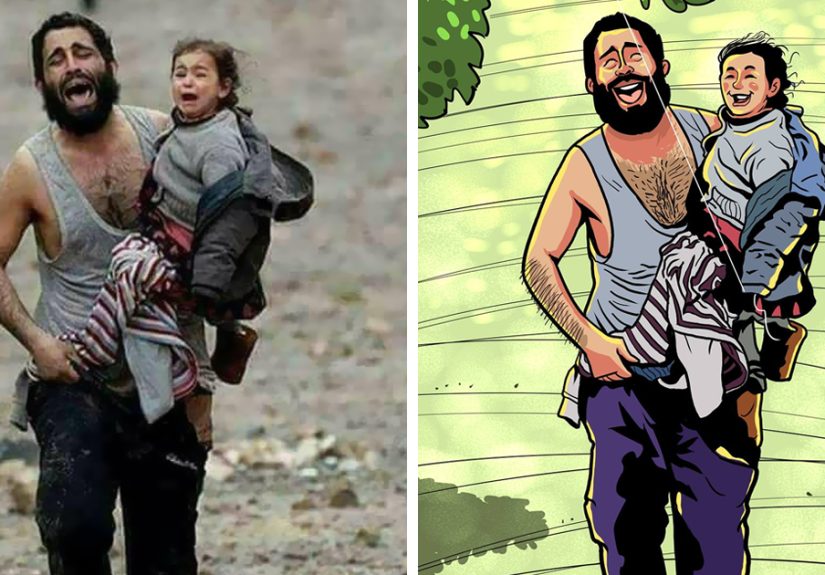
His project, widely known as The Global Happiness Challenge, reimagined heartbreaking photographs from war, displacement, and human suffering as joyful illustrations. Instead of rubble, he drew color. Instead of fear, he drew play. Instead of scenes shaped by violence, he imagined ordinary happiness: children reading, families smiling, neighborhoods blooming, and life continuing the way it should. The result is not denial. It is not decoration. It is a form of visual protest with a soft voice and a very loud message.
The title “Artist Turned Heartbreaking Photographs Into Happy Art” may sound simple, almost like a feel-good internet headline. But beneath it sits a deeper conversation about conflict photography, emotional storytelling, art therapy, digital activism, and the human need to imagine repair. Mishu’s work became popular because it did something rare: it made people feel sadness and hope at the same time, which is basically the emotional equivalent of laughing while cutting onions.
Who Is Morshed Mishu?
Morshed Abdulla Al, better known by his pen name Morshed Mishu, is a Bangladeshi cartoonist and illustrator whose work gained international attention after he began transforming tragic and shocking images into hopeful drawings. His visual style is direct, colorful, and emotionally readable. You do not need a museum studies degree, a black turtleneck, or the ability to say “post-structuralism” without blinking to understand it.
Mishu’s art reached a global audience in 2018 through his series The Global Happiness Challenge. In 2019, he was recognized by Forbes in its 30 Under 30 Asia list in the Media, Marketing & Advertising category. That recognition mattered because it showed how illustration, often treated as light or playful, can carry serious social meaning. A cartoon can be funny, yes. But it can also be brave. It can ask a question that a thousand-word editorial might spend three cups of coffee trying to phrase.
What Makes This Project So Powerful?
The emotional strength of the project comes from contrast. Mishu did not invent random happy scenes. He placed happiness directly beside sorrow. The original photographs often showed the impact of war and displacement. His illustrations offered an alternate version of the same visual structure: the same figures, the same general composition, but transformed into a world without violence.
This side-by-side method is important. If the happy drawing existed alone, it might look charming but ordinary. If the photograph existed alone, it might feel overwhelming. Together, they create a conversation. The viewer sees what happened, then sees what should have been possible. That gap between reality and possibility is where the artwork lives.
It Turns “What Happened?” Into “What If?”
News photography often answers the question, “What happened?” It documents, informs, and bears witness. Mishu’s illustrations ask a different question: “What if this child had been safe? What if this street had been peaceful? What if this family had never been forced into fear?” These questions do not erase the truth of the photograph. Instead, they sharpen it. Hope becomes a spotlight, not a curtain.
That is why the project works so well online. Social media is crowded with outrage, jokes, recipes, cat videos, and someone’s suspiciously perfect morning routine. A quiet visual comparison can cut through the noise. It gives viewers a moment to pause and feel something without being instructed exactly what to think.
The Art of Reframing Pain Without Erasing It
Reframing is not the same as pretending. This distinction matters. When an artist turns a heartbreaking photograph into happy art, the goal is not to say, “Everything is fine.” Clearly, everything is not fine. The goal is closer to saying, “This is what humanity should be fighting for.”
In Mishu’s work, happiness is not shallow. It is political. A playground is not just a playground when it replaces a scene of conflict. A book is not just a book when it appears in the hands of a child who should have had school, safety, and time to dream. A colorful neighborhood is not just cute background art when it stands in for a place damaged by war. These cheerful details carry moral weight.
The most effective pieces in the series use simple symbols: school bags, flowers, toys, sunshine, clean streets, and smiling faces. These are not complicated images. That is the point. Peace should not be complicated. Safety should not be a luxury item, like designer furniture or airport bottled water.
Why Happy Art Can Feel More Devastating Than Sad Art
At first glance, happy colors might seem like they soften the subject. But often, the opposite happens. When viewers see the hopeful version, they become more aware of what was lost in the real one. A bright illustration can make the original tragedy feel even sharper because it reveals the ordinary life that should have existed.
This is one of the most interesting emotional mechanics of the project. The sadness is not only in the painful photograph. It is also in the cheerful drawing. The drawing is beautiful because it imagines a better world, and heartbreaking because that better world did not arrive in time for the people in the photo.
In that sense, Mishu’s project belongs to a long tradition of artists responding to suffering with imagination. Some artists document pain directly. Others use symbolism, satire, murals, collage, or performance. Mishu uses visual substitution: he keeps the emotional skeleton of the image but changes its destiny.
Photography, Memory, and the Ethics of Looking
Conflict photography has always carried ethical questions. Photographs can wake up the world, but they can also expose vulnerable people to endless public viewing. They can preserve history, but they can also turn private suffering into a repeated public image. That tension is not easy to solve, and anyone who claims it is easy probably also thinks assembling flat-pack furniture is “relaxing.”
Mishu’s illustrations add another layer to this conversation. By redrawing widely recognized images rather than simply reposting them, he changes the act of looking. The viewer is invited not only to witness suffering but to imagine responsibility. The artwork does not ask, “Can you endure seeing this?” It asks, “Can you imagine a world where this does not happen?”
This shift matters because audiences can become numb to painful images. When people see too many scenes of crisis, they may shut down emotionally. The brain has a little bouncer at the door, and after enough distressing images, it says, “Sorry, we’re at capacity.” Hopeful reinterpretation can reopen attention without using shock as the only tool.
Visual Activism With a Gentle Punch
The phrase visual activism describes art that participates in social conversation. It can appear as posters, murals, photography, memes, comics, public installations, or digital illustrations. Mishu’s project fits this tradition because it uses imagery to challenge war and violence while remaining accessible to a broad audience.
What makes his approach distinctive is its tenderness. Many activist artworks confront viewers with anger, irony, or accusation. Those methods can be powerful. Mishu chooses a different emotional strategy: he uses sweetness. The sweetness is not weak. It is disarming. It gets past people’s defenses because it does not begin by shouting. It begins by imagining a child safe, a family together, a city alive.
In digital culture, that softness can travel far. People share images that help them express feelings they cannot easily put into words. Mishu’s illustrations gave audiences a way to say, “This is what I wish the world looked like.” That is a very shareable emotion.
The Role of Color in Transforming Meaning
Color is one of the project’s strongest tools. The original photographs often carry muted tones associated with dust, smoke, shadow, or emergency. Mishu’s illustrations replace that atmosphere with bright colors, clean lines, and visual warmth. The change is immediate. The eye understands the emotional turn before the mind finishes analyzing it.
Bright color does not merely make the images “prettier.” It changes the moral temperature. A gray street becomes a place where people might gather. A damaged background becomes a livable neighborhood. A frightened posture becomes playful movement. Color becomes a language of repair.
This is why illustration can do something photography cannot always do. Photography is tied to what the camera saw. Illustration can show what the heart refuses to stop wanting. Put simply: the camera says, “Here is the world.” The illustrator replies, “And here is the world we owe each other.”
How Art Helps People Process Difficult Emotions
Art therapy research and creative arts practices often emphasize that making images can help people express feelings that are difficult to explain verbally. While Mishu’s project is not a clinical therapy session, it uses a related principle: images can hold emotion safely. They can give shape to grief, anger, hope, and compassion without forcing everything into a neat sentence.
This is especially relevant in a time when people encounter global suffering through screens. Many viewers feel helpless. They care, but they do not know what to do with that care. Art can become a container for that emotional overload. It does not solve the crisis by itself, but it keeps compassion from going cold.
In that way, happy art made from heartbreaking photographs is not escapism. It is emotional organization. It says: “Here is the pain. Here is the hope. Hold both. Do not look away, but do not give up either.”
Specific Examples of Transformation in the Project
Some of the most discussed images in Mishu’s series reimagine children affected by conflict as children surrounded by books, toys, parks, or colorful homes. The transformation is simple but deeply effective. A child who was originally seen in a setting of danger is redrawn in a setting of learning or play. The message lands instantly: childhood should be protected.
Other illustrations replace damaged cityscapes with lively urban scenes. Buildings regain color. Streets become calm. People appear not as victims of disaster, but as neighbors in a shared community. These works are especially powerful because they remind viewers that cities are not just buildings. They are routines, jokes, markets, school mornings, family dinners, and someone yelling, “Where are my keys?” five minutes before leaving the house.
The humor of ordinary life matters here. Peace is not always cinematic. Sometimes peace is boring in the best possible way. It is a child doing homework, a parent making tea, a street vendor arranging fruit, a dog sleeping in the sun like it pays rent. Mishu’s art celebrates that ordinary safety.
Why the Internet Responded So Strongly
The internet loves transformation. Before-and-after images, room makeovers, restoration videos, rescued furniture, glow-ups: people click because transformation gives the brain a tiny fireworks show. Mishu’s project uses that same visual structure, but with a serious emotional purpose.
Viewers are drawn in by the format, then held by the meaning. They recognize the sadness of the original image and the beauty of the alternative. The artwork gives them a brief emotional journey: shock, sadness, relief, longing, and reflection. That is a lot for one image pair to accomplish. Most social posts are proud if they can make someone exhale through their nose.
Another reason the work spread is that it crosses language barriers. A viewer does not need to speak Bengali, English, Arabic, Spanish, or any other language to understand a child smiling where fear once was. Visual storytelling travels quickly because emotion is multilingual.
Is It Okay to Make Happy Art From Painful Images?
This is the hard question, and it deserves a serious answer. Turning painful photographs into hopeful illustrations can be meaningful, but it also requires sensitivity. Artists must avoid making suffering look cute, collectible, or convenient. The people in the original photographs are not props. Their experiences are real, and their dignity matters.
Mishu’s project succeeds because its emotional direction is compassionate rather than exploitative. The illustrations do not mock the original images or use them for cheap decoration. They mourn what happened by imagining what should have happened instead. That difference is crucial.
The best version of this kind of art does three things: it respects the source image, honors the humanity of the people represented, and points toward a better future. When those pieces are in place, happy art can become a form of remembrance rather than erasure.
Lessons for Artists, Writers, and Content Creators
Mishu’s work offers several useful lessons for anyone creating meaningful content. First, a strong concept can be simple. “What if heartbreaking photographs became happy art?” is easy to understand, yet emotionally rich. Second, contrast is powerful. The difference between the original and the illustration creates the impact. Third, hope is not childish. Hope can be a serious artistic tool.
For illustrators, the project shows how style can serve message. Clean lines and bright colors are not merely aesthetic choices. They make the imagined world feel reachable. For writers, the project is a reminder that tone matters. You can discuss heavy subjects without turning every paragraph into a thunderstorm. For marketers and digital storytellers, it proves that meaningful work can go viral without losing its soul.
Why This Topic Still Matters Today
The world continues to produce heartbreaking images. News feeds bring conflict, disasters, displacement, and injustice into daily life with relentless speed. People need facts, but they also need ways to emotionally process those facts. Art helps bridge that gap.
Projects like The Global Happiness Challenge remind audiences that compassion is not passive. To imagine a better world is not the same as building one, but it can be the beginning of care, conversation, donation, advocacy, education, or simply refusing to become numb. Imagination is not the whole toolbox, but it is the pencil that sketches the blueprint.
In a culture that often rewards outrage, Mishu’s art makes a case for tenderness. It says that the opposite of violence is not only peace. It is also play, school, color, family, safety, humor, and ordinary life continuing without fear.
Experiences Related to “Artist Turned Heartbreaking Photographs Into Happy Art”
One of the most relatable experiences connected to this topic is the feeling of wanting to “fix” an image after seeing it. Many people have had that moment: you see a difficult photograph online, and your mind immediately imagines a safer ending. You picture someone being helped, a child being comforted, a ruined place restored, or a frightened face becoming calm. That mental response is not weakness. It is empathy trying to draw.
In classrooms, this kind of creative reframing can become a powerful exercise when handled carefully. Students might look at a historical photograph, discuss its context respectfully, and then create an alternate image showing justice, safety, or healing. The goal would not be to rewrite history falsely. The goal would be to understand what was missing and why it mattered. A student might transform a scene of separation into one of reunion, or a damaged environment into a protected community garden. Through that process, young people learn that art can respond to history without pretending history was painless.
In community workshops, similar exercises can help people express hopes for their neighborhoods. Participants might bring images of abandoned lots, neglected public spaces, or places associated with difficult memories. Then they redraw them as libraries, parks, art walls, gardens, small businesses, or safe gathering spots. The finished drawings can become more than art. They can become visual proposals. Sometimes a picture of a better block is the first step toward asking, “Why not?”
On a personal level, many people already practice a small version of this idea in journals and sketchbooks. Someone may draw over an old photograph with flowers, stars, speech bubbles, or symbols of recovery. Someone else may paint a memory as they wish it had felt: warmer, safer, brighter. These private artworks may never go viral, win awards, or appear in a gallery, but they still matter. They help the maker turn emotional weight into something visible and manageable.
Digital artists also use this approach when they create hopeful edits, tribute illustrations, or imagined futures for communities affected by hardship. The best examples are careful and respectful. They do not chase attention by using pain as decoration. Instead, they ask viewers to care longer than the usual three-second scroll. That is difficult work in a fast internet culture where attention can vanish quicker than snacks at a family party.
The most meaningful experience this topic offers is the realization that happiness in art does not have to be shallow. A cheerful drawing can carry grief. A bright color can protest darkness. A smiling figure can remind us of someone’s right to safety. When an artist turns heartbreaking photographs into happy art, the final image is not saying, “Forget what happened.” It is saying, “Remember what should have happened, and let that memory change what we accept.”
Conclusion
Artist Turned Heartbreaking Photographs Into Happy Art is more than a story about clever illustration. It is a story about how imagination can challenge violence, how color can carry compassion, and how art can help audiences look at painful realities without surrendering to despair. Morshed Mishu’s work matters because it does not deny suffering. It answers suffering with a vision of what people deserve: safety, joy, dignity, and ordinary days filled with ordinary peace.
The project’s lasting power comes from its emotional honesty. It lets sadness remain sad, but it refuses to let sadness have the final word. In a world where heartbreaking photographs continue to circulate, happy art can become a gentle but firm reminder: another version of the world is worth imagining, and once imagined, worth building.