Table of Contents >> Show >> Hide
- The Runway Moment That Turned Into Fashion History
- Why It Wasn’t Really “Spray Paint”
- How the Dress Formed in Real Time
- The Material Science Hidden Inside the Glamour
- Why Coperni’s Choice Was So Smart
- Fashion History Was Watching, Too
- What the Bella Hadid Coperni Dress Says About the Future
- The Experience of Watching Fashion Become Material in Real Time
- Conclusion
- SEO Tags
Fashion loves a dramatic entrance, but Coperni’s now-famous Bella Hadid finale did something even harder: it made science look glamorous without turning the runway into a high school chemistry fair. One minute, the audience was watching a standard Paris Fashion Week show. The next, they were watching a dress appear in real time as a white spray transformed from mist into fabric right onstage. Social media did what social media does best and promptly lost its collective mind.
But the real reason this moment still sticks is that it was not just spectacle. It was engineering in heels. The viral Coperni dress became a cultural obsession because it fused performance, materials science, fashion history, and internet-age theater into one unforgettable scene. It looked like “spray paint,” sure, but what viewers were actually seeing was a spray-on textile technology called Fabrican: a material system designed to dry quickly, cling to a surface, and form a wearable nonwoven fabric.
That is why the moment mattered. It was not only a beautiful stunt. It was a live demonstration of how fibers, polymers, solvents, fit, and design thinking can work together to create clothing in a completely different way. In other words, the dress was serving face, form, and fluid mechanics.
The Runway Moment That Turned Into Fashion History
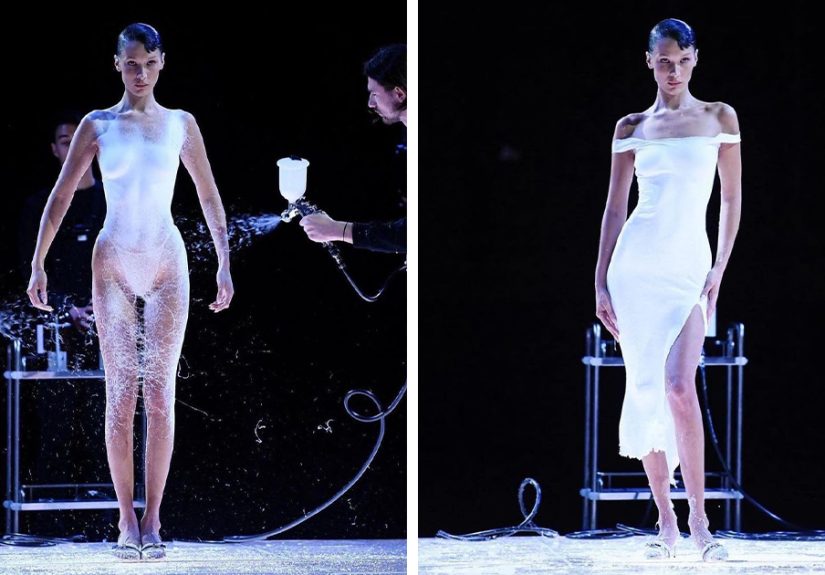
At Coperni’s Spring/Summer 2023 show in Paris, Bella Hadid stepped onto the stage for the final look while a team led by Fabrican inventor Dr. Manel Torres sprayed a white liquid material directly onto her body over a minimal base layer. As the material built up, it changed from a web-like mist into something more solid and dress-like. Then came the finishing touches: the neckline was adjusted, the shoulder line softened, and a slit was cut so the look felt less “lab experiment” and more “minimalist eveningwear with impeccable timing.”
The result was a fitted off-the-shoulder white dress that moved surprisingly well once Hadid walked. That last part matters. A runway audience might forgive a weird concept. It will not forgive a weird concept that waddles. The fact that the garment functioned as an actual dress, not just a gimmicky shell, is part of what made the moment feel futuristic instead of flimsy.
It also landed in a fashion context that was already primed for comparisons. Many viewers immediately connected the performance to Alexander McQueen’s famous 1999 show featuring Shalom Harlow and robot spray paint. But Coperni’s version was not simply a remake with a new cast. McQueen used paint as performance. Coperni used a material that was intended to become clothing. That difference is the whole plot twist.
Why It Wasn’t Really “Spray Paint”
The title most people remember uses the phrase “spray-painted dress,” because that is how the moment looked from a distance. But scientifically, that phrase is sloppy. What Bella Hadid wore was not paint in the normal sense. It was a spray-on fabric system designed to create a nonwoven textile once the liquid hit air and the supporting surface.
Fabrican has been described in technical and company materials as a blend of short fibers, a binder, and a diluent or solvent. When the mixture is sprayed, the solvent evaporates, leaving the fibers entangled and bound together into a fabric-like layer. Think of it as a wearable mist with commitment issues that suddenly decides to settle down and become a dress.
The Three Main Ingredients Doing the Heavy Lifting
Fibers: These can include natural or synthetic fibers. Their job is to create the actual textile structure. Without fibers, you do not get fabric. You get coating. Big difference.
Binder: The binder acts like the diplomatic glue of the operation. It helps the fibers hold together after application so the material has enough integrity to behave like cloth rather than drifting into chaos.
Diluent or solvent: This keeps the mixture sprayable inside the device. Once sprayed, it evaporates rapidly, which is the trigger that helps the material shift from liquid suspension to solid textile layer.
This basic fiber-binder-diluent model is not just runway mythology. It lines up with the patented description of spray-on fabric technology and with years of reporting on Fabrican’s development. So while the Coperni moment felt like fashion magic, the science behind it was less wizardry and more controlled material deposition.
How the Dress Formed in Real Time
What made the Coperni demonstration so mesmerizing was that people could watch the phase change with their own eyes. First, the spray appeared airy and almost cobweb-like. Then it thickened. Then it smoothed out. That visual progression is exactly what happens when a sprayable suspension begins to lose solvent and leave behind a denser network of bonded fibers.
The body itself functioned as a three-dimensional dress form. Traditional garment production usually starts with fabric that is cut into pattern pieces, sewn together, and fitted later. Here, the order was scrambled. The “fabric” was created in place, which meant the fit responded immediately to curves, posture, and proportion. It was less cut-and-sew and more spray-and-sculpt.
That explains why the dress looked so body-conscious from the start. It was not shaped to an abstract size chart. It was formed directly on the model in that exact moment. In technical terms, that means the support surface influences the final geometry. In plain English, the dress fit because the dress had no choice.
Why It Looked Smooth Instead of Fuzzy
If you spray fibers onto a surface, you might expect something rough or felt-like. And in fact, the earliest stage did look fuzzy. But repeated passes, controlled spraying, and finishing by hand helped compress and refine the outer layer. The final surface looked closer to a sleek jersey or soft suede-like textile than a fluffy science project. That transformation is one reason the moment felt so uncanny. Viewers were watching something born messy become elegant in minutes.
The Material Science Hidden Inside the Glamour
The science behind Bella Hadid’s Coperni dress becomes even more interesting once you stop looking at it as a celebrity moment and start looking at it as a materials case study. Spray-on fabric sits at the crossroads of textiles, chemistry, and manufacturing. It challenges the assumption that cloth must be woven, knitted, or cut from a roll.
In conventional textiles, structure is created before a garment is shaped. In spray-on fabric, structure and shaping can happen almost simultaneously. That opens the door to custom fit, fewer seams, and potentially less waste in certain applications. It also hints at a future where garments, bandages, protective layers, or custom surfaces could be applied on demand.
Fabrican’s technology has long been discussed beyond fashion, including possible uses in medicine, protective coverings, and other industrial contexts. That wider usefulness is part of what made the Coperni dress feel more important than a one-night fashion stunt. The runway did not invent the technology. It publicized it in the most dramatic way possible.
And that is classic fashion behavior, honestly. Science builds the rocket. Fashion makes sure everyone posts it to Instagram.
Can You Actually Wear It?
Yes, with context. Reports on Fabrican have noted that the material can be wearable, removable, and even reusable under the right conditions. But that does not mean the version seen on the runway is ready to replace every closet staple tomorrow. A live runway demonstration is a proof-of-concept performance, not a mass-market product rollout.
There are still practical questions: durability, comfort across long wear, breathability, washing performance, large-scale manufacturing, cost, skin sensitivity, and consistency across different environments. A dress created under controlled show conditions is one thing. Everyday clothing that survives weather, commuting, and somebody dropping iced coffee on it is another.
So no, this was not the moment your T-shirt factory packed up and went home. But it was a compelling preview of what alternative garment-making methods can look like when science leaves the lab and struts under runway lights.
Why Coperni’s Choice Was So Smart
Coperni did not become a talking point by accident. The brand has built a reputation for mixing clean, contemporary design with big tech-adjacent ideas. The Bella Hadid spray-on dress was a perfect expression of that identity. It was minimal in shape, maximal in impact, and tailor-made for the way fashion now circulates through short clips, screenshots, memes, and endless replays.
That matters because runway shows are no longer just for editors in the room. They are also for millions of viewers who may never care about hem finish, but absolutely care about a jaw-dropping 15-second clip. Coperni understood that a scientific demonstration could also become a digital event. The brand was not just dressing a model; it was dressing the algorithm.
Still, the moment worked because it had substance beneath the spectacle. People do not keep replaying a runway gimmick for years unless it taps into something bigger. In this case, that “something bigger” was a real question: what if clothing did not have to be made the way it has always been made?
Fashion History Was Watching, Too
The Coperni finale also resonated because it fit into a long tradition of designers turning the runway into a testing ground for ideas. From Hussein Chalayan’s technological experiments to Alexander McQueen’s theatrical provocations, fashion has always flirted with science, machinery, and illusion. The Bella Hadid moment felt new, but it also felt legible within that lineage.
That is part of why the clip spread so fast. Even viewers who did not know the technical details understood the emotional logic immediately. This was fashion doing what it does at its most ambitious: making people wonder not just “Would I wear that?” but “How on earth did they do that?”
And when a runway can trigger both questions at once, it usually earns its place in the history books.
What the Bella Hadid Coperni Dress Says About the Future
The science behind Bella Hadid’s spray-painted Coperni dress points toward a future where clothing may become more customizable, more immediate, and potentially more efficient in niche applications. Spray-on systems could one day help create one-off fits, rapid prototypes, theatrical costumes, medical textiles, or hybrid fashion-tech products that do not follow the old assembly line model.
But the bigger lesson is philosophical. The moment reminded audiences that fashion innovation is not limited to silhouettes, colors, and trend forecasts. Sometimes innovation lives inside the material itself. Sometimes the most exciting part of a dress is not the neckline or the slit, but the fact that the thing exists at all.
That is why the Coperni dress lasted beyond its viral week. It was not merely beautiful or shocking. It made viewers feel that they had seen a new manufacturing language being spoken in public for the first time. And that is rare.
The Experience of Watching Fashion Become Material in Real Time
One reason people are still fascinated by Bella Hadid’s Coperni spray dress is that the moment was deeply experiential. Even through a phone screen, viewers could sense the tension in the room. The scene unfolded slowly enough to build suspense, but quickly enough to feel miraculous. That balance is hard to pull off. Too fast, and the audience misses the process. Too slow, and the crowd starts mentally planning dinner. Coperni hit the sweet spot.
What made the experience so powerful was the sequence of emotions it created. First came confusion. People wondered whether they were watching a styling setup, an art performance, or the beginning of some very expensive prank. Then came recognition: the liquid was not staying liquid. It was becoming structure. Then came the fashion payoff, when the material stopped reading like a technical demo and started reading like a dress. By the time Bella Hadid walked away in the finished look, the audience had already gone through surprise, curiosity, analysis, and awe in the span of a few minutes.
That emotional arc is important because fashion often asks audiences to accept the finished result without seeing the labor behind it. Here, the labor was the show. The audience watched technicians spray, layer, adjust, and refine the garment in real time. Suddenly, the making of the dress was not hidden backstage. It was the main event. That gave the finale a strange intimacy. People were not just consuming an image. They were witnessing construction, decision-making, and transformation right in front of them.
There is also something uniquely modern about the way the experience worked online. On social media, the clip became shareable because it told a complete story without needing much explanation. A woman steps onto a runway. A white spray covers her. A dress appears. She walks. That is almost silent-film-level clarity. You do not need to know the brand, the season, or the science to understand that something unusual is happening. Yet the more you learn, the richer it becomes. That combination of instant readability and deeper meaning is internet gold.
For fashion fans, the experience was thrilling because it offered novelty without sacrificing beauty. For science-minded viewers, it was satisfying because the performance had a real technical basis. For skeptics, it at least sparked debate, which is its own kind of success in an attention economy. Some people saw innovation. Some saw theater. Some saw marketing genius wearing a white dress. All of them, however, saw something memorable.
And maybe that is the best way to understand the Coperni moment. It was not only about proving that a spray-on textile could work. It was about letting people feel the difference between looking at clothing and watching clothing come into existence. That experience taps into something basic and human: we love transformation. We love before-and-after. We love the second when the thing reveals what it has been becoming all along.
In that sense, Bella Hadid’s dress was more than a viral fashion clip. It was a live reveal of process, possibility, and performance all at once. The science made it credible. The styling made it chic. The pacing made it unforgettable. And the audience, both in the room and online, got the rare experience of seeing invention turn into silhouette before their eyes. Not bad for a dress that started as a spray cloud and ended as fashion history.
Conclusion
A closer look at Bella Hadid’s spray-painted Coperni dress reveals that the real story was never just celebrity, shock value, or runway drama. The magic came from the science. Fabrican’s spray-on textile system turned a viral fashion moment into a public lesson in how fibers, polymers, solvents, fit, and design can work together in a completely new way.
Coperni understood the theater of the moment, but the science is what gave it staying power. That is why the dress still gets discussed years later. It was not simply worn. It was formed. And in a fashion world full of things designed to disappear by next week, that is a pretty remarkable trick.