Table of Contents >> Show >> Hide
- What albinism actually is, minus the myths and movie nonsense
- Why portraits of people with albinism feel so visually arresting
- What the camera doesn’t show right away
- Sun protection is not optional
- The difference between admiration and objectification
- How representation changed the conversation
- How to photograph people with albinism respectfully
- Beauty, yes. But also skill, adaptation, and everyday brilliance
- Behind the lens: on the experience of capturing this beauty
- Conclusion
Editor’s note: This article preserves the requested headline, but the community-preferred phrase is often people with albinism. That is the language used throughout this piece, because people are never just a diagnosis with great lighting.
Some faces don’t just catch light. They seem to negotiate with it.
That is what struck me first when I began thinking seriously about the beauty of people with albinism. Not in a dreamy, over-filtered, social-media way. Not in a “wow, how unusual” way either. It was something far more interesting: the way light wrapped around pale lashes, hovered over silver brows, softened around skin with very little pigment, and turned every portrait into an argument against lazy beauty standards.
For years, popular culture treated albinism like a visual shortcut. The mysterious character. The spooky villain. The oddity. The person everyone stares at before learning how to speak like a normal human being again. But the real story is more grounded, more intelligent, and frankly more beautiful. People with albinism are not fantasy props. They are children, artists, students, parents, athletes, professionals, creators, and everyday people moving through a world that still has some catching up to do.
So if the phrase “I captured the hypnotizing beauty of albino people” grabs attention, this article is here to deepen it. Because the real power of a portrait is not that it makes someone look rare. It is that it makes someone look fully seen.
What albinism actually is, minus the myths and movie nonsense
Albinism is a group of inherited genetic conditions that reduce the amount of melanin the body makes. Melanin helps give color to the skin, hair, and eyes, and it also plays an important role in how the eyes develop and function. That is why albinism is not just about appearance. It is also commonly connected to visual differences such as reduced visual acuity, light sensitivity, involuntary eye movements, and depth-perception challenges.
There are different forms of albinism, including oculocutaneous albinism, which affects the skin, hair, and eyes, and ocular albinism, which primarily affects the eyes. In the United States, advocacy groups note that albinism occurs across all racial and ethnic groups. In other words, there is no single “look” that defines it, even if the internet loves pretending every condition comes with one aesthetic preset.
That matters in photography and storytelling. The person in front of the lens may have platinum hair and pale brows, or they may have warmer-toned skin, sandy hair, hazel eyes, or darker lashes than viewers expect. Albinism is not a costume. It is a genetic condition with a wide range of expression, and respectful visual storytelling begins by understanding that range.
Why portraits of people with albinism feel so visually arresting
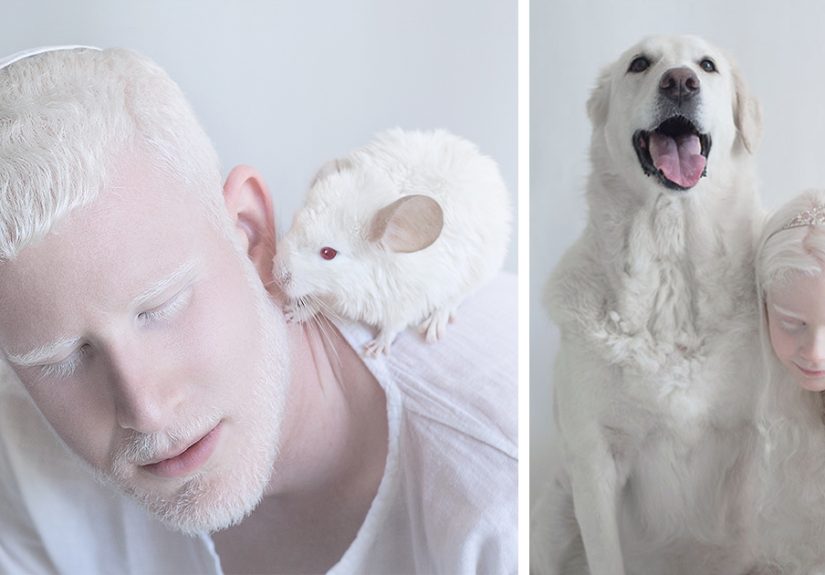
Let’s be honest: portraits of people with albinism can be unforgettable. The contrast between skin, hair, eyes, clothing, and background can look almost surreal. Eyelashes may read like fine brushstrokes. Irises can appear icy, translucent, violet-tinged, or storm-gray depending on the lighting. Hair can glow rather than merely shine. A freckle, a shadow line, or the texture of a lip suddenly becomes a major event. It is visual poetry, but it is also real life.
That is why the best portraits do not chase “otherness.” They pay attention to detail. They let texture, expression, posture, and personality do the heavy lifting. A strong image of a person with albinism is not powerful because the subject looks unreal. It is powerful because the subject looks undeniably human, and the viewer has to sit with that humanity instead of hiding behind stereotypes.
In that sense, the hypnotizing beauty people talk about is not just pigment or color. It is clarity. When the usual visual assumptions fall away, you start noticing things that should have mattered all along: confidence, tension, humor, warmth, posture, attitude, vulnerability. The portrait becomes less about surface difference and more about presence.
What the camera doesn’t show right away
A photograph can make beauty obvious. It can also make daily realities invisible.
Many people with albinism live with low vision or other eye-related challenges because melanin is involved in eye development. They may experience photophobia, or sensitivity to bright light. Some have nystagmus, which causes the eyes to move involuntarily. Others may have strabismus, reduced depth perception, or blurry distance vision that is not fully corrected with standard glasses. None of this makes them fragile. It just means the world may need a few adjustments, and good design, education, and accessibility should stop acting like those are outrageous demands.
This is also why sunglasses, hats, strategic lighting, tinted lenses, seating choices, magnification tools, large print, and low-vision supports can matter so much. What looks like a style choice in a portrait session might actually be a practical tool. A shady location might not just be artistically moody. It might be more comfortable. A subject turning slightly away from harsh noon light is not being difficult. They are being sensible, which is more than I can say for photographers who still think “just squint less” is useful direction.
Sun protection is not optional
Because melanin helps protect skin from ultraviolet damage, sun protection for people with albinism is a serious health issue, not just a beauty tip dressed up as wellness. Long-term sun exposure can raise the risk of sunburn, skin damage, and skin cancer. That is why experts consistently recommend a layered approach: broad-spectrum sunscreen, protective clothing, wide-brimmed hats, sunglasses, and shade whenever possible.
If you are photographing someone with albinism outdoors, this matters. Bring breaks. Offer shade. Plan around softer light. Use reflectors carefully instead of trying to recreate the surface temperature of Mercury. Keep water nearby. Think about timing. Early morning and late afternoon are not just flattering for a camera sensor; they are also kinder to skin and eyes.
And if you are writing about people with albinism rather than photographing them, remember this too: their beauty should never be described as though it exists apart from the practical care their bodies may require. A stunning portrait and a bottle of sunscreen can belong in the same sentence. In fact, they probably should.
The difference between admiration and objectification
This is where a lot of writing on the topic goes off the rails. It starts with admiration, then crashes straight into exoticizing language. Suddenly the subject is “ethereal,” “alien,” “ghostly,” or “otherworldly,” as though the only way to praise a person with albinism is to remove them from the human category entirely. That is lazy writing. It is also exhausting for the people on the receiving end of it.
Respectful storytelling asks different questions. What does this person want the viewer to notice first? How do they want to be styled? What parts of their life matter beyond the image? Are they a dancer, a college student, a parent, a software designer, a teenager who loves horror movies, a woman who prefers bold lipstick, a man who has spent years learning how to move through bright light, a kid who is tired of being treated like a biology exhibit?
Beauty becomes more interesting when it is connected to agency. A good portrait is not “Look how unusual this person is.” A great portrait is “Look how fully this person occupies the frame.”
How representation changed the conversation
One reason this topic now feels richer than it did a generation ago is that advocates, photographers, and organizations have pushed back against flat, dehumanizing imagery. Groups in the albinism community have long emphasized person-first language and real-world support. At the same time, projects centered on portraiture and representation have challenged the old medicalized, clinical, or sensational ways people with albinism were often shown.
That shift matters. When images move from textbook specimen vibes to fully realized portraiture, something changes in the viewer. The subject is no longer reduced to pigment, or lack of it. They become stylish, funny, direct, complicated, expressive, stubborn, glamorous, thoughtful, intense, or relaxed. In other words, they get to be people. Revolutionary stuff, apparently.
Representation also matters for children with albinism. Seeing people who look like you portrayed as confident, competent, and beautiful is not a small thing. It can shape identity, self-esteem, and possibility. Adults with albinism often talk about the importance of community, advocacy, and low-vision resources. Images that reflect dignity instead of distortion can become part of that support system.
How to photograph people with albinism respectfully
Start with conversation, not assumptions
Ask about comfort with bright light, preferred angles, styling choices, and whether the subject wears glasses, tinted lenses, hats, or sunscreen during the session. None of this ruins the art. It makes the art better.
Let the subject shape the story
Some people may want soft, airy portraits. Others may want drama, contrast, streetwear, sharp tailoring, rich jewel tones, or full editorial glam. Do not assume every person with albinism wants to be photographed like a woodland spirit who wandered into a linen catalog.
Use light like a collaborator
Diffuse light is often gentler and more flattering. Indoor window light, open shade, cloudy skies, or carefully controlled studio light can help avoid discomfort while preserving texture and dimension. Harsh midday light may wash out detail and strain the subject’s eyes.
Style with intention
Monochrome can be stunning, but so can saturated color. Emerald, cobalt, rust, burgundy, navy, lilac, black, cream, and metallics can all work beautifully depending on skin tone, hair tone, and the mood of the portrait. The goal is not to make the person look “more normal.” The goal is to create a visual language that feels true to them.
Write captions like a grown-up
Caption the person, not the condition. Mention albinism when it is relevant, but do not let it be the entire biography. “Portrait of Maya, a Chicago-based illustrator who has albinism” is far better than treating albinism as the whole identity package.
Beauty, yes. But also skill, adaptation, and everyday brilliance
One of the most misleading myths about albinism is that it makes people passive or dependent. In reality, many people with albinism develop highly practical ways of navigating light, text size, distance, classrooms, roads, public spaces, cameras, and screens. Some use magnification tools. Some advocate for school accommodations. Some use bioptic devices. Some become experts at reading environments in ways the rest of us barely notice.
That adaptability deserves attention too. It is part of the beauty story. Not because struggle is romantic, but because competence is attractive. The person in the portrait is not only beautiful because their lashes catch the light. They are beautiful because they know exactly how to live in their body, advocate for their needs, and move through a world that often misunderstands them.
Behind the lens: on the experience of capturing this beauty
The experience of photographing people with albinism changed the way I look at faces, and honestly, it changed the way I look at attention itself. At first, I thought the challenge would be technical. I assumed I would need to think about exposure, soft shadows, color balance, glare, and how to keep pale features from disappearing into the frame. That part was real, of course. But the bigger challenge was learning to slow down enough to see the person before seeing the condition.
When someone walks into a portrait session carrying a history of being stared at, mislabeled, or treated like a curiosity, the camera enters a room with baggage. You can feel it. There is often a brief pause at the beginning, a quiet calibration. Is this going to be another session where I am turned into an aesthetic object? Another situation where someone says “wow” before they say hello? Or is this going to be collaboration? Once trust begins to form, everything changes.
I started noticing how often confidence arrives in small gestures. The slight lift of a chin. The way someone chooses their sunglasses. A laugh after a conversation about bad movie stereotypes. The moment a subject says, “Actually, I want a darker backdrop,” or “Can we move out of this light?” Those details tell me far more than any dramatic close-up ever could. Beauty becomes less about surface perfection and more about self-possession.
Some of the most striking moments happened between poses. A hand adjusting a hat. A pause while sunscreen was reapplied. A glance away from bright light followed by a grin when the subject stepped back into a more comfortable shadow. Those moments reminded me that the image should never demand more from the person than the person wants to give. The best portraits were not forced. They were negotiated with respect.
I also learned how quickly viewers project stories onto faces they do not understand. People see pale lashes, translucent brows, light eyes, and silvery hair, and they rush to turn a human being into symbolism. Angelic. Strange. Ethereal. Mysterious. But when you spend real time with people with albinism, those clichés fall apart. The so-called mystery usually turns out to be something much better: humor, intelligence, directness, style, impatience, tenderness, and a very sharp radar for nonsense.
That is why I no longer think the real beauty here is simply visual, even though it is undeniably visual. The real beauty is the correction. A portrait can interrupt a stereotype in a fraction of a second. It can say, without preaching, that this face deserves dignity, fashion, complexity, and center stage. It can replace gawking with attention, and curiosity with respect. That feels more powerful than any perfect camera setting.
In the end, what stayed with me most was not the brightness of the hair or the unusual color of the eyes. It was the feeling that every strong portrait had the same message underneath it: I am here, I know exactly who I am, and you are finally seeing me clearly.
Conclusion
The hypnotizing beauty of people with albinism is real, but it is not magic trick beauty. It is not beauty that exists for spectators alone. It lives in the meeting point between light, genetics, visibility, confidence, adaptation, and representation. Yes, the visual details are remarkable. Yes, portraits can look almost cinematic. But the deeper truth is better than spectacle: people with albinism are compelling not because they are “other,” but because they reveal just how narrow our old ideas of beauty were in the first place.
A great portrait does not merely capture pale lashes or luminous skin. It captures dignity. It captures comfort. It captures style with context, beauty with reality, and individuality without reducing someone to a label. That is the difference between gawking and seeing. And once you understand that difference, you do not just take a better picture. You tell a better story.