Table of Contents >> Show >> Hide
- Quick Jump
- Why Fictional Bands Hit So Hard
- The Raddest Fictional Bands
- 1) Spinal Tap (This Is Spinal Tap)
- 2) The Wonders (That Thing You Do!)
- 3) Stillwater (Almost Famous)
- 4) The Blues Brothers (The Blues Brothers)
- 5) Josie and the Pussycats (Josie and the Pussycats)
- 6) Sex Bob-omb (Scott Pilgrim vs. the World)
- 7) The Soggy Bottom Boys (O Brother, Where Art Thou?)
- 8) Daisy Jones & the Six (Daisy Jones & the Six)
- The Lamest (But Lovably So) Fictional Bands
- Conclusion: Fake Bands, Real Feelings
- Extra: of Fictional-Band “Experience” (a.k.a. How These Bands Sneak Into Real Life)
- SEO Tags
Real bands fight over van space, drum mics, and who “borrowed” the last clean T-shirt. Fictional bands fight over… destiny, demons, and whether their
guitarist is a literal golden god. And somehow, the made-up ones still end up living rent-free in our brainsbecause when a movie or TV show nails a band,
it’s not just background noise. It’s world-building with a backbeat.
Below are 14 fictional bandssome legitimately great, some magnificently cringethat prove a simple truth: if the songs slap (or hilariously flop), we’ll
follow the tour bus anywhere.
Why Fictional Bands Hit So Hard
The best fictional bands don’t feel like a prop. They feel like a band with historyinside jokes, bruised egos, one perfect single, and at least one
questionable wardrobe era. Great “fake bands” also solve a tricky problem: they must sound believable and tell a story. Sometimes the story is
“we’re about to change music forever.” Sometimes it’s “we wrote a tribute song to a tiny horse and now we’re crying again.”
SEO bonus for your brain: when people search “best fictional bands,” they’re usually hunting for movie bands and TV bands
with real songstracks you can actually stream, quote, and annoy your friends with at group hangouts. (You know who you are.)
The Raddest Fictional Bands
1) Spinal Tap (This Is Spinal Tap)
The Mount Rushmore of fictional rock bands. Spinal Tap is what happens when heavy metal bravado meets human chaos and losesbeautifully. They’re absurd
(Stonehenge “set design” tragedy), but also weirdly legit: the riffs are crunchy, the harmonies hit, and the satire is so accurate it doubles as a
documentary for anyone who has ever loaded gear at 2 a.m.
Rad/Lame Meter: 11/10 rad, because the amp goes to 11. Best in-universe moment: “Big Bottom” turns bass into a lifestyle choice.
2) The Wonders (That Thing You Do!)
The Wonders are the perfect one-hit-wonder fantasy: one lightning-bolt song, one matching-suits phase, and one drummer who looks like he’s about to
transcend. “That Thing You Do!” is the kind of pop-rock rocket that makes you believe in radio, summer, and the power of a well-timed snare fill.
They’re the platonic ideal of “movie band that sounds real.”
Rad/Lame Meter: rad enough to get stuck in your head for 48 hours. Best track: “That Thing You Do!” (obviously), with “All My Only Dreams” as a strong B-side flex.
3) Stillwater (Almost Famous)
Stillwater isn’t just a band; it’s an entire 1970s rock ecosystemgroupies, drama, rolling suitcases, and myth-making. Their songs (especially “Fever Dog”)
feel like they crawled out of a smoky arena and immediately asked you for a cigarette and a second chance. The genius is that they sound like a band with
a catalog you haven’t heard yet… but somehow already miss.
Rad/Lame Meter: rad with a side of emotional damage. Signature track: “Fever Dog.” Best vibe: backstage tension you can practically tune to.
4) The Blues Brothers (The Blues Brothers)
Jake and Elwood Blues started as characters and accidentally became a real musical institution. The band is stacked with actual talent, and the mission is
simple: play classic R&B and soul like your rent depends on it (because it does). Their performances are joyful, loud, and blessedly free of irony
which is hilarious, considering everything else about them is a joke delivered in deadpan sunglasses.
Rad/Lame Meter: rad in a “respect the elders” way. Setlist staples: “Soul Man,” “Everybody Needs Somebody to Love,” and enough horn lines to wake three neighborhoods.
5) Josie and the Pussycats (Josie and the Pussycats)
This band didn’t just fake it; it manufactured pop perfection on purpose. The movie is a satire about the music industry, and the soundtrack is
unreasonably goodbig choruses, sharp hooks, and glossy angst that still holds up. It’s the rare fictional band where the “sellout” storyline is happening
on-screen while the songs quietly win in real life.
Rad/Lame Meter: rad with a wink. Best tracks: “3 Small Words” and “Pretend to Be Nice.” Best achievement: making bubblegum feel like a weapon.
6) Sex Bob-omb (Scott Pilgrim vs. the World)
Sex Bob-omb sounds like a garage band that practices in a freezing basement because the landlord “doesn’t believe in heat.” The songs are short, loud,
and charmingly messyexactly what you’d want from a band whose members are also trying to survive emotional boss battles. It’s punky, fuzzy, and somehow
tender underneath the distortion.
Rad/Lame Meter: rad in the “I can’t hear but I’m happy” sense. Best tracks: “Garbage Truck” and “We Are Sex Bob-omb.” Best feature: the music feels like the plot.
7) The Soggy Bottom Boys (O Brother, Where Art Thou?)
A fictional bluegrass group that accidentally sparked a very real obsession with old-time music? That’s power. The Soggy Bottom Boys’ “I Am a Man of
Constant Sorrow” works because it’s not trying to be cuteit’s performed like a traditional song that’s been carried for generations. In the movie, it’s
a hit that changes their lives. Outside the movie, it changed a lot of playlists.
Rad/Lame Meter: rad, then spiritually cleansing. Best track: “I Am a Man of Constant Sorrow.” Best flex: making “banjo-core” feel mainstream.
8) Daisy Jones & the Six (Daisy Jones & the Six)
This is the modern high-water mark for “fictional band, real album.” The show treats the group like lost rock history, and the music follows through:
a believable ’70s-inspired sound, big emotions, and enough internal friction to power a small city. “Aurora” plays like a real record with real scars
which is the whole point.
Rad/Lame Meter: rad in a prestige-TV, “pass the vinyl” way. Best hook: the songs don’t feel like imitations; they feel like artifacts.
The Lamest (But Lovably So) Fictional Bands
“Lame” is said with affection here. These are the bands that make you laugh, cringe, and thenagainst your better judgmenthit replay. They’re the reason
“worst fictional bands” lists always turn into “why do I know all the words?” lists.
9) Mouse Rat (Parks and Recreation)
Mouse Rat is what happens when pure enthusiasm forms a band before talent arrives. Their catalog is a chaotic scrapbook of genre experiments, questionable
name changes, and sincere bopsnone more iconic than the farewell anthem “5,000 Candles in the Wind.” It’s goofy, but it’s also weirdly earnest, which
is why it works. The joke is the band… and also, the band is the heart.
Rad/Lame Meter: 60% lame, 40% inspirational. Best tracks: “The Pit” and “5,000 Candles in the Wind.” Best quality: commitment, even when the notes aren’t.
10) The Be Sharps (The Simpsons)
The Be Sharps are a barbershop quartet parodying the Beatles’ rise-and-fall arc, and they do it with the confidence of a group that just discovered
matching outfits. “Baby on Board” is their crowning achievement: part wholesome, part commercial jingle, part “why is this so catchy?” The show turns a
throwaway gag into a fully realized pop culture memoryand that’s basically Springfield’s entire brand.
Rad/Lame Meter: lame on paper, rad in execution. Best track: “Baby on Board.” Best effect: you’ll hum it while doing dishes and feel judged by yourself.
11) The Beets (Doug)
The Beets are a kid-friendly punk/garage band that somehow predicted how nostalgia would work: one absurd song becomes a lifelong earworm. “Killer Tofu”
is catchy in the way a commercial jingle is catchyexcept it’s also a banger, and you hate that you just admitted that. If your brain has ever yelled
“KILLER TOFU!” unprompted, congratulations: you have a classic case of cartoon-music excellence.
Rad/Lame Meter: delightfully lame, secretly rad. Best tracks: “Killer Tofu” and “I Need More Allowance.” Best era: peak ’90s TV-band chaos.
12) 2gether (MTV’s 2gether)
2gether is the boy-band parody that understood the assignment: catchy enough to sound real, ridiculous enough to expose the formula. The songs are packed
with intentionally over-polished hooks (“U + Me = Us (Calculus)” is exactly as subtle as it sounds), and the whole project is basically Spinal Tap for the
TRL era. The result? A band that’s “lame” by design… and therefore extremely effective.
Rad/Lame Meter: aggressively lame (compliment). Best tracks: “U + Me = Us (Calculus),” “Say It (Don’t Spray It),” and the immortal “The Hardest Part of Breaking Up (Is Getting Back Your Stuff).”
13) Steel Dragon (Rock Star)
Steel Dragon is peak hair-metal fantasy: big hair, bigger choruses, and a level of confidence that should legally require a permit. The band is “lame” in
the same way a power ballad is “lame”meaning you roll your eyes, then you’re suddenly singing at full volume in traffic. Their songs (“We All Die Young,”
“Stand Up and Shout”) commit so hard to the era that it becomes weirdly charming.
Rad/Lame Meter: 80s-lame in the most enjoyable way. Best tracks: “We All Die Young” and “Stand Up and Shout.” Best feature: pure arena-sized melodrama.
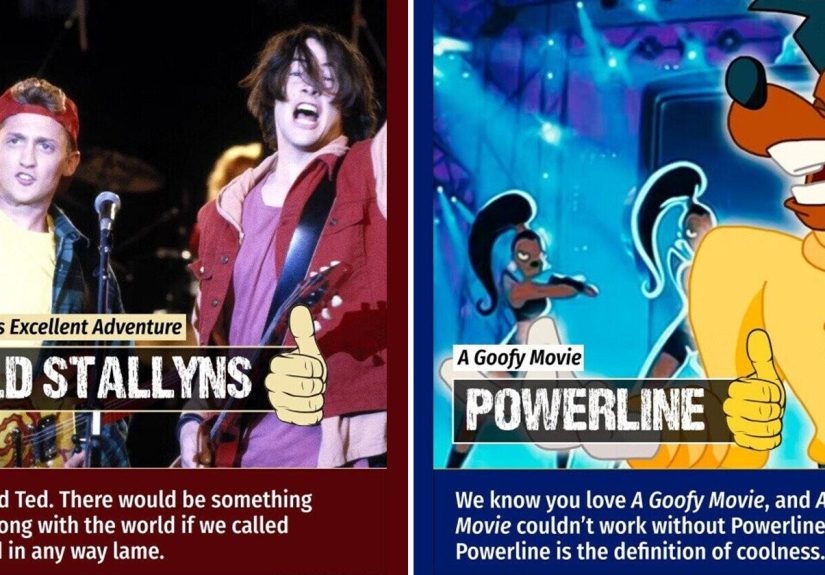
14) Wyld Stallyns (Bill & Ted)
Wyld Stallyns are the ultimate “trust the process” band: they’re not great now, but someday they’ll write the song that unites humanity. That’s either
inspiring or the most optimistic band bio ever written, depending on how your last open mic went. The franchise treats music like a cosmic force, and
Wyld Stallyns are the messy mortal vessel trying to hold it. Air guitars were harmed in the making of this legend.
Rad/Lame Meter: spiritual radness trapped in comedic lameness. Best moment: the unwavering belief that rock can literally save the world.
Conclusion: Fake Bands, Real Feelings
The best fictional bands don’t just mimic musicthey mimic music culture: the dreams, the delusions, the dumb arguments, and the one perfect song
that makes everything feel possible for three minutes. Whether you’re building a playlist of the best fictional bands or hunting the
world’s most lovable “worst” fake bands, the fun is the same: these artists never existed, yet their hooks still do.
And maybe that’s the magic. A fictional band is a reminder that music is a story machinesometimes it tells you who the characters are, and sometimes it
tells you who you are when nobody’s watching and the chorus hits.
Extra: of Fictional-Band “Experience” (a.k.a. How These Bands Sneak Into Real Life)
There’s a special kind of moment that only fictional bands can create: the instant you realize you’re emotionally invested in an artist who does not, in
fact, exist. It usually starts harmlessly. You watch a movie, you hear one track, you think, “That’s better than it needed to be,” and then you’re
suddenly searching for the soundtrack like it’s a lost classic. Congratulationsyou’ve been drafted into the fake-band fandom.
The “experience” often looks the same across generations. Someone hears The Wonders and immediately wants to start a garage band, even if the only
available instrument is a slightly haunted acoustic guitar from a relative’s closet. Someone else hears “Fever Dog” and begins talking like they’ve spent
time backstage in 1973, despite being born during the iPhone era. Another person swears “Baby on Board” is a real song from their childhood, which is true
in the only way pop culture can make something true: you remember it, so it counts.
Fictional bands also have a sneaky superpower: they make you feel like you’re in on a secret. When you queue up Sex Bob-omb, it’s not just musicit’s a
tiny portal back to neon fights, awkward romance, and the adrenaline of a perfectly timed drum crash. When you play Josie and the Pussycats, you’re not
merely listening; you’re reenacting a satire about fame while enjoying a soundtrack that refuses to be “just a joke.” That contradiction is part of the
pleasure. The music doesn’t wink at you from across the room; it grabs your sleeve and drags you onto the dance floor.
Then there’s the communal side. Fictional bands are incredible conversation starters because they’re safe, fun arguments. Nobody gets mad if you claim
Steel Dragon is “objectively great” (they’ll just laugh, then ask you to sing the chorus). Nobody files a formal complaint if you admit you know every word
to a 2gether song (they’ll simply judge you forever, which is traditional). And when someone drops “5,000 Candles in the Wind” at karaoke, the room does
something beautiful: it becomes a tiny, temporary fan club.
Finally, fictional bands are a reminder that good songwriting is good songwritingno matter where it appears. The medium can be a mockumentary, a prestige
series, a cartoon, or a sitcom, but the goal is the same: make the audience believe. When it works, you don’t just remember the scene. You remember the
band. And at some point, you catch yourself thinking, “I should’ve seen them live,” before your brain quietly adds, “…if that were possible.”