Table of Contents >> Show >> Hide
- Why “pro organizer” storage works when random bins don’t
- How to shop Amazon like a professional organizer
- 17 genius Amazon storage solutions pro organizers use
- Bluetooth label maker (handheld)
- Clear pantry bins with handles (stackable)
- Modular clear drawer organizer trays
- Expandable bamboo drawer dividers
- Acrylic shelf dividers
- Lazy Susans (turntables) for cabinets and the fridge
- Two-tier under-sink pull-out organizers
- Stackable lidded fabric bins (closet-friendly)
- Over-the-door pocket organizer (the “anything” organizer)
- Hanging closet rod extender (double-hang helper)
- Vacuum storage bags for bulky textiles
- Under-bed rolling bins (or low-profile lidded containers)
- Bed risers (when you need more under-bed space)
- Three-tier rolling utility cart
- Vertical file organizer / magazine holders
- Food container lid organizer (adjustable)
- Cable management kit: cord box + clips + ties
- Where people go wrong (and how pros avoid it)
- Experience: what it feels like when these systems actually stick (extra 500+ words)
- Conclusion: build a system, not a showroom
If your home has “mystery drawers,” a closet that eats hangers, or a pantry where snacks go to disappear,
you don’t need more willpoweryou need better systems. Professional organizers love Amazon because it’s
basically a convenience store for containers, dividers, and “why didn’t I buy this sooner?” tools.
The trick is knowing what actually works (and what becomes future clutter).
Below are 17 pro-approved, Amazon-easy storage solutions that help you create a home where things have a
place, stay in that place, and can be found without launching a full-scale archaeological dig.
Why “pro organizer” storage works when random bins don’t
Professional organizers aren’t secretly more organized humans. They just build systems that reduce friction:
you can see what you own, grab it easily, and put it back without negotiating with your future self.
Most pro-style systems follow the same logic:
- Group like with like (so you’re not storing scissors in three different ZIP codes).
- Contain categories with bins, dividers, and trays so items don’t migrate.
- Go vertical using risers, racks, and stacking to unlock “lost” space.
- Label so everyone in the home can maintain the system (including sleepy-you).
- Use modular pieces so your storage can change as your life changes.
Translation: the best Amazon organizers don’t just look tidy. They make tidy the default setting.
How to shop Amazon like a professional organizer
Before you add 47 items to your cart and call it “a fresh start,” use this quick pro checklist:
- Measure first. Cabinets, drawers, shelves, and the height between shelvesespecially under sinks.
- Choose clear when visibility matters. If you can’t see it, you’ll buy it again.
- Choose opaque when calm matters. For visual clutter (kids’ toys, cords), hiding can be sanity-saving.
- Pick a repeatable system. Buying one random bin is easy. Maintaining seven different bin “genres” is not.
- Start with one pain point. One drawer, one shelf, one cabinet. Win small. Then scale.
17 genius Amazon storage solutions pro organizers use
-
Bluetooth label maker (handheld)
A label maker is the difference between “organized” and “organized for 48 hours.” Pros love Bluetooth models
because you can create labels on your phone, print on the spot, and keep the system consistent across rooms.
Label bins from the front and the topespecially for high shelvesso you can identify items without
playing cabinet limbo.Best for: pantries, toy bins, file boxes, storage totes, fridge zones.
-
Clear pantry bins with handles (stackable)
Clear bins aren’t just prettythey’re category boundaries. Pros use handled bins to create “zones” like
snacks, baking, breakfast, and sauces. The handle matters because it turns a deep shelf into a pull-out
drawer: slide, grab, done.Best for: pantry shelves, fridge shelves, deep cabinets.
-
Modular clear drawer organizer trays
Junk drawers don’t need judgment; they need compartments. Modular trays let you build a custom layout for
batteries, scissors, tape, hair ties, and the mysterious Allen key you’ll need exactly once in 2028.
Pros like modular sets because they waste less space than one chunky organizer.Best for: kitchen drawers, vanity drawers, office drawers.
-
Expandable bamboo drawer dividers
Drawer dividers are the quiet heroes of daily life. Adjustable bamboo dividers keep stacks of tees, socks,
utensils, or workout gear from collapsing into a fabric avalanche. Pros love expandables because the same
set can work in a dresser today and a kitchen drawer tomorrow.Best for: dressers, kitchen drawers, linen closets.
-
Acrylic shelf dividers
Shelf dividers create “lanes” so stacks stop leaning into each other like they’re at a crowded concert.
Pros use them for sweaters, jeans, towels, and sheetsanything that turns into a slouchy pile by day three.
Clear acrylic keeps the look light and makes it easy to see what you have.Best for: closets, linen closets, nursery shelves.
-
Lazy Susans (turntables) for cabinets and the fridge
If you’ve ever knocked over six condiments to reach one, you’ve met the Lazy Susan use case. Pros use
turntables to keep small items reachablespices, oils, vitamins, sauce packets, skincare, you name it.
Some models even include removable bins so you can lift out a whole category at once.Best for: corner cabinets, pantries, fridges, bathroom cabinets.
-
Two-tier under-sink pull-out organizers
Under-sink spaces are awkward (pipes! moisture! chaos!), so pros love organizers that slide out and use
vertical space. Look for rust-resistant materials, smooth-glide drawers, and adjustable configurations to
work around plumbing. This instantly upgrades cleaning-supply storage from “pile” to “system.”Best for: kitchen and bathroom sinks, utility closets.
-
Stackable lidded fabric bins (closet-friendly)
Fabric bins are pro favorites when you want a softer look than plasticespecially in closets and bedrooms.
Lids help with dust and visual clutter, while stacking helps you take advantage of vertical space.
Use one bin = one category (scarves, hats, swimwear, cables, holiday napkins).Best for: closets, open shelving, kids’ rooms.
-
Over-the-door pocket organizer (the “anything” organizer)
Professional organizers love using over-the-door pocket organizers far beyond shoes: cleaning supplies,
hair tools, snacks, craft supplies, sunscreen, small toys, socks, dog gear, even foil and wraps in a pantry.
It’s storage that steals “unused” door space and gives every item a visible home.Best for: pantries, bathrooms, kids’ rooms, laundry rooms.
-
Hanging closet rod extender (double-hang helper)
If your closet has a sad empty void beneath hanging shirts, a rod extender can double your hanging space.
Pros use these for kids’ clothes, shirts, folded-over pants hangers, and seasonal items. The key is to
keep categories simple: one rod for “wear weekly,” the other for “wear sometimes.”Best for: small closets, kids’ closets, rentals.
-
Vacuum storage bags for bulky textiles
Comforters, winter coats, extra pillowssoft goods are space hogs. Vacuum storage bags shrink volume fast,
which is why pros recommend them for seasonal storage. The pro move: label the bag and store it
in a designated zone (under bed, top shelf, or a single “seasonal” tote) so it doesn’t become “mystery plastic.”Best for: bedding, winter gear, guest-room linens.
-
Under-bed rolling bins (or low-profile lidded containers)
Under-bed storage is prime real estateif you can access it easily. Pros like rolling bins for seasonal
clothes, shoes, gift wrap, and memory boxes. Choose low-profile containers that glide smoothly and
don’t require you to perform yoga just to retrieve a sweatshirt.Best for: bedrooms, dorm rooms, small homes.
-
Bed risers (when you need more under-bed space)
If your bed frame barely leaves room for a sheet of paper, risers can create usable storage space.
Pros use them carefully: stability first, and only when it won’t make the bed feel like it’s on stilts.
Pair risers with matching bins to keep the area looking intentionalnot like a storage unit with a duvet.Best for: small bedrooms, shared spaces, apartments.
-
Three-tier rolling utility cart
Rolling carts are the Swiss Army knife of organizing. Pros use them as coffee stations, craft carts,
homework hubs, skincare stations, bar carts, and “moving command centers” during home projects.
The wheels matter because you can tuck it away, roll it out, and keep surfaces clear.Best for: kitchens, bathrooms, offices, craft rooms.
-
Vertical file organizer / magazine holders
Vertical storage is a pro organizer love language. File organizers keep cutting boards, baking sheets,
foil boxes, mail, kids’ artwork, and manuals from turning into a leaning stack of stress. Think of it as
giving flat things a proper parking space.Best for: kitchens (bakeware), offices (paper), entryways (mail).
-
Food container lid organizer (adjustable)
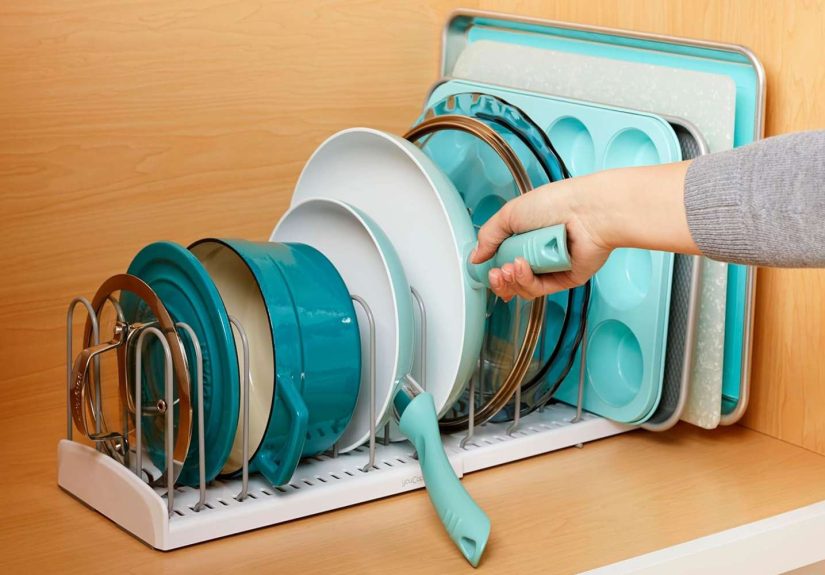
Lids are chaos with ambition. Pros love adjustable lid organizers because they keep lids upright, separated,
and easy to grab without triggering a plastic landslide. This is one of those “small fix, huge daily win”
upgradesespecially if you meal prep or store leftovers often.Best for: kitchen cabinets, deep drawers, pantry shelves.
-
Cable management kit: cord box + clips + ties
Cords multiply when you’re not looking. Pros use cable boxes to hide power strips, clips to route charging
cables where you actually use them, and reusable ties to keep extras contained. The goal isn’t perfection;
it’s “I can find the right cable without auditioning for a tech support job.”Best for: entertainment centers, desks, nightstands.
Where people go wrong (and how pros avoid it)
- Buying containers before decluttering: pros sort first, then buy what fits the keepers.
- Creating “misc” categories: one small “misc” bin is finesix means the system failed.
- Over-decanting: decant staples you use constantly; don’t decant a bag of quinoa you bought for your “new lifestyle.”
- Skipping labels: unlabeled bins become time capsules.
- Too many micro-categories: if it takes 12 steps to put something away, it won’t happen.
Experience: what it feels like when these systems actually stick (extra 500+ words)
The most common “after” story people share isn’t that their home suddenly looks like a catalog. It’s that their
home starts behaving differently. Mornings feel less frantic because the stuff you use every day stops playing
hide-and-seek. You don’t realize how much energy you spend searching until you stop doing it.
One of the biggest shifts happens in the kitchen. When clear bins create snack zones and a Lazy Susan makes
condiments reachable, you stop pulling everything out just to find one item. Instead of a messy cabinet that
gets worse every time you cook, you get a setup that naturally resets. People often describe this moment as
“I didn’t clean anythingI just stopped making new mess.” That’s exactly what pros aim for: a system that
reduces the mess-generating behavior in the first place.
Closets tend to be the next “wow” area. Shelf dividers and fabric bins make a closet feel calmer because the
visual noise drops. It’s not about owning less (though that can help). It’s about giving categories boundaries.
When sweaters have a lane and accessories have a bin, the closet stops being a free-for-all. The most practical
benefit people report is speed: you can get dressed faster because you can see what you have and put your hands
on it quickly. The emotional benefit is sneakier: you open the door and don’t feel like the closet is judging you.
Drawer organization is where people often become believers. Modular trays and expandable dividers don’t just
make drawers look neat; they prevent “drawer drift.” Without compartments, items slide around and piles form.
With compartments, everything has a home, and you can tell at a glance what’s missing. People frequently notice
that they buy fewer duplicates because they can actually find what they already ownbatteries, tape, hair ties,
the good scissors. The savings are small at first, then surprisingly real over time.
Under-sink pull-out organizers can feel like a minor upgrade until you use them for a week. The experience is
less “wow, pretty” and more “wow, this is functional.” Cleaning supplies stop getting lost behind pipes. You
don’t have to kneel, reach, and hope. Instead, you pull out a drawer and everything is right there. People also
tend to clean more consistentlynot because they became a new person, but because the supplies are accessible.
When access is easy, habits follow.
The place where systems fail most often is labeling and maintenance. People get excited, organize, and then
forget the last step: making it easy for everyone in the home to keep it going. A label maker helps because it
turns your system into shared language. When a bin says “Baking,” nobody has to guess where flour belongs.
If a bin says “Batteries + Tape,” it’s easier to put things back than to abandon them on the counter. The
best part? Labels reduce those tiny daily decisions that quietly drain attention.
Finally, many people describe a surprising side effect: confidence. Once you successfully organize one drawer
or one shelf with the right Amazon tools, the project stops feeling impossible. You start to trust yourself to
create systems that work. The goal isn’t a perfect home. It’s a home that supports your real lifebusy days,
tired nights, kids, pets, hobbies, and all. And when the system is built well, you don’t have to “try” to be
organized. You just live in a space that makes organization the easy option.
Conclusion: build a system, not a showroom
The best Amazon storage solutions aren’t magic. They’re tools that help you set boundaries for your stuff:
bins to contain categories, dividers to prevent drift, turntables to reclaim deep spaces, and labels to keep
the whole thing running without constant effort.
Start with one problem area, pick a few proven organizers from the list above, and build a system that matches
how you actually live. If it’s easy to use, it’ll last. If it’s annoying, it won’tno matter how cute the bin is.