Table of Contents >> Show >> Hide
- Why SEO pros quit (and why it’s rarely “they just wanted a new challenge”)
- 1) Build a real SEO career ladder (not “Junior → Overworked → Gone”)
- 2) Pay competitivelyand be transparent about it
- 3) Give autonomy with guardrails (because micromanaging SEO is a sport nobody enjoys)
- 4) Invest in learning: budget, time, and permission to experiment
- 5) Burnout-proof the role (because Google updates don’t care about your weekend plans)
- 6) Give SEOs the resources to win (tools, access, and cross-team commitment)
- 7) Recognition that isn’t cringe (and is actually timely)
- 8) Build a culture that keeps smart people curious (psychological safety + purpose)
- How to measure whether your SEO retention strategy is working
- A 30-day retention playbook for SEO leaders (steal this)
- FAQ
- Final thoughts
- Experience Notes from the SEO Trenches (the “this is why people really stay” section)
SEO people are a special breed. They can stare at a Search Console chart for 30 minutes and still be the calm one in the room. They can explain canonical tags to a room full of executives without crying (usually). And they can read a Google update announcement like it’s a suspense novel and still show up to your 9 a.m. standup.
Which is exactly why losing your best SEO talent hurts. Not just because recruiting takes forever, onboarding takes longer, and your backlog starts breeding like rabbitsbut because SEO is cumulative. Every month someone stays, they learn your site’s weird edge cases, your CMS quirks, your “why is this subdomain even here?” history, and the internal politics required to ship a simple title tag change. When they leave, that knowledge doesn’t get replaced by a job post and vibes.
This article breaks down eight practical, SEO-specific retention strategieswritten in the spirit of Moz: useful, grounded, and slightly allergic to corporate fluff. You’ll get what to do, why it works, and concrete examples you can steal without stealing anyone’s soul. (Because retention shouldn’t require interpretive dance or a pizza party that arrives cold.)
Why SEO pros quit (and why it’s rarely “they just wanted a new challenge”)
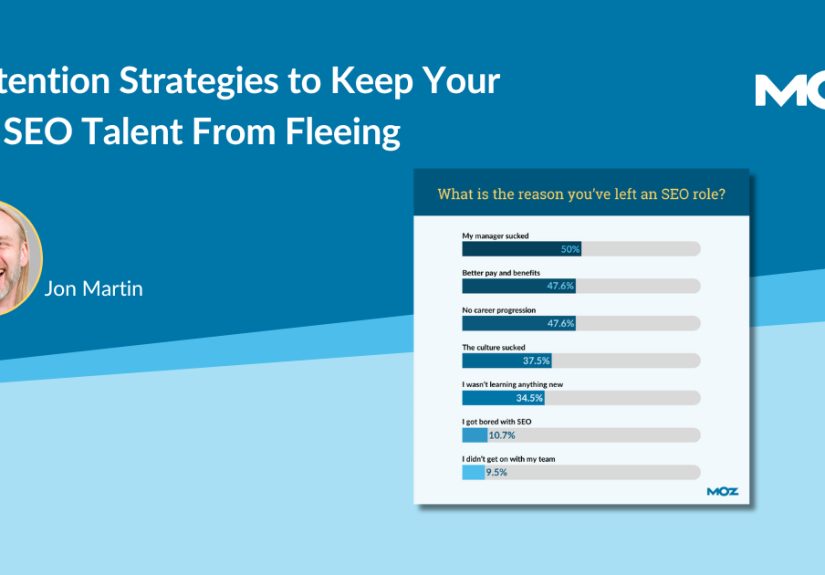
People leave SEO roles for the same big reasons they leave other rolespay, growth, burnout, bad managementbut SEO adds a few spicy extras: algorithm volatility, cross-team dependency, and being blamed for traffic drops caused by a site migration nobody told them about. Search is never “done,” which means your best SEOs can end up living in a permanent state of sprinting.
And turnover is expensive. Research often cited in management literature estimates replacing an employee costs about 21% of their annual pay on averagebefore you account for lost momentum and institutional knowledge. If you’re running an agency, add the extra cost of client churn when an account loses the strategist who understood the business. Suddenly, “retention” isn’t a soft HR word; it’s margin protection.
The good news: most retention problems are fixable with systems, not speeches. Let’s build the kind of SEO team that doesn’t treat LinkedIn like a dating app.
1) Build a real SEO career ladder (not “Junior → Overworked → Gone”)
One of the fastest ways to lose a strong SEO is to make their future feel foggy. If growth equals “wait until someone quits,” you’ve already lost. Strong SEOs want a path that rewards depth (technical expertise, content strategy mastery, data/analytics fluency) and leadership (mentoring, cross-functional influence, roadmap ownership).
What to do
- Create level expectations (SEO Specialist, Senior, Lead, Manager, Head of SEO) with clear competency areas: technical, content, links/PR, analytics, stakeholder management.
- Offer dual tracks: Individual Contributor (principal/strategist) and People Leadership (manager/director).
- Write promotion criteria tied to behaviors and impactnot “years of experience” or “being loud in meetings.”
SEO-specific example
A “Senior SEO” at your org might be expected to lead a technical audit program, partner with engineering on prioritization, and design an experimentation cadence (templates, internal linking, structured data). A “Lead SEO” might own a category strategy end-to-end and coach others. When people can see the ladder, they stop climbing out the window.
2) Pay competitivelyand be transparent about it
Compensation isn’t the only reason people leave, but underpaying is the fastest way to make every other problem feel personal. SEO is a specialized, high-impact skill set, and the market signals that. Industry reporting has cited a median salary around $82,000 across open SEO positions in recent job-market analyses, and specialized leadership roles can climb far higher. If your comp bands are stuck in 2018, your retention strategy is basically “hope.”
What to do
- Benchmark pay by level and region, and update bands at least annually.
- Publish salary ranges internally (yes, really). Transparency reduces “mystery resentment.”
- Reward impact with bonuses tied to outcomes SEOs influence (qualified organic leads, revenue contribution, retention of key pages during migrations).
- Support remote/hybrid costs with stipends for home office setup and collaboration travel where relevant.
SEO-specific example
If you’re an agency, consider a retention bonus for strategists who maintain client satisfaction and renewals across a full year not as a bribe, but as recognition that relationship continuity is value. If you’re in-house, tie bonuses to measurable wins: lifting non-brand organic conversions, improving indexation health, or reducing dependency on paid spend through durable content growth.
3) Give autonomy with guardrails (because micromanaging SEO is a sport nobody enjoys)
SEO professionals thrive when they can think, test, and iterate. They struggle when every decision requires three approvals and a meeting called “SEO Sync (Final) (Final-2).” Modern management research has repeatedly highlighted that autonomy mattersa lot. People don’t just want flexibility; they want control over how they do great work.
What to do
- Set outcomes (what success looks like), then let SEOs choose methods (how to get there).
- Define non-negotiables (brand guidelines, legal constraints, accessibility requirements) so autonomy doesn’t turn into chaos.
- Trust the craft: if you hired an expert, let them be one.
SEO-specific example
Instead of “Rewrite these 40 title tags exactly like this,” try: “We need higher CTR on these templates. Propose an approach, run a structured test, and show results after two weeks.” You’ll keep your SEO’s brain switched onand people don’t quit jobs where their brain is invited.
4) Invest in learning: budget, time, and permission to experiment
SEO changes constantly. Your team’s skills don’t “stay current” by accident. If learning only happens on nights and weekends, you’re training your best people to associate your company with unpaid labor.
What to do
- Allocate a learning budget (courses, conferences, certifications, books).
- Schedule learning time into work hours (a real calendar block, not a motivational poster).
- Normalize experimentation with a lightweight testing framework: hypothesis → change → measurement → decision.
SEO-specific example
Create a monthly “SEO Lab Day” where the team runs one controlled experiment: internal linking modules, schema changes, content refresh workflows, or page-speed improvements. The key is not perfection; it’s momentum. SEOs stay where they grow.
5) Burnout-proof the role (because Google updates don’t care about your weekend plans)
Search marketing can burn people out: constant change, constant urgency, and a steady drip of “Why did traffic drop yesterday?” even when yesterday was Sunday. Industry commentary has long pointed to stagnation and burnout as real career hazards in search marketing. And SEOs themselves have talked about how nonstop updates can hit work-life balance.
What to do
- Set realistic expectations: SEO is compounding, not instant.
- Protect focus time: create “no-meeting” blocks for audits, analysis, and strategy work.
- Rotate incident response: if your team monitors updates closely, implement a rotation so one person isn’t always “on alert.”
- Respect boundaries: no after-hours pings unless the site is literally on fire (and “ranking dropped two spots” is not a fire).
SEO-specific example
When an algorithm update hits, don’t demand same-day answers. Demand a process: “Confirm tracking, segment the impact, review top affected templates, and return with hypotheses and next steps.” That approach reduces panicand teams don’t flee stable environments.
6) Give SEOs the resources to win (tools, access, and cross-team commitment)
SEO is cross-functional by nature. If your SEO team can diagnose issues but can’t get engineering time to fix them, you’re not running SEOyou’re running a reporting department.
What to do
- Fund the tool stack your team needs (crawlers, rank tracking, log analysis tools, content optimization, reporting).
- Grant data access: analytics, tag manager, CMS permissions, and visibility into release calendars.
- Create cross-functional agreements (SLAs or operating norms) with engineering, product, and content teams.
SEO-specific example
If the SEO roadmap requires development support, set a quarterly allocation: “10% of sprint capacity reserved for SEO technical debt.” That single policy can prevent months of frustrationand frustration is a top ingredient in resignation soup.
7) Recognition that isn’t cringe (and is actually timely)
SEO work is often invisible until it fails. That’s unfair and demoralizing. Recognition fixes thatwhen it’s specific and prompt. Longitudinal workplace research has found well-recognized employees are substantially less likely to leave over multi-year periods, and recent business coverage has described a “recognition recession” where delayed praise erodes loyalty.
What to do
- Recognize the work behind the win (process + impact): “Your internal-linking revamp lifted conversions 18% and reduced orphan pages by 40%.”
- Make it visible: share wins in company updates, not just in SEO Slack.
- Use “credit receipts”: short written notes that employees can keep and reference in performance reviews.
SEO-specific example
Celebrate “unsexy” victories: fixing index bloat, improving crawl efficiency, preventing a migration catastrophe, or cleaning up analytics so reporting is trustworthy. The fastest way to lose a technical SEO is to pretend technical wins don’t count.
8) Build a culture that keeps smart people curious (psychological safety + purpose)
Your best SEOs ask hard questions: “Why are we publishing this?” “Why does this template exist?” “Why are we shipping a redesign without redirects?” If questioning is punished, your smartest people go quietand then they go somewhere else.
Teams perform better when people feel safe taking interpersonal risks: raising concerns, challenging assumptions, and sharing ideas without being mocked. That’s psychological safety, and it matters for innovation-heavy work like SEO.
What to do
- Reward truth-telling: thank people for surfacing risks early.
- Run blameless retros after launches and traffic shifts: focus on systems, not scapegoats.
- Connect SEO to purpose: show how organic growth supports customers, not just charts.
SEO-specific example
If an SEO warns a migration plan is missing redirects, treat it as leadership: they’re protecting revenue. If you treat it as “being difficult,” you’re training them to stop caring. And people who stop caring start updating their resumes.
How to measure whether your SEO retention strategy is working
Retention isn’t just “nobody quit this quarter.” Track leading indicators and operational friction before it becomes turnover. Start with the basics: retention rate over a period is commonly calculated by dividing the number of employees who stayed by the number you started with, then multiplying by 100.
Practical retention scorecard for SEO teams
- Retention rate (quarterly and annually)
- Internal mobility (promotions, lateral growth into technical/content/data specialties)
- Workload signals (after-hours messages, weekend “emergencies,” PTO usage)
- Engagement pulse (clarity of expectations, resources, recognition, growth opportunities)
- Delivery health (engineering throughput on SEO tickets, content production velocity, migration readiness)
If you want one simple managerial habit that pays dividends: regular, meaningful one-on-ones focused on clarity, growth, and obstacles. People stay when they feel seen and supportednot when they get a motivational quote in all-hands.
A 30-day retention playbook for SEO leaders (steal this)
- Week 1: Ask your top SEOs what would make them leave. Then listen without negotiating.
- Week 2: Draft career levels and share them for feedback. Make growth visible.
- Week 3: Protect focus time: add no-meeting blocks and define an update-response process.
- Week 4: Fix one high-friction resource problem (tool access, permissions, engineering SLA, or reporting trust).
If you do nothing else, do this: remove one recurring pain point that makes your SEO team feel powerless. Powerlessness is the silent killer of retention.
FAQ
What’s the #1 reason SEO talent leaves?
It’s rarely one thing. The most common pattern is a mix: unclear growth path + under-resourcing + constant pressure. People can tolerate a hard job when it’s fair, supported, and meaningful. They don’t tolerate “hard, chaotic, and ignored.”
Do retention strategies differ for agency vs. in-house SEO?
Yes. Agencies need to protect people from account overload and churn stress, while building prestige and learning pathways. In-house teams need strong cross-functional alignment (engineering, product, editorial) so SEO isn’t stuck as “advice without power.” Both need competitive pay, autonomy, learning, and recognition.
How do I retain technical SEOs specifically?
Technical SEOs leave when they can’t ship. Give them engineering partnership, time to analyze logs and crawl data, and recognition for preventative work (indexation fixes, migration planning, performance improvements). Also: don’t make them spend half their week in meetings. They’re not decorative.
Final thoughts
The best retention strategy is not a perk. It’s a work environment where skilled SEO professionals can do meaningful work, keep learning, and feel respectedwithout sacrificing their mental health to the Algorithm Gods. Build clear growth paths, pay fairly, protect focus time, invest in skills, and create a culture where truth-telling is safe. Your best SEO talent won’t just staythey’ll compound.
Experience Notes from the SEO Trenches (the “this is why people really stay” section)
In team after team, the retention story usually starts the same way: a great SEO joins, finds quick wins, and gets momentum. They fix indexation issues, streamline reporting, and create a content system that starts paying off. Then reality shows up: a redesign happens without redirects, engineering says “maybe next quarter,” and someone asks why rankings dipped after a cookie-consent banner slowed down page speed. The SEO stays calmbecause that’s what they dobut inside, they’re tallying how often they’re asked to own outcomes without being given authority.
The teams that keep their best SEOs don’t avoid problems; they handle them like adults. When a migration is coming, leadership brings SEO in early instead of as an afterthought. When an algorithm update lands, managers don’t demand instant certainty; they demand disciplined analysis. When cross-functional conflict pops up (“We want pop-ups everywhere!” vs. “Please don’t block the content!”), leaders resolve it with principles, not politics. Over time, that creates a feeling SEOs crave: stability without stagnation.
Another pattern: the highest-performing SEOs are often the most “invisible” because they prevent disasters. A clean internal linking structure, a well-managed canonicals strategy, a sane parameter handling setupnone of that produces confetti. But it prevents the slow leaks that kill growth. If you only praise the flashy wins (“We published 50 blogs!”) and ignore the infrastructure work, you’ll lose your technical backbone. The fix is simple: highlight preventative wins in leadership language. “This reduced crawl waste, improved indexation, and protected revenue.” When the org understands the value, the SEO stops feeling like a lone mechanic working under a moving bus.
And yesmoney matters. But the surprising retention unlock is often time. Time to think, time to test, time to learn, time to rest. SEOs who are always “on” start treating job interviews like a vacation. The most effective teams formalize focus: no-meeting blocks, documented processes for requests, and clear definitions of what counts as urgent. When you reduce randomization, you reduce anxiety. When you reduce anxiety, people stop fantasizing about quitting during every surprise Slack notification.
Finally, there’s the human part. The SEOs who stay long-term usually have two things: a future they can see and leaders they can trust. A future means a career ladder, mentorship, and stretch opportunities that don’t translate to “do two jobs for one paycheck.” Trust means autonomy, psychological safety, and honest conversationsespecially when performance dips or priorities change. If you want a simple retention ritual: once per quarter, ask your top SEO talent one question in a private 1:1: “What would make you excited to still be here a year from now?” Then turn the answer into a plan, not a compliment. That’s how you keep great SEOs from fleeingand how you build the kind of team that grows organic traffic while keeping its sanity intact.