Table of Contents >> Show >> Hide
- What “Paying SF and NY Reps More” Usually Means
- Why SF and NY Have Historically Commanded a Premium
- The Remote-Work Twist: The Premium Is Shrinking (But Not Gone)
- What the Market Data Looks Like (Real Examples)
- The Three Common Pay Models (and When Each Works)
- How to Decide If SF/NY Premium Pay Is Worth It
- Practical Compensation Examples (With Realistic Numbers)
- How to Communicate This Without Starting a Slack Uprising
- Common Mistakes That Make the 65% Statistic Look Generous
- So… Should You Pay SF and NY Reps More?
- Conclusion
- Real-World Experiences: What Paying SF and NY Reps More Feels Like (500+ Words)
If you’ve ever built a compensation plan and felt your soul briefly leave your body, welcome to the club.
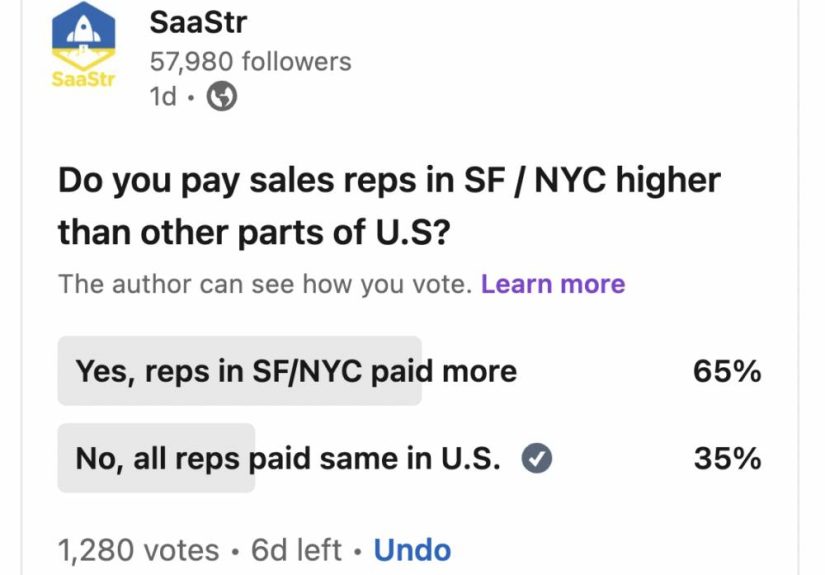
The debate over paying San Francisco and New York-based reps more has been around forever, but it got a crisp, headline-ready number when SaaStr asked the question:
Do you still pay reps in SF and NYC more? The result: yes65% said they do.
That “65%” isn’t just a fun stat for your next RevOps meeting (or your next anxiety dream). It’s a signal that even in a hybrid/remote world, geography still matters in sales compsometimes because it truly needs to, and sometimes because it’s just the path of least resistance.
Either way, if you’re paying SF and NY reps more (or thinking about it), you’re not alone.
What “Paying SF and NY Reps More” Usually Means
In practice, “paying more” can show up in a few ways:
- Higher base salary for the same role level (common for SDR/BDR and inside AEs).
- Higher on-target earnings (OTE), which typically includes base + expected variable/commission at goal.
- Different pay bands tied to location tiers (Tier 1 = SF/NY; Tier 2 = “major metros”; Tier 3 = “everywhere else”).
- Sign-on bonuses or equity used as a pressure valve when base bands feel too tight.
For sales roles, variable compensation is often a big part of the story. Commission is basically the “reward lever” tied to performance outcomesclose the deal, generate the pipeline, expand the account, earn the variable.
Why SF and NY Have Historically Commanded a Premium
1) Cost of living is not a myth (unfortunately)
The cleanest official way to talk about cost differences is the BEA’s Regional Price Parities (RPPs), which compare local price levels to the national average (U.S. = 100).
The San Francisco metro area is meaningfully above the national price level, and the New York metro area is also above average. In the latest metro RPP data (2023), SF’s “all items” RPP is about 118.2 and New York’s is about 112.5.
Translation: the same basket of goods/services costs roughly 18% more in SF and about 12% more in the New York metro than the U.S. average.
If you’re trying to keep purchasing power “similar enough” across your team, a 10–20% premium doesn’t look like a greedy luxury. It looks like math… wearing a hoodie.
2) The talent market is still more competitive in major hubs
Even with remote hiring, SF and NY remain dense talent ecosystems. People job-hop faster, recruiters are louder, and your top rep’s LinkedIn inbox is basically a nightclub line.
SaaStr framed it simply: those metros are still among the most competitive for sales talent, and companies have historically used lower-cost hubs elsewhere to scale.
3) Taxes can affect “real take-home” (and the conversation)
Compensation isn’t only about groceries and rent. State income tax differences change how “good” a number feels.
California and New York are regularly cited among the highest top marginal state income tax rates in the U.S.
Do companies build comp plans line-by-line around tax? Not usually. But reps absolutely notice, and it becomes part of the retention story (“My friend in Texas makes the same and keeps more of it.”).
The Remote-Work Twist: The Premium Is Shrinking (But Not Gone)
Remote work didn’t erase geographic differentialsit squeezed them. Many teams started questioning why two equally productive reps should have meaningfully different pay simply because one lives near good bagels and the other lives near good barbecue.
Recent GTM compensation commentary (based on 2025 benchmark data) argues that historic premiums of 20–30% in SF/NY/Boston have narrowed, with some “non-in-person” roles compressing to roughly 10–15% between the highest and lowest cost markets, while in-person/field roles can still carry larger premiums.
That range lines up nicely with the RPP reality: SF’s metro price level is about 118 vs. the national 100, and New York metro is about 112so a 10–20% premium is at least defensible if you’re anchoring to cost.
What the Market Data Looks Like (Real Examples)
“Reps” is a broad wordinside reps, SDRs, AEs, customer success, account managersso your benchmarks should match your role and segment.
But even broad public data hints at the pattern:
Example: Account Executive base pay (job-posting-based)
Indeed’s job-posting-based estimates show a higher base salary figure for account executives in San Francisco than the U.S. overall average.
For example, recent Indeed snapshots put SF account executive base pay well above the national average.
Example: OTE benchmarks (sales community data)
RepVue’s compensation datasets (commonly used in SaaS sales circles) show substantial OTE levels for account executives in major metros, with San Francisco and New York frequently appearing at the top end of the distribution.
Do these numbers vary by company stage, segment (SMB vs. enterprise), and product category? Absolutely. But the pattern matters:
higher-cost, higher-competition markets often correlate with higher comp expectations.
The Three Common Pay Models (and When Each Works)
Model A: National pay bands (same pay everywhere)
You create one band per role and level, regardless of where the rep lives. SF and NY reps get paid the same as Phoenix and Pittsburgh.
It’s simple, easy to explain, and feels fairespecially if the job is remote and the results are measurable.
Best for: fully remote inside sales, early-stage teams, and roles where geography has minimal impact on outcomes.
Risk: you may underpay in SF/NY compared to local expectations (harder hiring), or overpay in lower-cost areas (higher burn).
Model B: Geographic tiers (location-based pay bands)
You define a few location tiers and set bands accordingly. This approach is widely discussed in compensation strategy circles as “location-based pay” or “geographic differentials,” with the basic idea being that comp reflects local labor markets and cost structures.
Best for: teams that hire across many metros and want consistency without pretending every market is identical.
Risk: it can feel unfair if not communicated well (“Same quota, same territory, why less?”). It also becomes complicated when someone moves.
Model C: Role-based pay + modest geographic guardrails
This is the “split-the-difference” model: your band is mostly driven by role/level, but you add a controlled geo rangeoften closer to that 10–15% spread for remote rolesso the comp doesn’t wildly diverge by ZIP code.
Best for: modern hybrid orgs trying to keep recruiting competitive in SF/NY without creating a two-class sales team.
Risk: requires strong job architecture and a clear compensation philosophy (or it turns into “vibes-based payroll”).
How to Decide If SF/NY Premium Pay Is Worth It
Step 1: Define what you’re paying for
Are you paying for cost of living, cost of labor (market rates), or expected impact (bigger deals, strategic territories)?
These are different justifications, and mixing them is how comp decks become haunted.
Step 2: Separate “role location” from “customer location”
If the rep sells into NYC financial services from a laptop in Ohio, geography matters less than if they’re running in-person meetings across Manhattan three days a week.
Remote selling reduces the logic for large differentials, while truly field-based requirements keep the premium alive.
Step 3: Use cost data as a guardrail, not the whole identity
Cost indexes help keep your banding grounded. RPP data can be a strong sanity check: SF metro prices are notably above the U.S. average; NY metro is also above.
If your “premium” is 40% for an inside AE role, you’re probably paying for competition and legacy norms more than cost.
Step 4: Make sure quota and territory design match comp logic
Nothing triggers rep outrage faster than unequal pay with equal expectations. If SF/NY reps have bigger patch complexity, higher cost of customer acquisition, or more enterprise-heavy portfolios, a premium can be framed as “job scope,” not “rent.”
Practical Compensation Examples (With Realistic Numbers)
Here are three simplified examples to illustrate how teams implement a premium without turning comp into a choose-your-own-adventure novel:
Example 1: Inside AE (remote-first) with a small differential
- Tier 2 markets: $90k base / $90k variable = $180k OTE
- Tier 1 (SF/NY): $100k base / $100k variable = $200k OTE
That’s an 11% bump in OTEroughly in the same neighborhood as metro price-level differences and the “compressed differential” view for remote roles.
Example 2: SDR/BDR with stability emphasis
- Tier 2: $55k base / $25k variable = $80k OTE
- SF/NY: $62k base / $28k variable = $90k OTE
This keeps the base strong (important for early-career roles) while preserving incentive structure.
Example 3: Field enterprise AE with a bigger premium
- Non-Tier 1: $120k base / $120k variable = $240k OTE
- SF/NY: $140k base / $140k variable = $280k OTE
Larger premium can be justified when in-person presence and local enterprise networks are part of the job’s actual scope (not just the rep’s mailing address).
How to Communicate This Without Starting a Slack Uprising
Say the quiet part out loud: you have a compensation philosophy
If you don’t explain your “why,” reps will invent one. And their version will be: “They don’t value me.”
Instead, write it down:
- Do you lead with market pricing (cost of labor)?
- Do you lead with internal equity (same pay for same role)?
- Do you blend both with a limited geographic range?
Define OTE and how it’s earned
People misunderstand OTE constantly. It’s not guaranteed pay; it’s the target outcome if a rep hits goals.
Spell out base, variable mechanics, and what “at plan” truly means.
Have a policy for movers
Reps move. Sometimes for family. Sometimes for sunshine. Sometimes because rent is a personal attack.
Decide in advance: does comp adjust when someone relocates? If yes, on what timeline? Put it in the plan docs.
Common Mistakes That Make the 65% Statistic Look Generous
- Over-indexing on legacy norms: “SF pays more because it always has.” Not a strategy.
- Using too many tiers: Five tiers becomes a geography trivia contest instead of a pay system.
- Paying different base but identical quotas: Expect resentment unless job scope truly differs.
- Ignoring the recruiting signal: Candidates compare offers across metros, especially in sales-heavy markets.
So… Should You Pay SF and NY Reps More?
The most honest answer is: it depends on what you’re optimizing for.
SaaStr’s poll result (65% paying more) suggests many teams still see valueor necessityin keeping a premium for those hubs.
But the direction of travel is equally clear: remote work has pushed many companies toward smaller differentials, tighter ranges, and more role-based consistency.
If you’re hiring remote inside reps and paying a huge SF/NY premium, you may be paying for tradition more than performance.
If you’re hiring enterprise sellers who must be in-market, premiums can still make practical sense.
Conclusion
“65% of you pay your SF and NY reps more” is both a benchmark and a mirror: it reflects real cost and competition, and it exposes how tricky “fairness” becomes when your team is distributed.
The best comp strategies don’t pretend geography doesn’t existbut they also don’t let geography become the entire personality of the plan.
If you want an approach that survives the next wave of remote-work shifts, build role-based bands, allow modest geographic guardrails (especially for remote roles), and make sure quotas and territories match the story your pay plan is telling.
Because nothing should be “at risk” more than commissionexcept maybe your sanity.
Real-World Experiences: What Paying SF and NY Reps More Feels Like (500+ Words)
Let’s get out of spreadsheets for a minute and talk about what actually happens when you pay SF and NY reps morebecause comp isn’t just a model, it’s a daily lived experience inside your revenue team.
Experience #1: The founder who wants “fair,” then meets “offers.”
At the start, it’s easy to be principled: one national pay band, no exceptions, everybody equals, cue the inspirational music.
Then the first SF candidate says, politely, “This base is below market,” and the second SF candidate says, less politely, “lol.”
Suddenly, your “fairness” policy becomes “fairness (terms and conditions apply).”
You make the SF/NY offer higher, telling yourself it’s temporaryjust to get the team built.
Six months later, that higher number has become the new internal anchor, and everyone knows it exists.
Even reps outside SF/NY who were happy yesterday start doing math today.
Experience #2: The rep in a lower-cost city who doesn’t feel “lower value.”
This is where the emotion shows up. A top-performing rep in, say, Dallas or Atlanta hits quota, brings in clean pipeline, runs crisp demos, and closes deals on Zoom like it’s an Olympic sport.
Then they learn the SF rep in the same role has a higher base.
If you can’t tie the difference to scopebigger accounts, heavier territory complexity, in-person demandsthe story in their head becomes:
“My location is being discounted… and I’m the one carrying the number.”
That rep may not quit immediately, but motivation gets weird. They start interviewing “just to see,” which is sales-language for “I’m halfway out the door.”
Experience #3: The SF/NY rep who still feels broke.
Here’s the twist: even with a premium, SF/NY reps often don’t feel “overpaid.” They feel “still trying to survive.”
If your premium is modest (say 10–15%) and housing costs are crushing, the rep’s lived experience is, “I’m paid more, but my bank account doesn’t feel more.”
This can create a strange dynamic where SF/NY reps feel the premium is necessary just to be neutral, while non-SF/NY reps view the same premium as a special advantage.
Both groups can feel wronged at the same time, which is an impressive feat of organizational alchemy.
Experience #4: The manager who becomes a translator between math and feelings.
Frontline managers end up doing the emotional labor of compensation strategy.
They explain pay bands, talk through OTE, remind people that variable comp is the real performance lever, and try to keep everyone focused on controllables.
When comp is unclear, managers become unpaid diplomats.
When comp is clear, managers become coaches againwhich is exactly where you want them.
This is why documentation and consistent messaging matter: if your plan can’t be explained simply, it can’t be defended when a rep is angry (and reps are famously calm, always).
Experience #5: The “move” that turns comp into a plot twist.
Someone moves out of SF. Someone moves into NY. Someone moves “temporarily” to Miami and somehow never returns.
If you don’t have a clear policy, every move becomes a one-off negotiation, and that’s how pay equity quietly breaks.
The smoothest teams treat moves like a normal process: review comp at a defined point, adjust bands if your policy requires it, and communicate the timeline clearly.
Not because you love rulesbut because rules prevent drama, and drama is a terrible KPI.
Bottom line: paying SF and NY reps more can be rational, competitive, and even kind.
But it has social consequences inside your org. If you’re in the 65% who do it, your job isn’t just to set the numberit’s to set the narrative:
what the premium is for, how big it is, when it applies, and how reps can grow their earnings through performance.
When that story is solid, your comp plan feels like a system. When it’s not, your comp plan feels like a rumor.