Table of Contents >> Show >> Hide
- Why Minimalist Kitchen Rules Actually Work
- Rule 1: Keep Countertops on a Strict Diet
- Rule 2: Give Every Item a Job and a Zone
- Rule 3: Own Fewer Tools, but Better Ones
- Rule 4: Store by Frequency, Not by Wishful Thinking
- Rule 5: Contain and Label, but Keep It Simple
- Rule 6: Reset the Kitchen Daily and Treat Food Like It Can Become Clutter
- Common Mistakes That Make Kitchens Feel More Chaotic
- How to Start Without Overhauling the Entire Kitchen
- Real-Life Experiences With a More Minimal Kitchen
- Final Thoughts
A clean kitchen is one of those things that sounds simple until real life shows up with grocery bags, snack wrappers, three cutting boards, and a mug collection that somehow multiplied overnight. Minimalists are not magical people who float through life owning exactly one spoon and a suspicious amount of inner peace. They simply follow a few practical rules that make the kitchen easier to use, easier to clean, and much harder to turn into a countertop crime scene.
The good news is that minimalist kitchen organization is not about making your space look sterile or boring. It is about removing friction. When the coffee mugs are where you actually reach for them, when the junk drawer is not auditioning for a disaster documentary, and when your counters are clear enough to chop an onion without moving six random things first, cooking feels better. Cleaning feels faster. Even takeout feels more respectable when you can plate it in a kitchen that does not look like it lost a bar fight.
If you want a clean and organized kitchen that still feels warm and lived-in, these six rules are the ones worth stealing. They are practical, realistic, and surprisingly powerful, especially when you use them together instead of trying one trendy hack and hoping your pantry experiences spiritual growth.
Why Minimalist Kitchen Rules Actually Work
Minimalists focus less on buying more organizers and more on reducing decisions. That is the real secret. A kitchen gets messy when too many items compete for too little space, when tools do not have assigned homes, and when daily habits create tiny piles that quietly become full-blown clutter. The solution is not a prettier bin. The solution is a system that makes the right choice the easy choice.
In other words, the goal is not just a photogenic kitchen. The goal is a functional kitchen that supports cooking, cleanup, storage, and everyday life without making you feel like you need a project manager to unload the dishwasher.
Rule 1: Keep Countertops on a Strict Diet
If minimalists had a kitchen motto, it would probably be this: your counters are for working, not for permanent storage. Clear counters instantly make a kitchen look cleaner, but they also make it easier to prep food, wipe surfaces, and avoid that slow buildup of “I will deal with it later” objects.
What should stay out
Only keep out what you use constantly and what genuinely earns its footprint. That might mean a coffee maker, a toaster you use every day, a fruit bowl, or a utensil crock. It does not mean six specialty appliances, unopened mail, vitamins, shopping bags, and a decorative tray holding objects no one remembers buying.
How to follow this rule
- Choose one small zone for daily-use appliances.
- Move seasonal or rarely used gadgets into cabinets or a nearby closet.
- Give non-kitchen items a different landing spot somewhere else in the home.
- End each day with a two-minute counter sweep.
This rule works because visual clutter creates mental clutter. A cleaner surface gives the entire room breathing room. It also removes the classic excuse for not cooking: “I would make dinner, but first I need to excavate the cutting board.”
Rule 2: Give Every Item a Job and a Zone
A minimalist kitchen is not organized because everything is hidden. It is organized because everything has a home. The simplest way to do that is by creating zones based on how you actually use the kitchen, not how a catalog thinks you should live.
Examples of useful kitchen zones
- Breakfast zone: mugs, coffee, tea, filters, sweeteners, cereal bowls.
- Prep zone: knives, cutting boards, mixing bowls, measuring tools.
- Cooking zone: oils, spices, utensils, pans near the stove.
- Lunchbox zone: food containers, wraps, reusable bags, water bottles.
- Cleaning zone: dish soap, brushes, towels, trash bags, dishwasher tabs.
Once you group items by task, your kitchen stops making you wander from drawer to cabinet to pantry like a confused contestant on a timed game show. You move less, find things faster, and put items away more consistently because the storage makes sense.
If something never seems to make it back to its spot, that is useful information. It usually means the item is stored in the wrong zone, too high, too deep, or too far from where it gets used. Minimalists fix the system instead of blaming themselves for not being naturally tidy enough.
Rule 3: Own Fewer Tools, but Better Ones
This rule is where minimalist kitchens quietly win. They are not packed with novelty gadgets, duplicate utensils, or one-purpose items bought during a moment of late-night shopping optimism. They keep what gets used, what works well, and what solves a real problem. The rest gets donated, recycled, or gently thanked for its service before leaving the building.
What usually clutters a kitchen fastest
- Duplicate spatulas, peelers, whisks, and measuring cups
- Promotional mugs and random travel tumblers
- Single-use gadgets that looked clever online
- Food storage containers with missing lids or mystery bottoms
- Expired pantry items and spices from another era
A good test is simple: if you have not used it in a long time, do not enjoy using it, or own three versions of the same thing, it is probably taking up more value in space than it returns in function. Minimalists often rely on a version of the “one in, one out” rule. Buy a new mug? An old mug leaves. Add a new pan? Time to ask which older one is just squatting in the cabinet.
This does not mean your kitchen must become joyless and stripped down. It means your favorite chef’s knife should not have to live in a drawer packed tighter than an airport carry-on. Good tools deserve room to work. So do you.
Rule 4: Store by Frequency, Not by Wishful Thinking
One of the smartest kitchen organization tips minimalists follow is storing items according to how often they are used. Daily items should be the easiest to reach. Weekly items can live a little farther away. Rarely used items can go high, low, or beyond the prime real estate altogether.
A simple frequency map
- Daily use: eye-level shelves, front drawers, accessible counters.
- Weekly use: upper cabinets, second-row pantry shelves.
- Rare use: top shelves, deep storage, labeled bins, utility closet.
This matters because clutter often comes from inconvenience. When the blender is hard to reach but the mail is easy to drop on the counter, guess which habit wins. When the lunch containers are buried behind cake stands and holiday platters, people stop putting them away properly. A clean and organized kitchen is built around easy access to the things that support your routine.
Think about your actual life here. If you make smoothies every morning, the blender is not “special occasion equipment.” If you bake twice a year, your bundt pan does not need front-row seating. Storage should reflect behavior, not fantasy. Your future sourdough era can apply for shelf space when it arrives.
Rule 5: Contain and Label, but Keep It Simple
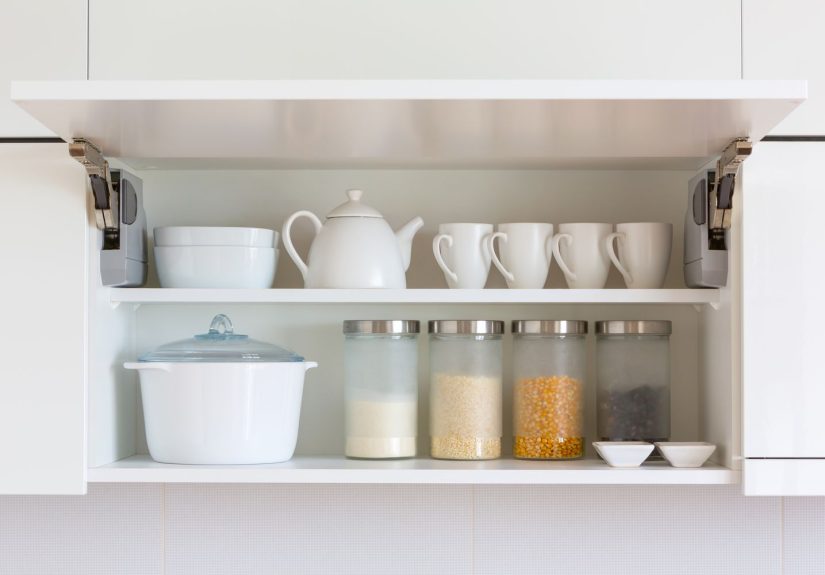
Minimalists love containers, but not because every bean deserves a luxury apartment. Containers are useful because they corral like with like, prevent small items from spreading, and make shelves easier to maintain. The trick is using them to simplify, not to create a tiny bureaucracy in your pantry.
Where containers help most
- Snack categories for kids or grab-and-go lunches
- Baking supplies such as flour, sugar, and chocolate chips
- Packets, wraps, and small pantry odds and ends
- Food storage lids and reusable bags
- Fridge bins for deli items, yogurts, or meal-prep ingredients
Transparent bins are handy because you can see what is inside without turning organization into archaeology. Labels also help, especially in shared kitchens, but keep them broad and flexible. “Snacks,” “Breakfast,” and “Baking” work better than ultra-specific labels that require you to relabel your life every time you buy granola bars instead of crackers.
If you decant dry goods, make sure it helps your routine rather than adding chores. Some people love matching jars. Others discover they have created an unpaid internship for themselves involving funnels. Both are acceptable, but the best system is the one you will keep using a month from now.
Rule 6: Reset the Kitchen Daily and Treat Food Like It Can Become Clutter
This is the rule that separates a briefly tidy kitchen from one that stays that way. Minimalists do not wait for chaos to become official. They reset the space in small doses every day.
Your daily reset can be very short
- Unload or reload the dishwasher.
- Wash the sink and wipe the faucet.
- Clear counters and the kitchen table.
- Put stray items back in their zones.
- Check the fridge for leftovers that need a plan.
That last point matters more than people think. Food clutter is still clutter. A refrigerator packed with forgotten containers, half-used sauces, and produce in witness protection is not organized just because the door closes. A minimalist kitchen includes food habits that reduce waste and make meals easier.
Label leftovers if needed, use older items first, and keep a short mental or written list of what needs to be eaten soon. This saves money, clears space, and prevents the classic fridge mystery where you stare into a container and ask whether it is soup, pasta, or a science fair entry.
Common Mistakes That Make Kitchens Feel More Chaotic
Even well-meaning people sabotage their own kitchen organization with a few common habits. The first is buying organizers before editing the stuff. You cannot container your way out of too much inventory. The second is over-labeling. If your pantry needs staff training to decode it, the system is too complicated. The third is storing based on appearance rather than workflow. Beautiful storage still fails if it makes daily cooking harder.
Another mistake is treating the kitchen like a storage annex for the rest of the house. Keys, chargers, school papers, receipts, dog leashes, and unopened packages all love to migrate there because the kitchen is busy and visible. Minimalists set boundaries. The kitchen is for cooking, eating, cleaning, and storing kitchen-related essentials. It is not the witness protection program for every homeless object in the home.
How to Start Without Overhauling the Entire Kitchen
If your kitchen feels overwhelming, do not empty every cabinet at once unless that kind of chaos energizes you. For most people, the smarter move is starting with one friction-heavy area. Pick the drawer that jams every morning. Pick the container cabinet that attacks you when opened. Pick the counter corner where random stuff goes to retire.
Use this order:
- Remove everything from that one area.
- Throw away trash and obvious duplicates.
- Group similar items together.
- Put back only what belongs there and what you actually use.
- Add a simple container or divider only if it solves a real problem.
That one small win creates momentum. A cleaner kitchen usually happens through repeated edits, not one dramatic weekend where you attempt to become a new person between breakfast and Sunday night.
Real-Life Experiences With a More Minimal Kitchen
One of the most interesting things about minimalist kitchen habits is how quickly people notice the change in daily life. Not in a dramatic movie-montage way, where sunlight suddenly hits the countertops and someone starts baking artisan galettes while laughing in linen. The change is usually quieter and more useful than that.
For example, people who clear their counters often say the kitchen starts feeling larger almost immediately, even when nothing about the square footage changes. A small apartment kitchen can go from cramped to calm just by removing the appliance lineup and creating one open prep space. That visual calm tends to reduce stress because the room no longer greets you with unfinished business every time you walk in.
Another common experience is that cooking becomes easier because fewer tools are competing for attention. Someone who once owned three can openers, five water bottles with missing lids, and enough travel mugs to caffeinate a soccer team often finds that meal prep speeds up after decluttering. There is less rummaging, less reshuffling, and less frustration. The kitchen begins to support the cook instead of testing their patience.
Families also notice that zones cut down on repetitive questions. When snacks live in one bin, lunch supplies live in one drawer, and coffee items stay together, people stop asking where everything is. Shared kitchens become smoother because the setup is obvious. Even kids can help put groceries away when categories make sense. That is not just organization. That is domestic diplomacy.
There is also a money-saving side to the experience. Once the pantry and refrigerator are easier to see, people tend to waste less food. They rediscover ingredients before buying duplicates, use leftovers more often, and stop losing produce in the back of the fridge like it slipped into another dimension. A kitchen that is visually organized makes inventory easier, and better inventory usually leads to smarter shopping.
Many people also describe a subtle emotional shift. A more minimal kitchen does not just look neat; it feels easier to maintain. That matters because maintenance is where most systems fail. When the reset takes five minutes instead of forty-five, you are far more likely to stick with it. Instead of waiting for the kitchen to become a disaster, you handle small messes as they happen. Over time, that builds confidence. You stop thinking of yourself as messy and start realizing your old setup was simply working against you.
Even enthusiastic cooks benefit from minimalist rules. In fact, they may benefit the most. People who cook often need efficiency, not excess. A serious home cook usually prefers one excellent skillet over three mediocre ones, one sharp chef’s knife over a drawer of disappointing blades, and one accessible prep station over decorative clutter. Minimalism does not kill personality in the kitchen. It protects function so personality has room to breathe.
And perhaps the most relatable experience of all is this: cleaning gets less annoying. Not fun, exactly. Let us not get reckless. But less annoying? Absolutely. Fewer things on the counter means fewer things to move. Fewer duplicates in cabinets means less shoving and collapsing. Fewer mystery containers in the fridge means fewer unpleasant discoveries. In a world full of complicated problems, that kind of everyday ease feels surprisingly luxurious.
Final Thoughts
A minimalist kitchen is not about deprivation. It is about clarity. The six rules are simple: keep counters clear, assign zones, own fewer but better tools, store by frequency, contain things simply, and reset the room every day. Follow those rules, and your kitchen becomes easier to cook in, easier to clean, and easier to enjoy.
You do not need a giant renovation, a rainbow of matching bins, or the self-control of a monk who owns one fork. You just need a kitchen that matches the way you actually live. When that happens, the room starts working with you instead of against you, and that is when clean and organized stops being a goal and starts becoming your normal.