Table of Contents >> Show >> Hide
- Why Technique Matters More Than People Think
- Before You Start: Set Yourself Up for a Better Spin
- Way #1: The Classic Pinch-and-Flick Spin
- Way #2: The Tabletop Launch
- Way #3: The One-Handed Thumb Snap
- Way #4: The Finger Transfer Spin
- How to Get Longer, Smoother Spins
- Mistakes Beginners Make All the Time
- Final Thoughts
- The Experience of Learning to Spin a Fidget Spinner
- SEO Tags
Some trends vanish in a puff of glitter and bad decision-making. The fidget spinner, however, keeps hanging on like that one catchy pop chorus you pretend not to know by heart. Whether you picked one up for fun, for focus, or because it was sitting on a desk begging to be flicked, learning how to spin a fidget spinner well makes the whole thing far more satisfying. A sloppy spin feels like a shopping cart with one bad wheel. A clean spin feels oddly elegant, like your fingertips suddenly earned a tiny engineering degree.
This guide breaks down four practical ways to spin a fidget spinner, from the classic beginner-friendly flick to smoother one-handed methods that make you look more coordinated than you may actually be. Along the way, you’ll also learn how to improve balance, reduce wobble, avoid common mistakes, and get longer, smoother rotations. So if you’ve ever wondered whether there’s a right way to use a hand spinner, the answer is yes. Thankfully, it doesn’t require ninja training, just decent finger placement and a little patience.
Why Technique Matters More Than People Think
At first glance, a fidget spinner seems gloriously simple: hold the middle, flick the side, enjoy the blur. And yes, that is the basic idea. But small changes in grip, angle, force, and timing can completely change the result. Good technique helps the spinner rotate smoothly, stay balanced, feel quieter in your hand, and last longer between flicks. Bad technique usually leads to wobbling, scraping, weak spins, and the deeply humbling moment when your spinner launches itself onto the floor like it has rent to pay somewhere else.
It also helps to understand what you’re holding. Most fidget spinners rely on a center bearing that lets the outer body rotate while your fingers stay mostly still. That means the center cap should remain stable while the weighted arms do the work. If your fingers squeeze too hard, touch the spinning edges, or shift around too much, you create drag and kill momentum. In plain English: let the spinner spin. Don’t babysit it like it’s a soufflé.
Before You Start: Set Yourself Up for a Better Spin
Choose a decent grip
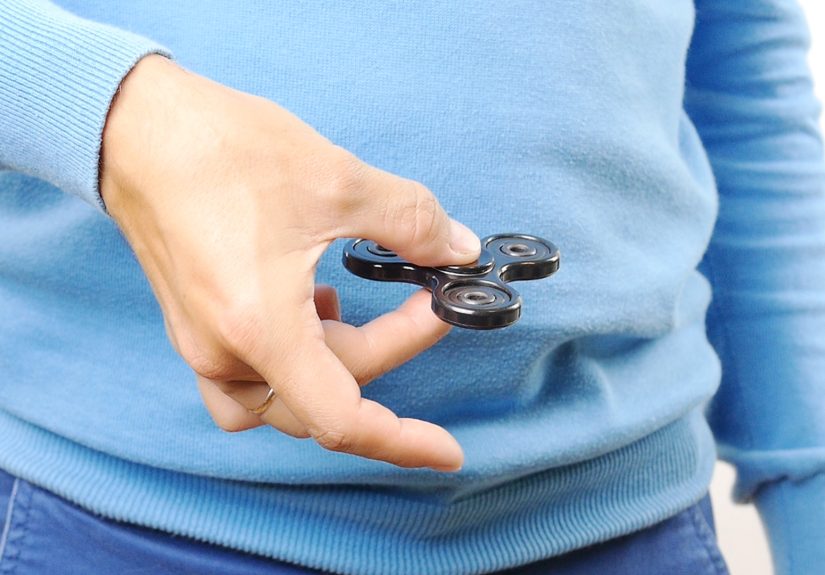
For almost every method, place your thumb on one side of the center cap and your index finger on the other. Hold the cap firmly enough to stabilize it, but not so tightly that you pinch the life out of the bearing. Think “secure,” not “I’m opening a stubborn pickle jar.”
Check your environment
If you’re learning a new spin, stand or sit over a desk, couch, or bed. Hard floors are ruthless. They have no sympathy for your confidence or your spinner’s finish.
Use a clean, smooth spinner
A quality bearing and a clean center mechanism make a huge difference. If your spinner feels gritty, noisy, or uneven, the problem may not be your technique at all. Sometimes the spinner is just having a mechanical identity crisis.
Know when not to use it
Fidget tools can be relaxing and satisfying, but context matters. In quiet classrooms, meetings, or anywhere a visible or noisy object distracts other people, the spinner may stop being a helpful tool and become a tiny propeller of annoyance. There is a time for spinning and a time for pretending to be a mature adult.
Way #1: The Classic Pinch-and-Flick Spin
If you only learn one technique, make it this one. The classic pinch-and-flick is the most reliable way to spin a fidget spinner, and it’s the foundation for everything else. It is simple, efficient, and dramatically less embarrassing than trying advanced tricks before you can keep the thing balanced for more than four seconds.
How to do it
- Hold the center cap between your thumb and index finger.
- Use a finger from your other hand, usually your index finger or middle finger, to flick one outer arm.
- Flick with a quick, clean motion rather than a long push.
- Let the spinner rotate freely without brushing the edges.
Why it works
This method gives you the best control over force and direction. Because one hand stabilizes the spinner while the other creates motion, it’s easier to produce a strong, even start. It’s also the best method for beginners because it teaches the basic relationship between grip and momentum.
Best use case
Use this when you want the longest, smoothest spin with the least drama. It is perfect for beginners, casual use, and anyone who prefers performance over showing off.
Common mistakes
The biggest mistake is over-flicking. People tend to wind up like they’re trying to start a lawn mower. Don’t. A short, sharp flick works better than a wild slap. Another mistake is squeezing the center too hard, which creates friction and shortens the spin.
Way #2: The Tabletop Launch
The tabletop launch is ideal if you want a stable spin without holding the spinner the entire time. It’s also a nice option for people who want to watch the movement itself, because let’s be honest, half the fun of a hand spinner is staring at it like it contains life’s answers.
How to do it
- Place the spinner flat on a smooth, level table.
- Hold the center lightly with one finger, or steady it briefly before launch.
- Flick one arm with your other hand.
- Lift your stabilizing finger away immediately so the spinner rotates freely.
Why it works
The table provides support, so you don’t have to balance the spinner in the air. That makes it easier to judge how hard to flick and whether your spinner is wobbling because of poor technique or a bad bearing. In other words, the table tells the truth. It is the brutally honest friend of spinner practice.
Best use case
This method works well for beginners, for testing spin quality, and for anyone trying to get a smoother visual effect. It is also useful when you want to demonstrate how a spinner moves without juggling it in your hand.
Common mistakes
The main problem here is dragging your finger across the spinner as it starts moving. That kills speed fast. Another issue is using a rough or uneven surface. If the table has crumbs, grooves, or mystery stickiness, your spinner will not exactly thrive.
Way #3: The One-Handed Thumb Snap
Once you’ve mastered the basic spin, the one-handed thumb snap is the next logical move. It feels cleaner, faster, and more natural once you get used to it. It also gives off a subtle “I have done this more than three times” energy.
How to do it
- Hold the center cap between your thumb and middle finger.
- Use your index finger or thumb on the same hand to flick one outer arm.
- Keep the hand relaxed so the cap stays steady while the body rotates.
- Practice the motion slowly first, then add speed.
Why it works
This method reduces extra movement because everything happens in one hand. It can feel awkward at first, but once your fingers learn the spacing, it becomes a very efficient way to spin a fidget spinner while standing, walking, or pretending to listen during a painfully long conference call.
Best use case
Use the one-handed spin when you want convenience and mobility. It’s especially good for experienced users who want quick starts without needing both hands every time.
Common mistakes
The most common mistake is shifting the center cap while trying to flick. If your grip moves, the spinner wobbles immediately. Start with small flicks until your hand learns to separate “holding” from “launching.” Your fingers need teamwork, not a labor dispute.
Way #4: The Finger Transfer Spin
This is where spinning becomes a little more stylish. The finger transfer spin starts with a normal launch, then moves the spinner from one finger position to another while it’s still rotating. It’s not exactly a circus act, but it does look cooler than staring at your inbox.
How to do it
- Start with a strong classic pinch-and-flick spin.
- Once the spinner is rotating steadily, shift it from a thumb-and-index hold to balancing on one finger, usually your index finger.
- Keep the spinner level as you transfer it.
- Optionally move it back to a two-finger hold or pass it to the other hand.
Why it works
This technique builds on the spinner’s balance. Once it has enough speed, the rotating body becomes easier to stabilize during a careful transfer. The key word there is careful. This is not a baseball throw. It is more like convincing a spinning little machine not to betray you.
Best use case
Use this when you want to develop control, try beginner tricks, or simply make the spinner feel more interactive. It’s fun, a little flashy, and a great way to practice smooth hand movement.
Common mistakes
Trying the transfer too early is the classic error. If the spinner isn’t moving fast enough, it becomes unstable during the handoff. Another common problem is tilting the spinner. Keep it as level as possible and move slowly. Smooth wins here. Speed comes later.
How to Get Longer, Smoother Spins
- Use short, crisp flicks: Quick force beats dramatic windups.
- Keep your fingers off the arms: Even light contact creates drag.
- Hold the center cap steady: The middle should anchor, not wobble.
- Practice with the same spinner first: Consistency helps your fingers learn the balance point.
- Clean the bearing if needed: A dirty spinner can feel slow no matter how good your technique is.
- Use smooth edges and quality materials: Better construction usually means better control and fewer weird vibrations.
Mistakes Beginners Make All the Time
One beginner mistake is treating every spin like a power event. More force does not automatically mean more spin time. A clean launch matters more than brute strength. Another problem is constantly touching the spinner while it rotates. If you keep poking it, of course it stops. It’s a spinner, not a needy houseplant.
People also underestimate positioning. If the spinner starts at a crooked angle, even a strong flick may create wobble. And finally, many new users confuse “fidget tool” with “flying object.” Please resist the urge to toss it, catch it with your face, or invent your own dental bill.
Final Thoughts
Learning how to spin a fidget spinner is one of those oddly satisfying little skills that looks simple from a distance but becomes more interesting the second you try to do it well. The classic pinch-and-flick gives you the best foundation. The tabletop launch helps you understand balance. The one-handed thumb snap makes spinning more convenient. And the finger transfer spin adds a bit of flair without requiring Olympic-level finger choreography.
In the end, the best way to spin a fidget spinner is the method that feels smooth, controlled, and enjoyable to you. Start with the basics, keep your grip light, and focus on clean motion instead of chaos. With a little practice, your spinner will glide instead of wobble, and your fingers will look like they know exactly what they’re doing. Even if, deep down, everyone involved is still just winging it.
The Experience of Learning to Spin a Fidget Spinner
There’s a surprisingly specific experience that comes with learning how to spin a fidget spinner well. At first, it feels almost too simple to take seriously. You hold the center, flick the side, and assume that’s the whole story. Then the spinner wobbles like a confused ceiling fan, clips your knuckle, and drops to the floor. Suddenly, the toy has become a tiny professor teaching a lesson in coordination, timing, and humility.
For beginners, the first real breakthrough is discovering that smooth beats strong. Most people start by trying to overpower the spinner, as if the answer is more force, more speed, more drama. But after a few failed launches, you realize the best spin often comes from a controlled flick and a steady grip. That moment changes the whole experience. The spinner stops feeling random and starts feeling responsive. Instead of fighting it, you begin working with it.
There’s also something oddly calming about the repetition. The motion is small, the sound is soft, and the result is immediate. Flick, spin, pause. Flick, spin, pause. It creates a little loop of action and feedback that can feel satisfying in a way that’s hard to explain unless you’ve done it. It’s not magic, and it’s definitely not a replacement for real concentration strategies, but as a tactile habit, it has a certain charm. Your hands stay busy, your eyes catch the blur of motion, and for a moment your brain gets to focus on something simple and mechanical instead of the usual chaos of messages, tabs, reminders, and existential nonsense.
The experience changes again once you move beyond the basic spin. A one-handed launch feels clumsy at first, then suddenly natural. A finger transfer seems impossible right up until the moment it works, at which point you immediately want to do it again five more times like you’ve unlocked a side quest. That’s part of the appeal: the learning curve is shallow enough to feel approachable, but there’s still enough skill involved to make progress feel real.
And then there’s the social side of it. Hand someone a spinner and they almost always try it. Some go for brute force. Some get weirdly competitive about spin time. Some stare at it like they’re decoding the universe. It’s one of those rare little objects that invites interaction without needing instructions, batteries, or a thirty-minute setup video narrated by a guy named Brad in a garage.
What makes the experience memorable isn’t just the spinning. It’s the way such a small object turns finger movement into something you can feel improving almost immediately. You notice better control, cleaner launches, steadier transfers, and fewer accidental drops. Tiny adjustments produce visible results, and that makes practice satisfying. In a world full of complicated hobbies and expensive gear, there’s something refreshing about a skill that lives entirely between your fingertips.
So yes, learning to spin a fidget spinner can be funny, slightly nerdy, and more absorbing than it has any right to be. But that’s exactly why people keep picking them up. The experience is simple, tactile, and just technical enough to reward patience. And frankly, not every hobby needs to be profound. Sometimes it’s enough that the thing spins well, feels good in your hand, and gives your brain a brief vacation from being dramatic.