Table of Contents >> Show >> Hide
- Body and Movement Facts That Feel Made Up
- 1. The word “kangaroo” didn’t start in English.
- 2. “Macropod” basically means “big foot.”
- 3. Red kangaroos are the largest living marsupials on Earth.
- 4. A kangaroo’s tail is not just decoration.
- 5. Kangaroos can use that tail like an extra leg.
- 6. Some experts call it a five-footed walk.
- 7. Kangaroos do not hop the way most people imagine.
- 8. A big kangaroo can cover more than 23 feet in one hop.
- 9. In emergencies, some can stretch a leap to roughly 39 feet.
- 10. They can hit speeds above 30 miles per hour.
- 11. Hopping can actually be energy-efficient.
- 12. Their hind feet are built like high-performance equipment.
- 13. Some kangaroo relatives have fused toes used for grooming.
- 14. Tree kangaroos break the usual kangaroo body plan.
- 15. Tree kangaroos can move backward.
- 16. Some tree kangaroos can leap 60 feet to the ground without injury.
- Baby, Pouch, and Family Facts That Sound Totally Unreal
- 17. A baby kangaroo is called a joey.
- 18. Joeys are born shockingly tiny.
- 19. Gestation is very short.
- 20. A joey has to crawl into the pouch on its own.
- 21. The pouch is basically a mobile nursery.
- 22. Some joeys stay in the pouch for months.
- 23. Joeys often peek out before they fully leave.
- 24. Mothers can support three babies at different stages at once.
- 25. Some kangaroos can pause an embryo’s development.
- 26. A mother can make two different kinds of milk at the same time.
- 27. A kangaroo pouch is not always spotless.
- Behavior, Habitat, and Survival Facts You’ll Want to Tell Everyone
- 28. Kangaroos usually travel in groups called mobs.
- 29. They have a surprisingly large social vocabulary.
- 30. Male kangaroos really do box.
- 31. Red kangaroos and gray kangaroos do not live exactly the same lives.
- 32. Female red kangaroos can look bluish-gray.
- 33. Eastern gray kangaroos can be identified by a black-tipped tail.
- 34. Kangaroos are herbivores, but not boring eaters.
- 35. “Kangaroo” is both specific and broad.
- Why Kangaroos Never Stop Being Fascinating
- Experience: What Kangaroos Feel Like in Real Life
- Final Thoughts
Kangaroos look like the kind of animal somebody invented after too much coffee and zero supervision. They balance on giant feet, carry babies in built-in pockets, box like amateur heavyweights, and use their tails like extra equipment. And yet every weird detail is gloriously real. That is exactly why kangaroo facts never get old: the deeper you go, the more this famous Australian wildlife icon starts to sound like science fiction in fur.
But here’s the fun part: kangaroos are not just odd. They are brilliantly designed for survival. Their bodies are built for speed, their family life is straight-up astonishing, and their behavior is more complex than the average cartoon version ever admits. From the mighty red kangaroo to tree-climbing relatives that look like they missed the “stay on the ground” memo, these marsupials are full of surprises.
So let’s get into it. Here are 35 incredible kangaroo facts that sound fake but aren’tall real, all wild, and all guaranteed to make you look at the next joey photo with a lot more respect.
Body and Movement Facts That Feel Made Up
1. The word “kangaroo” didn’t start in English.
The name comes from gangurru, a word used by the Guugu Yimithirr people of Far North Queensland. So yes, one of the world’s most recognizable animal names was borrowed long before it became a mascot, logo, or tourist magnet.
2. “Macropod” basically means “big foot.”
Kangaroos belong to the macropod family, and the name literally translates to “big foot.” Subtle? Not even a little. Accurate? Extremely.
3. Red kangaroos are the largest living marsupials on Earth.
If you thought pouches were only for cute, compact animals, the red kangaroo would like a word. Adult males can stand close to 6 feet tall and outweigh plenty of humans.
4. A kangaroo’s tail is not just decoration.
That thick, muscular tail is a serious tool. It helps with balance when standing and hopping, and it becomes even more impressive when the animal moves slowly.
5. Kangaroos can use that tail like an extra leg.
When walking at a slow pace, kangaroos plant their forearms and tail, swing their hind legs forward, and move in what looks like a wonderfully weird tripod-plus system. It is one of the strangest gaits in the mammal world.
6. Some experts call it a five-footed walk.
That slow-motion shuffle is often described as a “five-footed” gait because the tail functions so actively during movement. Nature really looked at a regular four-limbed design and said, “Let’s get experimental.”
7. Kangaroos do not hop the way most people imagine.
Their style of movement is called saltation, which means both hind feet push off the ground at the same time. It is not a random bounce. It is a highly specialized locomotion system.
8. A big kangaroo can cover more than 23 feet in one hop.
That is not “pretty athletic for a herbivore.” That is “good luck catching that” territory.
9. In emergencies, some can stretch a leap to roughly 39 feet.
At that point, the word “hop” feels almost disrespectful. That is less bunny behavior and more airborne commitment.
10. They can hit speeds above 30 miles per hour.
Depending on the species and situation, large kangaroos can move at well over 30 mph. Which means the cartoon version that lazily bounces across the background is underselling the package.
11. Hopping can actually be energy-efficient.
Kangaroos are famous for moving efficiently, and research-backed zoo sources note that they can burn less energy as their hopping speed increases, at least up to their cruising pace. The spring-loaded design is doing a lot of work.
12. Their hind feet are built like high-performance equipment.
The fourth toe does most of the heavy lifting, while the feet themselves are long and powerful. A kangaroo is not just leggy. It is engineered.
13. Some kangaroo relatives have fused toes used for grooming.
In the broader macropod family, the second and third toes are fused for much of their length but end in separate nails. That sounds fake until you realize evolution loves complicated solutions.
14. Tree kangaroos break the usual kangaroo body plan.
Most kangaroos are built for open ground. Tree kangaroos, on the other hand, are adapted for climbing, which makes them look like somebody remixed the classic design for a rainforest expansion pack.
15. Tree kangaroos can move backward.
San Diego Zoo notes that tree kangaroos are the only kangaroos able to move their back legs independently and move backward. Ground kangaroos are built to launch forward, not casually reverse like a pickup truck.
16. Some tree kangaroos can leap 60 feet to the ground without injury.
That sounds like a superhero origin story, but it is a real documented ability in tree kangaroo species. Falling from a second-story height is bad for humans. For them, it is Tuesday.
Baby, Pouch, and Family Facts That Sound Totally Unreal
17. A baby kangaroo is called a joey.
This is one of the few animal facts everybody thinks they know. The funny part is that the truly weird information starts right after the name.
18. Joeys are born shockingly tiny.
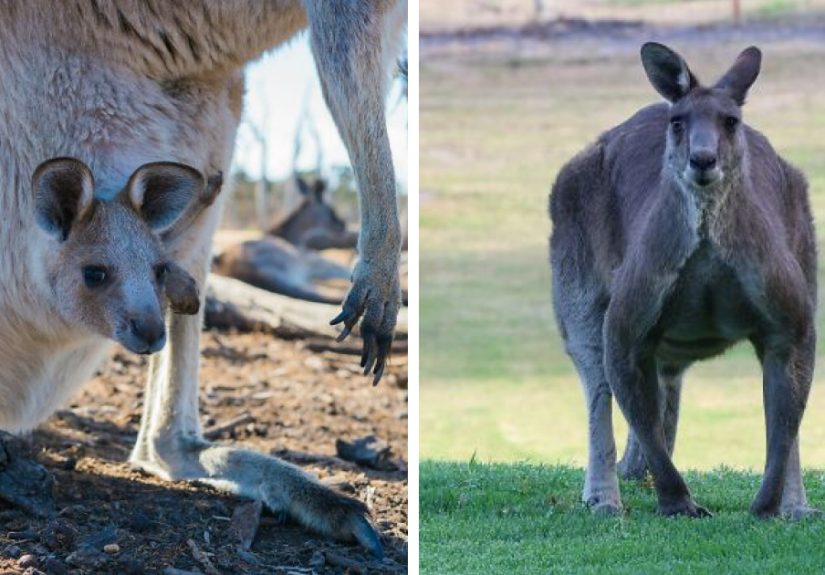
Depending on the species, a newborn can be less than a gram and about the size of a jellybean, kidney bean, or lima bean. Meanwhile, the mother might be the size of a linebacker. That size contrast is ridiculous and real.
19. Gestation is very short.
Many kangaroo and wallaby relatives give birth after only about a month of pregnancy. Instead of finishing development in the womb, the baby continues its journey in the pouch.
20. A joey has to crawl into the pouch on its own.
Right after birth, the tiny newborn climbs through its mother’s fur to reach the pouch and attach to a nipple. No GPS. No practice run. Just one heroic little scramble.
21. The pouch is basically a mobile nursery.
Once inside, the joey stays warm, protected, and attached to a food source while it continues developing. It is less “cute pocket” and more “external intensive care unit.”
22. Some joeys stay in the pouch for months.
Depending on the species, pouch time can range from roughly four months to well over a year. So the pouch is not a quick stop. It is a full lease.
23. Joeys often peek out before they fully leave.
Many young kangaroos begin sticking their heads out and sampling the outside world before they permanently exit. It is basically nature’s version of testing the neighborhood before moving out.
24. Mothers can support three babies at different stages at once.
Yes, really. A female may have one embryo in reserve, one joey in the pouch, and one older joey outside the pouch but still nursing. If that sounds like impossible multitasking, welcome to kangaroo motherhood.
25. Some kangaroos can pause an embryo’s development.
This reproductive trick is called embryonic diapause. In simple terms, a fertilized embryo can stay on hold until conditions are right or another joey is far enough along. It is the biological equivalent of hitting “save draft.”
26. A mother can make two different kinds of milk at the same time.
That sounds fake enough to start an argument at dinner, but it is true. If she is nursing young at different stages, her body can produce milk tailored to each one’s needs.
27. A kangaroo pouch is not always spotless.
Joeys pee and poop in there, and mothers clean the pouch out. So while the pouch looks adorable from a distance, it is also a hardworking, high-maintenance nursery.
Behavior, Habitat, and Survival Facts You’ll Want to Tell Everyone
28. Kangaroos usually travel in groups called mobs.
Not herds. Not packs. Mobs. Which is a wonderfully dramatic word for a bunch of grass-eating marsupials quietly minding their own business.
29. They have a surprisingly large social vocabulary.
Kangaroos communicate with foot thumps, grunts, hisses, cough-like sounds, and softer clucks or clicks between mothers and young. In other words, they are not silent hoppers. They are chatty in their own style.
30. Male kangaroos really do box.
That famous image is not a myth. Males may lock forearms, shove, and kick with powerful hind legs to establish dominance. It looks comical until you remember how strong those legs are.
31. Red kangaroos and gray kangaroos do not live exactly the same lives.
Red kangaroos are more at home in open inland plains, scrubland, and desert country, while gray kangaroos usually prefer woodlands and areas with more available water. Same celebrity family, very different real estate preferences.
32. Female red kangaroos can look bluish-gray.
Despite the species name, females are often grayish and are sometimes nicknamed “blue flyers.” So even the red kangaroo comes with a plot twist.
33. Eastern gray kangaroos can be identified by a black-tipped tail.
It is one of those field-guide details that sounds small until you are trying to tell one gray kangaroo from another and realize nature did leave a label after all.
34. Kangaroos are herbivores, but not boring eaters.
They mainly graze on grasses, but some species also eat leaves, shrubs, and broad-leaved plants called forbs. The menu is plant-based, but it is not just endless lawn clipping.
35. “Kangaroo” is both specific and broad.
In the strict sense, the term often refers to the large kangaroo species like the red, eastern gray, and western gray. In a broader family sense, people use it for a larger group of macropods that includes wallaroos, wallabies, and tree kangaroos. So the word is doing more work than most people realize.
Why Kangaroos Never Stop Being Fascinating
What makes kangaroos so memorable is not just that they are strange. It is that their strangeness is practical. Every supposedly unbelievable featurethe pouch, the tail, the giant feet, the strange reproductive timing, the spring-loaded hoppingsolves a real problem. Kangaroos are not weird by accident. They are weird with purpose.
That is why kangaroo facts hit differently from ordinary animal trivia. They reveal an animal that is both iconic and genuinely surprising. The more you learn about the kangaroo pouch, the joey, the power of the tail, and the athletic genius of a red kangaroo, the more obvious it becomes that evolution absolutely cooked here.
Experience: What Kangaroos Feel Like in Real Life
Reading about kangaroos is one thing. Seeing them in person is a completely different experience, because the first surprise is how quiet they can seem right before they move. A kangaroo standing still has this calm, almost statuesque look, like it is posing for a postcard and pretending not to notice you. Then it shifts its weight, leans forward, and suddenly turns into pure motion. It does not look like running. It looks like the landscape itself decided to bounce.
For many people, the most unforgettable moment is seeing a joey peek out of the pouch for the first time. Photos make it seem cute, but real life adds a strange layer of disbelief. Your brain knows the baby is in there, but it still feels impossible when a tiny face appears, looks around, and disappears again like a furry magician’s trick. It is one of those wildlife moments that makes a whole crowd go quiet for a second and then immediately start smiling.
Watching a mob together is just as memorable. Kangaroos are not always doing dramatic movie-scene jumps. Often they are grazing, resting in the shade, flicking their ears, or pausing to study the world with that alert, slightly skeptical expression they seem to wear so well. The group dynamic is interesting because even when nothing “big” is happening, you can sense communication moving through them. One animal shifts. Another looks up. A foot thumps. Several heads turn. The whole mob feels loosely connected, like a neighborhood where everybody knows everybody else’s business.
There is also something oddly impressive about how physical they are. A large male does not just look tall; it looks solid, balanced, and powerful in a way that makes the boxing stories feel much more believable. Their forearms seem almost too small until you see how the whole body works together. The tail braces. The torso leans. The hind legs coil. Then the animal launches with an ease that makes the mechanics look effortless.
And then there is the setting. Kangaroos seem to belong to wide spaces. Whether you imagine them in open plains, grassy habitats, or woodland edges, they carry the feeling of distance with them. Even in a managed wildlife setting, they somehow keep an untamed energy. They do not come across as pets, performers, or oversized rabbits. They feel like specialistsanimals perfectly suited to a world of heat, movement, caution, and speed.
That is why experiences with kangaroos tend to stay with people. They are cute, yes, but they are also startlingly efficient, athletic, and odd. You remember the texture of the fur, the giant feet, the thickness of the tail, the sudden height when one stands upright, and the almost comical impossibility of a baby living inside that pouch. Most of all, you remember the feeling that kangaroos should not quite work as well as they doand yet they absolutely do.
Final Thoughts
Kangaroos are proof that the natural world does not need exaggeration. The real version is already outrageous enough. A giant marsupial with spring-loaded legs, a muscular tail, a built-in nursery, and a baby that crawls to safety minutes after birth should sound fake. Instead, it is just another Tuesday in Australian wildlife. That is exactly what makes these animals so easy to admire and so hard to forget.