Table of Contents >> Show >> Hide
- What makes a slogan go from “meh” to “please erase my memory”
- 30 worst advertising slogans and taglines (and the lesson each teaches)
- “Fly in Leather.” (Braniff)
- “Mist Stick.” (Clairol)
- “Bite the wax tadpole.” (Early Coca-Cola transliteration story)
- “Cue.” (Colgate toothpaste name)
- “Turn it loose.” (Coors)
- “Nothing sucks like an Electrolux.” (Frequently attributed)
- Gerber’s baby-face packaging (export cautionary tale)
- “Finger-lickin’ good.” (KFC, early China translation issue)
- “Bensi.” (Mercedes-Benz nickname/branding story)
- Nike flame logo detail (religious resemblance concern)
- Parker Pen: “won’t leak in your pocket…” (translation story)
- “Barf” soap (Paxam)
- “Come alive with Pepsi.” (translation rumor ecosystem)
- “Got Milk?” (Spanish-market interpretation problem)
- “The closest thing to home.” (McDonald’s)
- “We do it all for you.” (McDonald’s)
- “My McDonald’s.” (McDonald’s)
- “Did somebody say McDonald’s?” (McDonald’s)
- “It’s what I eat and what I do.” (McDonald’s)
- “What we’re made of.” (McDonald’s)
- “Lovin’ Beats Hatin’.” (McDonald’s)
- “It’s not for women.” (Dr Pepper Ten)
- “You can never be too thin.” (Pretzel Crisps)
- “Ask Why.” (Enron)
- “Beyond Petroleum.” (BP)
- “The Future of Awesome.” (Comcast/Xfinity)
- “This is not your father’s Oldsmobile.” (Oldsmobile)
- “If PBS doesn’t do it, who will?” (PBS)
- “What can Brown do for you?” (UPS)
- “We all go, why not Enjoy the Go.” (Charmin)
- How to avoid writing the next “worst tagline”
- of “real-world” lessons marketers take from bad slogans
- Conclusion
A great slogan is a tiny poem that makes you feel something, remember something, and maybe even buy something.
A bad slogan is a tiny poem that makes you squint, cringe, or ask, “Wait… what does that mean?”
And the truly legendary bad ones? They become cautionary tales passed around marketing teams like urban folklore:
a campfire story, but the campfire is a quarterly planning meeting and the ghost is your brand reputation.
This list isn’t here to dunk on copywriters (they’ve suffered enough). It’s here to show patternswhy slogans fail,
what those failures reveal about customers, and how you can avoid launching the next tagline that lives forever
as a screenshot in someone’s “marketing oops” folder.
What makes a slogan go from “meh” to “please erase my memory”
1) It’s unclear, so people fill in the blanks (with jokes)
Ambiguity can be clever. But if your line creates accidental double meanings, customers won’t ask your brand team for clarification.
They’ll just… interpret it. Loudly. Online.
2) It doesn’t travel well across cultures and languages
Literal translation is where good slogans go to get lost. Words carry slang, idioms, and cultural baggage.
A phrase that sounds warm and inviting in English can land as confusing, insulting, or unintentionally hilarious elsewhere.
3) It’s tone-deaf, especially in a crisis-heavy world
Taglines that brag about values, purity, safety, or “doing the right thing” can backfire if public perception doesn’t match.
The slogan becomes a punchline, not a promise.
4) It’s “corporate oatmeal”
Some lines aren’t offensivethey’re just empty. They sound like they were assembled from a kit:
“Better,” “Future,” “Innovation,” “Together,” “Beyond,” “Awesome.” If the words could describe any company,
they describe no company.
30 worst advertising slogans and taglines (and the lesson each teaches)
-
“Fly in Leather.” (Braniff)
Type: Translation trouble
Intended: premium vibes. In Spanish markets, it reportedly landed closer to “Fly naked.”
Luxury is hard to sell when your message sounds like a dare. Lesson: test for meaning, not just word-for-word accuracy. -
“Mist Stick.” (Clairol)
Type: Naming that didn’t travel
An innocent product name became unfortunate slang in German. If your brand name can be read as something gross,
that’s what customers will remember. Lesson: run quick slang checks in every launch marketalways. -
“Bite the wax tadpole.” (Early Coca-Cola transliteration story)
Type: Localization legend with real roots
The story is often summarized as “Coca-Cola was translated badly in China,” though details vary by retelling.
Either way, it’s the poster child for why phonetics alone isn’t enough. Lesson: a great local name must sound right and mean right. -
“Cue.” (Colgate toothpaste name)
Type: Unfortunate association
“Cue” reportedly collided with an existing adult-media association in a market where the product launched.
Even if your brand never intended the connection, consumers don’t care. Lesson: check trademark/category adjacency and cultural references, not just dictionaries. -
“Turn it loose.” (Coors)
Type: Idiom gone wrong
A carefree English phrase reportedly mapped to slang about stomach trouble in Spanish, which is… not the “refreshing beer moment” anyone ordered.
Lesson: idioms are fragile; translate the idea, not the words. -
“Nothing sucks like an Electrolux.” (Frequently attributed)
Type: Double meaning / disputed attribution
This line is famous because vacuum cleaners do, in fact, suckyet the phrase can also sound like an insult.
It’s also often discussed as an urban-legend-style “did they really run that?” example. Lesson: if a slogan can be read as self-roast, it will be. -
Gerber’s baby-face packaging (export cautionary tale)
Type: Visual “tagline” mismatch
Sometimes the “message” isn’t a sentenceit’s the label. The commonly cited lesson: in some markets, packaging images can imply ingredients, not warmth.
Lesson: treat visuals like copy; test them for interpretation. -
“Finger-lickin’ good.” (KFC, early China translation issue)
Type: Literal translation weirdness
Reports describe an early Chinese rendering that conveyed a much more alarming image than “tasty.”
Lesson: when a slogan relies on an idiom, it needs transcreationnot a literal swap. -
“Bensi.” (Mercedes-Benz nickname/branding story)
Type: Unintended meaning
The commonly repeated anecdote: a local interpretation sounded like “rush to die.”
Even if the exact wording varies by source, the caution remains: phonetics can betray you. Lesson: validate names with native speakers, not just translators. -
Nike flame logo detail (religious resemblance concern)
Type: Symbolic misread
Sometimes it’s not the taglineit’s a design element that resembles something sensitive in another culture.
Lesson: do cultural review for symbols, shapes, and typographynot only for words. -
Parker Pen: “won’t leak in your pocket…” (translation story)
Type: One word creates a whole new sentence
The famous marketing-class version: a mistranslation swapped “embarrass” for a word about pregnancy.
Lesson: high-stakes words (body, health, relationships) need extra reviewbecause mistakes become headlines. -
“Barf” soap (Paxam)
Type: Naming that invites an instant gag joke
If your product name sounds like the thing you want customers to avoid, you are doing “branding” on hard mode.
Lesson: say it out loud, then imagine a middle-schooler heard it. That’s your real QA team. -
“Come alive with Pepsi.” (translation rumor ecosystem)
Type: Famous but disputed translation tale
The story is often repeated as “Pepsi brings your ancestors back from the grave,” though sources disagree on what really happened.
Lesson: whether myth or fact, the takeaway stands: do not treat language like a copy-paste operation. -
“Got Milk?” (Spanish-market interpretation problem)
Type: Meaning drift
A literal rendering can read like a question about lactationvery different from “Do you have milk?”
Some accounts say the issue was caught early and adapted. Lesson: translation isn’t the finish line; audience interpretation is. -
“The closest thing to home.” (McDonald’s)
Type: Overpromising comfort
Fast food can be familiar, surebut calling it “home” risks sounding strangely needy (and invites jokes about what “home” tastes like).
Lesson: don’t claim emotional intimacy you haven’t earned. -
“We do it all for you.” (McDonald’s)
Type: Vague devotion
It’s meant to be customer-first. It lands as genericand accidentally implies “we do everything,” which is impossible to prove.
Lesson: specifics beat worship. Tell me what you do, not how much you adore me. -
“My McDonald’s.” (McDonald’s)
Type: Forced personalization
Personalization works when customers feel seen. It fails when the brand tells you what you feel.
Lesson: let customers claim a brand; don’t try to “assign” them a relationship in six characters. -
“Did somebody say McDonald’s?” (McDonald’s)
Type: Catchphrase cosplay
It wants to sound like a fun group moment, but it can feel like an actor waiting for applause.
Lesson: slogans shouldn’t sound like they’re trying to become memes. -
“It’s what I eat and what I do.” (McDonald’s)
Type: Identity overreach
When a brand tries to become someone’s personality, it can come off as awkwardor out of touch with how people actually eat.
Lesson: be part of life; don’t claim to be the lifestyle. -
“What we’re made of.” (McDonald’s)
Type: Transparency… without the receipts
In an era when people ask hard questions about ingredients, this slogan can invite scrutiny you aren’t ready for.
Lesson: if you tee up transparency, make sure your proof is louder than your copy. -
“Lovin’ Beats Hatin’.” (McDonald’s)
Type: Trend-chasing tone
It aims for positivity but risks sounding like a bumper sticker drafted by committee.
Lesson: “good vibes” messaging works when it’s rooted in brand truth, not borrowed slang. -
“It’s not for women.” (Dr Pepper Ten)
Type: Alienating half your audience
When a product markets itself by excluding people, it’s building a brand on a dare, not a benefit.
Lesson: identity-based jokes age fastand usually badly. Sell the product, not a stereotype. -
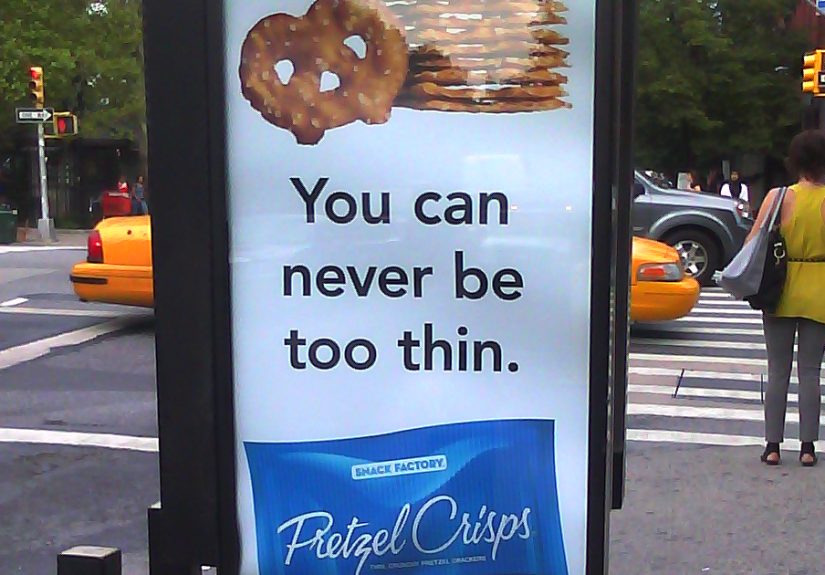
“You can never be too thin.” (Pretzel Crisps)
Type: Harmful message
This line drew backlash because it echoes damaging body idealsespecially for young audiences.
Lesson: if your “clever” hook could be read as shaming or unhealthy, it’s not clever. It’s a liability. -
“Ask Why.” (Enron)
Type: Slogan meets scandal
The phrase tried to position Enron as smart and curious. After the company’s collapse, the slogan turned into an unintended self-own.
Lesson: values-based taglines must match behavior, or they boomerang. -
“Beyond Petroleum.” (BP)
Type: Aspirational branding that invites receipts
The idea signaled a greener future. Critics later used it as a contrast point when events and perceptions didn’t align.
Lesson: don’t “announce” transformationdemonstrate it until the audience believes it for you. -
“The Future of Awesome.” (Comcast/Xfinity)
Type: Buzzword overload
“Awesome” is fun. “The Future of Awesome” is… a lot. It’s a promise so broad it’s hard to measure, easy to mock, and impossible to satisfy.
Lesson: if a slogan sounds like a tech keynote slide, tighten it. -
“This is not your father’s Oldsmobile.” (Oldsmobile)
Type: Fighting your own brand equity
It tried to shed an “older” image, but it also reminded everyone of the exact stereotype it wanted to escape.
Lesson: don’t lead with the insult. Lead with what’s genuinely newand let the audience connect the dots. -
“If PBS doesn’t do it, who will?” (PBS)
Type: Guilt-as-marketing
It’s memorable, but it can sound like a scold. Some audiences respond; others recoil.
Lesson: urgency can work, but “support us or else” is a risky emotional frame. -
“What can Brown do for you?” (UPS)
Type: Accidental middle-school humor
Iconic? Yes. Also easy to parody? Absolutely. The phrasing invites jokes, because “Brown” does a lot of heavy lifting.
Lesson: if your slogan is one pun away from chaos, be ready to own the jokeor rewrite. -
“We all go, why not Enjoy the Go.” (Charmin)
Type: Bathroom honesty with a thin line
Charmin leans into the reality everyone sharesbut the phrasing can still feel like it’s trying too hard to make “bathroom talk” adorable.
Lesson: if you go blunt, go confident. If you go cute, go simple. Don’t wobble between both.
How to avoid writing the next “worst tagline”
Run the 5-minute “misread” test
- Read it fast (like a highway billboard). If it needs explanation, it’s not a sloganit’s a paragraph missing its friends.
- Read it literally. If it becomes weird when taken at face value, customers will absolutely take it at face value.
- Read it sarcastically. If it turns into an insult when said with a smirk, social media will provide the smirk.
- Translate the idea (not the words) and have native speakers react, not “approve.”
- Check values claims. If it sounds like a promise, ask what proof you can show within one click.
Prefer benefits that customers can feel
The safest, strongest slogans usually point to something concrete:
faster, easier, tastier, cleaner, simpler, calmer, kinder. “Awesome” is a vibe. “Stops leaks” is a reason.
Vibes are finebut reasons are harder to dunk on.
of “real-world” lessons marketers take from bad slogans
In a lot of marketing debriefs, the slogan isn’t the real mistakeit’s just the most visible symptom. The pattern often starts weeks earlier:
a team is trying to satisfy too many goals at once. The tagline must be funny and premium and universal and short and
work on a billboard and sound great in a voiceover and translate cleanly and feel “modern,” which usually means
someone suggests the word “awesome” and everyone nods like it’s a renewable resource.
Here’s what experienced brand teams learn the hard way: slogans don’t fail in a vacuum (even the ones about vacuums).
They fail because humans are pattern-finding machines with a strong sense of humor and a short patience budget.
If your line is even slightly confusing, people will resolve the confusion by making it entertaining. That’s not cruelty
it’s the internet’s customer service model.
Another common lesson: “We’ll fix it in post” does not apply to meaning. You can color-grade a video. You cannot color-grade an implication.
If a tagline suggests something harmful, exclusionary, or tone-deaf, polishing the typography won’t rescue it. In fact, clean design can amplify the problem
by making the message feel more official. That’s why the best teams stress-test language early with real people, not just internal stakeholders.
Internal reviews tend to ask, “Do we like it?” Real audiences answer, “What does this do for me?” and “Is this trying too hard?”
Then there’s the “values trap.” Slogans like “Beyond Petroleum” or “Ask Why” aim to signal character. The risk is that the slogan becomes evidence in a case
the public is building about you. The more virtuous the line sounds, the more satisfying it is to quote back at you when something goes wrong.
That doesn’t mean brands should avoid values. It means values must be backed by actions that customers can point to without needing a PR interpreter.
Finally, many teams discover that the best slogan work feels less like writing and more like editing.
The winning line is often the simplest one that still sounds like you. Not the CEO’s favorite phrase.
Not the trend of the month. Not the “one line that can work for every audience.”
A slogan is allowed to be specific. In fact, specificity is what gives it a spine.
If you remember one “experience-based” rule from this list, make it this:
a good tagline is understood instantly and argued about later. A bad tagline is argued about instantly and understood never.
Conclusion
The world doesn’t need more slogans that sound like motivational posters or software updates. It needs clarity, humanity, and a tiny spark of truth.
The “worst advertising slogans and taglines” are funnyuntil you remember they cost real money, real time, and sometimes real trust.
The good news is that most of these disasters are avoidable with simple testing, cultural awareness, and the courage to delete words you don’t need.