Table of Contents >> Show >> Hide
- Why Handmade Diwali Cards Feel So Special
- 1. Make a Rangoli-Inspired Diwali Card
- 2. Make a Pop-Up Diya Card
- 3. Make a Layered Lotus Shaker Card
- What to Write Inside a Diwali Card
- Tips for Making Your Diwali Cards Look Better Instantly
- Experiences That Make Diwali Card-Making More Meaningful
- Final Thoughts
- SEO Tags
Diwali cards have one very important job: they should feel like joy the second someone sees them. Not mild joy, either. We are talking full-on, “Oh wow, you made this?” joy. That is the magic of a good handmade card during Diwali, the Festival of Lights. The holiday is widely associated with light, warmth, celebration, and welcoming beauty into the home, which makes it a perfect excuse to break out the cardstock, metallic pens, glitter, and every craft supply that has been living rent-free in your drawer for months.
If you want to make something thoughtful without turning your table into a disaster zone of glue dots and gold paper scraps, this guide will help. Below, you will find three practical ways to make Diwali cards that look festive, personal, and web-worthy without requiring a fine arts degree or the patience of a saint. These ideas are built around classic Diwali-inspired motifs such as diyas, rangoli patterns, lotus flowers, warm jewel tones, and shimmering metallic accents. In other words, the cards will look celebratory, not like your printer gave up halfway through.
Whether you are crafting with kids, making cards for friends and family, or creating a handmade note to tuck into a gift basket, these DIY Diwali card ideas are easy to customize. You can keep them simple, layer them up for a more elegant look, or turn the whole thing into a family craft night with snacks, music, and just enough glitter to regret later.
Why Handmade Diwali Cards Feel So Special
One reason handmade Diwali greeting cards work so well is that the holiday itself is rich with symbolism. Light, color, patterns, hospitality, and meaningful wishes all play a role in the celebration. A handmade card lets you bring those ideas together in one small format. You are not just sending paper. You are sending intention.
When designing a card for Diwali, think in layers. Start with color palettes like saffron, crimson, deep blue, marigold, emerald, pink, and gold. Add familiar festive motifs such as a diya flame, floral borders, mandala-like geometry, stars, lanterns, or rangoli-inspired shapes. Then finish with a message that feels warm and human. The best Diwali cards do not try too hard. They look bright, polished, and personal. Basically, they have the confidence of a person who arrives at a party with homemade dessert.
1. Make a Rangoli-Inspired Diwali Card
If you want a card that looks intricate but is surprisingly forgiving, a rangoli-inspired Diwali card is the place to start. Rangoli designs are known for symmetry, color, and decorative flourishes, which translate beautifully into card-making. The best part is that small imperfections usually disappear once the full pattern comes together. So yes, this is a craft where “close enough” often becomes “wow, that’s gorgeous.”
What You’ll Need
Blank cardstock or folded card base, pencil, ruler, fine-tip black pen or gold marker, watercolor paints or brush pens, metallic gel pens, and optional rhinestones or sequins.
How to Make It
Start by lightly sketching a centered design on the front of your card. You can use a circle, diamond, or square as the base shape, then build outward with petals, teardrops, dots, leaf shapes, and curved lines. Symmetry matters more than perfection, so divide the design visually into four or eight sections and repeat the same pattern around the center.
Once the pencil layout looks balanced, trace the lines with a gold or black pen. Then fill the shapes with warm, festive colors. Watercolors work especially well because they create a soft glow, while metallic pens add crisp contrast and sparkle. To make the design more dimensional, place tiny dots around the edges, layer a second outline around petals, or add one small rhinestone in the center.
The finished look should feel detailed but not crowded. Leave some breathing room on the card so the eye has a place to rest. In design terms, that is called balance. In normal-person terms, it means not decorating every square inch like the card owes you money.
Why This Card Works
This is one of the easiest homemade Diwali card ideas because it looks artistic even if you use simple shapes. It also works for nearly any age group. Kids can make a loose, colorful version with markers and stickers, while adults can turn the same idea into an elegant handmade card with fine detailing and metallic accents.
2. Make a Pop-Up Diya Card
If your goal is to create a card that feels interactive and memorable, go with a pop-up diya card. The diya, or small oil lamp, is one of the most recognizable symbols associated with Diwali. Turning it into a pop-up centerpiece gives the card movement and surprise, which is always a win. People love a card that does something when it opens. We are all basically five years old when paper engineering is involved.
What You’ll Need
Heavy cardstock, colored paper in orange, yellow, red, and gold, scissors or craft knife, glue stick or double-sided tape, foam dots if you want extra depth, and a metallic marker for details.
How to Make It
Fold a card base in half. On the inside fold, cut two short, parallel slits and push the tab inward to create a basic pop-up platform. This platform will hold the diya bowl. Cut a diya shape from colored cardstock and attach it to the tab. Then cut layered flame pieces in yellow, orange, and gold, making each one slightly smaller than the one behind it. Stack them and glue the flame above the diya.
Decorate the inside background with tiny stars, dots, swirls, or a simple arch shape behind the lamp to mimic the look of a glowing niche. On the front of the card, keep the design clean and elegant. A simple message like Happy Diwali, Wishing You Light and Joy, or May Your Home Glow with Happiness works beautifully.
If you want to upgrade the card, add a border using a metallic pen, line the diya bowl with a contrasting paper, or create a layered front cover with a cutout window so the lamp is partially revealed before the card is opened. That little preview makes the whole thing feel more professional, like you definitely know what you are doing even if you are secretly fixing glue mistakes with your thumbnail.
Why This Card Works
A pop-up diya card feels festive and meaningful without needing a lot of supplies. It is especially good for family members, close friends, or anyone you want to impress with a little extra effort. Among easy Diwali card ideas, this one offers the biggest visual payoff for the least dramatic amount of paper cutting.
3. Make a Layered Lotus Shaker Card
For a more modern, polished look, try a lotus shaker Diwali card. The lotus is associated with beauty, purity, and grace, and it pairs perfectly with festive colors and a little sparkle. A shaker card includes a transparent window filled with loose sequins, glitter, or confetti, so the front gently moves when you shake it. It is a card and a tiny party in one object.
What You’ll Need
Card base, decorative paper, clear acetate or transparent packaging sheet, foam adhesive strips, sequins or fine glitter, scissors or die-cut shape, and cardstock for a lotus or circular frame.
How to Make It
Start by cutting a window in the front panel of your card. A circle, arch, or lotus silhouette all work well. Glue a piece of clear acetate behind the window. Then use foam adhesive around the opening to build a shallow pocket. Sprinkle in sequins, tiny stars, or glitter confetti before sealing the back layer in place.
Now decorate the front with a lotus motif, gold border, or layered paper petals. Keep the embellishments mainly around the shaker window so it remains the star of the design. On the inside, write a warm message by hand to balance the glitz with something sincere.
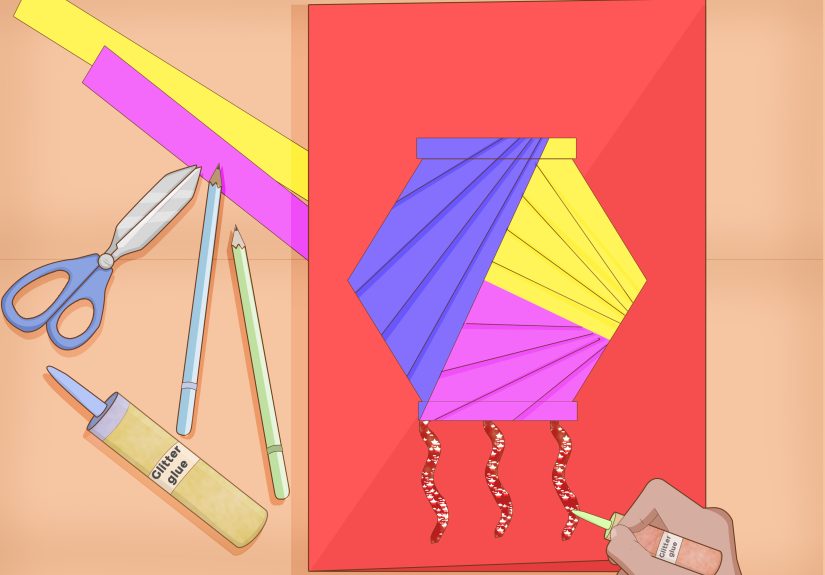
This is also a great card to make with a lantern theme instead of a lotus. If you prefer a more geometric look, use a hanging lantern silhouette on the card front and fill the shaker section with gold and orange confetti to mimic glowing light. It is festive, elegant, and just dramatic enough to feel special.
Why This Card Works
Shaker cards are ideal when you want a handmade result that still feels giftable and refined. This version is especially strong if you are making Diwali cards for adults, coworkers, hosts, neighbors, or anyone who appreciates a design that looks custom rather than crafty in the elementary-school sense.
What to Write Inside a Diwali Card
Once the outside looks beautiful, do not let the inside collapse into a bland one-liner. A good message completes the card. You can keep it classic with something like, “Wishing you peace, prosperity, and happiness this Diwali,” or “May the light of Diwali fill your home with warmth and joy.”
If your relationship is more casual, a friendly note works too: “Hope your Diwali is bright, sweet, and full of good food,” or “Sending warm wishes for a joyful Festival of Lights.” If the card is for someone close, mention a shared memory, a family tradition, or a hope for the coming year. Handmade cards become keepsakes when the message sounds like a person wrote it, not a robot that recently discovered emotions.
Tips for Making Your Diwali Cards Look Better Instantly
Use heavier paper whenever possible. Thin paper can buckle under paint, glue, or too many embellishments. Limit yourself to two or three main colors plus one metallic accent so the design stays cohesive. Mix textures for visual interest, such as matte cardstock with glitter paper or watercolor with metallic pen details. Most importantly, leave some negative space. Not every card needs to look like a fireworks finale exploded on it.
It also helps to make one sample before producing several cards in a batch. That first card teaches you the spacing, the fold mechanics, and the exact moment you realize glitter will somehow migrate to your elbow. After that, the rest go faster and look more consistent.
Experiences That Make Diwali Card-Making More Meaningful
One of the most interesting things about making Diwali cards is that the craft changes depending on who you are making them with and who you are making them for. On paper, it sounds like a simple DIY project. In real life, it often becomes a small event. A family table fills up. Someone insists on using way too many sequins. Someone else argues that every card needs more gold. There is laughter, a little chaos, and eventually a stack of handmade cards that somehow carry all of that energy with them.
I have noticed that DIY Diwali cards work especially well in group settings because they give everyone a role. Kids can color flames, stamp circles, glue borders, and add stickers. Teenagers usually pretend they are too cool for crafting until they start designing a shockingly good card with a layered lantern cutout. Adults, meanwhile, become very serious about symmetry and spacing, as if a slightly crooked lotus petal is a matter of national importance. That mix of personalities is part of the fun.
There is also something surprisingly thoughtful about making a card by hand in a season that is often full of shopping, wrapping, planning, and rushing. A handmade card slows the whole thing down. You choose the colors intentionally. You think about the message before writing it. You decide whether the person receiving it would like something playful, elegant, traditional, or modern. Even a quick card can feel personal because it reflects your choices in a way a store-bought card usually cannot.
Another experience many people have is discovering that a “simple” card is not always the easiest one to make. A plain front with one diya and a clean greeting actually requires restraint, which is harder than it sounds when you have glitter sitting nearby making bad decisions on your behalf. On the other hand, a busy rangoli card can be more forgiving because it invites detail and color. That is why beginners often do better when they start with rich patterns instead of minimalist designs.
Card-making also becomes a bridge between generations. Grandparents may recognize symbolic motifs immediately. Parents may focus on the message and presentation. Children often respond first to color and sparkle. When everyone contributes, the finished card can carry multiple perspectives at once. It is decoration, greeting, and memory all packed into one folded sheet of cardstock, which is honestly impressive for something that began life as paper from a craft aisle.
And then there is the moment the card is received. That part matters. People tend to pause longer when they open a handmade card. They touch the textured paper. They notice the cut edges, the metallic outline, the tiny uneven dot that proves a real human made this thing at an actual table. In a world full of fast messages and disappearing notifications, a handmade Diwali greeting card feels wonderfully stubborn. It insists on being held, opened, read, and sometimes saved.
So yes, making Diwali cards is about paper, color, and technique. But it is also about atmosphere, memory, and connection. It is about turning symbols of light into something tangible and shareable. It is about creating a small object that says, “I thought of you, and I wanted that thought to look beautiful.” That is a pretty good reason to clear off the table, pull out the cardstock, and make something festive.
Final Thoughts
If you are wondering which of these three ways to make Diwali cards is best, the real answer is simple: choose the one that matches your time, your supplies, and your style. Go with the rangoli card if you love color and pattern. Pick the pop-up diya card if you want a meaningful design with a little surprise. Choose the lotus shaker card if you want sparkle, movement, and a polished finish.
No matter which approach you try, the secret is not perfection. It is intention. Diwali is a celebration of light, hope, beauty, and connection, and a handmade card can reflect all of that in a way that feels warm and unforgettable. So make the card, write the message, embrace the glitter fallout, and let your greetings shine.