Table of Contents >> Show >> Hide
- First, What Does “Market Value” Mean?
- Method 1: Market Capitalization (Equity Market Value)
- Method 2: Enterprise Value (Total Firm Value / Takeover Value)
- Method 3: Comparable-Company Multiples (Implied Market Value)
- How to Choose the Best Method (Without Overthinking It)
- Real-World Experiences: What Valuation Feels Like in Practice
- Conclusion
“What’s this company worth?” sounds like a simple questionuntil you realize it’s secretly three questions wearing a trench coat.
Are you asking what the stock market says the equity is worth? What the whole business would cost to buy? Or what similar
companies are selling for right now?
The good news: you don’t need a fancy finance cape to get solid answers. You just need to pick the right lens and do the math carefully.
Below are three practical ways to calculate a company’s market value, with clear formulas, examples, and the kinds of “gotchas” that trip up
smart people (including the kind who own two monitors and still forget to subtract cash).
First, What Does “Market Value” Mean?
In everyday investing talk, market value often means “what the market would pay today.” For a public company, that’s typically based
on its current share price. For buying the entire business, you’ll usually look at enterprise value. And for private companies (or when you want a
sanity check), you can infer value using comparable-company multiplesbasically, “what are businesses like this trading at?”
A related term you’ll hear in taxes, accounting, and deal documents is fair market value: the price a willing buyer and seller would
agree on with reasonable knowledge and no pressure. That definition matters because “value” changes depending on whether you’re valuing a minority
stake, a controlling stake, or a hypothetical sale.
Method 1: Market Capitalization (Equity Market Value)
If the company is publicly traded, the cleanest starting point is market capitalizationthe market value of its equity. Think of it as:
“If you bought every share at today’s price, what would it cost?”
Formula
Market Cap = Share Price × Shares Outstanding
Where to find the inputs
- Share price: Current trading price.
- Shares outstanding: Company filings (often in the 10-K/10-Q) and market data pages.
Example
Let’s say a company trades at $25 per share and has 100,000,000 shares outstanding.
Market Cap = $25 × 100,000,000 = $2,500,000,000 (that’s $2.5B).
Common “don’t step on this rake” mistakes
-
Using the wrong share count: Basic shares vs. diluted shares. If the company has lots of options and restricted stock units (RSUs),
fully diluted share count can matter for “real-world” equity value discussions. -
Confusing price with value: A $500 stock can be “smaller” than a $5 stock if the share count is different. Share price is a sticker;
market cap is the whole price tag. -
Ignoring new information: An 8-K filing (major events, acquisitions, leadership changes) can move price quicklybecause markets love
surprises and hate spreadsheets.
When market cap is the right answer: You want the market value of the equity of a public companyespecially for index sizing, comparing
company “size,” or quick peer comparisons.
Method 2: Enterprise Value (Total Firm Value / Takeover Value)
Market cap tells you what the equity is worth. But if you’re thinking like an acquirer“What would it cost to buy the business operations?”
you usually want enterprise value (EV).
EV adjusts for the idea that a buyer assumes (or pays off) the company’s debt but also gets its cash. In other words: buying a company isn’t just buying
the stock; you’re buying the whole capital structure.
Core formula (common version)
Enterprise Value = Market Cap + Total Debt − Cash & Cash Equivalents
In more detailed models, EV can also include preferred equity and minority interest (and sometimes subtract non-operating investments). But the formula above
is the standard quick calculation most people start with.
Example
- Market Cap: $2.5B
- Total Debt: $1.0B
- Cash & Cash Equivalents: $0.2B
EV = 2.5B + 1.0B − 0.2B = $3.3B
Why EV is so popular in valuation
-
Capital-structure neutral comparisons: Two companies can have the same operations but different debt levels. EV helps you compare the
business itself, not just how it’s financed. -
Works well with operating metrics: EV pairs naturally with EBITDA, revenue, and free cash flow metrics.
That’s why you’ll see multiples like EV/EBITDA and EV/Revenue. - Closer to “what it costs to buy”: It’s often called “takeover value” for a reason.
EV pitfalls to watch
-
What counts as “debt”? Short-term and long-term debt are obvious. Leases, preferred stock, and other claims can matter depending on the
company. Real-world EV is a little more “accounting-adjacent” than people expect. -
What counts as “cash”? Companies may hold restricted cash or cash needed for operations. Many analysts focus on excess cash rather
than every dollar on the balance sheet.
When EV is the right answer: You’re valuing the whole business (not just equity), comparing companies with different leverage, or using
EV-based multiples.
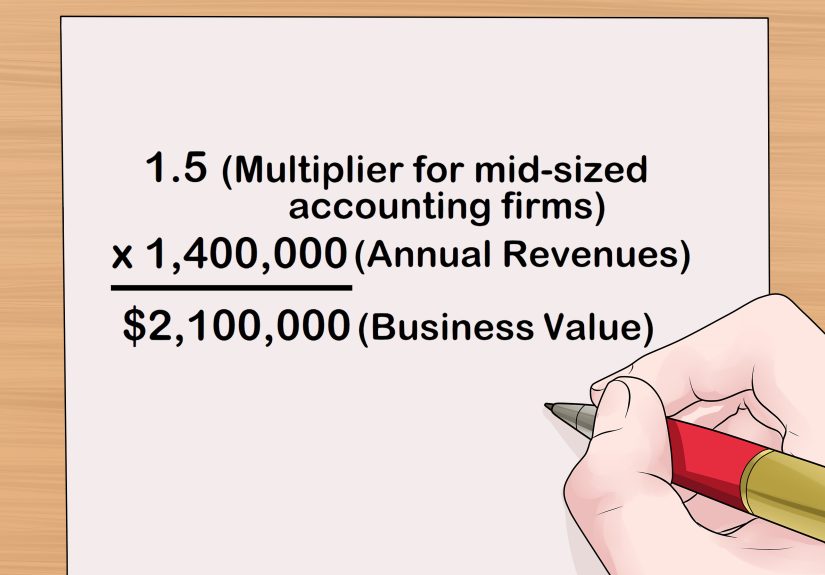
Method 3: Comparable-Company Multiples (Implied Market Value)
If market cap is the “what the market says today” number, and EV is the “what it costs to own the whole business” number, then comparables answer:
“What does the market pay for businesses like this?”
This is called relative valuation or the market approach. It’s widely used because it’s fast, intuitive, and anchored to
actual pricing in the marketlike using neighborhood home sales to estimate what your house might sell for, except with more spreadsheets and fewer open houses.
Step-by-step process
- Pick a peer group: Find similar public companies (same industry, business model, growth profile, margins, customer type).
-
Choose a multiple: Common ones include P/E (price-to-earnings) for profitable companies,
EV/EBITDA for operating comparisons, and EV/Revenue for high-growth or early-margin businesses. - Calculate peer multiples: Use market prices (market cap or EV) and financial statement metrics (earnings, EBITDA, revenue).
- Apply the multiple to the target company: Multiply the chosen multiple by the target company’s metric to get implied value.
- Adjust thoughtfully: Differences in size, growth, risk, margins, and accounting can justify a higher or lower multiple.
Quick example using EV/EBITDA
Suppose comparable companies trade around 9× EV/EBITDA. Your target company has EBITDA of $50M.
Implied EV = 9 × $50M = $450M
If the company has $120M of net debt (debt minus cash), then implied equity value is:
Implied Equity Value ≈ $450M − $120M = $330M
Which multiple should you use?
- P/E: Simple and popular, but sensitive to capital structure, taxes, one-time items, and accounting choices.
- EV/EBITDA: Widely used for operating comparisons; reduces noise from financing and some accounting differences.
- EV/Revenue: Helpful for fast-growing companies where earnings are intentionally low due to reinvestment.
Comparable valuation “reality checks”
- Garbage comps = garbage output: If your peer group isn’t actually comparable, the multiple is just a fancy random number generator.
-
Market mood swings: Multiples expand and contract with interest rates, sentiment, and sector cycles. Your “value” can change without the
company changingmarkets are talented like that. -
Private companies need adjustments: Lack of liquidity, concentrated control, and limited disclosure often require discounts or premiums in
practice.
When comparables are the right answer: You want a market-anchored estimate of value, especially for private companies, IPO prep,
M&A discussions, or “Does this price even make sense?” sanity checks.
How to Choose the Best Method (Without Overthinking It)
- If it’s a public company and you mean equity: Start with market cap.
- If you mean the whole business: Use enterprise value.
- If it’s private (or you want a market-based estimate): Use comparables (and consider more than one multiple).
In real-world valuation work, people often triangulate: market cap (if public), EV, and compsthen ask, “Do these tell a consistent story?”
If they don’t, that’s not a failure. That’s a clue.
Real-World Experiences: What Valuation Feels Like in Practice
If you’ve never valued a company before, it can look like a clean math problem. And sometimes it isright up until the moment your inputs come from the real
world, which is famously allergic to being neat.
One of the first practical lessons people learn: the biggest valuation errors are usually conceptual, not calculator-based. Someone can nail
the market cap formula and still be “wrong” because they’re answering the wrong question. For example, a founder might say, “Our company is worth $200M,” while
describing a future funding round price (implied equity value), while an acquirer is thinking in enterprise value terms (value of operations), and a tax advisor
is thinking fair market value of a specific class of shares. Same sentence, three different meanings, one very confusing meeting.
Another on-the-ground reality: inputs are not neutral. With comparable multiples, picking peers is half art. Two analysts can start with the same
industry list and end up with different valuations because one included higher-growth companies and the other filtered for profitability. Neither is “cheating.”
They’re just making different judgments about what “similar” means. This is why good valuation work explains why a peer set makes sense, not just what
the peer set is.
EV calculations also teach humility. People expect EV to be plug-and-play, but it can turn into a rabbit hole: Is lease debt included? What about preferred stock?
Is cash restricted? Are there non-operating investments? The more complicated the business, the more EV becomes a “claims on the business” exercise rather than a
simple three-line formula. The experience here is less “I memorized a definition” and more “I understand what the definition is trying to represent.”
Then there’s the timing factor. Valuation is a snapshot, and snapshots can be unflattering. In a hot market, multiples rise and everyone looks brilliant. In a
cold market, multiples fall and suddenly your company is “worth” less even if revenue is up. That feels unfair, but it’s a feature of market pricing: it’s a
consensus estimate that includes opportunity cost (like interest rates) and risk appetite, not just company performance.
Finally, experienced folks learn to communicate value with ranges and reasoning, not just a single heroic number. A clean output like “$450M” is temptinguntil
someone treats it as destiny. In practice, the best outcome is a valuation that’s decision-useful: it explains what drives value (growth, margins,
risk, leverage), highlights sensitivity (what changes the answer), and makes it clear which “market value” you’re talking about (equity value, enterprise value,
or implied value from comps). The math matters, but the storyand the definitionsmatter just as much.
Conclusion
Calculating a company’s market value isn’t about finding the one true number. It’s about choosing the right measurement for the question you’re actually
trying to answer:
- Market cap for public-company equity value
- Enterprise value for the value of the whole business
- Comparable multiples for a market-anchored implied value (especially useful for private companies)
Use the method that matches your purpose, double-check your inputs, and remember: valuation is part math, part judgment, and part explaining to someone why you
didn’t “just Google the number.” (You did. You just also did the work.)