Table of Contents >> Show >> Hide
- What Is the 2025 One Hertz Challenge?
- Inside “Shoulda Put a Ring Oscillator On It”
- Ring Oscillator 101: How It Works
- Ring Oscillator vs. Crystal: The 1 Hz Tradeoff
- The Artistic Side of Timing Circuits
- Design Lessons from “Shoulda Put a Ring Oscillator On It”
- Thinking About Your Own One Hertz Project
- Experience: What It’s Like to Build Around 1 Hz and Ring Oscillators
- Conclusion
Some people collect stamps. Others look at a perfectly good one-second interval and think,
“I bet I can over-engineer that.” That, in a nutshell, is the spirit behind the
2025 One Hertz Challenge on Hackaday and the gloriously nerdy entry
“Shoulda Put a Ring Oscillator On It.” This isn’t just about blinking an LED once per
second. It’s about how you get that one hertz in the first place – and whether
you can do it with style, LEDs, and a little analog mischief.
In this deep dive, we’ll unpack what the One Hertz Challenge is all about, why a
ring oscillator is such a fun (if slightly chaotic) way to hit 1 Hz,
and what makes the featured project stand out. Along the way, we’ll look at how
ring oscillators compare to more traditional clock sources like crystals, and why
makers keep choosing the weird option on purpose.
What Is the 2025 One Hertz Challenge?
Hackaday’s 2025 One Hertz Challenge is deliberately simple and
delightfully cruel: build something that does anything, as long as it
does it once per second. That’s it. Whether your project flashes lights,
moves a motor, updates a display, or triggers some absurd mechanical contraption,
the only hard rule is the beat: 1 Hz, over and over again.
To enter, builders document their projects on Hackaday.io and tag them for the contest.
Entries range from practical clocks and metronomes to wildly artistic or deliberately
uncooperative devices, like a “Metronalmost” that works hard to avoid ever
ticking exactly once per second. The result is a weirdly diverse
gallery of gadgets united by one simple numeric constraint.
Why 1 Hz Is Weirdly Fascinating
One hertz sounds boring: it’s just one cycle per second. But in electronics, it’s
unusually slow. Most microcontrollers, ring oscillators, and RF systems operate in
kilohertz, megahertz, or gigahertz ranges. To hit exactly 1 Hz, you usually have to:
- Start with a much higher frequency (like a crystal at 32.768 kHz or several MHz).
- Use digital dividers or counters to divide that frequency down.
- Or design an inherently slow analog oscillator, often using large resistors and capacitors.
That’s what makes the challenge interesting: do you lean on precise, well-behaved
oscillators, or do you build something quirky and analog that merely looks
like it’s hitting one tick per second?
Inside “Shoulda Put a Ring Oscillator On It”
The Hackaday feature “2025 One Hertz Challenge: Shoulda Put a Ring Oscillator On It”
spotlights an entry called the One Hertz Sculpture by
maker Pierre-Loup M. Instead of a boxy PCB,
this project turns a timing circuit into a piece of free-form circuit art.
A Free-Form Circuit in a Picture Frame
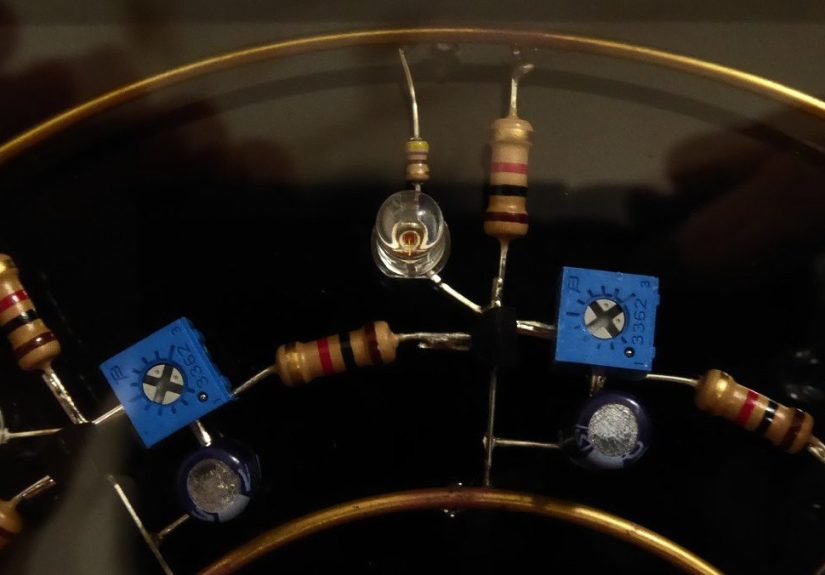
The sculpture lives inside a picture frame: nine LEDs arranged in a ring, supported by
shaped wires and discrete components that float in midair. It’s both an electronics
experiment and a design piece you could hang on the wall. The LEDs appear to “chase”
around the ring, creating a reverse-chase effect as one LED at a time goes dark.
The entire cycle takes roughly one second to loopclose enough to 1 Hz for the human
eye to accept it as a steady beat.
But behind that calm visual, the electronics are doing something quite nerdy:
implementing a ring oscillator out of discrete parts.
Resistor-Transistor Logic and Handmade Inverters
At the core of the sculpture is a chain of nine inverter stages, each built from
resistor–transistor logic using classic 2N3904 NPN transistors.
In a pure ring oscillator, each inverter introduces a propagation delay. With an odd
number of inverters, the signal continuously flips and chases itself around the loop.
The problem? A simple transistor-based ring oscillator like this can naturally run in
the megahertz rangeway too fast for art or visibility. Hackaday notes
that this design, left to its own devices, could easily oscillate around 5 MHz.
To slow it down, each transistor stage is paired with an RC network that increases the
time constant, stretching the delay so the effective frequency drops to around 1 Hz.
The result is a lovely compromise: it’s not a precision timekeeper worthy of a
metrology lab, but it’s accurate enough that you perceive a pleasant one-second
rhythm as the LEDs chase around the ring.
Ring Oscillator 101: How It Works
A ring oscillator is one of the simplest oscillator circuits you can
build. It consists of:
- An odd number of inverter stages (3, 5, 7, 9, etc.).
- The output of the last inverter fed back into the input of the first.
- Some propagation delay in each stage.
Because the signal can’t settle into a stable 0 or 1 (it keeps getting inverted
and delayed), the circuit spontaneously oscillates. The oscillation frequency is
roughly determined by:
f ≈ 1 / (2 × N × tdelay)
where N is the number of stages and tdelay
is the delay per stage. Increase the delay, and the frequency drops. That’s why the
One Hertz Sculpture tacks RC networks onto each inverter: it amplifies delay and
slows the loop.
Ring Oscillators in the Real World
Ring oscillators aren’t just hobby curiosities. They show up in:
-
Integrated circuits for on-chip clock generation and process
monitoring, where you care about relative speed rather than exact frequency. -
Voltage-controlled oscillators (VCOs) in PLL-based clock generators,
where a wide tuning range is more important than crystal-level accuracy. -
Reliability and aging studies, where engineers measure how device
characteristics drift over time by watching changes in oscillation frequency.
They’re compact, easy to integrate in CMOS, and wonderfully responsive to voltage,
temperature, and device variationswhich is both a feature and a bug.
Ring Oscillator vs. Crystal: The 1 Hz Tradeoff
If your goal is to hit exactly 1 Hz, a ring oscillator is not the
ideal tool. It tends to drift with temperature, supply voltage, and component tolerances.
Engineers often warn that ring oscillators are “terrible for accuracy” and are best
used where relative frequency or jitter tolerance is acceptable.
For precise, long-term stable timing, you’re more likely to see:
-
Crystal oscillators, which use quartz resonance to achieve very
stable frequencies (like 32.768 kHz in many RTCs) that can be divided down to 1 Hz. - LC oscillators or other resonant structures for RF and higher-frequency clocks.
But here’s the catch: Hackaday’s One Hertz Challenge doesn’t necessarily demand
metrology-grade accuracy. It rewards creativity, aesthetics, and interesting engineering
approaches. That’s where ring oscillators shine.
Why Use a Ring Oscillator for a 1 Hz Challenge?
Choosing a ring oscillator for a 1 Hz project is basically saying:
- “I know this is not the easy way, and I’m doing it anyway.”
- “This isn’t just about making a clockit’s about exploring a circuit.”
- “If the timing drifts a bit, that’s part of the charm.”
In the One Hertz Sculpture, the ring oscillator isn’t just a clock source; it is
the art. The transistor-resistor network and LED ring visually represent the signal
moving through the system. You can almost see the propagation delay as the dark LED
travels around the circle.
The Artistic Side of Timing Circuits
Hackaday has been highlighting not just practical timing devices but also playful and
artistic interpretations of the One Hertz idea. There are entries like:
- Sculptural clocks and circuit art pieces that treat 1 Hz as a visual rhythm rather than a strict metric.
- Devices like the “Metronalmost,” which intentionally avoids ever landing exactly on 1 Hz and weaponizes timing jitter as a design feature.
- Mechanical escapement-based clocks and neon or Nixie-tube ring oscillator clocks that use old-school display tech with modern driver circuits.
The One Hertz Sculpture fits right in. It is unapologetically decorative, with the
electronics fully exposed instead of buried on a board. The fact that its timing
isn’t perfect only reinforces the point: this is a sculpture first,
clock second.
Design Lessons from “Shoulda Put a Ring Oscillator On It”
1. Start with the Visual Story
The project begins with a simple visual idea: a ring of LEDs in a picture frame.
That aesthetic concept drives every design decisionthe number of LEDs, the physical
layout of components, and even the choice of ring oscillator topology.
If you’re entering a creative electronics contest, this is a smart move: decide what
you want people to see first, then work backward to the circuitry that makes
that effect happen.
2. Embrace Imperfect Accuracy for Better Storytelling
From a pure engineering standpoint, the ring oscillator–RC combo is imprecise. Its
effective 1 Hz rate can drift, and it’s not going to win any “Time Lords” category
for accuracy. But the project doesn’t need to. The point is the concept: demonstrating
a ring oscillator slowed down enough that humans can appreciate it.
Sometimes, deliberately choosing the “wrong” tool makes your build more memorable.
There’s a reason so many One Hertz Challenge entries avoid easy solutions like
microcontrollers with built-in RTCs and instead lean on obscure timing tricks,
radio time references, or weird mathematics.
3. Use Constraints to Spark Creativity
The 1 Hz constraint might seem minor, but it forces design decisions:
- How will you generate the 1 Hz signal?
- How will you display or use the beat?
- Will your project be art, tool, toy, or troll?
The One Hertz Sculpture accepts the constraint and runs with itturning a simple timing
requirement into an excuse to explore analog art, LED behavior, and transistor logic
in a visually engaging way.
Thinking About Your Own One Hertz Project
If this Hackaday feature has you itching to join the fun (or preparing for future
contests), here are a few directions you could take:
-
Pure analog: Design a slow RC or relaxation oscillator, then use it
to drive a relay, solenoid, or mechanical sculpture. -
Crystal-based precision: Use a 32.768 kHz crystal oscillator and
digital dividers to get an extremely stable 1 Hz pulse for a clock or timing tool. -
Radio or network time: Derive 1 Hz from GPS, radio time codes, or
NTP for an over-the-top “this will be accurate until the end of the universe” vibe. -
Ring oscillator art: Take inspiration from the One Hertz Sculpture
and turn a ring oscillator into something you’d actually frame and hang.
Whichever path you choose, the sweet spot is where engineering challenge, aesthetics,
and narrative all meet.
Experience: What It’s Like to Build Around 1 Hz and Ring Oscillators
Even if you’ve designed plenty of fast digital circuits, working at 1 Hz with a ring
oscillator feels different. Makers who tinker with these circuits tend to share a
few common experiences and lessons.
Watching the Invisible Become Visible
In most ICs, a ring oscillator hums along at tens or hundreds of megahertz. You never
“see” itit’s just a clock source. But when you stretch the delay so that the loop
takes a whole second to complete, the behavior becomes tangible:
- You can point to each LED in the ring and say, “The signal is here now.”
-
You start to intuit how propagation delay adds up as the “dark” or “bright” spot
advances step by step. - You see how tiny changes in component values or supply voltage subtly affect speed.
That’s one of the quiet joys behind a project like the One Hertz Sculpture. It’s a
teaching tool disguised as wall art. If you show it to a beginner, you can literally
trace the flow of logic around the ring and explain why an odd number of inverters
matters.
The Reality of Drift, Jitter, and “Good Enough”
When you first set out to build a one hertz circuit, it’s tempting to obsess over
perfection: “Is this exactly one second? Is it drifting over time? What’s the ppm
error?” After a whileespecially if you’re using a ring oscillatoryou learn to
relax a bit.
The experience usually goes something like this:
-
You pick resistor and capacitor values that should give roughly 1/9 of a second
per stage. - You power it up and realize your loop completes in slightly under or over one second.
-
You tweak values, change supply voltage, or move components, and the timing nudges
closer but never quite locks perfectly.
At some point, you accept that the circuit has a personality. It’s steady enough to
be recognizable as “once per second,” and that’s what matters for an artistic build.
The small timing variations actually give the sculpture a kind of analog charm that
a rock-solid crystal clock wouldn’t have.
Mechanical and Aesthetic Challenges
Building a free-form ring oscillator sculpture isn’t just about schematics. You have
to think mechanically:
- How will the wires support the components without shorting?
-
Can you arrange the transistors and resistors so the structure looks intentional,
not random? - Will the LED ring look balanced from different angles in the frame?
Many makers discover that these questions take just as much time as the electrical
design. You end up bending and re-bending wires, re-soldering joints, and stepping
back repeatedly to judge the overall compositionjust like you would with sculpture
or jewelry making.
Debugging at One Hertz
Debugging a 1 Hz circuit offers its own unique rhythm. Instead of watching a
high-speed waveform on an oscilloscope, you can often debug by eye:
- If one LED in the ring never lights, that stage might be wired backward or shorted.
-
If the dark “gap” jumps unpredictably or freezes, you may have a loose connection
or marginal biasing on a transistor. -
If the timing suddenly speeds up or slows down, a power-supply issue or temperature
change may be affecting your RC time constants.
This slower pace can be strangely satisfying. You make a small change, wait a few
cycles, and literally watch the behavior evolve in real time. It turns debugging into
a quiet feedback loop between you and the circuit.
Community and Creativity
Finally, part of the experience is social. Contests like the One Hertz Challenge
attract a wide mix of participantsprofessional engineers, students, artists, and
hobbyists with decades of tinkering behind them. Browsing the entries, you see:
- Perfectly engineered precision clocks sitting next to chaotic analog contraptions.
- Projects that treat 1 Hz as a serious timing problem.
- Projects that treat 1 Hz as a punchline, trolling the very idea of exact timing.
When a project like “Shoulda Put a Ring Oscillator On It” gets featured, it sends a
clear message: creative misuse of technology is welcome here. You don’t have to build
the most accurate 1 Hz device to stand out; you just have to interpret that one-second
heartbeat in a way that tells a story.
Conclusion
The 2025 One Hertz Challenge looks simple on paper, but projects like
“Shoulda Put a Ring Oscillator On It” prove that a single hertz can inspire a surprising
amount of creativity. By slowing a ring oscillator down to human timescales and turning
it into free-form circuit art, the One Hertz Sculpture blends analog electronics,
timing theory, and visual design into one memorable build.
Whether you’re an engineer curious about ring oscillators, a maker looking for your
next Hackaday.io project, or just someone who likes blinking lights in picture frames,
there’s a lot to learn from this entry. Sometimes, the best way to understand a circuit
is to make it big, slow, and beautiful enough to live on your wall.