Table of Contents >> Show >> Hide
- Before You Build: The 5-Minute Spice Plan That Saves Hours
- 16 DIY Spice Rack Ideas
- 1) Cabinet Door Slim Shelves
- 2) Dollar-Store Tension Rod Spice Gate
- 3) Tiered Shelf Risers (DIY Stadium Seating)
- 4) Drawer Insert with Angled Rows
- 5) Magnetic Strip + Metal-Lid Jars
- 6) Sheet-Metal Spice Board
- 7) Pegboard Spice Wall
- 8) Repurposed Wooden Crate “Spice Cubby”
- 9) Floating Ledge Racks (Minimalist & Practical)
- 10) Under-Shelf Hanging Spice Basket
- 11) Lazy Susan Turntable Station
- 12) Spice “File” Box for Packets
- 13) Test Tube Spice Rack (Compact + Fun)
- 14) Upcycled Picture Frame “Spice Shelf”
- 15) Behind-the-Door Pantry Spice Column
- 16) Countertop Caddy with Handles
- Smart Placement: Keep Spices Fresh (and Not Weird)
- Conclusion
- DIY Spice Rack Experiences: What People Learn After the First Week (and the First Spill)
If your spice situation currently looks like a tiny bottle apocalypse (paprika rolling under the toaster, oregano hiding behind the
cereal, and that mysterious jar labeled “??? 2019”), you’re not alone. Spices are small, slippery, and weirdly talented at multiplying
when you’re not looking.
The good news: you don’t need a full kitchen remodel to make your spices behave. With a little DIY creativitysome scrap wood, a few
screws, maybe a magnetic stripyou can reclaim cabinet space, clear your counters, and actually find cumin before the onions
burn. Below are 16 practical DIY spice rack ideas that work in real kitchens (including small apartments, rental-friendly spaces,
and “my cabinets were designed in 1973” situations).
Before You Build: The 5-Minute Spice Plan That Saves Hours
1) Measure the space you actually have
Pick your target zone first: inside a cabinet door, on a pantry wall, beside the stove, inside a drawer, or on the fridge. Then measure:
height, width, and depth (especially if you’re mounting inside a doorbottle depth matters).
2) Decide how you want to “think” while cooking
- Alphabetical: fastest to find, easiest to maintain.
- By cuisine: taco spices together, baking spices together, etc.
- By frequency: daily drivers in front; occasional spices elsewhere.
3) Standardize containers (optional, but powerful)
You can keep original jars, but matching containers make DIY racks easier because everything fits. If you do decant, label the top
(for drawer storage) and the side (for shelf storage), and write a refill date if you’re feeling extra responsible.
16 DIY Spice Rack Ideas
1) Cabinet Door Slim Shelves
Build shallow ledges on the inside of a cabinet door using thin wood strips or ready-cut trim. Add a small lip so jars don’t escape
every time you close the door like it owes them money.
- Best for: small kitchens, hidden storage
- Pro tip: test door clearance firstdeep jars can hit shelves inside the cabinet
2) Dollar-Store Tension Rod Spice Gate
Turn any shelf into a spice corral by installing a mini tension rod across the front. It’s the simplest “keep jars from falling”
hack, and it’s wonderfully low commitment.
- Best for: renters, quick fixes
- Pro tip: use two rods (one higher) if you stack smaller jars
3) Tiered Shelf Risers (DIY Stadium Seating)
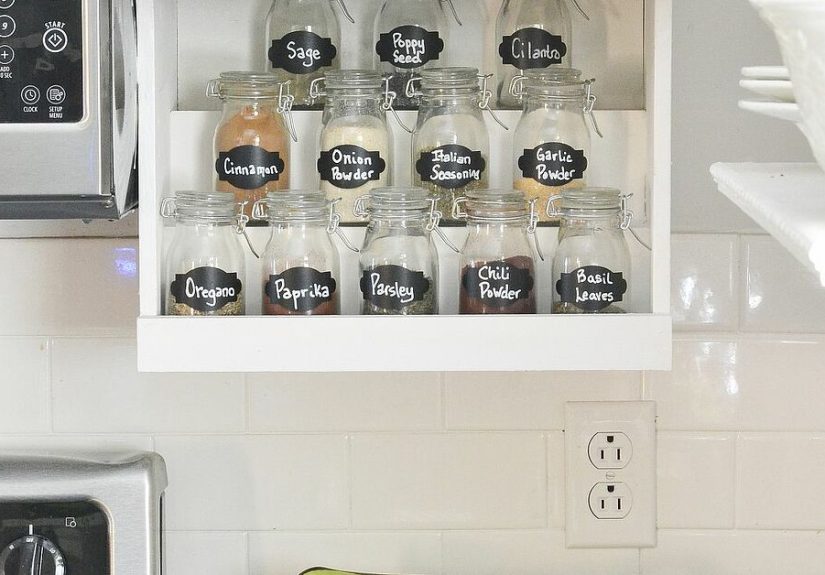
Make a stepped riser from scrap wood (or sturdy cardboard + adhesive shelf liner) so spices in the back aren’t sentenced to a lifetime
of invisibility. Think “concert seating,” but for cinnamon.
- Best for: cabinet shelves, pantry shelves
- Pro tip: add non-slip liner to each step
4) Drawer Insert with Angled Rows
Build an angled spice drawer insert using thin boards cut into lanes. Angling the jars makes labels readable at a glance and keeps
them from rolling around like tiny bowling pins.
- Best for: deep drawers, neat freaks (affectionate)
- Pro tip: label jar lids for maximum speed
5) Magnetic Strip + Metal-Lid Jars
Mount a strong magnetic knife strip or metal bar on the wall, then use spice jars with metal lids (or glue magnets to jar bottoms).
This turns spices into functional wall decorand frees up cabinet space.
- Best for: small kitchens, modern looks
- Pro tip: keep magnets away from heat/steam zones for longevity
6) Sheet-Metal Spice Board
Attach a thin sheet of metal to a framed board, paint it to match your kitchen, and stick magnetized spice jars on it. It’s like a
spice gallery wall you can season dinner with.
- Best for: pantry walls, back-of-door setups
- Pro tip: add a small “catch ledge” at the bottom as insurance
7) Pegboard Spice Wall
Pegboard isn’t just for garages. Mount a small pegboard panel and add mini shelves or hooks to hold spices, measuring spoons, and
small baskets for packets.
- Best for: flexible storage, growing collections
- Pro tip: outline shelf positions with painter’s tape before committing
8) Repurposed Wooden Crate “Spice Cubby”
A small crate or wine box can become a cubby-style rack. Sand it, stain it, mount it, and you’ve got a rustic organizer that looks
like it came from a boutique (not your garage).
- Best for: farmhouse style, pantry walls
- Pro tip: add thin dividers if jars tip over
9) Floating Ledge Racks (Minimalist & Practical)
Install narrow floating ledges in a vertical stack. Keep the lip tall enough to secure jars, but shallow enough to avoid “doorway”
vibes where spices disappear into a tunnel.
- Best for: empty wall space near prep areas
- Pro tip: stagger ledges to fit taller grinders
10) Under-Shelf Hanging Spice Basket
Use under-shelf baskets (or DIY a small wire basket mount) to store spices below an existing shelf. It’s a great “found space” trick
when cabinets are full.
- Best for: pantries, upper cabinets
- Pro tip: keep heavier jars toward the bracket side
11) Lazy Susan Turntable Station
A spinning turntable is one of the easiest ways to stop the “move nine jars to reach one” problem. Add a DIY label ring around the edge
to keep categories consistent.
- Best for: corner cabinets, deep shelves
- Pro tip: use two-tier turntables if you have height
12) Spice “File” Box for Packets
Spice packets and mixes love chaos. Create a mini file system using a small box and DIY dividers (cardstock, thin plastic, or wood).
Label sections like “taco,” “gravy,” “marinades,” and “backup.”
- Best for: packet hoarders (no judgment)
- Pro tip: keep it near the pantry, not the stovesteam is the enemy
13) Test Tube Spice Rack (Compact + Fun)
Mount a rack that holds test tubes or slim cylindrical containers. It’s a sleek look for small amounts of frequently used spices.
It also makes you feel mildly like a delicious scientist.
- Best for: minimalists, small spice sets
- Pro tip: choose containers with secure caps to prevent moisture
14) Upcycled Picture Frame “Spice Shelf”
A sturdy picture frame can become the front face of a shallow box shelf. Add a backing panel, side strips, and small ledges, then mount
it like wall artbecause your paprika deserves a gallery moment.
- Best for: decorative kitchens, budget upcycles
- Pro tip: use wall anchors if mounting drywall-only
15) Behind-the-Door Pantry Spice Column
Use the back of a pantry door for a tall, narrow spice rack with multiple rows. This is “I found storage in a place I forgot existed”
energy, and it works beautifully.
- Best for: pantries, broom closets turned food storage
- Pro tip: keep heaviest jars on lower rows for stability
16) Countertop Caddy with Handles
Build a small portable spice caddy (a divided box with a handle). Pull it out when cooking, put it away when done. Perfect if you share
a kitchen or don’t want wall/cabinet installs.
- Best for: renters, busy cooks, multipurpose kitchens
- Pro tip: store oils separately so the caddy doesn’t become a “slippery carry”
Smart Placement: Keep Spices Fresh (and Not Weird)
Wherever you store them, spices last longer when they’re protected from heat, light, and moisture. That means the area
right above the stove might be convenient, but it’s also the spa resort where spices go to age rapidly. A nearby cabinet or pantry zone
is often a better compromise.
Also: if you’re mounting racks, use anchors when needed, check for level, and don’t overload shallow shelves. Spices are lightweight
individually, but 30 jars together can add uplike a tiny glass gym membership.
Conclusion
A great spice setup doesn’t have to be expensive, complicated, or Pinterest-perfect. The best DIY spice rack is the one that matches
how you cook: easy to see, easy to reach, and easy to maintain when life gets busy. Pick one idea that fits your kitchen’s “problem spot”
(drawer chaos, cabinet black hole, or counter clutter), build it in an afternoon, and enjoy the strange joy of finding smoked paprika
on the first try.
DIY Spice Rack Experiences: What People Learn After the First Week (and the First Spill)
In real kitchens, the “best” spice rack often comes down to habits more than hardware. DIYers who reorganize their spices commonly
report that the first week feels magicallike suddenly owning a calm, competent kitchen. Then reality arrives: you buy one new seasoning,
someone puts garlic powder back in the wrong spot, and a jar of cumin tips over and makes your drawer smell like a taco truck in the best
possible way.
One of the most consistent lessons people share is that visibility beats capacity. A rack that holds 60 jars isn’t helpful
if you can’t see what you own. Tiered risers, angled drawer inserts, and shallow door racks tend to “stick” long-term because they make
every label readable. That reduces duplicates, toobecause many of us already own three different cinnamons and a fourth one called
“ground something” that nobody can identify.
Another common experience: labeling is the make-or-break moment. Folks who label the tops of jars for drawersor label
the fronts for shelvessay they spend less time hunting and more time cooking. People also mention that writing a purchase month/year (even
lightly) helps them rotate older spices and replace the ones that have lost their punch. If labeling sounds tedious, a simple shortcut is
to label only your top 12–15 most-used spices first. Momentum is a real thing.
DIYers also learn quickly that location matters. Spices stored right next to the stove are convenient, but many people notice clumping
fasterespecially for garlic powder, onion powder, and anything with a fine grind. Moving spices just a few feet away (inside a cabinet or
pantry) often improves freshness. The same goes for open shelving: it looks great, but if your kitchen gets a lot of sun, you may prefer
tinted containers or a closed cabinet setup.
Finally, there’s the “maintenance truth”: the easiest system to keep organized is the one that matches how you naturally reset the kitchen.
If you already wipe counters nightly, a countertop caddy you can return to a shelf may feel effortless. If you’re a “shut the cabinet and
pretend everything is fine” person (again: no judgment), a cabinet-door rack or pantry-door column can be your best friend because it
hides mess while staying functional. The goal isn’t perfectionit’s fewer little frustrations, fewer duplicate jars, and more space to cook
without playing spice Jenga.