Table of Contents >> Show >> Hide
- Quick Table of Contents
- The Find: From “Trash” to Treasure
- What Was in the Hoard?
- Why 1,000-Year-Old Silver Coins Matter
- How Archaeologists Read a Coin Hoard
- The Metal-Detecting Rulebook (So You Don’t Become the Villain)
- Similar Finds That Put This One in Perspective
- What We Still Don’t Know
- Experiences: What It Feels Like to Uncover Time (Extra )
- Conclusion
Most teenagers are out there collecting screen time and snack wrappers. One 13-year-old, however, collected something way rarer:
a glittering pile of medieval silver that had been hiding in plain sight for roughly a millennium. The kind of find that makes
archaeologists sprint, historians grin, and everyone else immediately think, “So… should I buy a metal detector?”
This isn’t just a feel-good “kid finds treasure” headline. A hoard of ancient coins and silver objects can act like a time capsule:
it preserves evidence of trade routes, political power, religious change, and even the everyday money habits of people who lived
when castles were new and Wi-Fi was a rumor told around longhouse fires.
Below, we’ll break down what was found, why it matters, what it suggests (and what it absolutely does not prove),
plus the real-world rules that keep “amazing discovery” from turning into “please return that to the authorities.”
The Find: From “Trash” to Treasure
The story starts the way many great archaeological moments do: with something that looks unimpressive. A young detectorist and his
adult partner were scanning a field when the detector signaled a small piece of metal. At first glance, it seemed like the
universe had gifted them… a scrap of junk. The kind of find that usually earns a shrug and a quiet vow to stop digging near
wherever people picnic.
But after cleaning it, the “junk” revealed itself as silveran old coin or fragment from a far more dramatic chapter of history.
That single moment flipped the script. Professionals got involved, a planned excavation followed, and what emerged wasn’t one coin,
but a concentrated stash of silver objects and coins linked to the Viking Age and the churning politics of late 10th-century northern Europe.
Where did it happen?
The discovery took place on Germany’s Baltic coast region, an area thatduring the Viking Agesat near major sea lanes, trade corridors,
and contested borders. That matters, because hoards aren’t buried randomly. People hide wealth where they live, where they travel,
or where they panic. Often all three.
Why was the find such a big deal?
Coin hoards are more than shiny piles. They’re evidence. Coins have dates, rulers, mints, symbols, and metal content. When you find
hundreds togetherplus jewelry and “silver bits” used like cashyou get a snapshot of real economic life: who had wealth, what they valued,
how far their trade networks reached, and what kind of trouble might have convinced them to bury it and never return.
What Was in the Hoard?
Reports describe a mixed treasure trove: not just coins, but silver objects that would have functioned as both adornment and money.
That blend is classic Viking Age behavior. In many places, silver wasn’t “spendable” because it had a king’s face on itit was spendable
because it was silver and you could weigh it, cut it, trade it, melt it, or show it off at a feast like the original flex.
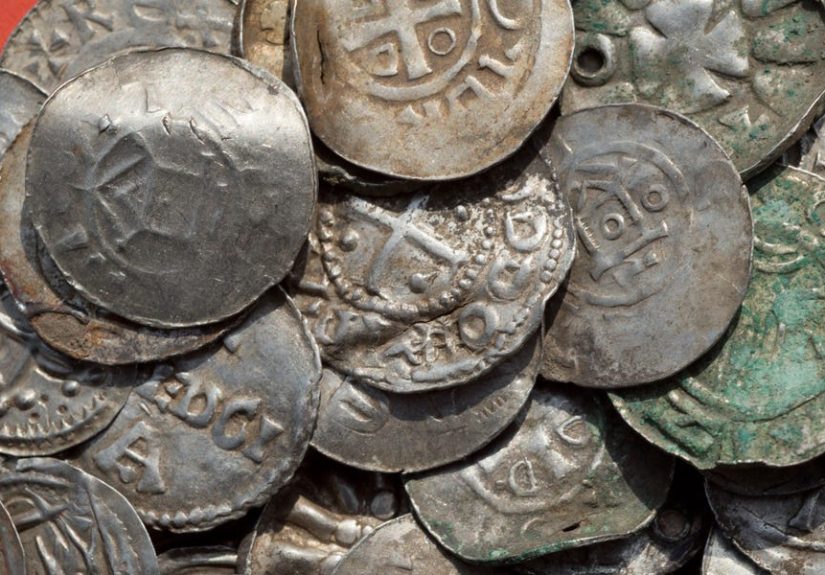
The coins
The hoard included large numbers of silver coinssome tied to a powerful Scandinavian ruler often associated with the name “Bluetooth.”
Importantly, finds like this can contain coins from multiple regions and times, including Islamic silver that moved across vast trade networks.
A spread like that hints at long-distance exchange: silver traveling through hands, ships, markets, and raids, eventually landing
in one person’s private “do not touch” savings pile.
The silver objects
Alongside the coins were items like rings, beads, bracelets, and other silver piecesobjects that could be worn as jewelry or repurposed as currency.
Some hoards also include amulets such as a Thor’s hammer, which is more than cool Norse-iconography merch. It reflects identity, belief,
and sometimes tension during periods when Christianity spread and older traditions were still deeply rooted.
How many coins are we talking?
The phrase “treasure trove” isn’t clickbait here: accounts describe hundreds of coins and silver pieces in the overall assemblage. In other words:
not a single lucky coin, but a deposit large enough that archaeologists treat it as regionally significant and historically revealing.
Why 1,000-Year-Old Silver Coins Matter
If you’re wondering why experts get so excited about “old money,” here’s the secret: coins are tiny propaganda posters that survive in the dirt.
They carry the fingerprints of powerwho ruled, what symbols mattered, how rulers wanted to be seen, and how connected a region was to wider trade.
Harald “Bluetooth” and a royal connection (with a big caution label)
The hoard has been discussed in connection with the reign of Harald Bluetooth, a major figure in Scandinavian history, remembered for
unifying territories and playing a role in the Christianization of Denmark. Some of the coins are attributed to his era, and the timing
of burial suggested by the latest coins fits with political turmoil at the end of the 10th century.
That said, “linked to a king” is not the same as “owned by a king.” Archaeologists and historians often emphasize that a hoard can be associated
with a period, an economy, or a political moment without being a literal royal piggy bank. The real value is what it tells us about the world
around that ruler: conflict, movement, and wealth in circulation.
Coins as messaging: crosses, authority, and the politics of belief
Coins can carry symbolslike crossesthat signal religious affiliation and political messaging. In transitional eras, money can become a tool
for normalizing new ideas (“Here’s your change, and also: welcome to the new official religion.”). When a hoard contains coins from that era,
it becomes a clue to how identity and authority were being broadcastone transaction at a time.
Trade networks: silver that traveled farther than most people ever did
Viking Age hoards often include silver that originated well beyond Scandinavia or the Baltic coastparticularly Islamic silver coins (dirhams)
that entered northern Europe through trade routes stretching across Eastern Europe and beyond. A hoard that mixes regions is basically a
medieval map drawn in metal: it suggests contact zones, exchange, and the movement of wealth through commerce, alliances, and sometimes violence.
How Archaeologists Read a Coin Hoard
Archaeology isn’t just “dig it up and post it.” Professionals treat hoards like crime scenes from the past: context matters as much as the objects.
The soil layers, the clustering, the depth, the distributionthese details can help determine whether a hoard was hidden quickly, buried carefully,
split into parcels, or deposited over time.
Dating the burial: the “newest coin” clue
A basic principle: the most recent coin in a hoard often helps estimate when it was buried. If the newest coin dates to the late 10th century,
then the hoard likely went underground sometime after that coin entered circulation. That doesn’t give an exact day (“Tuesday at 3 p.m.”),
but it narrows the window and helps historians connect the burial to events like rebellions, invasions, or sudden regime shifts.
Why bury silver at all?
People bury hoards for reasons that range from practical to spiritual:
- Emergency savings: hiding wealth during war, raids, or political chaos.
- Portability problems: you can’t exactly Venmo a chest of silver across the Baltic.
- Community unrest: when leaders fall, loyalties shift, and “owning money” becomes risky.
- Ritual deposits: in some contexts, valuables are offered or buried for symbolic reasons.
The heartbreaking twist? Many hoards were never retrieved because the owner died, fled, was captured, or simply couldn’t find the spot again.
(Raise your hand if you’ve ever hidden something “somewhere safe” and later discovered the safest place was your own forgetful brain.)
Coins + jewelry + cut silver: money worked differently
Modern money is trust-based and standardized. Viking Age silver economies were often weight-based and flexible. Arm rings could be worn and
then snapped into pieces to pay. Coins could circulate far from where they were minted, valued as silver rather than as “official legal tender.”
That’s why hoards often look like a mix of piggy bank + jewelry box + emergency fund.
The Metal-Detecting Rulebook (So You Don’t Become the Villain)
Stories like this inspire people to grab a metal detector and march confidently into a field like they’re starring in a reality show.
But real archaeology is less “loot” and more “document, report, preserve.”
1) Permission is non-negotiable
Detecting on private land without permission is trespassing, and detecting on protected sites can be illegal. Even when the law allows detecting,
it often comes with rules. Archaeologists support responsible hobbyists, but “responsible” starts with permission and awareness of protected areas.
2) If it looks ancient, stop digging like you’re mining crypto
Once you suspect a significant archaeological find, the goal changes from “find more” to “don’t destroy context.” Digging aggressively can break
fragile items and erase informationlike the exact position of objectswhich is often more valuable than the object itself for interpreting history.
3) Report quickly and cooperate
The best-case scenario is what happened here: hobbyists alerted professionals, and professionals conducted a planned recovery. That collaboration
preserves the items and the story the soil can tell. It also helps ensure the find is recorded, studied, andofteneventually displayed for the public.
Similar Finds That Put This One in Perspective
The “kid finds ancient silver” story is unusual, but coin hoards and Viking Age silver caches appear regularly enough to teach broader lessons.
When you compare hoards, patterns emerge: where wealth accumulated, how trade shifted, and how communities reacted to instability.
Viking hoards as “savings accounts with mud-based security”
Other Viking-related discoverieslike hoards containing coins, ingots, and hack-silvershow the same economic logic: silver as a store of value.
Some finds are deliberately bundled, some are separated into parcels, and some include objects that seem symbolic as well as valuable.
Comparing these hoards helps archaeologists identify regional habits, trade connections, and cultural transitions.
Detectorists and major discoveries
In multiple countries, trained hobbyists (sometimes working with heritage services) have located hoards that professionals then excavate.
The key is the partnership: the public helps locate, the experts preserve context, and everyone benefits from the historical knowledge recovered.
Not all hoards are “royal,” but many are historically huge
Some famous hoards sell for millions, while others end up in museums as priceless research collections. The monetary value can be dramatic, but the
historic value is steadier: it’s the evidence that can rewrite what we thought we knew about a region’s economy, politics, and connections.
What We Still Don’t Know
The internet loves a clean story: “This was King So-and-So’s personal stash.” Archaeology often delivers a smarter story: “This hoard fits the timeline,
includes coins from that ruler’s era, and was buried during political turmoilso it may relate to events connected to him.”
Who buried it?
A hoard can be buried by:
- a wealthy trader managing risk,
- a local leader hedging against chaos,
- a household pooling silver as a safety net,
- or someone with connections to a ruler’s network.
Was it truly connected to a king?
The association is plausible in the sense that the coins and timing fit the broader historical frame, and some reporting discusses the possibility.
But professionals usually avoid claiming direct royal ownership unless there’s extraordinary evidence (inscriptions, direct provenance, or documentation).
The hoard is exciting even without a crown attached.
Experiences: What It Feels Like to Uncover Time (Extra )
Imagine you’re 13 and your “biggest discovery” so far is a missing sock behind the dryer. Then your metal detector chirps, you dig a little,
and suddenly you’re holding silver that last saw daylight when knights were not a Halloween costume but a workplace hazard. People who’ve made
real finds often describe a weird emotional cocktail: excitement first, then disbelief, then a kind of quiet respect that hits you like,
“Oh… this belonged to someone. Someone real.”
Detectorists and archaeologists also talk about the “moment of recognition.” At first it’s just metal. Then you notice a stamped design,
a line of lettering, a cross, a patternsomething intentionally made. Your brain shifts gears from “object” to “message.” That’s when the
adrenaline spikes, but so does the responsibility. Because you’re not just holding treasure; you’re holding evidence. And evidence has rules.
One of the most repeated experiences in responsible detecting circles is learning to slow down. When you suspect you’ve hit something significant,
speed becomes the enemy. The urge is to dig faster. The smarter move is to stop, mark the spot, take photos, and contact the right experts.
People who’ve cooperated with heritage authorities often say the collaboration is part of the thrill: watching professionals map the site,
record the layers, and recover objects in a way that preserves the story, not just the sparkle.
There’s also a strong “community” experiencebecause big finds rarely stay private for long. Museums may become involved. Researchers may examine
the coins, identify where they were minted, and compare them to other hoards. Suddenly you’re in a chain of people connecting dots across centuries.
Even when a hoard has high market value, the deeper reward many finders describe is being part of something permanent: the historical record.
Not many hobbies let you contribute to scholarship before you’re old enough to drive.
And then there’s the human story you can’t unsee once you start thinking about it. A buried hoard is a frozen emergency plan. Somebody hid it with
intention. They expected to return. The fact that they didn’t is often the most haunting detail. When you hold a coin hoard, you’re holding both
prosperity and interruptionwealth saved and a future that didn’t happen. That emotional weight is why archaeologists care so much about context:
it helps us understand not just what people owned, but what they feared, what they hoped for, and how they navigated uncertain times.
So if this story makes you want to grab a metal detector, consider adopting the best “treasure hunter” mindset: be curious, be patient, and be ethical.
The real magic isn’t keeping the find. It’s helping the find keep its meaningso a thousand years from now, someone else can learn from what you saved.