Table of Contents >> Show >> Hide
- Why a Garden Arch Trellis Works So Well
- 1. Create a Rose-Covered Entrance Arch
- 2. Build a Cattle Panel Arch in the Kitchen Garden
- 3. Choose a Minimalist Black Metal Arch for a Clean Look
- 4. Go Rustic with Natural Branches or Willow
- 5. Add an Arch with Built-In Planters
- 6. Use an Arch to Separate Garden Rooms
- 7. Attach a Half-Arch or Wall-Side Trellis Near the House
- 8. Repeat Several Arches to Form a Tunnel
- 9. Frame a Bench or Seating Area with an Arch
- 10. Make It Double as a Privacy Screen
- 11. Paint a Cottage Arch White for Instant Brightness
- 12. Use a Bare Arch as Off-Season Sculpture
- How to Choose the Right Plants for Your Arch Trellis
- Materials That Hold Up Beautifully
- Practical Experience: What These Garden Arch Trellis Ideas Look Like in Real Life
- Conclusion
- SEO Tags
Every garden deserves a little drama. Not soap-opera drama. Good drama. The kind that makes people walk through your yard, stop mid-step, and say, “Okay, who lives here, and why is their garden suddenly the main character?” A garden arch trellis does exactly that. It adds height, shape, and a sense of destination while giving climbing plants a stylish place to do their thing.
Whether your space leans cottage-core, modern, rustic, edible, or gloriously chaotic in the best possible way, the right arch can turn an ordinary path into an experience. It can frame a view, divide garden rooms, soften fences, support vegetables, and make even a small yard feel layered and intentional. Better yet, it works hard while looking charming, which is frankly the dream.
Below, you’ll find 12 garden arch trellis ideas that blend beauty with function, plus practical tips on choosing materials, matching the right plants to the right support, and making the whole setup look like you absolutely planned it that way from the beginning.
Why a Garden Arch Trellis Works So Well
A garden arch trellis is one of those rare landscape features that can be decorative and useful at the same time. It creates vertical interest, draws the eye upward, and helps organize the yard. In design terms, it becomes a focal point. In real-life terms, it makes your landscape look more polished without needing a full backyard renovation or a second mortgage.
It also gives climbing plants the structure they need. Twining vines, tendril climbers, and rambling roses all behave a little differently, so the best arch trellis ideas match plant habit with support style. Light annual vines may be happy on a slimmer frame, while heavy roses, grapes, or vigorous vegetable vines need a sturdier arch that won’t wobble dramatically the first time summer gets ambitious.
1. Create a Rose-Covered Entrance Arch
If your goal is “storybook garden, but make it believable,” start here. A rose-covered arch at the entrance to a path or front garden instantly adds romance and structure. Choose a sturdy wood or metal frame and train climbing roses slowly over time, tying the canes in place as they grow. Roses are beautiful, but they are not known for independently following directions.
This idea works especially well in cottage gardens, traditional landscapes, and front-yard entry points where you want an obvious visual welcome. Pair the arch with lavender, catmint, or salvia at the base for softness and long-season color. The result feels lush without looking like the garden swallowed the architecture whole.
2. Build a Cattle Panel Arch in the Kitchen Garden
One of the smartest garden arch trellis ideas is also one of the most practical: a cattle panel arch between raised beds. It is strong, relatively budget-friendly, and excellent for edible climbers like pole beans, cucumbers, loofah, peas, and small-fruited squash. It turns a productive space into something unexpectedly elegant, which is a nice bonus for vegetables that usually don’t get enough credit for their beauty.
Use this type of arch to connect two beds or to define an entry into the vegetable garden. Once covered in green vines, it creates a tunnel effect that feels both functional and charming. It also improves airflow, keeps fruit cleaner, and makes harvesting easier. In other words, this arch is not just pretty. It earns its keep.
3. Choose a Minimalist Black Metal Arch for a Clean Look
If your style leans modern or transitional, a simple black metal arch is hard to beat. It has enough presence to anchor the landscape but doesn’t visually overwhelm nearby plantings. Even without vines, it reads as sculptural. With vines, it becomes sleek, dramatic, and just a little smug about how good it looks.
This style pairs beautifully with white flowering clematis, star jasmine in warm climates, or a restrained planting palette of ornamental grasses and clipped shrubs. The contrast between airy plants and crisp lines keeps the landscape balanced. It is also a smart choice near patios, gravel paths, or contemporary homes where heavy rustic detailing would feel out of place.
4. Go Rustic with Natural Branches or Willow
For a softer, more organic look, consider a rustic arbor made from branches, saplings, or woven willow. This idea fits beautifully in cottage gardens, pollinator beds, meadow-style landscapes, and woodland edges. Instead of looking imported from a catalog, it feels as though the garden quietly made it for itself.
Natural-material arches are especially effective when planted with informal climbers such as sweet peas, morning glories, scarlet runner beans, or lighter clematis varieties. The slight irregularity is part of the charm. In a polished garden, this kind of arch adds soul. In a casual garden, it looks completely at home.
5. Add an Arch with Built-In Planters
An arch flanked by planters adds instant weight and presence. It works well at the beginning of a path, at the entrance to a patio, or as a transition between lawn and garden. The planters help anchor the structure visually, and they give you extra planting room for spillers, annual color, or fragrant herbs.
This approach is especially useful in smaller landscapes where every feature needs to do a bit more. You can plant climbers in the ground or in the containers themselves, depending on the size of the setup. Try mandevilla in warm climates, black-eyed Susan vine for fast seasonal color, or compact clematis for a layered effect. It feels lush, intentional, and just a little bit fancy without trying too hard.
6. Use an Arch to Separate Garden Rooms
One of the best design moves in landscaping is creating a sense of progression. An arch trellis can mark the transition from one “room” to another, such as from a lawn to a cutting garden, from a patio to a vegetable plot, or from the side yard into a private seating nook. Suddenly, the garden has chapters instead of just square footage.
This idea makes even modest yards feel more layered and purposeful. Add a gate for extra character, or leave the opening uncovered so the shape alone does the work. Climbers can soften the structure, but the arch itself should be interesting enough to hold attention in winter when the plants are off-duty.
7. Attach a Half-Arch or Wall-Side Trellis Near the House
Not every garden arch needs to stand alone in the middle of the yard like it is auditioning for a period drama. A wall-adjacent or half-arch trellis can soften a blank exterior wall, frame a doorway, or highlight a side entrance. It adds vertical beauty where ground space is limited and can double as living wall art.
This is a great option for narrow side yards, courtyards, or smaller urban gardens. Choose a design with an arched top for a more decorative look, then train a flowering vine upward. Just be smart about plant choice. Some vigorous climbers can cling aggressively or trap moisture where you do not want it, so keep a little breathing room between the trellis and the wall.
8. Repeat Several Arches to Form a Tunnel
If one arch is charming, a series of arches is unforgettable. Repeating the same structure over a path creates rhythm, unity, and a tunnel effect that feels immersive in the best possible way. This works especially well in long borders, kitchen gardens, or pathways that connect two standout areas of the yard.
You do not need a huge estate to pull this off. Even a short run of two or three matching arches can have major impact. Cover them with the same vine for a cohesive look, or mix plants with staggered bloom times for season-long interest. It is the garden equivalent of a great outfit built around one excellent idea.
9. Frame a Bench or Seating Area with an Arch
An arch behind or beside a bench creates the feeling of a destination. It tells visitors, “Yes, this is where you sit with your coffee and pretend you are the kind of person who has everything under control.” Whether that is true is between you and the weeds.
Use this idea in a quiet corner, near a cutting garden, or at the end of a path. Softly fragrant climbers such as jasmine, roses, or sweet autumn-style bloomers can make the space feel even more inviting. Add gravel, a small table, and layered plantings around the base, and the whole area becomes a true garden retreat.
10. Make It Double as a Privacy Screen
An arch trellis can do more than support vines. It can help block views, create enclosure, and provide just enough privacy without building a solid barrier. Choose a wider structure with lattice or side panels and place it where you want visual separation, such as between a patio and neighboring property or between a utility area and the prettier parts of the garden.
Plant it with dense but manageable vines and let the greenery soften the screen over time. This idea is useful when you want privacy that still feels open and breathable. It also blends better into garden-style landscapes than a plain fence panel stuck in the middle of everything.
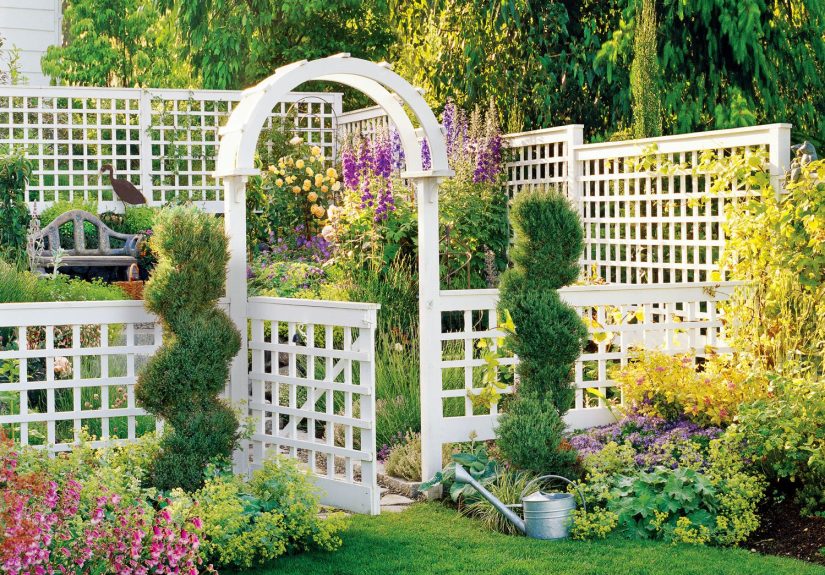
11. Paint a Cottage Arch White for Instant Brightness
A classic white arch trellis has timeless appeal. It pops against green foliage, brightens shady corners, and gives a garden that cheerful, polished look people love in cottage-style landscapes. It is especially effective near picket fences, front walkways, and perennial borders full of soft color.
Pair it with clematis, sweet peas, or annual vines for a lighter, more delicate effect. If you want more contrast, let deep purple flowers or dark foliage plants frame the base. The key is keeping the plant palette relaxed so the arch looks welcoming instead of overly staged.
12. Use a Bare Arch as Off-Season Sculpture
Here is a design trick many people overlook: a garden arch trellis should still look good when it is not covered in foliage. In fall, winter, and early spring, the structure itself becomes part of the visual composition. That means shape, material, finish, and proportion matter just as much as the flowers you plan to grow on it.
Choose an arch with beautiful lines, decorative finials, elegant metalwork, or simple proportions that suit your home. Then let seasonal vines take center stage when they are in bloom. This approach ensures your landscape has architecture all year long, not just during the months when everything is behaving beautifully.
How to Choose the Right Plants for Your Arch Trellis
Match vine habit to structure
Some climbers twine, some use tendrils, and some, like climbing roses, need to be tied in by hand. Lightweight annuals can thrive on slim or decorative arches, while heavier plants need strong frames and secure anchoring.
Think about season and maintenance
Want instant summer coverage? Annual vines are fast and dramatic. Want long-term structure and repeat performance? Perennial climbers such as clematis, climbing roses, jasmine, or certain honeysuckles can deliver, provided they suit your climate and are not invasive where you live.
Respect the mature size
A tiny arch with a giant vine is a classic garden mismatch. Give vigorous plants enough room, and do not underestimate how quickly a healthy climber can turn “pretty support” into “structural engineering question.”
Materials That Hold Up Beautifully
Wood arches feel warm and classic, especially in cottage or naturalistic gardens. Metal arches tend to last longer and work well in formal or modern spaces. Natural branch arches are beautiful for informal gardens but may need more frequent repair or replacement. Whatever material you choose, anchor it well. Wind, heavy rain, and mature vines are not known for gentleness.
If you are growing edibles or heavier ornamentals, prioritize strength over delicacy. A support that looks graceful but bends under summer growth is not romantic. It is just annoying.
Practical Experience: What These Garden Arch Trellis Ideas Look Like in Real Life
In real gardens, garden arch trellis ideas are often less about perfection and more about how a space feels once the structure is in place. One of the biggest surprises is how much an arch changes the mood of the yard before a single vine has fully grown. Even bare, it creates a destination. A simple gravel path suddenly feels intentional. A vegetable bed looks more designed. A small backyard starts to feel like it has layers, which is landscape magic on a reasonable budget.
Many gardeners also find that the most successful arches are the ones placed with a purpose. An arch over a random patch of grass can look nice, but an arch that frames a gate, marks a turn in the path, or leads into a productive kitchen garden feels memorable. It gives the eye somewhere to go. That is part of why these structures are so effective: they guide movement without shouting about it.
Another common lesson is that sturdiness matters more than people expect. Lightweight arches often look great in the store and far less impressive once they are loaded with wet vines, wind, and a season’s worth of enthusiastic growth. Gardeners who choose stronger materials from the start usually end up happier in the long run, especially if they are growing roses, grapes, squash, or any climber with big ambitions.
There is also the plant-behavior reality check. Not every vine politely climbs the way the label suggests. Some need tying, some wander, and some seem determined to make friends with everything except the trellis. That is normal. Part of the experience is a little training, a little editing, and the occasional conversation with a plant that has clearly ignored the assignment. The payoff comes when the structure and the plant finally work together and the arch starts looking established rather than newly introduced.
Seasonality is another thing people notice over time. A rose arch can be breathtaking in bloom, but the best arches still contribute in the off-season. In winter, the silhouette matters. In early spring, the framework gives shape while the rest of the garden wakes up. In summer, it becomes immersive. In fall, it can frame seed heads, hips, or fading foliage beautifully. That year-round presence is one reason arches feel like such smart investments in landscape design.
Perhaps the most satisfying part is how personal these features become. Some gardeners use them for edible tunnels filled with beans and cucumbers. Others turn them into floral entrances dripping with clematis or jasmine. Some prefer a modern black metal frame with just a hint of vine, while others want full cottage abundance and are perfectly happy if the whole thing looks one bloom away from a fairy tale. There is no single right version. The best garden arch trellis is the one that suits the style of the home, the scale of the yard, and the amount of maintenance the gardener is honestly willing to do.
That honesty matters. The dream arch is not just the prettiest one on a mood board. It is the one you can maintain, enjoy, and keep standing confidently through every season. When chosen well, a garden arch trellis adds charm, structure, productivity, and personality all at once. That is a rare combination in landscaping, and it is exactly why these arches keep showing up in the most beloved gardens.
Conclusion
The best garden arch trellis ideas do more than support climbing plants. They shape the way a landscape looks, moves, and feels. They can make a small garden seem more layered, a plain path seem more inviting, and a productive vegetable patch feel downright enchanting. Whether you choose a rustic branch tunnel, a modern metal arch, a rose-covered entry, or a practical cattle panel walkway, the right structure adds instant charm and long-term value.
The secret is to match the arch to the style of your space, the strength needed for your plants, and the experience you want the garden to create. Do that well, and your landscape will not just have another feature. It will have a moment.