Table of Contents >> Show >> Hide
- What a Credit Card Cash Advance Actually Is
- Why Cash Advances Are So Expensive
- The Sneaky Part: Transactions That Can Be Treated as Cash Advances
- How a Cash Advance Can Hurt More Than Your Wallet
- A Simple Example of Why the Cost Adds Up So Fast
- Better Alternatives When You Need Money Fast
- When a Cash Advance Might Be Defensible
- Additional Experiences: What This Looks Like in Real Life
- Final Takeaway
- SEO Tags
Sometimes life does not send a polite calendar invite before it detonates your budget. Your car needs a repair today. Your landlord wants the balance now. Your dog eats something expensive and medically adventurous. In moments like these, a credit card cash advance can look like a financial superhero. You walk up to an ATM, tap your card, grab cash, and move on with your life.
Unfortunately, that superhero is usually a villain in a nice cape. A credit card cash advance is one of the most expensive ways to borrow money. It often comes with an upfront fee, a higher APR than regular purchases, and interest that starts piling up almost immediately. In other words, it is not just “using your credit card differently.” It is more like turning your wallet into a tiny emergency loan office with terrible rates and zero charm.
If you have ever wondered why personal finance experts keep side-eyeing cash advances, this is the reason. They are fast, convenient, and alarmingly good at making a short-term problem more expensive than it needs to be. Here is what a cash advance really is, why it costs so much, and what to do instead before your ATM receipt starts auditioning for the role of “financial regret.”
What a Credit Card Cash Advance Actually Is
A credit card cash advance is when you borrow cash against your card’s credit line instead of using the card to buy something directly. You might do this at an ATM with a PIN, at a bank branch, with a convenience check mailed by your issuer, or through certain transactions that your card company treats as cash-equivalent activity.
That last part matters. A lot. Many people think a cash advance only means pulling bills from an ATM. In reality, some issuers may also treat certain money orders, wire transfers, gambling transactions, lottery purchases, or other “cash-like” transactions as cash advances. That means you can trigger cash-advance pricing without hearing the dramatic ATM sound effects first.
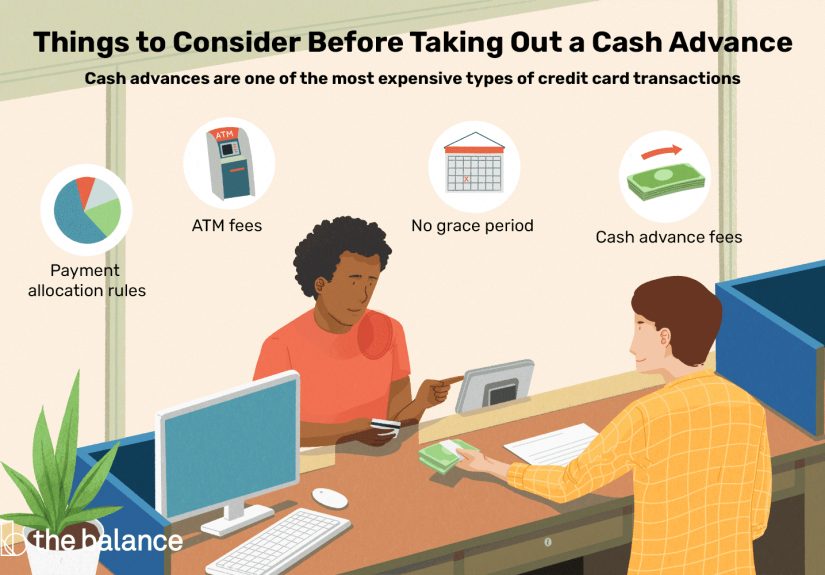
Regular purchases and cash advances may sit on the same card account, but they do not play by the same rules. Purchases often come with a grace period if you pay your statement balance in full. Cash advances usually do not. That difference is the entire plot twist.
Why Cash Advances Are So Expensive
1. You usually pay a fee before the money even leaves the machine
Most cash advances come with an upfront transaction fee. It is commonly a percentage of the amount advanced, often with a minimum dollar amount. So the moment you borrow the money, the meter is already running. Borrow $300, and you may owe a fee right away. Borrow $1,000, and the fee gets more “ambitious.”
This is one reason cash advances feel deceptively harmless. The fee can look small at first glance, especially when it is framed as a percentage. But percentages have a way of becoming rude in a hurry. A 5% fee on a $1,000 advance is $50 before interest even enters the room.
2. Interest usually starts immediately
With normal credit card purchases, many cardholders get a grace period. That means if you pay the statement balance in full by the due date, you may avoid interest on new purchases. Cash advances usually skip that courtesy. Interest often starts accruing from the transaction date or when the advance posts to your account.
That means even if you are responsible, organized, and the kind of person who alphabetizes batteries for fun, a cash advance can still cost you interest almost right away. It is borrowing on “premium mode,” except the premium part is only the cost.
3. The cash advance APR is often higher than the purchase APR
Credit cards often have multiple APRs: one for purchases, another for balance transfers, and a separate one for cash advances. The cash advance APR is commonly the least friendly of the bunch. So you are not just paying interest sooner; you may also be paying it at a higher rate.
That double hit is what makes cash advances so painful. If a regular purchase is a hill, a cash advance is the same hill wearing a weighted backpack and charging admission.
4. You may also pay ATM or bank fees
Your card issuer’s fee is not always the only charge. The ATM operator or bank may add its own fee on top. Suddenly your “quick fix” has become a small parade of charges, each one insisting it is normal and unavoidable.
5. Your cash advance limit may be lower than your full credit limit
Many cards do not let you withdraw your entire available credit line as cash. You may have a separate, lower cash advance limit. That means the feature is expensive and still may not solve a larger emergency. It is like paying luxury pricing for economy seating.
The Sneaky Part: Transactions That Can Be Treated as Cash Advances
This is where people get blindsided. Some transactions do not look like “cash” in the everyday sense, but the issuer may still code them as a cash advance. Examples can include convenience checks, certain money orders, some gambling or sports-betting charges, wire transfers, and other cash-equivalent purchases.
Why does that matter? Because you may think you are making a regular card transaction, only to discover later that the issuer saw it as cash access. Now you have the fee, the higher APR, and immediate interest accrual. Congratulations, your harmless transaction has been upgraded to a financial ambush.
The lesson here is simple: if a transaction behaves like cash, there is a decent chance your card issuer may treat it like cash too. Before you tap, swipe, or type, check your card agreement.
How a Cash Advance Can Hurt More Than Your Wallet
It can raise your credit utilization
A cash advance increases your revolving balance. That can push up your credit utilization ratio, which is the amount of credit you are using compared with your total available credit. Higher utilization can put pressure on your credit scores, especially if the advance is large relative to your limit.
In plain English, you may pay more to borrow and still end up looking riskier to lenders. That is a nasty two-for-one special nobody asked for.
It can trap you in a short-term cycle
Cash advances are often used in moments of stress, not comfort. If you are already short on cash, taking on a balance with immediate interest and high fees can make next month tighter too. Then the next emergency hits, and the temptation to do it again grows. That is how one “just this once” decision quietly becomes a pattern.
It can make your statement harder to untangle
Once your card has purchases, fees, and a cash advance balance with different pricing rules, your statement becomes less intuitive. You can still manage it, of course, but it becomes easier to underestimate the true cost or to assume paying by the due date will wipe everything clean. Often, it will not.
A Simple Example of Why the Cost Adds Up So Fast
Let’s say you take a $500 cash advance because your car battery dies and you need the money immediately. Your issuer charges a 5% cash advance fee. That is $25. The ATM adds a $3 fee. Now you owe $528 before a single day of interest gets counted.
Now assume your cash advance APR is about 30%. If you carry that $500 advance for 30 days, you could add roughly another $12 to $13 in interest, depending on how the issuer calculates it. Your emergency $500 can easily cost more than $40 in a month, and that is without a massive balance or a long repayment window.
Scale that up to $1,000, and the pain gets louder. A 5% fee is $50. Add a small ATM fee, then a month of high-rate interest, and you can be staring at a cost near $80 just for the privilege of borrowing your own future money. That is not a lifeline. That is a toll road with opinions.
Better Alternatives When You Need Money Fast
Ask for a payment plan first
If the expense is medical, utility-related, tuition-related, or tied to a service provider, ask whether they offer a payment plan, hardship option, or due-date extension. This is one of the most underrated moves in personal finance. People often assume “I need cash,” when the real issue is “I need more time.” Those are not the same problem.
Use a regular card purchase instead of cash if possible
If the merchant accepts credit cards directly, using your card for the purchase may be far cheaper than taking a cash advance to pay it. A normal purchase may come with your purchase APR and, if you pay in full by the due date, possibly a grace period. Cash advances usually offer neither advantage.
Look at a credit union or personal loan
If you truly need borrowed funds, a small personal loan or a credit-union option may be less expensive than a cash advance. It may not feel as instant, but the total cost can be much easier to live with. Fast money is nice. Affordable money is nicer.
Use emergency savings if you have them
This is exactly what an emergency fund is for. It is not there to look pretty in your banking app. It is there so you do not have to pay 5% plus immediate interest because your transmission decided to become a philosopher.
Talk to your employer, family, or friends carefully
Not everyone has this option, and it should be handled with boundaries and respect. But an honest conversation, a short written repayment plan, and a clear date may still beat a high-fee cash advance. Awkward can be survivable. Compound interest is persistent.
Sell something nonessential before borrowing badly
It is not glamorous, but neither is paying premium rates for emergency cash. If the need is short-term and the item is replaceable, selling unused gear, old electronics, or furniture can be a smarter play than converting your credit card into a mini loan shark.
When a Cash Advance Might Be Defensible
There are rare moments when a cash advance may be the least-worst option: a true emergency, no cheaper alternative, and a very fast repayment plan already in place. Maybe you need cash today to avoid a much bigger financial hit tomorrow. Maybe you can repay the entire amount within days, not weeks. In that narrow situation, a cash advance may be survivable.
But “defensible” is not the same as “good.” It simply means the fire is already large and this bucket, while expensive, is still better than letting the whole kitchen burn down.
Additional Experiences: What This Looks Like in Real Life
The most common cash advance story is not reckless. It is ordinary. Someone is between paychecks, an urgent bill lands badly, and the fastest solution looks like a withdrawal from a credit card. A lot of people do not even realize how expensive it is until the statement arrives. The number on the screen at the ATM feels manageable, but the statement tells a different story: the advance fee, the interest charge, the slightly higher balance than expected, and the sinking realization that this was not “just borrowing a little cash.”
Take a typical car repair example. Someone needs $600 to get to work again by Monday. The repair shop wants payment now. A cash advance seems easier than calling three relatives, applying for a small loan, or asking for more time. The person takes the advance, solves the immediate problem, and feels relieved for about 48 hours. Then rent, groceries, and gas still show up right on schedule. Because the cash advance started accruing interest right away, the balance is already growing. By the next billing cycle, the problem is no longer the car repair. The problem is the repair plus the fee plus the interest plus the fact that cash flow is still tight.
Another very real experience happens with “surprise” cash advances. Someone buys a money order, funds a betting account, or uses a convenience check assuming it will work like a normal purchase. Then the statement labels it as a cash advance. That kind of surprise is especially frustrating because the borrower never consciously chose the expensive option. It was hidden inside the transaction type. People often describe this as the moment they started reading card terms more carefully, usually with the emotional energy of a person reading a parking ticket.
There is also the snowball effect. One small cash advance can change the psychology of borrowing. After the first one, the barrier feels lower. The next emergency becomes easier to “solve” the same way. Then the card balance rises, the available credit shrinks, and financial stress gets louder. Many borrowers say the worst part was not the first fee. It was realizing that short-term relief kept making the following month harder.
On the flip side, people who avoid cash advances usually tell a different story. They negotiate a bill, ask for a payment extension, use a regular credit card purchase instead of cash, borrow from a credit union, or patch the problem together with a few less glamorous solutions. None of those options feel magical. But they usually cost less and preserve more breathing room. That is the key lesson from real-life experience: a cash advance often solves the clock problem, but it rarely solves the money problem. It just reschedules the pain and adds fees for the trouble.
Final Takeaway
If you remember only one thing, remember this: a credit card cash advance is usually expensive from minute one. You may pay a fee up front, a higher APR than regular purchases, and interest that starts immediately. On top of that, some transactions you would not expect can still be treated as cash advances, and the resulting balance can strain your budget and your credit profile.
That is why the best strategy is not “How do I use a cash advance wisely?” It is “What can I do before I end up needing one?” Build a small emergency cushion. Ask for payment flexibility. Read your card terms. Use ordinary card purchases when possible instead of pulling cash. And if you absolutely must take a cash advance, treat it like a financial emergency flare, not a convenience feature.
Because when your credit card offers you cash in seconds, it is not doing you a favor. It is handing you a very expensive shortcut and hoping you do not read the receipt too closely.