Table of Contents >> Show >> Hide
- First, What Do People Mean by “The Army Has a Navy”?
- How Big Is the Army’s “Navy,” Really?
- Meet the Army’s Watercraft Fleet: Not Glamorous, Extremely Useful
- Where the Army’s Boats Actually Live
- Why This Matters More Now: “Contested Logistics” Isn’t a Buzzword
- Who Crews This “Army Navy”? Soldiers, Not Sailors
- The Catch: Readiness, Aging Hulls, and a Fleet That Got Smaller
- So… Is the Army’s Navy “Bigger Than Most Navies” or Just a Great Headline?
- Conclusion: The Army’s Boats Are a Strategic Flex
- Experiences: What It’s Like in the Army’s “Other Navy” (Extended Section)
If you’ve ever said, “The Army has… boats?” congratulationsyou’ve just stepped into one of the U.S. military’s best
party tricks. The U.S. Army (yes, the land one) operates a fleet of watercraft that, depending on what you count and
how you define “navy,” can outnumber the entire naval forces of many countries. It’s the kind of fact that sounds
like a trivia question written by someone who’s had three coffees and an argument with Wikipedia.
But it’s also realand it matters. Because modern war (and modern disaster response) runs on logistics. And in a
world where ports can be damaged, roads can be denied, and islands are separated by a whole lot of inconvenient
ocean, the ability to move soldiers, vehicles, containers, fuel, and humanitarian aid by water is not a cute side
hobby. It’s a strategic advantage.
First, What Do People Mean by “The Army Has a Navy”?
Let’s clear the deck: the Army does not have aircraft carriers, guided-missile destroyers, or sailors in white hats
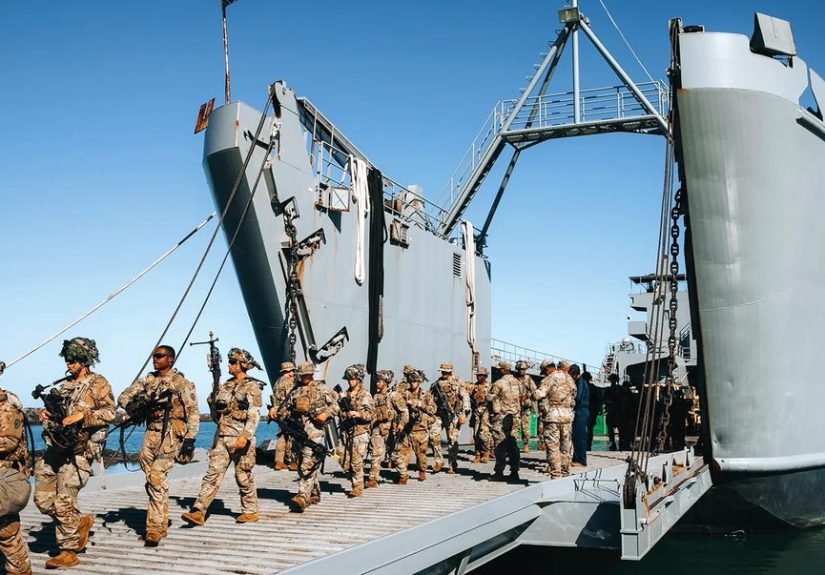
dramatically staring into the horizon. The Army’s “navy” is a fleet of workhorse vesselslanding craft, support
ships, tugboats, and floating causewaysbuilt to do the unglamorous jobs that make everything else possible.
Think less “Top Gun: Maverick,” more “Top Forklift: Container Edition.”
So why does the Army operate ships at all?
The short answer: because somebody has to bridge the “last nautical mile.” The Army needs a way to move heavy gear
from ship to shore when there’s no friendly port, no functional pier, or no safe road network waiting on the other
side. That mission includes supporting amphibious and riverine operations and joint logistics-over-the-shore
(JLOTS)the capability to build temporary sea-based delivery systems when ports aren’t usable.
Historically, Army watercraft were massive in numberpeaking at eye-watering levels during major wars and then
shrinking over decades. Today, the Army’s fleet is smaller than it used to be, but still significant in capability
(and still weirdly surprising to anyone who thinks “Army” automatically means “no boats”).
How Big Is the Army’s “Navy,” Really?
Here’s where the viral claim gets both true and complicated. If you’re imagining a single, stable number, I have
bad news: military fleet counts are like chili recipeseveryone argues about what counts as an ingredient.
The modern fleet: smaller, but still substantial
According to a U.S. Government Accountability Office (GAO) report, as of May 2024 the Army owned 70 watercraft
vessels. That figure reflects years of divestment and consolidation, and it includes several categories of vessels
and systems used for transport, towing, and over-the-shore operations.
Why “bigger than most navies” can still be a fair headline
Many countries have very small naval forcessometimes single-digit ship countsespecially if their maritime needs
are mostly patrol and search-and-rescue. For example, New Zealand’s naval fleet has been described in reporting as
including nine ships in several classes. Ireland’s Naval Service describes its current fleet as eight patrol vessels
(four OPVs, two large patrol vessels, and two inshore patrol vessels). Compared to those kinds of numbers, even a
70-vessel Army watercraft fleet can look “bigger than most navies” in raw hull count.
But here’s the honest nuance: comparing an Army landing craft fleet to a nation’s warfighting navy is apples-to-oranges.
One is built for moving tanks and containers onto beaches; the other is built (at least in theory) for controlling sea lanes
and winning naval battles. Still, if your definition of “navy” is “a military service operating vessels,” the Army’s fleet
absolutely earns the eyebrow raise.
Meet the Army’s Watercraft Fleet: Not Glamorous, Extremely Useful
The Army’s watercraft are designed for logistics in places where infrastructure is limited, damaged, or contested.
The GAO notes that the fleet moves supplies, equipment, and personnel across deep ocean, shallow coastal waters,
inland waterways, and riversexactly the messy environments where smooth plans go to die.
Logistics Support Vessels (LSVs): the heavy lifters
If the Army had a “big ship energy” category, this would be it. LSVs are large seagoing vessels designed to haul
heavy cargo and roll-on/roll-off vehicles over long distancesthen put them onto a shore that may not have a port.
The GAO reports the Army had eight LSVs as of May 2024, with an average age around 30 years.
Landing Craft Utility (LCU): the beach-delivery specialists
LCUs are basically the logistics equivalent of saying, “Fine, we’ll make our own pier.” They can move vehicles,
containers, and outsized cargo to shoreespecially in logistics-over-the-shore operations. The GAO reports the Army
had 17 LCUs as of May 2024, with an average age around 32 years, and they’re undergoing service-life extension work.
Landing Craft Mechanized (LCM), tugs, and the unsung supporting cast
Smaller craft handle shorter-range movements, inland waterways, and port support. Tugslarge and smalldo exactly
what you think: they shove, pull, and reposition big floating things that don’t like being told where to go. And in
a world of temporary piers and modular systems, that job becomes surprisingly important.
Modular Causeway Systems (MCS): floating infrastructure
If you’ve ever looked at a temporary pier system and thought, “That seems like adult LEGO, but with ocean
consequences,” you’re not wrong. Modular causeway systems are floating components that can form causeways and
temporary platforms for moving cargo from ship to shore during JLOTS operations. They’re part engineering, part
seamanship, and part praying the sea state behaves.
Maneuver Support Vessel (Light): the modernization story
The Army is also acquiring newer vessels to replace aging craft, including a Maneuver Support Vessel (Light) as
noted in the GAO’s breakdown of fleet types. Translation: the Army knows it can’t keep running a maritime logistics
enterprise on “vessels older than some of the people operating them.”
Where the Army’s Boats Actually Live
Unlike the Navy, which has major fleets and bases worldwide, the Army’s watercraft are concentrated in a few key
locations that support rapid response and Indo-Pacific operations. The GAO reports Army watercraft are based at
Joint Base Langley-Eustis (Virginia), Joint Base Pearl Harbor-Hickam (Hawaii), and in Japan (Yokohama and Naha,
Okinawa).
This footprint is not random. It’s geography with a purpose: it puts Army mariners close to the Pacific theater
where distances are huge, islands are many, and moving heavy stuff by water is not optional.
Why This Matters More Now: “Contested Logistics” Isn’t a Buzzword
The GAO report frames Army watercraft as a “key enabler” for the joint forceespecially in the Indo-Pacific. That
phrasing is important because it connects boats to strategy: the ability to distribute forces, resupply units, and
keep equipment moving across ocean spaces is central to deterrence and war plans.
The tyranny of distance (and why trucks can’t swim)
In Europe, you can sometimes solve logistics problems by building a new road plan and throwing enough trucks at it.
In the Pacific, an “alternate route” may involve 2,000 miles of saltwater and a reef that hates you personally. A
watercraft fleet gives commanders options: move fuel and ammo to a beach, shift equipment between islands, support
joint amphibious operations, and keep supply lines functioning even when ports are constrained.
Real-world example: Joint Logistics Over-the-Shore and the Gaza pier
JLOTS is the capability that becomes headline news when ports are unavailable and humanitarian needs are urgent.
Reporting on the 2024 Gaza pier effort noted Army involvement and highlighted the reality that building and
sustaining over-the-shore delivery is hard, maintenance-heavy, and highly dependent on sea conditions. Other
reporting has emphasized that JLOTS is more than “a pier”it’s a whole system of causeways, tugs, and ship-to-shore
integration.
Exercises and theater presence
Army watercraft also show up in major Indo-Pacific exercises and deployments, where the mission isn’t “naval combat”
but “keep the force supplied, mobile, and capable.” This is the part of military power that rarely gets a movie
montagebut makes the movie possible.
Who Crews This “Army Navy”? Soldiers, Not Sailors
The Army’s mariners are Soldiers in the Transportation Corps who train specifically for maritime operations. The
Army lists MOS 88K (Watercraft Operator) and MOS 88L (Watercraft Engineer) as specialties responsible for
navigation, cargo operations, vessel handling, and maintaining propulsion and ship systems. There’s also a
maritime licensing and qualifications structure that oversees who’s allowed to operate which vessels.
If this sounds like the Army quietly reinvented a small merchant marine inside its own ranks… that’s not the worst
mental picture. The mission demands professional seamanship, engineering discipline, and the ability to operate
under Army tasking and joint command structures.
The Catch: Readiness, Aging Hulls, and a Fleet That Got Smaller
The fun headline (“Army has a navy!”) has a serious underside: keeping a small, specialized fleet ready is hard.
The GAO reports that the Army’s fully mission capable rate declined from 75% in 2020 to less than 40% in 2024, far
below the Army’s stated goal for ground equipment readiness. At the same time, demandespecially in the
Indo-Pacifichas increased.
Divestment and the maintenance hangover
The Army reduced its watercraft inventory from 134 vessels in 2018 to 70 by May 2024, according to reporting that
cited the GAO findings. That downsizing meant fewer vessels to meet mission demand, fewer training opportunities,
and a tighter margin for repairs and modernization.
Aging vessels and service-life extensions
The GAO report notes that the Army’s LSVs and LCUs were originally expected to have minimum useful service lives of
25 years. Many are now well past that baseline and are being extended toward a 40-year horizon. Service-life
extension programs help, but they don’t change physics: metal fatigues, parts become harder to source, and
maintenance delays can cascade into operational shortages.
So… Is the Army’s Navy “Bigger Than Most Navies” or Just a Great Headline?
It’s bothdepending on how you read it.
-
As a literal statement about warfighting navies: it’s not a direct comparison. The Army’s fleet
is built for logistics and support, not sea control. -
As a statement about number of military-operated vessels: it can be true, because many nations’
naval fleets are quite small in raw hull count. -
As a reminder about what wins wars: it’s absolutely true in spirit. Logistics is power, and the
Army’s ability to move heavy stuff across water expands the joint force’s options in a way that’s hard to
replace.
If you want the best one-sentence summary, try this: The Army’s watercraft fleet is a floating toolbox for the
hard problemsmoving the force when the map says “port,” but reality says “nope.”
Conclusion: The Army’s Boats Are a Strategic Flex
The U.S. Army’s “navy” isn’t about naval battlesit’s about making sure the joint force can move, land, and sustain
itself when ports are damaged, roads are denied, or geography is simply rude. Whether the fleet is 70 vessels today
or larger under broader counting methods, the point remains: the Army operates a serious maritime capability with
specialized Soldiers, unique vessels, and missions that matter most when everything else is difficult.
And yes, it’s still funny the first time you hear it. But once you understand what those vessels domoving tanks,
building floating causeways, supporting over-the-shore operationsyou start to realize it’s not a joke. It’s a
quiet advantage. One that just happens to float.
Experiences: What It’s Like in the Army’s “Other Navy” (Extended Section)
Imagine you’re up before sunrise, not because someone loves morning motivation posters, but because tides and
schedules don’t care about your sleep cycle. You’re a Soldierbut your day starts with a pre-check that looks more
like a mariner’s routine than a typical motor pool lineup. Fuel levels, engine status, hydraulic systems, radios,
mooring lines, fire suppression gear. On land you might inspect tires and torque. Here, you’re listening to the
shipliterally. A different vibration, a new rattle, a pump that sounds “off” by half a note. The ocean has a
thousand ways to turn small problems into big ones, and it’s famously unsentimental.
There’s a strange identity shift that happens when you work these missions. You still wear the same uniform, still
speak Army acronyms, still live in a world of taskings and timelines. But when you’re underway, you’re also part of
a crew that has to think like a ship. Weather becomes a plan variable. Sea state becomes a risk brief. “How far?”
becomes “How far, and what’s the water doing while we try?”
The work itself feels like logistics with consequences. Loading a vehicle isn’t just “drive it onto a platform.”
It’s weight distribution, tie-down points, ramp angles, and the kind of careful choreography that keeps steel from
shifting when the craft starts to roll. Containers aren’t just containersthey’re a math problem in cubic space and
stability. When you hear “ship-to-shore,” it’s not abstract. It’s the ramp meeting sand, the tug nudging a floating
piece of infrastructure into place, and everyone silently doing the mental calculation: “If the surf kicks up,
what’s our backup plan?”
During exercises, the experience can feel like being the backstage crew for a giant production. The public sees
the dramatic partsformations, helicopters, amphibious landings, the splashy photos. But the people moving fuel,
water, and equipment by watercraft know that the show doesn’t happen unless the boring parts are perfect. You
learn to love checklists. You learn to respect the small stuff: the right shackle, the right line, the right
comms check. And you learn that “good enough” is not a personality trait you can bring onto a boat.
The most vivid moments often come when the mission is urgent or the environment is unforgiving. Temporary piers and
modular causeways are impressive, but they’re also fragile compared to permanent infrastructure. When the sea is
calm, everything feels possible. When it isn’t, the ocean reminds you that engineering has limits and schedules are
only polite suggestions. Crews talk about the pride of making it work anywayabout solving problems with the tools
they have, about improvising safely, and about the quiet satisfaction of watching cargo move where it’s needed
because your team made the route exist.
And there’s something else: community. A watercraft crew is small enough that every person matters, and specialized
enough that everyone understands what’s at stake. You trust people differently when a mistake can become a
mechanical casualtyor worse. That shared responsibility builds a particular kind of bond. It’s not flashy. It
doesn’t need to be. It’s the kind of professionalism that keeps a fleet moving and a joint force supplied.
So yes, the Army has a navy. But if you ask the people living it, they’ll probably describe it another way:
a mission that feels half seamanship, half logistics, and 100% essentialespecially when the world’s edges are
made of water.