Table of Contents >> Show >> Hide
- Why a Faux Fiddle Leaf Fig Is Such a Smart Decor Move
- What the Best Faux Fiddle Leaf Fig Gets Right
- How to Spot a Cheap Fake From Across the Room
- The Styling Trick That Makes a Faux Fiddle Leaf Fig Look Expensive
- Best Rooms for a Realistic Faux Fiddle Leaf Fig
- How to Care for a Faux Fiddle Leaf Fig So It Keeps Looking Real
- So, What Is the Best Faux Fiddle Leaf Fig I've Ever Seen?
- A Longer Personal Note: My Experience With the Best Faux Fiddle Leaf Fig I've Ever Seen
- Conclusion
- SEO Tags
If there were an Olympic event for dramatically dying houseplants, the real fiddle leaf fig would at least medal in “Most Likely to Lose Three Leaves Overnight and Pretend It Was Your Fault.” That is exactly why the best faux fiddle leaf fig feels like such a decorating miracle. It gives you the height, the sculptural shape, the glossy green swagger, and the “wow, your house looks expensive” energywithout requiring bright indirect light, a humidity pep talk, or a weekly emotional check-in.
After studying how home editors, product testers, and major decor retailers describe the most realistic artificial trees, one thing becomes very clear: the best faux fiddle leaf fig is not just a random fake plant with oversized leaves. The great ones nail the details. They understand proportion. They know how to fake a convincing trunk. They give the leaves that slightly waxy finish that real fiddle leaf figs naturally have. And most importantly, they look like they belong in a room instead of looking like they were dropped there by a panicked office manager in 2009.
This guide breaks down exactly what makes an artificial fiddle leaf fig tree look expensive, believable, and worth your money. If you want a realistic faux fiddle leaf fig for a living room corner, an entryway, a bedroom, or a home office that needs a little botanical drama, you are in the right place.
Why a Faux Fiddle Leaf Fig Is Such a Smart Decor Move
A real fiddle leaf fig is beautiful, but it can also be a little theatrical. It likes bright indirect light, consistent conditions, and careful watering. Change one thing too quickly and it may respond by dropping leaves like a tiny leafy diva. A high-quality faux fiddle leaf fig solves that problem in one fell swoop. It delivers the same broad-leafed silhouette and architectural height without asking you to rearrange your life around a pot of soil.
That is part of the reason faux greenery keeps showing up in shopping roundups and home decor guides. People want rooms that feel fresh, layered, and alive, but they also want practical design. An artificial fiddle leaf fig works in dark corners, vacation homes, guest rooms, offices, and anywhere else a real plant might stage a slow-motion breakdown.
It is also one of the rare fake plants that has a natural advantage: real fiddle leaf fig leaves are already thick, glossy, and dramatic. That means a faux version has an easier job than, say, a delicate fern or a fragile flowering stem. When manufacturers get the sheen and shape right, the illusion can be seriously good.
What the Best Faux Fiddle Leaf Fig Gets Right
1. The Leaves Look Waxy, Not Weird
The first thing people notice is the leaf surface. The best faux fiddle leaf fig has leaves with a soft sheen rather than an aggressively plastic shine. Think polished, not greasy. The most convincing versions also vary the leaf color a little, mixing deeper green mature leaves with slightly brighter new-growth tones. That tiny shift matters more than you would think. Uniform color is one of the fastest ways to make a fake plant look fake.
Good leaves also have visible veining and a shape that feels slightly irregular. In real life, fiddle leaf figs are not perfect cookie-cutter clones. Some leaves curl a touch. Some angle forward. Some sit slightly higher or lower than the others. When an artificial tree mimics that natural inconsistency, it stops reading like a showroom prop and starts reading like a real plant that just happens to have its life together.
2. The Branches Are Bendable
If I had to hand out one universal rule for buying an artificial fiddle leaf fig tree, it would be this: never trust a plant that refuses to be fluffed. Wired branches are the secret weapon. They let you spread the canopy, bend the stems into a looser shape, and avoid that stiff “fresh out of the shipping carton” look. A great faux tree is not always born realistic. Sometimes it needs five minutes and a little branch therapy.
This is where many of the best-reviewed faux plants win. They arrive packed tight, but once you separate the branches and rotate the leaves, the plant takes on a more organic silhouette. That adjustability is the difference between “nice fake tree” and “wait, is that real?”
3. The Trunk Has Texture
The trunk is where many cheaper plants go off the rails. Some are too smooth. Some are too shiny. Some look like a broom handle got promoted. The best faux fiddle leaf fig has bark-like variation, believable branching, and enough natural-looking color shift to suggest wood rather than molded plastic pretending to be wood.
This matters because the trunk acts as the visual anchor. If the trunk looks fake, your eye stops believing the leaves, too. But when the base structure feels substantial and textured, the whole tree becomes more persuasive.
4. The Proportions Feel Human
A realistic faux fiddle leaf fig should fit the room the way a real one would. Not every home needs a towering eight-foot giant, and not every sad little corner can be fixed by a tabletop version trying its best. Great styling starts with scale. Larger rooms can handle a 6- to 8-foot tree that adds vertical interest. Smaller rooms often do better with a 4- to 5-foot version that still gives you shape without turning the space into a jungle-themed obstacle course.
In other words, the best faux fiddle leaf fig is not automatically the biggest one. It is the one that fills the space on purpose.
How to Spot a Cheap Fake From Across the Room
Let us be honest: some artificial plants commit visual crimes. Here is what instantly gives them away:
- Leaves that are all the same size and color
- A trunk with no texture or variation
- Overstuffed, bushy branching that looks more like broccoli than a fiddle leaf fig
- A tiny pot that makes the tree look top-heavy and toy-like
- Flat, compressed leaves that were never shaped after unboxing
- Excessively bright green tones that scream “I was manufactured in a hurry”
If a faux fiddle leaf fig has one or two of these issues, you may still be able to rescue it with styling. If it has all of them, back away slowly and spend your money elsewhere.
The Styling Trick That Makes a Faux Fiddle Leaf Fig Look Expensive
Here is the move that changes everything: do not leave it in the original pot unless that pot is genuinely attractive. Many artificial fiddle leaf fig trees ship in a simple nursery base designed to be dropped into a decorative planter or woven basket. That is not a flaw. That is an invitation.
Upgrade the Base
A larger planter instantly improves the proportions and hides the too-neat fake moss or faux dirt. Woven baskets are especially effective because they soften the transition between the trunk and the base while adding warmth and texture. A ceramic pot works beautifully in more polished or modern spaces. Either way, the moment you give the tree a proper home, it starts looking far more intentional.
Spread the Leaves Like You Mean It
Take the plant out of the box and spend time shaping it. Separate the branches. Rotate the leaf faces in different directions. Tilt a few upward, let others drape slightly outward, and avoid perfect symmetry. Nature does not do showroom symmetry, and neither should your fake plant.
Place It Where a Real Plant Would Actually Live
Even though it is faux, it should still be styled like a real plant. Put it beside a sofa, near an entry console, next to a reading chair, or in that awkward empty corner that has been begging for purpose since the day you moved in. Avoid sticking it in a random dead zone with no surrounding decor. A convincing plant lives in conversation with the room.
Best Rooms for a Realistic Faux Fiddle Leaf Fig
Living Room
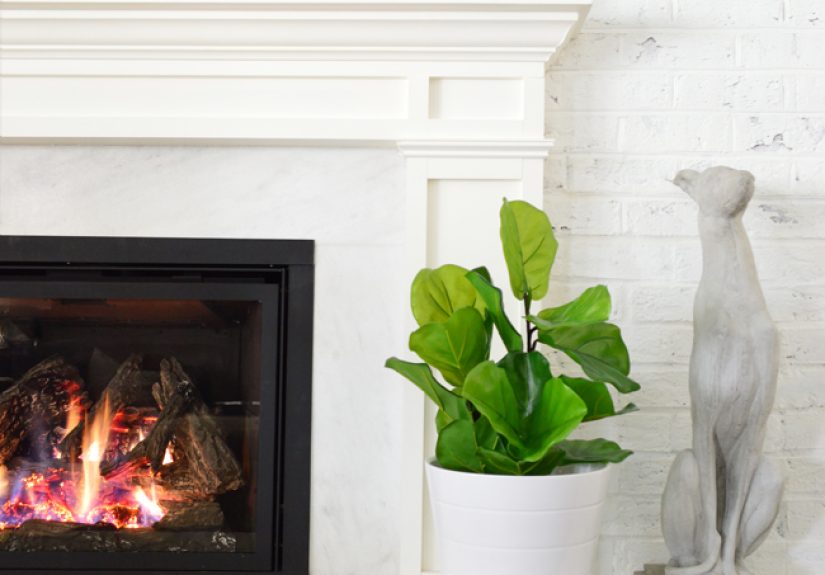
This is the classic placement for a large artificial fiddle leaf fig tree. It adds height, breaks up blank walls, and softens rooms with lots of straight lines. Put one near a media console, fireplace, or accent chair, and suddenly the whole room looks more designed.
Bedroom
A faux fiddle leaf fig in the bedroom adds softness without introducing maintenance. It works especially well in corners near dressers or beside windows where you want visual balance but not actual plant-care responsibility before coffee.
Entryway
If your entry feels flat, a fake fiddle leaf fig can add instant personality. It gives the space height and hospitality, almost like your home is saying, “Yes, I am pulled together, thanks for noticing.”
Home Office
Artificial greenery is ideal in workspaces because it adds life without adding chores. A mid-size faux tree can make a sterile office feel warmer and more finished, especially if your desk setup leans minimal or modern.
How to Care for a Faux Fiddle Leaf Fig So It Keeps Looking Real
The sales pitch for a faux plant is “no maintenance,” but let us not get carried away. It is low maintenance, not invisible maintenance. Dust happens. Leaves can flatten. Baskets can get scuffed. Fortunately, upkeep is easy.
- Dust the leaves regularly with a soft microfiber cloth or duster
- Use a gentle wipe for plastic or rubbery foliage when needed
- Reshape branches every so often if the canopy starts looking compressed
- Keep it out of harsh conditions if it is not rated for outdoor use
- Refresh the pot styling with moss, a basket, or a better planter if the base starts looking tired
That is it. No fertilizer. No leaf-drop heartbreak. No texting your friend a blurry photo and asking, “Why is it doing this to me?”
So, What Is the Best Faux Fiddle Leaf Fig I’ve Ever Seen?
It is the one that understands restraint. Not the bushiest. Not the glossiest. Not the one trying to prove itself with 700 leaves and a suspiciously tiny pot. The best faux fiddle leaf fig is the one that captures the spirit of the real plant: a sculptural trunk, broad waxy leaves, believable variation, and enough flexibility to be styled naturally in your home.
In practical terms, the winner usually has a few consistent traits: wired branches, textured bark, leaf color variation, a base that can be easily repotted, and a size that suits the room. It is also the kind of plant that looks better after you have lived with it for a day and taken the time to shape it properly. That is the magic. Great faux plants do not just arrive. They are finished by the person styling them.
If you have ever wanted that lush designer-home look without becoming a full-time plant nurse, this is one of the easiest decor wins you can buy. A high-quality artificial fiddle leaf fig can add height, softness, color, and polish in about ten minutes flat. For a home upgrade, that is a pretty excellent return on investment.
A Longer Personal Note: My Experience With the Best Faux Fiddle Leaf Fig I’ve Ever Seen
I still remember the first time I saw a faux fiddle leaf fig that actually fooled me. I was walking through a beautifully styled roomwarm wood tones, a neutral rug, one linen chair that looked both expensive and suspiciously nap-friendlyand there it was in the corner. Tall. Glossy. Graceful. Effortlessly put together. Basically the exact opposite of me before lunch. I did the thing everyone does when they think a plant might be fake but do not want to embarrass themselves: I stared at it from a respectful distance and tried to act casual.
At first glance, it looked real. Not “real for a fake plant.” Just real. The leaves had that broad, leathery look that fiddle leaf figs are famous for, and the trunk did not have that weird plastic-orange tone that cheaper artificial trees sometimes have. The plant was tucked into a woven basket that made the whole setup feel relaxed and expensive at the same time. It did not scream for attention, but it quietly made the entire room better. That, to me, is the hallmark of good decor. It does not need applause. It just makes the space work.
Of course, once I found out it was faux, I became instantly obsessed. I circled it. I leaned in. I checked the leaf placement like an overcaffeinated detective in a home decor procedural. What made it so convincing was not one flashy detail. It was the combination of little choices. The leaves were not identical. Some were turned slightly outward, some up, some down. The trunk had enough texture to feel organic. The color shifted just enough to mimic natural growth. Even the height was right. It filled the corner without swallowing the lamp beside it.
That experience changed how I think about artificial plants. Before that, I assumed faux greenery was either obviously fake or oddly formal, like something you would see in a dentist’s waiting room next to a stack of old magazines and a fish tank with one judgmental goldfish. But the best faux fiddle leaf fig taught me that a really good one does something different. It behaves like a styling tool. It adds softness to hard lines. It lifts the eye upward. It makes empty corners feel intentional. It brings in color without clutter. And unlike a real fiddle leaf fig, it never punishes you for going out of town for four days.
Since then, I have seen plenty of imitators. Some were too neon. Some were too bushy. Some looked like they had been assembled by a committee that had only heard fiddle leaf figs described over the phone. But every now and then, I come across one that gets it right, and the feeling is the same every time: relief, delight, and just a little smug joy. Relief because yes, beautiful things can also be practical. Delight because the room instantly looks more finished. And smug joy because I know that while other people are rotating real plants toward the sun and Googling “why are my fiddle leaf fig leaves sad,” I am over here dusting mine twice a month and getting on with my life.
That is why this category matters more than it seems. The best faux fiddle leaf fig is not just a fake plant. It is a shortcut to atmosphere. It is proof that low-maintenance can still be stylish. And honestly, in a world full of things demanding our constant attention, there is something deeply satisfying about a decor choice that simply shows up, looks gorgeous, and asks for almost nothing in return.
Conclusion
If you want the lush, editorial look of a real fiddle leaf fig without the watering schedule, leaf drop, or nerve damage, a well-made faux version is absolutely worth it. Focus on believable materials, flexible branches, good proportions, and a stylish planter or basket, and you will end up with a tree that feels polished rather than plasticky. In the right room, the best faux fiddle leaf fig does exactly what great decor should do: it makes your home feel more finished, more welcoming, and a little more like the version of yourself who definitely has it all together.