Table of Contents >> Show >> Hide
- What Is a Steam Radiator?
- What Is a Hot Water Radiator?
- The Core Difference: How the Heat Travels
- Steam vs. Hot Water Radiator: Quick Comparison
- How to Tell Which Type You Have
- Which One Feels Better in Daily Life?
- Which System Is More Efficient?
- Noise, Maintenance, and Common Problems
- Can You Control Room Temperature Better With Hot Water?
- Should You Replace Steam With Hot Water?
- Which One Is Better for Your Home?
- Real-World Experiences: What Living With Each System Is Actually Like
- Final Takeaway
If you have an old-school radiator sitting under your window like a cast-iron throne, you might assume all radiators work the same way. They do not. In fact, two homes can have nearly identical-looking radiators and run on completely different systems. One may use steam. The other may use hot water. And that difference affects everything from comfort and noise to efficiency, maintenance, and upgrade options.
At a glance, both systems use a boiler instead of a furnace. Both move heat through pipes instead of blowing warm air through ducts. Both can make a room feel pleasantly cozy on a cold day. But under the hood, steam and hot water radiators are very different beasts. Steam is dramatic. Hot water is usually calmer. Steam likes to make an entrance. Hot water tends to slip into the room like it pays the heating bill personally.
If you are buying an older home, trying to diagnose radiator problems, planning a boiler replacement, or just wondering why one radiator hisses while another needs bleeding, this guide will walk you through the real differences in plain English. No contractor jargon fog. No fake “ultimate guide” fluff. Just useful information you can actually use.
What Is a Steam Radiator?
A steam radiator is part of a heating system in which a boiler heats water until it turns to steam. That steam travels through pipes to the radiators, where it gives off heat. As the steam cools, it condenses back into water and returns to the boiler to be heated again.
In many older American homes and apartment buildings, steam systems are one-pipe systems. That means steam travels into the radiator and condensate leaves through the same pipe. Some steam systems are two-pipe designs, but one-pipe steam is the classic setup many homeowners picture when they think of a vintage radiator with a little air vent on the side.
Steam systems became especially common in older urban buildings because steam can move a lot of heat through relatively small pipes. That made it practical for tall buildings and dense older housing stock. It also helps explain why steam is still hanging around in plenty of Northeastern homes like a very stubborn houseguest who actually does pay rent.
What Is a Hot Water Radiator?
A hot water radiator, often called a hydronic radiator, is part of a closed-loop system. The boiler heats water, but not to the point of making steam. A circulator pump moves that hot water through pipes to radiators, baseboards, or panel radiators. The water releases heat into the room and then returns to the boiler to be reheated.
Hot water systems are more common in newer boiler-heated homes and in many retrofit projects. They are known for steady, even heat and greater control. Because the water stays liquid, the system can be zoned more easily, paired with modern controls, and adapted to lower-temperature operation in many cases.
That last point matters more than it sounds. Lower-temperature hydronic systems can work especially well with modern condensing boilers and, in some designs, even with hydronic heat pumps. Translation: hot water systems often have more upgrade flexibility for homeowners thinking long term.
The Core Difference: How the Heat Travels
The biggest difference between steam and hot water radiators is simple: steam systems move vapor, while hot water systems move liquid water.
Steam systems
The boiler creates steam, the steam rises through pipes, air leaves through vents, and the radiator heats up as steam condenses inside it. Because the system depends on phase change, gravity, air venting, and proper pitch, steam heat has a personality. Sometimes that personality is charming. Sometimes it bangs at 5:30 a.m. like it is auditioning for a percussion ensemble.
Hot water systems
The boiler heats water and a pump circulates it through the system. Because the water is being actively moved and recirculated, the heat delivery is usually steadier and easier to control. Instead of waiting for steam to fill a radiator, you are sending heated water where it needs to go and adjusting flow as needed.
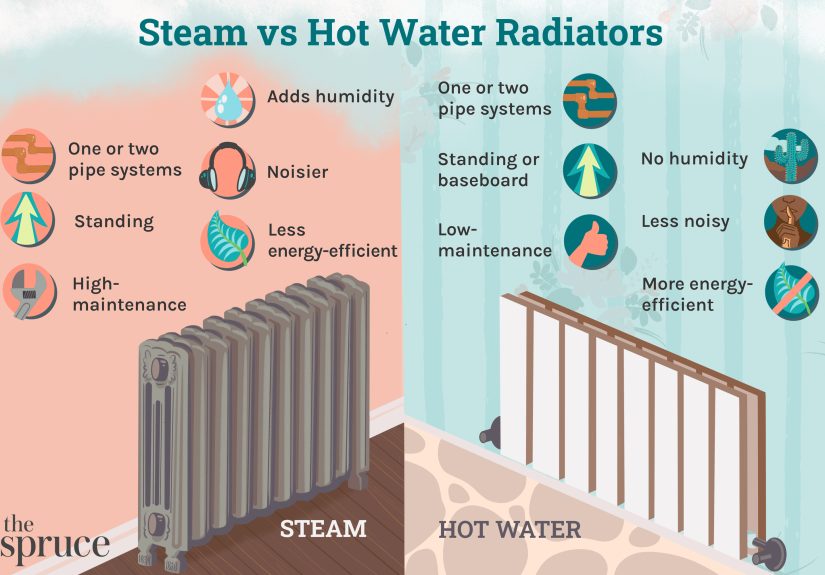
Steam vs. Hot Water Radiator: Quick Comparison
| Feature | Steam Radiator | Hot Water Radiator |
|---|---|---|
| Heat medium | Steam vapor | Liquid hot water |
| Typical piping | Often one-pipe, sometimes two-pipe | Usually two-pipe supply and return |
| Temperature | Generally hotter operation | Usually lower-temperature operation |
| Control | More limited, especially in one-pipe systems | Easier zoning and room-by-room control |
| Noise | Can hiss, click, or bang | Usually quieter, though air can cause gurgling |
| Maintenance | Vents, pitch, boiler water level, balancing | Bleeding air, pump checks, valve maintenance |
| Efficiency potential | Can be effective, but often less efficient in practice | Usually more efficient and easier to optimize |
| Modern upgrade compatibility | More limited | Better fit for zoning and lower-temp equipment |
How to Tell Which Type You Have
This is where many homeowners get tripped up. A chunky cast-iron radiator does not automatically mean steam. It could easily be hot water.
Signs you may have steam radiators
- A single pipe connects to the radiator.
- You see a small air vent on the side of the radiator.
- The radiators heat in cycles and may hiss or knock.
- Your home is older, especially in a city with lots of historic housing stock.
Signs you may have hot water radiators
- Two pipes connect to the radiator, one for supply and one for return.
- You have a bleed valve near the top of the radiator.
- The system feels quieter and more even.
- Your boiler setup includes a circulator pump and often zoning components.
There are exceptions, so if you are unsure, check the boiler, piping, and radiator fittings together. A contractor can identify the system quickly, but homeowners can often spot the clues with one good flashlight and about three minutes of detective work.
Which One Feels Better in Daily Life?
Comfort is not just about air temperature. It is also about consistency, surface warmth, room balance, and how much the system overshoots or undershoots the thermostat setting.
Steam heat feel
Steam heat often feels powerful and satisfying once the radiator gets hot. In an old apartment on a bitter winter morning, steam can make a room feel toasty in a way that encourages loafing. The downside is that one-pipe steam systems can be less precise. Heat often arrives in cycles, which can mean a room swings from cool to warm to “why am I opening a window in January?”
Hot water heat feel
Hot water heat is usually steadier and more predictable. Because the system can modulate flow and divide the home into zones more easily, rooms are often easier to keep at different target temperatures. Bedrooms can be cooler, living spaces warmer, and that always-freezing back room can finally stop acting like a walk-in refrigerator.
In general, hot water systems offer finer control, while steam systems often deliver more of an all-or-nothing heating rhythm.
Which System Is More Efficient?
As a rule, hot water radiator systems are usually more efficient than steam systems, especially in residential settings. That does not mean steam is bad. It means hot water is generally easier to optimize.
Here is why. Steam boilers operate at higher temperatures, and steam systems can be harder to fine-tune. Balancing, venting, and cycling all matter. A neglected steam system can waste energy through uneven distribution, overheating, and uninsulated piping. A well-tuned steam system, however, can still perform surprisingly well.
Hot water systems have several built-in advantages. They can be zoned more easily. They can circulate lower-temperature water. They can work better with thermostatic radiator valves. They can also pair more naturally with condensing boilers, which perform best when return water temperatures are lower. That is one reason hydronic systems are often seen as more future-friendly.
Still, efficiency is not only about system type. A badly maintained hot water system can underperform. A carefully tuned steam system with insulated mains, proper venting, and sensible controls can do much better than homeowners expect. The real villain in heating bills is often not “steam versus water,” but neglect versus maintenance.
Noise, Maintenance, and Common Problems
Steam radiator issues
Steam radiators are famous for hiss, clank, knock, and occasional attitude. Those noises usually point to a system issue, not a radiator trying to communicate with the afterlife.
Common steam problems include:
- Banging caused by trapped condensate or improper radiator pitch
- Faulty or mismatched air vents
- Uneven heating caused by poor balancing
- Overheating in some rooms and underheating in others
- Boiler water-level or low-water-cutoff issues
Steam systems also need their piping and boiler sized correctly. Oversized boilers can short-cycle, which wastes energy and hurts comfort.
Hot water radiator issues
Hot water systems are usually quieter, but they are not maintenance-free. Air trapped in the system can reduce performance and cause gurgling or cold spots. That is why many radiators need bleeding at the start of the heating season.
Common hot water problems include:
- Air pockets in radiators
- Circulator pump issues
- Leaking valves or pipe joints
- Sludge, corrosion, or mineral buildup in older systems
- Uneven flow if the system is poorly balanced
In many homes, hot water maintenance feels more straightforward. In many steam homes, maintenance feels more specialized. That does not make steam bad, but it does mean the right technician matters more than ever.
Can You Control Room Temperature Better With Hot Water?
Usually, yes.
Hot water systems are generally easier to divide into zones, each with its own thermostat. That makes them a strong choice for larger homes, additions, finished basements, and households where one person likes it cozy while another believes winter builds character.
Thermostatic radiator valves can also improve individual room control on many hot water systems. Steam systems can use certain radiator controls too, but the results are often more limited, especially in one-pipe steam setups. In those systems, the heat delivery depends heavily on cycling, venting, and how quickly steam reaches the radiator.
So if your main priority is flexibility and room-by-room comfort, hot water usually has the edge.
Should You Replace Steam With Hot Water?
This is the question that appears right after “What on earth is that banging sound?” and right before “How much is this going to cost me?”
The answer depends on the condition of the existing system, your budget, and your goals.
Keep steam if:
- The system is structurally sound and heats well once balanced
- You live in an older home where preserving original infrastructure matters
- You want to avoid a major piping conversion project
- You have access to a contractor who truly understands steam
Consider converting or replacing if:
- The steam system is failing and major components need replacement
- You want zoning and finer comfort control
- You are doing a major renovation anyway
- You want to use lower-temperature hydronic equipment in the future
Converting from steam to hot water is not a casual weekend project. It can involve boiler replacement, piping changes, radiator assessment, valve changes, and control upgrades. In some homes, reusing old cast-iron radiators is possible. In others, it is not worth the complication. That is why the right decision is less about internet opinions and more about a whole-system evaluation.
Which One Is Better for Your Home?
If you want the cleanest one-line answer, here it is: hot water radiators are usually better for efficiency, flexibility, and modern control, while steam radiators can still be excellent in older homes when they are properly maintained and balanced.
Choose steam if you already have a solid steam system and want to preserve what works. Choose hot water if you want greater control, easier zoning, quieter operation, and broader compatibility with modern high-efficiency equipment.
Neither system deserves blind loyalty. This is not a sports rivalry. Your radiator does not need a fan club. It needs correct sizing, good maintenance, and realistic expectations.
Real-World Experiences: What Living With Each System Is Actually Like
On paper, steam and hot water radiators can sound like a technical comparison between one heating method and another. In real life, the difference often shows up in small daily moments.
In many older city apartments with steam heat, winter mornings have a certain rhythm. The pipes start to warm. A radiator hisses softly. Then there is a click, maybe a little ping, and finally the room fills with that distinct deep warmth only a hot cast-iron radiator seems to provide. Some people love that feeling because it makes a room feel instantly lived in. Others are less enchanted when the bedroom becomes tropical at 2 a.m. and the only practical thermostat is opening the window a crack. Steam often creates memorable heat, but it can also create memorable arguments about blankets.
Homeowners who live with steam for years often say the system works best when they stop fighting it and start tuning it. Proper main venting, radiator vent selection, boiler maintenance, and pipe insulation can change the experience dramatically. A house that once felt uneven and noisy can become much calmer after a knowledgeable steam contractor goes through the system carefully. The problem is that not every HVAC technician is a steam expert. Many homeowners learn this the expensive way after replacing parts that were never the real issue.
Hot water radiator owners usually describe a different experience. The heat tends to feel steadier. Instead of waiting for the whole system to cycle on hard, rooms warm more gradually and stay more even. In homes with zoning, people quickly get attached to the idea that the upstairs bedrooms do not need to match the living room temperature exactly. Once someone gets used to bedroom comfort being separate from kitchen comfort, they rarely volunteer to go back.
There is also a practical side to day-to-day life with hot water. If a radiator has a cold spot, the homeowner may simply bleed trapped air and move on with life. That is not always fun, but it is a relatively understandable maintenance task. With steam, by contrast, odd behavior can involve pitch, venting rate, near-boiler piping, condensate return, pressure settings, or balancing. That is a longer mystery novel.
Renovation stories highlight the difference even more. People restoring older homes often fall back in love with original cast-iron radiators because they look fantastic and produce a gentle, lasting warmth. If those radiators are connected to a modern hot water system with smart controls, they can offer a blend of vintage aesthetics and contemporary comfort. That combination is hard to beat. On the other hand, homeowners who keep steam often develop a kind of affectionate respect for it. Steam may not be fussy in the same way a smartphone app is fussy, but it absolutely expects you to understand its rules.
The most honest takeaway from real-world experience is this: steam feels more historic, more forceful, and sometimes more temperamental. Hot water feels more adaptable, more even, and more forgiving. Neither one is automatically perfect. But if you know what you have, maintain it properly, and match your expectations to the system, either can heat a home beautifully.
Final Takeaway
Steam and hot water radiators may look similar from across the room, but they operate in very different ways. Steam systems heat with vapor, often run hotter, and usually offer less precise control. Hot water systems circulate liquid water, tend to be quieter, and usually provide better comfort management and efficiency potential.
If your home already has a good steam system, do not assume it needs to be ripped out. If you are planning a major upgrade and want modern performance, hot water is usually the more flexible path. Either way, the smartest move is to understand the system you have before you spend money trying to change it.
Because when it comes to radiators, the real difference is not just what heats the metal. It is how that choice shapes comfort, maintenance, and life in your house all winter long.