Table of Contents >> Show >> Hide
- Quick Cheat Sheet (Copy/Paste Friendly)
- The 11 Steps
- Step 1: Learn the main phrase: “Buon compleanno!”
- Step 2: Add the crowd favorite: “Tanti auguri!”
- Step 3: Combine them for maximum birthday energy
- Step 4: Get the pronunciation right (the easy way)
- Step 5: Personalize it with a name (and punctuation)
- Step 6: Level up with heartfelt add-ons (without getting cheesy)
- Step 7: Write a birthday card message that sounds human
- Step 8: Handle belated wishes like a pro (a.k.a. save yourself)
- Step 9: Learn the Italian birthday song (“Tanti auguri a te”)
- Step 10: Add an Italian-style toast: “Cin cin!”
- Step 11: Know what to say when you get the wishes
- Common Mistakes (So You Don’t Accidentally Wish Someone a Happy… Something Else)
- Mini Practice: 5 Real-Life Scenarios
- Experience-Based Notes: What It’s Like to Use These Phrases in the Wild (Bonus ~)
- Conclusion
You could spend years mastering Italian verb conjugations… or you could learn the most important phrase of all:
how to wish someone a happy birthday without sounding like a confused GPS. The good news? Italian birthday wishes
are friendly, musical, and wonderfully flexibleso you can keep it simple or go full romantic-poet-with-cake.
In this guide, you’ll learn the classic Italian “Happy Birthday,” the most common alternatives, how to pronounce them
so you don’t accidentally invent a new pasta shape, and exactly what to say in texts, cards, and birthday toasts.
We’ll do it in 11 practical steps, with examples you can steal immediately (that’s not plagiarismthat’s efficiency).
Quick Cheat Sheet (Copy/Paste Friendly)
| Italian | Meaning | When to Use | Easy Pronunciation Hint |
|---|---|---|---|
| Buon compleanno! | Happy birthday! | Universal (safe for anyone) | “Bwon kom-pleh-AHN-noh” |
| Tanti auguri! | Many wishes! | Birthdays + other celebrations | “TAHN-tee ow-GOO-ree” |
| Tanti auguri di buon compleanno! | Many wishes for your birthday! | More complete / extra warm | Combine the two above |
| Auguri! | Best wishes! | Quick, casual, totally normal | “ow-GOO-ree” |
| Cento di questi giorni! | 100 more days like this! | Toast / card (a classic vibe) | “CHEN-toh dee KWEH-stee JOR-nee” |
| Auguri in ritardo! | Belated birthday wishes! | When you’re late (oops) | “ow-GOO-ree in ree-TAR-doh” |
The 11 Steps
Step 1: Learn the main phrase: “Buon compleanno!”
The most direct way to say “Happy Birthday” in Italian is:
Buon compleanno!
It literally works like “Have a good birthday,” and it’s the safest option in every settingfriends, coworkers,
grandparents, your neighbor who knows everyone’s business.
Example:
“Buon compleanno, Sara! Spero che sia una giornata bellissima.”
(“Happy birthday, Sara! I hope it’s a beautiful day.”)
Step 2: Add the crowd favorite: “Tanti auguri!”
If Italians had a “Top 40” of celebratory phrases, Tanti auguri! would be stuck at #1.
It means “many wishes,” and it’s used for birthdays and other happy occasions (think: “best wishes”).
On a birthday, it lands perfectlywarm, natural, and very Italian.
Example (casual): “Tanti auguri! 🎉”
That’s it. That’s the whole text. No one is mad. In fact, you look cool.
Step 3: Combine them for maximum birthday energy
Want to sound extra thoughtful without writing a novel? Combine the two most common ideas:
Tanti auguri di buon compleanno!
It’s a fuller “Happy birthday!” that still feels totally everyday.
Example (friendly but polished):
“Tanti auguri di buon compleanno! Ti auguro il meglio.”
(“Many happy birthday wishes! I wish you the best.”)
Step 4: Get the pronunciation right (the easy way)
You don’t need opera-level dictionjust a few Italian basics:
- “Buon” sounds like “bwon” (it slides together).
- com-ple-AN-no has the stress near the end: kom-pleh-AHN-noh.
-
Italian double consonants (like the “nn” in compleanno) are held a touch longer.
Don’t panicjust don’t swallow them. - au in auguri is like “ow” in “wow.”
Mini drill (say it three times, slightly more confident each time):
“Bwon kom-pleh-AHN-noh!”
“TAHN-tee ow-GOO-ree!”
Step 5: Personalize it with a name (and punctuation)
Italians love direct, friendly address. Add the person’s name and you’re instantly more fluent-looking:
- Buon compleanno, Marco!
- Tanti auguri, Giulia!
Pro tip: In texts, punctuation does a lot of heavy lifting. Compare:
“Buon compleanno.” (sounds mildly bored) vs.
“Buon compleanno!!” (you remembered and you care).
Step 6: Level up with heartfelt add-ons (without getting cheesy)
Once you’ve got the basics, sprinkle in one of these upgrades:
- Auguri di cuore! (Heartfelt wishes!)
- Un mondo di auguri! (A world of wishes!)
- Auguroni! (Big wishes! Very friendly, very warm.)
- Cento di questi giorni! (Here’s to 100 more!)
Example (sweet, not over-the-top):
“Buon compleanno! Auguri di cuore.”
(“Happy birthday! Heartfelt wishes.”)
Step 7: Write a birthday card message that sounds human
Cards are where people accidentally become robots (“Wishing you a day of dayness!”). Keep it simple and sincere.
Here are templates that feel natural:
Casual (friends, siblings, close coworkers)
- Buon compleanno! Divertiti tantissimo! (Have a ton of fun!)
- Tanti auguri! Ti meriti il meglio. (You deserve the best.)
- Buon compleanno! Stasera si festeggia! (Tonight we celebrate!)
Warm but not too personal (neighbors, acquaintances)
- Tanti auguri di buon compleanno! Una splendida giornata. (Have a wonderful day.)
- Buon compleanno! Che sia un anno pieno di cose belle. (May it be a year full of good things.)
More formal (boss, clients, professional settings)
- Buon compleanno! Le auguro un anno ricco di soddisfazioni. (I wish you a year full of accomplishments.)
- Tanti auguri di buon compleanno. Cordiali saluti, (Best wishes. Sincerely,)
Step 8: Handle belated wishes like a pro (a.k.a. save yourself)
Forgot the date? First, breathe. Second, use the magical phrase:
Auguri in ritardo! (Belated birthday wishes!)
If you want to add an apology without sounding dramatic:
- Scusami, mi sono dimenticato/a! Auguri in ritardo! (Sorry, I forgot! Belated wishes!)
- Anche se in ritardo, tanti auguri! (Even if late, many wishes!)
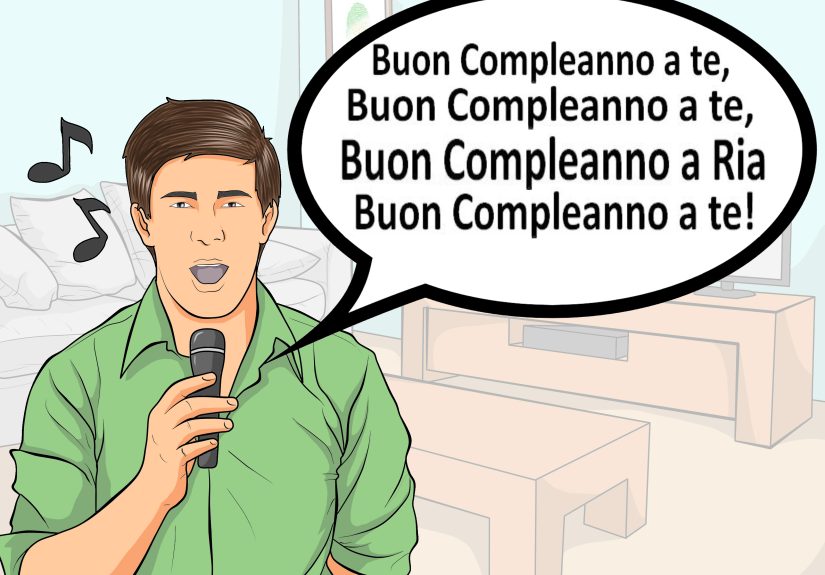
Step 9: Learn the Italian birthday song (“Tanti auguri a te”)
If there’s cake, there’s a strong chance someone will start singing. The Italian version commonly goes:
Tanti auguri a te,
Tanti auguri a te,
Tanti auguri a [Nome],
Tanti auguri a te!
You can swap in the person’s name on the third line. If you’re nervous, just smile and join in on the last
“a te!” like you’ve been doing it your whole life.
Bonus: Some families add playful variations (like “tanti giorni felici” “many happy days”).
Don’t overthink itmatch the room.
Step 10: Add an Italian-style toast: “Cin cin!”
At many Italian-style celebrations, you’ll hear a toast right before (or right after) the birthday wish.
The classic clink-and-smile toast is:
Cin cin! (Cheers!)
Pair it with a birthday line:
- Cin cin! Tanti auguri!
- Cin cin! Buon compleanno!
- Cin cin! Cento di questi giorni!
Cultural note (because it’s fun): in some Italian contexts, opening gifts right away is totally normal.
So if you hand over a present, don’t be shocked if they unwrap it immediately with a big smile.
Step 11: Know what to say when you get the wishes
Someone tells you “Buon compleanno!”what do you say back? Keep it simple:
- Grazie! (Thanks!)
- Grazie mille! (Thanks a lot!)
- Grazie per gli auguri! (Thanks for the wishes!)
- Grazie a tutti! (Thanks, everyone!)
If you’re replying to multiple messages (social media mode), Grazie a tutti per gli auguri! is a great all-in-one line.
Common Mistakes (So You Don’t Accidentally Wish Someone a Happy… Something Else)
- Changing the phrase for gender: You don’t need to. Buon compleanno stays the same for everyone.
-
Overusing “Felice compleanno”: It exists, but it’s less common than Buon compleanno.
If you want to sound natural, start with the classic. -
Wishing “Happy Birthday” too early: Some Italians consider early wishes unlucky.
If you’re not sure, wait until the day (or use a neutral “I can’t wait to celebrate!”). - Pronouncing “auguri” like “uh-GOO-ree”: Aim for ow-GOO-ree (that “au” matters).
Mini Practice: 5 Real-Life Scenarios
-
Texting a friend:
“Tanti auguri, Anna!! 🎂🎉” -
Writing a card:
“Buon compleanno! Che sia un anno pieno di felicità. Auguri di cuore!” -
Talking to a coworker:
“Buon compleanno! Spero che tu possa festeggiare alla grande.” -
You forgot (but you’re fixing it):
“Auguri in ritardo! Scusami, mi è proprio sfuggito.” -
Making a toast:
“Cin cin! Tanti auguri di buon compleanno!”
Experience-Based Notes: What It’s Like to Use These Phrases in the Wild (Bonus ~)
Learning birthday Italian is one thing; using it in real life is where the fun (and occasional chaos) starts.
Here are a few experience-based moments you’re likely to run intoand how to handle them without breaking a sweat.
1) The “I practiced… and then my mouth forgot” moment
A super common first-time experience is practicing Buon compleanno flawlessly alone, then walking up to a real person
and suddenly hearing your brain go, “Wow, Italian has letters.” If that happens, don’t force a perfect accent.
Italians (and Italian speakers everywhere) usually respond best to confidence and clarity, not perfection.
Smile, say “Buon compleanno!” slowly, and let the rhythm do the work. If you stumble, simply repeat it once
at a calmer pacerepetition reads as emphasis, not failure. Think: “I meant that.” Not: “I forgot language.”
2) The “Auguri is everywhere” surprise
Many learners expect one fixed birthday phrase, then discover auguri shows up for birthdays, holidays,
anniversaries, graduationsbasically any moment where humans feel joy and/or obligation. The experience of hearing
“Auguri!” in different contexts can be confusing for about five minutes, and then it becomes a superpower.
Once you realize it’s like “best wishes,” you’ll start using it naturally: short, friendly, and never awkward.
It’s the perfect phrase for quick messages when you don’t know how formal to be.
3) The birthday song dilemma (do you sing or mime?)
The Italian birthday song experience often goes like this: someone starts singing Tanti auguri a te,
half the group joins confidently, and the other half does a polite, supportive face that says,
“I am here emotionally, not musically.” Both are acceptable. If you’re unsure, hop in on the first line quietly,
then increase volume by the third line when you recognize the pattern (because it’s the same structure each time).
If the group swaps in the birthday person’s name, don’t panicjust keep singing “tanti auguri” and let your face
communicate enthusiasm. Pro tip: clapping on beat covers a multitude of lyrical sins.
4) The “Italian birthday style” culture gap
Depending on where you celebrate, you might notice different expectations: who pays, when gifts open, how dramatic the toast gets,
and whether the cake is a quiet moment or a full event. A common experience for Americans at Italian-style parties is being surprised
by how socially interactive the birthday wish becomespeople may repeat wishes, add affectionate phrases, or turn a simple “happy birthday”
into a mini speech. If you want to join in without overdoing it, use a two-part combo that always fits:
“Buon compleanno! Auguri di cuore!” It’s warm, natural, and short enough that you won’t feel like you’re running for office.
5) The “belated message rescue”
Belated birthdays happen to everyone. The good news is that “Auguri in ritardo!” is socially normal and instantly understood.
In real-life use, the key is adding a tiny bit of humilityone quick apology line is plentythen focusing on the celebration.
A message like “Auguri in ritardo! Spero tu abbia passato una bellissima giornata.” feels kind and genuine,
and it shifts attention away from the delay. Most people care far more that you remembered at all than whether you remembered on time.
Conclusion
If you remember only one thing, make it Buon compleanno! It’s the universal, always-correct Italian “Happy Birthday.”
From there, you can add Tanti auguri! for a more conversational feel, sing Tanti auguri a te when the cake arrives,
and sprinkle in warm upgrades like Auguri di cuore or Cento di questi giorni when you want to sound extra thoughtful.
Try one phrase todaytext it, say it out loud, or use it the next time someone mentions their birthday. Italian is a language that rewards
boldness, and birthdays are the friendliest place to start. Now go forth and wish responsibly (and may your pronunciation be blessed by espresso).