Table of Contents >> Show >> Hide
- What Is Yahtzee?
- What You Need to Play Yahtzee
- How to Play Yahtzee: Basic Rules
- Understanding the Yahtzee Scorecard
- Upper Section Scoring
- Lower Section Scoring
- Yahtzee Bonus and Joker Rules
- How to Win Yahtzee: Practical Strategies
- Strategy 1: Protect the Upper Section Bonus
- Strategy 2: Do Not Waste Chance Too Early
- Strategy 3: Know When to Scratch a Category
- Strategy 4: Chase Straights When the Dice Invite You
- Strategy 5: Be Careful With Low Three of a Kind Scores
- Strategy 6: Take a Good Full House When It Appears
- Strategy 7: Adjust Based on the Scorecard, Not Your Mood
- Example Turn: Thinking Like a Yahtzee Player
- Common Yahtzee Mistakes Beginners Make
- Best Opening Priorities
- Endgame Strategy: Survive the Final Boxes
- Real-Table Experience: What Playing Yahtzee Teaches You
- Conclusion
- SEO Tags
Yahtzee is the rare dice game that can make a quiet kitchen table sound like a sports arena. One minute everyone is politely sipping coffee; the next, someone is shouting “YAHTZEE!” like they just discovered electricity. The beauty of the gameueeze the best score from thirteen turns of luck, math, and mildly dramatic decision-making.
If you are new to the game, do not worry. Yahtzee looks more complicated than it is because the scorecard has many boxes. Once you understand the rhythmroll, decide, reroll, scoreit becomes wonderfully easy. But winning consistently? That takes more than hoping the dice are in a generous mood. This guide explains how to play Yahtzee, how Yahtzee scoring works, and which winning strategies help turn “random dice chaos” into a smart game plan.
What Is Yahtzee?
Yahtzee is a classic dice game played with five six-sided dice, a score sheet, and at least one player. It is usually played by two or more people, but solo Yahtzee is also popular for practice. The goal is to earn the highest total score after thirteen rounds. Each round gives you one turn, and each turn gives you up to three rolls.
The game blends luck and strategy. You cannot control what the dice show, unless you have made a suspicious pact with probability, but you can control which dice to keep, when to take a safe score, and when to gamble for a bigger combination. That balance is what keeps Yahtzee fresh even after dozens of games.
What You Need to Play Yahtzee
To play a standard game of Yahtzee, you need:
- Five six-sided dice
- A Yahtzee score sheet
- A pencil or pen
- A flat rolling area
- Two or more players, or one player for solo practice
Many official sets include a dice cup or shaker, but it is not required. A cup does add a little drama, especially when someone starts shaking it like they are summoning thunder.
How to Play Yahtzee: Basic Rules
1. Decide Who Goes First
Players can roll one die each, with the highest roll going first, or choose any fair method. Play usually continues clockwise.
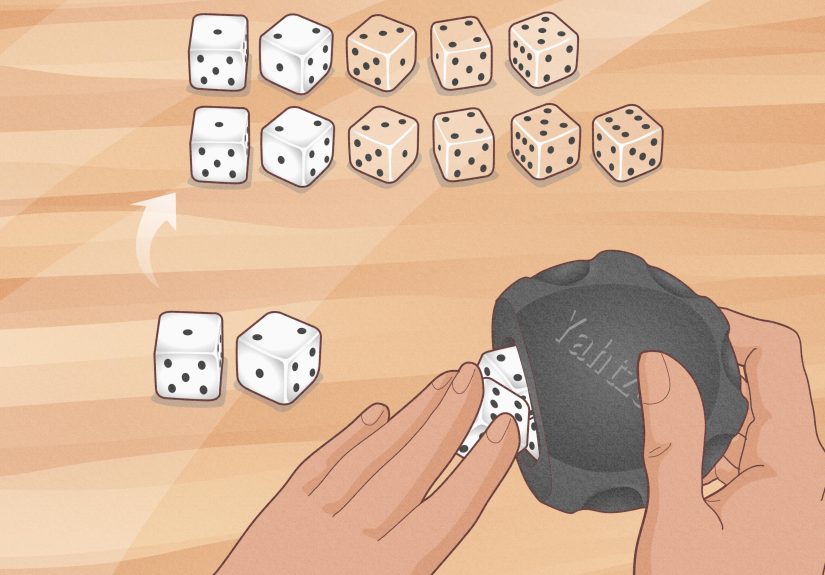
2. Roll All Five Dice
On your turn, roll all five dice. After the first roll, look at the result and decide which dice you want to keep. For example, if you roll 6-6-2-3-5, you might keep the two sixes and reroll the other three dice in hopes of building Three of a Kind, Four of a Kind, or even Yahtzee.
3. Reroll Up to Two More Times
You may roll up to three times total on a turn: the first roll plus two optional rerolls. You can reroll any number of dice, including dice you previously kept. Nothing is locked unless you decide your turn is finished. If your dice betray you after the second roll, yes, you may reroll all five dice on the third roll. Desperate? Maybe. Legal? Absolutely.
4. Choose One Scoring Category
After you stop rolling, you must enter a score in one open category on your scorecard. Each category can be used only once, except Yahtzee bonuses. If your dice do not qualify for any useful category, you may have to score zero in one box. This is called “scratching” a category, and it hurts, but sometimes it is the smartest move.
5. Play Thirteen Rounds
Each player takes thirteen turns because there are thirteen scoring boxes. Once every player has filled every box, add the totals. The highest score wins.
Understanding the Yahtzee Scorecard
The Yahtzee scorecard is divided into two sections: the Upper Section and the Lower Section. The Upper Section rewards collecting matching numbers. The Lower Section rewards poker-style dice combinations such as Full House, Straights, and Yahtzee.
Upper Section Scoring
In the Upper Section, you score only the dice that match the chosen number. All other dice are ignored.
| Category | How to Score | Example |
|---|---|---|
| Aces | Add all 1s | 1-1-3-4-6 scores 2 |
| Twos | Add all 2s | 2-2-2-5-6 scores 6 |
| Threes | Add all 3s | 3-3-4-5-6 scores 6 |
| Fours | Add all 4s | 4-4-4-1-2 scores 12 |
| Fives | Add all 5s | 5-5-5-2-3 scores 15 |
| Sixes | Add all 6s | 6-6-6-6-1 scores 24 |
The 35-Point Upper Section Bonus
If your Upper Section total is 63 or higher, you earn a 35-point bonus. The easiest way to understand the target is this: three of each number equals exactly 63 points. Three Aces score 3, three Twos score 6, three Threes score 9, three Fours score 12, three Fives score 15, and three Sixes score 18. Add those together and you get 63.
This bonus is one of the biggest keys to winning Yahtzee. It is worth more than a Small Straight and almost as much as a Large Straight. Ignore it too casually, and your opponent may quietly walk away with the game while pretending they “just got lucky.” Suspicious behavior, but technically allowed.
Lower Section Scoring
The Lower Section is where Yahtzee becomes more tactical. Some categories score a fixed amount, while others score the total of all five dice.
| Category | Requirement | Score |
|---|---|---|
| Three of a Kind | At least three dice showing the same number | Total of all five dice |
| Four of a Kind | At least four dice showing the same number | Total of all five dice |
| Full House | Three of one number and two of another | 25 points |
| Small Straight | Four consecutive numbers | 30 points |
| Large Straight | Five consecutive numbers | 40 points |
| Yahtzee | Five dice showing the same number | 50 points |
| Chance | Any dice combination | Total of all five dice |
Three of a Kind and Four of a Kind
For Three of a Kind and Four of a Kind, you score the total of all five dice, not just the matching dice. A roll of 5-5-5-4-6 qualifies as Three of a Kind and scores 25. A roll of 6-6-6-6-2 qualifies as Four of a Kind and scores 26.
Full House
A Full House is three dice of one number and two dice of another, such as 3-3-3-5-5. It scores 25 points. Early in the game, a Full House is often worth taking because 25 guaranteed points can be better than chasing something prettier and ending up with a scorecard-shaped frown.
Small Straight
A Small Straight is any four-number sequence: 1-2-3-4, 2-3-4-5, or 3-4-5-6. The fifth die can be anything. A Small Straight scores 30 points.
Large Straight
A Large Straight uses all five dice in sequence: 1-2-3-4-5 or 2-3-4-5-6. It scores 40 points. If you roll a Large Straight but the Large Straight box is already filled, you can usually score it as a Small Straight if that box is open.
Yahtzee
A Yahtzee is five of a kind, such as 4-4-4-4-4. The first Yahtzee scores 50 points in the Yahtzee box. It is the game’s celebrity category: rare, loud, and guaranteed to make everyone check your dice suspiciously.
Chance
Chance is the safety net. It accepts any roll and scores the total of all five dice. Because Chance can rescue a messy turn late in the game, experienced players often avoid using it too early unless the total is strong, usually around 24 or higher.
Yahtzee Bonus and Joker Rules
If you roll another Yahtzee after already scoring 50 in the Yahtzee box, you earn a 100-point Yahtzee bonus. Then you must score the roll in another open category. If the matching Upper Section category is open, it is typically used there. If that box is already filled, the Yahtzee can work as a Joker in the Lower Section, allowing you to score categories such as Full House, Small Straight, or Large Straight for their normal fixed values even though the dice are five of a kind.
If your Yahtzee box was previously filled with zero, later Yahtzees do not receive the 100-point bonus. That is why scratching Yahtzee is a serious decision. Sometimes it is necessary, especially late in the game, but early on you should think twice before closing the door on bonus potential.
How to Win Yahtzee: Practical Strategies
Strategy 1: Protect the Upper Section Bonus
The 35-point bonus is not glamorous, but it wins games. Your baseline goal is three of each number. If you score only two Fives, you are 5 points behind pace. You can recover by scoring four Sixes, which puts you 6 points above pace. Think of the Upper Section as a small budget. Some categories create debt; others pay it off.
High numbers matter most. Four Sixes score 24, which is excellent. Four Fives score 20. Four Fours score 16. These high rolls can compensate for weak Aces, Twos, or Threes. If you roll four Sixes, strongly consider scoring Sixes rather than Four of a Kind, especially if you are still chasing the upper bonus.
Strategy 2: Do Not Waste Chance Too Early
Chance looks harmless, but it is valuable because it can absorb an ugly roll when all your other boxes are difficult. If you use Chance on a low score in the first few rounds, you may regret it later when your dice produce something like 6-5-4-3-2 and your remaining categories all demand matching numbers.
A good rule of thumb: use Chance early only when the total is strong or when the alternative damages your scorecard more severely. A total of 25 or higher is usually respectable. A total of 17 in Chance during round two is like eating your emergency snack before leaving the driveway.
Strategy 3: Know When to Scratch a Category
Scoring zero feels painful, but smart players use scratches strategically. Low-value Upper Section boxes, especially Aces or Twos, often make better scratch candidates than major Lower Section categories early in the game. Scratching Aces costs at most 5 points, while scratching Large Straight costs 40.
Late in the game, the decision changes. If Yahtzee remains open but you have no realistic path to it, scratching Yahtzee may be better than sacrificing a category that can still score. Yahtzee is a game of timing, not just hoping for heroic dice.
Strategy 4: Chase Straights When the Dice Invite You
Small and Large Straights are easier when your first roll already contains a useful sequence. If you roll 1-2-3-4-6, you already have a Small Straight and are one die away from a Large Straight. If Large Straight is open, rerolling the 6 for a 5 may be worth the risk. If you miss, you can still score Small Straight if it remains available.
However, chasing straights from scattered dice is usually inefficient. A roll of 1-1-4-6-6 is not whispering “Large Straight.” It is whispering “please make a practical decision.” Listen to it.
Strategy 5: Be Careful With Low Three of a Kind Scores
Three of a Kind and Four of a Kind score the total of all dice, so the face value matters. Three 2s with a 1 and 3 score only 10. That is legal, but not exciting. If you are early in the game, you may be better off scoring Twos, aiming for a Full House, or rerolling aggressively for a stronger result.
On the other hand, three 6s with a 5 and 4 score 27, which is excellent for Three of a Kind. In Yahtzee, the same pattern can be either weak or wonderful depending on the numbers involved.
Strategy 6: Take a Good Full House When It Appears
Full House scores 25 points, which is solid. If you roll a natural Full House early, taking it is often wise. Some players get greedy and reroll part of it to chase Yahtzee, only to end with a sad collection of unrelated dice and a new respect for humility.
There are exceptions. If you have three Sixes and two low dice, you might chase Yahtzee or score Sixes depending on your Upper Section needs. But for many ordinary Full Houses, banking 25 points is a strong move.
Strategy 7: Adjust Based on the Scorecard, Not Your Mood
The best Yahtzee decision depends on what boxes remain open. A roll that is terrible in round two may be useful in round twelve. Always scan your scorecard before deciding what to keep. Ask yourself: Which categories are still open? What scores do I need for the upper bonus? Which box can absorb a bad result? What is my opponent doing?
Good Yahtzee players are not just dice rollers. They are scorecard readers. The dice tell you what is possible; the scorecard tells you what is smart.
Example Turn: Thinking Like a Yahtzee Player
Suppose your first roll is 6-6-6-2-4. What should you do?
If your Sixes box is open, scoring 18 is right on pace for the upper bonus. You could keep the three Sixes and reroll the 2 and 4, hoping for another Six or even Yahtzee. If you roll one more Six, you can score 24 in Sixes, giving yourself a 6-point cushion toward the bonus. If you roll two more Sixes, congratulations, please shout responsibly.
If your Sixes box is already filled, you might aim for Three of a Kind, Four of a Kind, or Yahtzee. If you end with 6-6-6-5-4, Three of a Kind scores 27, a strong result. If you end with 6-6-6-6-3, Four of a Kind scores 27. The right choice depends on which categories are still available.
Common Yahtzee Mistakes Beginners Make
Filling Categories Too Quickly
New players often grab the first legal score they see. That works sometimes, but Yahtzee rewards patience. Before scoring, compare at least two options. A roll of 4-4-4-2-2 could be Full House, Fours, Three of a Kind, or Chance. The best answer depends on your scorecard.
Ignoring the Upper Bonus
The upper bonus is easy to forget because it arrives later, but those 35 points are huge. Track whether you are above or below the “three of each number” pace. If you fall behind, look for a chance to score four or five of a high number.
Chasing Yahtzee Every Time
Yahtzee is exciting, but chasing it too often can wreck a scorecard. If you already have a strong guaranteed score, think carefully before gambling it away. The dice do not care about your dreams. They are tiny cubes with no emotional training.
Using Chance as a Trash Can
Chance is flexible, but it should not automatically receive your first bad roll. Sometimes a zero in Aces is less damaging than a weak Chance score. Save Chance for a turn when you need flexibility.
Best Opening Priorities
In the early game, focus on building a strong foundation. Look for Fives and Sixes in the Upper Section, take a natural Full House if it appears, and secure straights when the dice already provide a strong sequence. Do not panic over one weak score. Yahtzee gives you thirteen rounds, and a single scratch does not ruin everything.
A strong opening often means keeping multiple possibilities alive. For example, a first roll of 2-3-4-5-5 can become a Small Straight, Large Straight, Fives score, or even a Full House depending on your reroll. Flexible rolls are powerful because they give you options after the dice change.
Endgame Strategy: Survive the Final Boxes
The final rounds are where Yahtzee gets spicy. Your scorecard may have only awkward boxes left, and every decision matters. If your remaining boxes are Large Straight, Yahtzee, and Aces, your strategy is very different than if you still have Chance and Fives open.
Late in the game, calculate realistic outcomes. If you need Large Straight and roll 1-2-3-4-4, go for it. If you need Yahtzee and roll five different numbers, consider whether another open box can reduce the damage. The endgame is about minimizing disaster as much as maximizing glory.
Real-Table Experience: What Playing Yahtzee Teaches You
After enough games of Yahtzee, you start noticing that the real battle is not just against your opponents. It is against impatience. Everyone has a story about the turn that got away: the Full House they broke apart, the Large Straight they almost had, the Yahtzee chase that ended in three 1s and a dramatic sigh. These moments are funny because they feel personal, even though the dice are just rolling around with complete indifference.
One practical experience many players learn quickly is that confidence can be expensive. A player rolls three 5s on the first roll and thinks, “I can definitely get Yahtzee.” They reroll the other two dice. No 5. They reroll again. Still no 5. Now they must decide whether to score 15 in Fives, take a modest Three of a Kind total, or use another category. The lesson is not that chasing Yahtzee is always wrong. The lesson is that every reroll has an opportunity cost. You are not only chasing one score; you are giving up another.
Another common table lesson involves the upper bonus. Beginners often treat Aces through Sixes like boring chores before the “real” categories. Then the final scores are added and someone wins by 30 points because they quietly earned the 35-point bonus. It feels sneaky, but it is not. It is disciplined scoring. The player who takes four Sixes in the Sixes box instead of rushing to Four of a Kind may look conservative at the time, but that move can create the cushion needed to survive weak Twos or Threes later.
Family games also reveal how different personalities approach risk. The cautious player banks a Small Straight immediately. The gambler says, “One more roll,” and aims for the Large Straight. The comedian at the table announces a “guaranteed Yahtzee” before rolling a collection of dice that looks like a phone number. None of these styles is wrong, but the best players learn when to switch modes. Early game? Keep options open. Middle game? Protect the upper bonus and grab solid lower scores. Endgame? Take the best realistic result and avoid unnecessary zeros.
One of the most useful habits is narrating your choices silently before scoring: “If I put this in Fives, I stay on bonus pace. If I put it in Three of a Kind, I get 23 points but still need Fives later. If I use Chance now, what saves me next round?” This small pause prevents rushed decisions. Yahtzee is fast, but it rewards the player who thinks for ten extra seconds.
The final experience worth remembering is that Yahtzee stays fun because no strategy guarantees victory. A beginner can roll two Yahtzees and become a legend for the evening. An expert can play correctly and still get trapped by cold dice. That unpredictability is the charm. The goal is not to eliminate luck; it is to make better decisions when luck hands you something weird. And in Yahtzee, “something weird” is basically the house special.
Conclusion
Learning how to play Yahtzee is easy: roll five dice, keep what helps, reroll what does not, and score one category each turn. Playing well takes more thought. The strongest players protect the 35-point upper bonus, avoid wasting Chance, choose scratch categories wisely, and understand when to chase big combinations like Large Straight or Yahtzee.
Yahtzee is popular because it gives every player a chance. Luck opens the door, but strategy decides who walks through it with the scorecard held high. Whether you are teaching friends, playing with family, or practicing solo, the key is to balance bold moves with practical scoring. And when the dice finally line up five of a kind, do not be shy. A proper “YAHTZEE!” is part of the rules in spirit, if not in print.