Table of Contents >> Show >> Hide
- The Famous Line: “There’s No Crying in Baseball!”
- Who Wrote A League of Their Own?
- How the Line Was Actually Created
- Why the Line Fits Jimmy Dugan So Perfectly
- The Role of Tom Hanks in Making the Quote Immortal
- Why the Line Became Bigger Than the Movie
- The Genius of Making a Sports Quote About Emotion
- How Research Helped the Writers Find the Right Tone
- What Writers Can Learn From This Famous Line
- Experiences Related to the Topic: Why This Line Still Feels So Useful
- Conclusion
Some movie quotes arrive wearing a tuxedo, waving to the crowd, and begging to be carved into pop-culture marble. Others sneak in through the dugout, covered in dirt, yelling at an outfielder, and somehow become immortal. “There’s no crying in baseball!” belongs proudly to the second group.
The line, shouted by Tom Hanks as the cranky, washed-up manager Jimmy Dugan in A League of Their Own, has long outlived the 1992 film that introduced it. It is repeated at ballparks, in office meetings, during family game nights, and anywhere someone needs to jokingly announce that emotions are making the room inconvenient. But the story behind the line is even better than the quote itself: it was not engineered as a catchphrase. It was born from character, conflict, research, improvisation, and two screenwriters who knew that the funniest moments often come from emotional pressure rather than punchline machinery.
Lowell Ganz and Babaloo Mandel, the screenwriting duo behind the film’s screenplay, did not sit down and declare, “Today we shall create a sports movie quote for the ages.” That would have been very Hollywood, and also very unlikely to work. Instead, they built a scene around Jimmy Dugan’s insecurity, the Rockford Peaches’ growing seriousness, and the absurd collision between old-school baseball macho nonsense and a team of women proving they belonged on the field.
The Famous Line: “There’s No Crying in Baseball!”
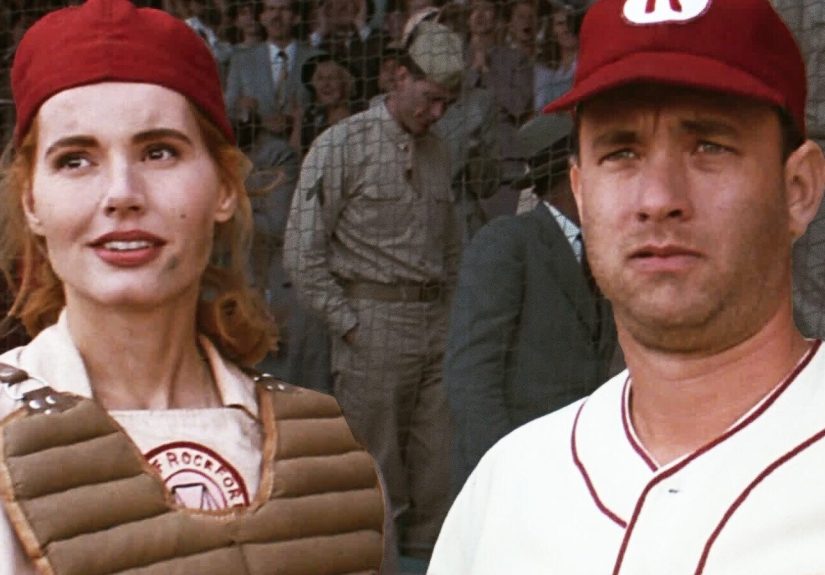
In the movie, Jimmy Dugan explodes after right fielder Evelyn Gardner makes a poor throw and misses the cutoff person. Evelyn, played by Bitty Schram, begins to cry. Jimmy is stunned, offended, and completely unequipped for human emotion. Then comes the line: “There’s no crying in baseball!”
The reason it works is not simply that the sentence is funny. On paper, it is almost too plain. No crying. In baseball. That is the joke. But in the scene, the line becomes a perfect window into Jimmy Dugan. He is not just reacting to Evelyn. He is reacting to the idea that the game he once dominated is now being played by women he underestimated, managed by a man who has lost his pride, and watched by a public that may be changing faster than he can handle.
That is why the quote feels bigger than a one-liner. It is funny because Jimmy is being ridiculous. It is memorable because he believes it with the force of a man defending the last soggy cardboard box of his dignity.
Who Wrote A League of Their Own?
A League of Their Own was directed by Penny Marshall and written by Lowell Ganz and Babaloo Mandel, from a story by Kelly Candaele and Kim Wilson. The film starred Geena Davis as Dottie Hinson, Lori Petty as Kit Keller, Tom Hanks as Jimmy Dugan, Madonna as Mae Mordabito, Rosie O’Donnell as Doris Murphy, and a deep bench of supporting performers who made the Rockford Peaches feel like a real team rather than a Hollywood costume party with bats.
The movie was inspired by the real All-American Girls Professional Baseball League, founded during World War II when many male players were serving overseas. The league gave hundreds of women a chance to play professional baseball, even while they were forced to navigate strict expectations about femininity, uniforms, conduct, and public image. In other words, they were asked to steal bases and look dainty doing it. Baseball history, meet contradiction.
Kelly Candaele’s mother, Helen Callaghan, played in the league, and his earlier documentary work helped bring this forgotten chapter of American sports history to wider attention. Penny Marshall saw the potential for a feature film: not just a sports story, but a story about sisters, ambition, public performance, private sacrifice, and women doing extraordinary work while the world argued over whether they should be allowed to do it at all.
How the Line Was Actually Created
The origin of “There’s no crying in baseball!” came from the way Ganz and Mandel wrote together. Unlike some screenwriting teams who split scenes and later stitch them together, Ganz and Mandel often worked in the same room, bouncing dialogue back and forth. They acted scenes out loud. They tested rhythm. They played characters against each other until a line sounded alive.
For the crying scene, they knew the basic dramatic situation: Jimmy Dugan, still learning to take the Rockford Peaches seriously, would berate Evelyn Gardner after a mistake. Evelyn would cry. Jimmy would not know what to do with that. His confusion would become anger, and his anger would become comedy.
The writers shaped the moment as a rant, not a polished slogan. Early versions of the dialogue reportedly included Jimmy reaching for old baseball examples and macho memories, trying to explain that humiliation was just part of the sport. The phrase “there’s no crying in baseball” emerged naturally from that emotional logic. It was not a bumper sticker first. It was a character reaction first.
A Real-Life Spark Behind the Scene
One of the fascinating details behind the line is that it was partly inspired by a real incident from the writers’ professional lives. Ganz and Mandel had once witnessed a woman crying during a story meeting. A producer’s dismissive response to that moment stuck with them. The emotional awkwardness, the discomfort with tears in a professional setting, and the old-school male reflex to treat vulnerability as weakness all became useful ingredients when they wrote Jimmy’s tirade.
That background matters because it shows why the scene has bite. It is not just about baseball. It is about a culture that often tells people, especially women, that emotion invalidates competence. Evelyn makes a mistake, yes. But Jimmy’s reaction is wildly disproportionate, which is exactly why the comedy lands. He behaves as though a few tears might collapse the entire national pastime.
Why the Line Fits Jimmy Dugan So Perfectly
Jimmy Dugan is a former baseball star whose glory days are behind him. When the film introduces him, he is lazy, cynical, and not especially interested in managing women. His job with the Peaches is not a noble calling at first. It is a paycheck, a hiding place, and possibly the only uniform that still wants him.
That makes the famous line more than a joke. Jimmy is defending an idea of baseball that makes him feel safe. In his mind, baseball is hard, rough, unsentimental, and male. Then he finds himself surrounded by women who can hit, throw, slide, strategize, and care deeply about winning. The Peaches do not ruin baseball for him. They rescue it from his bitterness.
When Jimmy yells that there is no crying in baseball, he is really yelling at change. He is yelling at embarrassment. He is yelling at the fact that these women are making him feel something again. That is a lot of baggage for one sentence, which is probably why audiences keep carrying it around.
The Role of Tom Hanks in Making the Quote Immortal
Great writing can put a line on the launchpad, but performance lights the rocket. Tom Hanks’s delivery turned “There’s no crying in baseball!” into one of the most quoted sports movie lines ever.
Hanks does not play the moment as a tidy joke. He plays it as panic disguised as authority. Jimmy looks genuinely confused that Evelyn is crying, as if she has violated a rule written somewhere in invisible clubhouse ink. His voice rises, his face tightens, and his frustration becomes so theatrical that the audience laughs at both the line and the man saying it.
The scene also gives Hanks room to reveal Jimmy’s ridiculousness without making him a cartoon. Jimmy is harsh, but he is not empty. Over the film, he evolves. He begins as a man who thinks managing women’s baseball is beneath him and ends as someone who respects the players enough to fight for them, teach them, and care about the outcome. The quote is funny because it captures the old Jimmy. The movie works because he does not stay there.
Why the Line Became Bigger Than the Movie
Not every famous movie quote becomes a cultural tool. Some lines are famous because fans love the movie. Others become useful because they apply everywhere. “There’s no crying in baseball!” is the second kind.
People use it when a friend loses at Monopoly. They use it when a coworker complains about a minor inconvenience. They use it ironically, affectionately, and sometimes completely out of context, which is the final stage of quote immortality. Once a line survives outside its original scene, it becomes part of everyday language.
The American Film Institute ranked “There’s no crying in baseball!” among its top 100 movie quotes, a sign that the line has moved from fan favorite to film-history landmark. That ranking makes sense. The quote is short, specific, funny, and emotionally readable even to someone who has never seen the movie. You do not need a scouting report to understand it.
The Genius of Making a Sports Quote About Emotion
Sports movies are full of motivational speeches. Coaches talk about heart, teamwork, sacrifice, destiny, and leaving everything on the field. Those speeches can be stirring, but they can also start sounding like someone spilled protein powder into a thesaurus.
A League of Their Own takes a different route. Its most famous line is not inspirational in the traditional sense. It is not about winning the big game. It is about a manager being emotionally incompetent at high volume. That is much funnier, and oddly more human.
The joke also flips a sports cliché. Baseball is often treated as a sacred arena of toughness and tradition. But A League of Their Own is about people who were excluded from that tradition and then proved they belonged. By putting a macho rule in the mouth of a broken-down male manager, the film gently mocks the very gatekeeping it is dramatizing.
How Research Helped the Writers Find the Right Tone
Although the famous line itself came from a comic scene, the movie’s foundation was built on research. Penny Marshall wanted the film to honor the women of the All-American Girls Professional Baseball League, not turn them into a novelty act. Ganz and Mandel studied the league’s history: bus trips, chaperones, uniforms, charm school expectations, injuries, fan reactions, and the strange mix of freedom and restriction that shaped the players’ lives.
That research helped the writers balance comedy with respect. The movie laughs often, but it does not laugh at the women for playing baseball. It laughs at the absurdity of the world around them: the scouts judging talent and appearance at the same time, the executives worrying about ticket sales, the public treating women athletes as both impressive and suspicious, and Jimmy Dugan needing half a season to realize what the audience already knows.
The crying scene works because it sits inside that larger structure. Evelyn’s tears are funny in the moment because Jimmy handles them terribly. But the film never suggests that the women are weak. In fact, the Peaches are the emotional and athletic engine of the story. Jimmy’s line is memorable because he is wrong in such a spectacularly quotable way.
What Writers Can Learn From This Famous Line
1. Write Character First, Catchphrase Second
The line became famous because it belonged to Jimmy Dugan. If another character said it, the quote would lose its spark. Imagine Dottie saying it calmly during practice. Fine, maybe mildly amusing. Now imagine Jimmy bellowing it like the umpire has just outlawed gravity. That is the movie magic.
2. Let Conflict Create the Joke
The humor does not come from a random wisecrack. It comes from conflict: Evelyn is upset, Jimmy is furious, the team is watching, and the umpire eventually gets involved. The scene has pressure. Comedy loves pressure. Without pressure, a joke is just a balloon with no air.
3. Use Specificity
“There’s no crying in sports” would be forgettable. “There’s no crying in baseball” is specific. It sounds like an ancient clubhouse commandment. The word “baseball” gives the line its rhythm, its authority, and its absurdity.
4. Trust the Audience to Understand Irony
The movie does not pause to explain why Jimmy is being ridiculous. It lets the audience see it. That confidence is one reason the line still works. Viewers understand that the sentence is funny because it is both forceful and foolish.
Experiences Related to the Topic: Why This Line Still Feels So Useful
One reason “There’s no crying in baseball!” remains so popular is that almost everyone has experienced a Jimmy Dugan moment, either as the person overreacting or the person being overreacted to. Maybe it happened during a school project, a family board game, a youth sports practice, a workplace meeting, or a group activity where one person decided that the stakes were suddenly Olympic-level. The line gives us a comic way to recognize that emotional mismatch.
Think about a casual softball game where someone drops an easy fly ball. Most people laugh, brush it off, and wait for the next batter. But every now and then, someone treats the mistake like a national emergency. That person may not yell Jimmy’s exact words, but the spirit is there: too much intensity, not enough perspective. Quoting the line in that moment can deflate the tension. It reminds everyone that games are supposed to include mistakes, sweat, embarrassment, and yes, sometimes feelings.
The quote also resonates with writers because it demonstrates how a small scene can carry a large theme. A beginner might assume the most important line in a sports movie should happen during the championship game. A League of Their Own proves otherwise. Its most famous quote happens in the messy middle, during a regular moment of team friction. That is an encouraging lesson: memorable writing does not always require a grand stage. Sometimes it needs a bad throw, a crying player, and a manager with the emotional intelligence of a pine tar rag.
For anyone creating content, fiction, scripts, essays, or even social media posts, the line offers a practical reminder: clarity wins. The phrase is short. It has rhythm. It contains a surprise. It is easy to repeat. It also creates an instant image. You can hear the dusty dugout, see Jimmy’s disbelief, and feel the team’s awkward silence. Strong writing often does that. It compresses a whole scene into a sentence people want to carry away.
There is also a deeper personal experience connected to the quote: many people grow up hearing that certain spaces require toughness and silence. Sports, work, competition, leadership, and even family roles can come with unwritten rules about what emotions are acceptable. The genius of the line is that it exposes how silly those rules can sound when spoken plainly. “There’s no crying in baseball” is funny because of course people cry in baseball. They cry when they win, when they lose, when they retire, when they make the Hall of Fame, and when their team blows a lead that was mathematically supposed to be safe. Baseball may not require crying, but it certainly makes room for it.
That is why the line endures. It can be used as a joke, but it also points to something real. A League of Their Own is not arguing that feelings make athletes weaker. It shows that passion, pressure, frustration, pride, and vulnerability are all part of competition. Jimmy Dugan’s journey is learning that the women he dismisses are not delicate outsiders. They are ballplayers. They care enough to cry, improve, argue, win, and keep showing up. That is not weakness. That is the game.
Conclusion
The most famous line in A League of Their Own did not come from a studio formula or a calculated attempt to manufacture a quote. It came from Lowell Ganz and Babaloo Mandel doing the hard, playful work of screenwriting: researching the world, understanding the characters, improvising dialogue, and letting conflict reveal comedy.
“There’s no crying in baseball!” is funny because Jimmy Dugan says it with total conviction. It is lasting because the movie knows he is wrong. The line captures the tension between tradition and change, toughness and vulnerability, ego and growth. It belongs to a scene, but it also belongs to anyone who has ever watched someone take a game, job, argument, or tiny inconvenience far too seriously.
More than three decades later, the quote still swings hard. Not bad for a line that started as part of a rant and ended up in the dugout of American pop culture forever.
Note: This article is based on synthesized research from reputable film-history, interview, baseball-history, and archival sources. Source links are intentionally omitted in the article body for clean web publication.