Table of Contents >> Show >> Hide
- The Honest Answer: Nobody Has Generated Fusion Power for the Grid Yet
- Why Fusion Power Is So Hard, Even After Big Breakthroughs
- Who Might Build the First Fusion Power Plant?
- What Could Delay the First Fusion Plant?
- So, When Will the First Nuclear Fusion Power Plant Generate Power?
- The Human Experience of Waiting for Fusion Power
- Conclusion
Fusion power has been “about 20 years away” for so long that the joke is old enough to rent a car. But the punchline is starting to wear out. After a burst of technical milestones, new funding, government roadmaps, and private-sector bravado, the question has changed from “Is fusion always a science-fair dream?” to “Okay, seriously, when does the first fusion power plant actually make electricity?”
The answer is both exciting and annoyingly grown-up: possibly by the late 2020s in the most ambitious private-company scenario, more plausibly in the early 2030s for a first serious grid-connected demonstration, and more broadly in the mid-2030s under current U.S. government roadmaps. In other words, fusion is no longer stuck in science fiction, but it still has plenty of engineering paperwork, materials headaches, fuel-cycle puzzles, and reality checks to survive before it can become a dependable source of electricity.
This matters because fusion is the energy world’s ultimate overachiever. In principle, it offers carbon-free power, no smokestack emissions, and far less long-lived radioactive waste than conventional nuclear fission. It is the process that powers the sun, except on Earth we are trying to bottle a star, make it behave, and then convince utilities to trust it with the grid. No pressure.
The Honest Answer: Nobody Has Generated Fusion Power for the Grid Yet
Before talking about dates, it helps to clear away one giant misunderstanding. A fusion experiment is not the same thing as a fusion power plant. A lab can produce a breakthrough fusion shot and still be nowhere near selling electricity to homes, factories, or data centers.
That distinction is why recent headlines can sound more dramatic than the underlying reality. Yes, fusion research has made major progress. Yes, private companies are racing toward commercial machines. And yes, government agencies in the United States now talk about fusion on a much more serious timeline than they did a decade ago. But no company, national lab, or university has yet built a fusion plant that reliably feeds commercial electricity into the grid.
So when will the first one do it? Right now, the leading public claims fall into three buckets:
Late 2020s: the boldest private-company target, with Helion saying its first fusion power plant is expected to begin producing electricity by 2028.
Early 2030s: the most talked-about grid-scale commercial plan, with Commonwealth Fusion Systems aiming for ARC in Virginia in the early 2030s.
Mid-2030s: the broader strategic target in current U.S. fusion policy, with the Department of Energy now framing commercial fusion power to the grid around the mid-2030s.
That spread tells you everything. Fusion is close enough for calendars, but not close enough for certainty.
Why Fusion Power Is So Hard, Even After Big Breakthroughs
Scientific victory is not the same as commercial victory
One of the biggest milestones came from Lawrence Livermore National Laboratory’s National Ignition Facility, which achieved fusion ignition and has repeated ignition results. That was a historic scientific breakthrough. But LLNL is very clear on a point that often gets lost in the hype: NIF is an experimental facility, not a power plant.
That difference is enormous. A power plant does not just need a dramatic result once in a while. It needs to operate repeatedly, safely, affordably, and with enough uptime that a utility operator does not age ten years every time the machine hiccups. The grid loves boring reliability. Fusion, so far, has been brilliant but not boring.
Net energy, net electricity, and profitable power are three different things
Fusion discussions also get tangled because people use “net gain” like it solves everything. It does not. There are at least three milestones that matter.
First is scientific gain: producing more fusion energy than the energy directly delivered into the fuel target or plasma in a specific experiment. That is a major research success.
Second is net electricity: the entire plant produces more electricity than it consumes. This is much harder because it includes magnets, lasers, cooling systems, pumping, control systems, tritium handling, and all the unglamorous machinery that accountants eventually learn to fear.
Third is commercial viability: the plant can produce electricity at a cost and reliability level utilities can actually use. A machine that makes a little power for a short time but costs a fortune is not the future of energy. It is a very expensive science story.
That is why the National Academies and fusion experts have long emphasized the need for a fusion pilot plant. A pilot plant is supposed to answer the uncomfortable questions: Can it run? Can it maintain itself? Can it handle heat and neutron damage? Can it breed or source fuel? Can it produce useful electricity? Can it do all this without a heroic intervention every Tuesday?
Who Might Build the First Fusion Power Plant?
Helion: the fastest public timeline
Helion has the most aggressive public schedule in the field. The company announced a power purchase agreement with Microsoft and said its first facility aims to begin producing electricity by 2028, targeting at least 50 megawatts after ramp-up. In 2025, Reuters reported that Helion had begun construction on a site in Malaga, Washington, for the planned plant that would supply Microsoft data centers.
Helion’s approach is unusual compared with many other fusion developers. Rather than leaning on a more conventional steam-turbine model, the company aims to generate electricity directly through pulsed magnetic systems. That makes its story especially interesting because, if it works, it could skip some of the complexity of traditional thermal power conversion. It also means Helion is trying to prove a different commercial architecture, not just a different plasma trick.
In early 2026, Helion said its Polaris prototype became the first privately funded fusion machine to operate with deuterium-tritium fuel and reached plasma temperatures of 150 million degrees Celsius. That is real progress, and not the kind of progress you get by waving at a reactor and saying encouraging things. Still, the gap between a hot prototype and a dependable grid asset remains huge.
So, could Helion be first? Absolutely. Could the 2028 target slip? Also absolutely. In fusion, confidence and uncertainty are roommates.
Commonwealth Fusion Systems: the early-2030s heavyweight
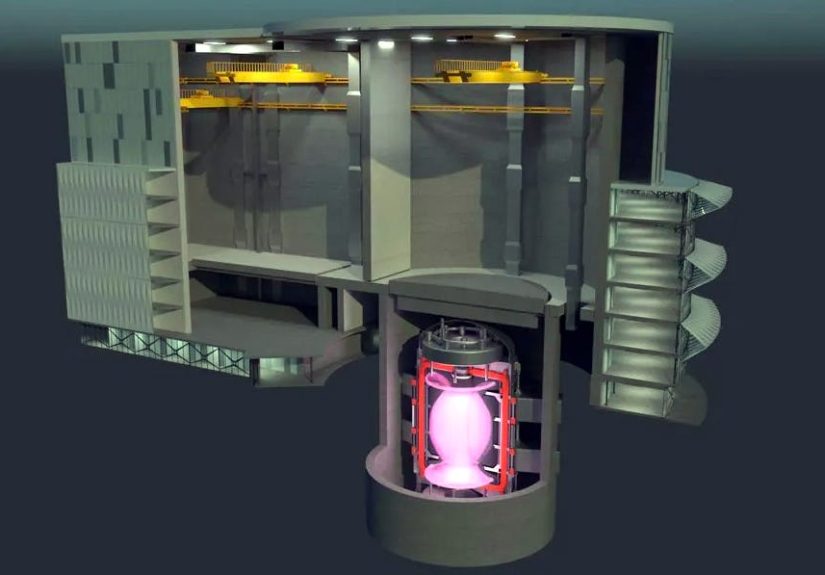
Commonwealth Fusion Systems, an MIT spinout, may have the most prominent grid-scale commercial project on paper. The company says its ARC plant in Chesterfield County, Virginia, is intended to be the world’s first grid-scale commercial fusion power plant. The project is expected to generate about 400 megawatts of electricity in the early 2030s.
That is a different scale and posture from Helion’s first-plant narrative. ARC is not just a technology flex. It is positioned as an actual utility-scale generating asset. CFS is also working on SPARC, a demonstration tokamak in Massachusetts that MIT-related reporting says is expected to become a commercially relevant fusion machine and aim for net energy generation around 2027.
If SPARC performs well and ARC stays on schedule, CFS could become the first company to deliver what many people picture when they hear the phrase fusion power plant: a large, grid-connected, electricity-producing facility that looks like part of the serious energy system rather than a daring pilot tucked into the corner of a lab campus.
Still, “early 2030s” is one of those phrases that sounds precise until you realize it has the emotional range of a shrug. It is close enough to energize investors and vague enough to survive engineering reality.
Type One Energy and TVA: a strong mid-2030s contender
Another serious U.S. effort is the partnership between Type One Energy and the Tennessee Valley Authority. TVA says the planned Infinity Two stellarator-based pilot plant could provide 350 megawatts of baseload electricity as early as the mid-2030s.
That timeline is later than Helion’s and a bit later than the earliest CFS ambitions, but it may fit more comfortably with the broader U.S. policy picture. It also reflects a theme that now runs across the fusion sector: utilities are no longer just politely smiling at researchers. They are starting to participate in siting, planning, and grid discussions.
What Could Delay the First Fusion Plant?
Fuel supply is not a side quest
One of the less glamorous but absolutely critical issues is fusion fuel, especially tritium. The Department of Energy’s 2024 fusion strategy notes that deuterium-tritium plants will need startup tritium and, over time, a way to breed more tritium from lithium. That is not a tiny procurement detail. It is a make-or-break issue.
If a fusion plant cannot secure fuel at scale, it is not a power plant. It is a very expensive sculpture with strong opinions about plasma.
Materials have to survive an absurdly harsh environment
Fusion machines must withstand extreme heat, neutron bombardment, and punishing operating conditions. The walls, blankets, plasma-facing components, and other systems need to perform in an environment that is basically nature’s way of saying, “Maybe try something easier.”
This is why DOE, ORNL, PPPL, and other national-lab efforts keep emphasizing materials, blankets, fuel cycles, and plant engineering. The hard part is no longer only getting the plasma to behave. The hard part is building an entire industrial system around it that does not melt down financially or physically.
Regulation is moving, but it still matters
The Nuclear Regulatory Commission has been working to establish a clearer framework for fusion machines, and its current roadmap includes proposed rulemaking in 2026 and final rules and guidance by the end of 2027. That is encouraging because regulation is not just a legal nuisance; it is part of how projects become financeable and repeatable.
Investors like ambition. Utilities like certainty. Regulators are what stand awkwardly in the middle and decide whether a futuristic machine can graduate into infrastructure.
So, When Will the First Nuclear Fusion Power Plant Generate Power?
If you want the bold answer, it is 2028, because that is the earliest serious public target from a company actively building toward it.
If you want the more cautious answer, it is the early 2030s, because that is where the strongest grid-scale commercial project claims currently cluster.
If you want the policy-and-expert answer, it is the mid-2030s, because that is where the U.S. government roadmap now places commercial fusion power to the grid, and where long-range expert thinking has often landed when accounting for engineering, licensing, and scale-up.
My best practical reading of the field is this: the first fusion electricity could appear in a limited, highly watched commercial setting before the decade ends, but the first widely recognized, utility-relevant fusion power plant is more likely to arrive in the early 2030s. Fusion is finally on the clock, but the clock still has trust issues.
The Human Experience of Waiting for Fusion Power
There is also a very real human side to this story, and it deserves more than a quick footnote. The race toward the first fusion power plant is not just about reactors, magnets, lasers, or investors tossing billions around like confetti at a science convention. It is also about the experience of living through a technology transition that feels both immediate and just out of reach.
For engineers inside the fusion industry, the experience is probably a mix of adrenaline and chronic humility. One month brings a record plasma temperature, a fresh permit, or a major financing round. The next month delivers a materials problem, a design revision, or a reminder that a beautiful simulation does not have to answer to maintenance crews. Fusion work seems to create a very specific emotional state: the belief that history is close, paired with the daily evidence that physics still has not agreed to a launch date.
For researchers at national labs and universities, the experience is different but just as intense. They have watched decades of incremental progress, often with less public attention than the recent startup era now attracts. Many of them have lived through multiple cycles of hype, skepticism, underfunding, and rediscovery. To them, today’s momentum probably feels validating, but also slightly amusing. They know that every “breakthrough” headline should come with a quiet subtitle: Wonderful. Now please solve the other fourteen impossible things.
For utilities and grid planners, fusion creates a strange kind of optimism. They are not in the business of falling in love with prototypes. They care about dispatchability, maintenance schedules, siting, transmission, workforce, and cost per megawatt-hour. Yet fusion keeps creeping into serious conversations because the long-term prize is enormous: firm, carbon-free power that could support electrification, industrial demand, and even the fast-growing electricity appetite of AI-driven data centers. The experience for utilities is less like cheering at a moonshot and more like quietly asking, “Can this thing show up on time and not ruin our planning model?”
For communities near proposed sites, the experience is even more grounded. Fusion arrives not as a glamorous scientific concept but as questions about jobs, land use, safety, permitting, local identity, and whether the project will actually benefit the region. A proposed fusion plant in Virginia or Tennessee is not just a symbol of the future. It is also trucks, training, tax revenue, public meetings, and neighbors asking what exactly is being built down the road. That local experience will matter more than flashy investor decks.
Then there is the broader public, which tends to encounter fusion in brief bursts: a headline about ignition, a billionaire investment, a Microsoft deal, a claim that the first plant is just a few years away. For ordinary readers, fusion can feel like a miracle that is always almost here. That creates a kind of emotional whiplash. People want something clean, abundant, and dramatic enough to rewrite the energy story. Fusion offers that promise, but it asks for patience at exactly the moment when climate urgency makes patience feel morally irritating.
And that may be the deepest experience tied to this topic: fusion is a technology that teaches society how to balance hope with discipline. It invites big dreams, but it punishes lazy thinking. It attracts grand promises, but it rewards detail. It can inspire schoolkids, startup founders, utility executives, and plasma physicists at the same time, which is not something many energy technologies can claim.
So while the world waits for the first fusion power plant to generate electricity, people are already living through the transition in smaller ways. They are building supply chains, drafting rules, training technicians, arguing over timelines, designing magnets, testing materials, and trying to turn a famous scientific dream into an ordinary piece of infrastructure. That may sound less romantic than “bottling the sun,” but in truth it is the most exciting part. A technology starts to become real not when it makes the boldest promise, but when thousands of people begin doing the unglamorous work that makes the promise boringly repeatable.
Fusion has not reached that finish line yet. But for the first time in a long time, it looks less like a permanent future tense and more like a countdown with actual numbers on it.
Conclusion
The first nuclear fusion power plant is no longer a fantasy question. It is now a scheduling question with competing answers. Helion is aiming for 2028. Commonwealth Fusion Systems is targeting the early 2030s for a grid-scale plant. TVA and Type One Energy point toward the mid-2030s. The Department of Energy now frames commercial fusion power to the grid around the mid-2030s. Put all of that together, and the clearest conclusion is simple: fusion power is getting closer, but the first real electrons will likely arrive before fusion becomes routine.
When the first plant finally generates electricity, the moment will not just mark a scientific achievement. It will signal that fusion has crossed the hardest boundary of all: from astonishing experiment to usable infrastructure. And that is when the real energy revolution would begin.