Table of Contents >> Show >> Hide
- So What Exactly Is the “Vintage Garden Trend”?
- Why Garden Arbors Are Back (And Why It Makes Perfect Sense)
- Where Designers Put Arbors for Maximum “Wow”
- Picking the Right Arbor: Materials, Scale, and Style
- The Best Climbing Plants for a Garden Arbor
- How Designers Style Arbors So They Look Intentional (Not Like a Random Wedding Prop)
- Maintenance and Longevity: Keep the Romance, Lose the Chaos
- Budget-Friendly Ways to Join the Arbor Comeback
- Common Mistakes (So You Don’t Become a Before Photo)
- Conclusion: The Comeback That Actually Improves Your Yard
- Extra: Real-World Arbor Experiences (The Part People Don’t Tell You)
Some trends return quietly. Others kick down the garden gate wearing a floppy hat and carrying a bouquet.
This one does the latter. Designers across the U.S. are seeing a decidedly vintage detail pop up again and again:
the garden arborthose charming arches and “portals” that make a backyard feel like it has a storyline.
And no, an arbor isn’t just “a thing vines attack until it disappears.” Done right, it’s architecture for plants,
a subtle way to define space outdoors, and a fast track to making your yard look like it knows what it’s doing.
Let’s talk about why garden arbors are making a comeback, how to use them like a designer,
and what to grow on them so you get romancenot regret.
So What Exactly Is the “Vintage Garden Trend”?
The comeback trend is the garden arbor (sometimes called a garden arch). Traditionally,
it’s a freestanding structure with posts and a curved or flat topoften latticedplaced over a gate, path,
or seating nook. Think: a little “hello” moment that turns a regular walkway into an entrance.
In vintage gardenscottage gardens, formal estate landscapes, even old-school kitchen gardensarbors were used
to add height, create a focal point, and support climbing plants like roses, clematis, and honeysuckle.
Today’s versions do all of that, plus they help define outdoor living spaces when you don’t have
a sprawling yard (or a sprawling budget).
Arbor vs. Pergola vs. Trellis (No Judgement, Just Definitions)
- Arbor: Usually an arch or doorway-scale structure that frames a path or entry.
- Pergola: A larger overhead structure (often for patios) that creates a room-like canopy.
- Trellis: A vertical support panelgreat against walls, fences, or in beds for climbers.
The shared idea is the same: vertical garden design. You’re not just planting; you’re composing
a scene with height, texture, and a little suspense (what’s through the arch?!).
Why Garden Arbors Are Back (And Why It Makes Perfect Sense)
Designers say the return of the arbor is tied to a bigger shift: people want their yards to feel like real spaces,
not leftover green carpet around the house. The arbor is a shortcut to structurevisually and emotionally.
It makes a garden feel “finished,” even if you’re still negotiating with a patch of crabgrass.
1) Outdoor Living Got Serious
We’ve entered the era of the backyard as an extension of the home: dining, lounging, hosting, working, escaping
from your group chatoutside. An arbor gives you a “threshold” that separates spaces the way a hallway or doorway does indoors.
That’s powerful design psychology for a couple posts and a roof grid.
2) Vintage Romance Is Trending
Cottage garden style, old-world charm, and “I definitely read novels in the garden” energy are everywhere.
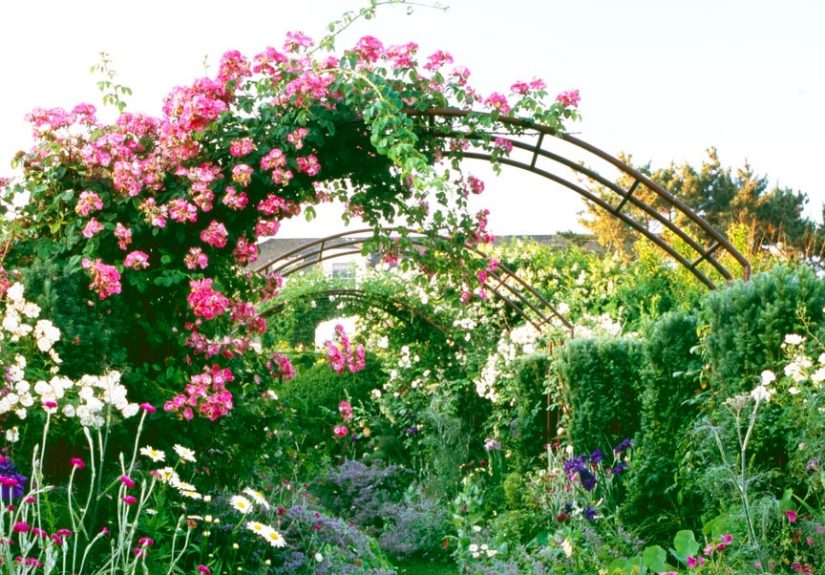
Arbors play perfectly with that vibeespecially when covered in climbers or paired with brick paths,
clipped herbs, and soft lighting.
3) Small Yards Need Big Moves
If you don’t have space to go wide, go up. An arbor draws the eye vertically, creating dimension and the illusion
of a larger landscape. It’s the outdoor equivalent of hanging curtains higher to make ceilings look taller.
Same trick. More bees.
Where Designers Put Arbors for Maximum “Wow”
The best arbors aren’t random decorations; they’re placed with intention. Here are designer-approved locations that
make an arbor look inevitablelike it was always meant to be there.
Over a Garden Gate or Front Path
Classic for a reason: it creates arrival. Even a modest front walkway becomes a moment when framed by an arbor,
especially with climbing roses or clematis softening the structure.
As a Transition Between “Rooms”
Use an arbor to separate a patio from a lawn, a veggie patch from ornamentals, or a play area from the “adult”
zone (also known as: the place with beverages and better chairs). This is one of the most effective ways to make a
backyard feel designed rather than accidental.
At the End of a View
Designers love placing an arbor where it caps a sightlineend of a path, edge of a bed, or opening toward a focal point
(a bench, sculpture, birdbath, or that hydrangea you’re emotionally invested in).
As a Cozy Nook (Add a Bench)
An arbor with a bench underneath is instant “garden room.” Add gravel, a pair of planters, and a string of warm lights,
and you’ve created a destinationno permit required.
Picking the Right Arbor: Materials, Scale, and Style
Before you buy the prettiest one on the internet, think like a designer: function first, then aesthetics.
Your arbor needs to match your home, your garden style, andcruciallythe plant you want to grow on it.
Material Matters (Because Vines Are Not Gentle)
- Wood (cedar/redwood): Warm, classic, easy to paint or stain. Great for cottage and traditional homes.
- Metal (steel/iron): Elegant, often slimmer profiles. Excellent for a vintage look with serious durability.
- Vinyl/composite: Low maintenance, but can read “suburban new-build” unless styled thoughtfully.
If you’re growing vigorous climbers (hello, wisteria), prioritize structural strength. Some vines can get heavy and woody,
and they don’t hesitate to test your fasteners like they’re auditioning for a demolition crew.
Scale and Proportions
Your arbor should be tall enough to walk under comfortably and wide enough that it doesn’t feel like you’re entering
a hedge maze designed by someone who hates shoulders. Oversizing slightly usually looks more intentional than undersizing.
Match the Architecture
A simple black metal arbor looks sharp with modern or farmhouse exteriors. A painted wood arbor with lattice sides
suits traditional homes. If your house has strong lines, echo them. If your garden is wild, let the plants do the softening.
The Best Climbing Plants for a Garden Arbor
The magic is in the pairing. A good arbor is like a great outfit: it’s fine on its own, but it becomes iconic with the right accessories.
Here are climbers that designers and gardeners love for arbors, plus a few honest warnings.
Climbing Roses (The Classic)
If you want that vintage, storybook effect, climbing roses are the headline act.
Choose varieties suited to your climate, give them full sun, and train the canes along the structure so blooms frame the entry.
Bonus: fragrance. Minor con: thorns, which keep you humble.
Clematis (Color Without the Bully Behavior)
Clematis adds dramatic flowers and tends to play nicely on a trellis or arbor when supported properly.
Pay attention to pruning groups (some bloom on old wood, some on new), and you’ll get a dependable show instead of confusion.
Coral Honeysuckle (A Native-Friendly Option)
For a hummingbird-attracting arbor moment, coral honeysuckle is a favorite native vine in many regions.
It delivers color and wildlife value without automatically trying to annex your neighbor’s fence.
American Wisteria (If You Want Wisteria, Be Smart About It)
Wisteria is stunningcascading flowers, romantic canopy, the whole fairytale.
But it can also be vigorous and heavy. If you’re committed, look into American wisteria and build sturdily,
then prune regularly so your arbor doesn’t become a cautionary tale at the next block party.
Grapevines (Edible Shade, If You’re Into “Garden With Benefits”)
Training grapes over an arbor can create a leafy canopy and produce fruit, but it requires seasonal pruning and a plan.
The payoff is major: shade, texture, and snacks. That’s hard to beat.
Quick Reality Check: Plants to Use Carefully
- Very aggressive vines: Some can overwhelm structures, spread aggressively, or require heavy pruning.
- Too-strong climbers on flimsy arbors: Match vine vigor to your arbor’s build quality.
- Invasive species in your region: Always check local guidance before planting.
How Designers Style Arbors So They Look Intentional (Not Like a Random Wedding Prop)
The difference between “magical” and “why is that there?” is styling. Designers use a few repeatable tricks:
1) Anchor the Base
Add two large planters, symmetrical shrubs, or matching perennials at the posts. This visually “plants” the arbor into the landscape,
even before your vines fill in.
2) Give It a Path
A gravel path, stepping stones, brick walkway, or even a mown strip of lawn signals purpose.
An arbor floating over plain grass can look like it got lost on the way to a garden tour.
3) Add Lighting
Warm string lights, downlighting, or subtle solar fixtures turn an arbor into an evening feature.
The vibe shift is immediate: from “yard” to “destination.”
4) Repeat the Shape Somewhere Else
Echo the arbor’s curve with rounded planters, a circular patio, or soft-edged beds.
Repetition is one of the oldest design rules because it works (and because it makes things look expensive).
Maintenance and Longevity: Keep the Romance, Lose the Chaos
A thriving arbor is low drama when you keep up with two things: the structure and the vine.
Train Early, Train Often
Guide young growth where you want it with soft ties. If you wait until the vine is thick and woody,
it will decide the design directionand it will not consult you.
Prune With the Plant’s Schedule
Some vines bloom on old wood, others on new. Pruning at the wrong time can reduce flowers for a season.
Learn the basics for your plant (especially with clematis and wisteria) and you’ll get better blooms with less frustration.
Protect the Structure
- For wood: re-stain or re-paint as needed, and keep the base from sitting in soggy soil.
- For metal: check for rust, especially at joints and anchor points.
- For all: inspect fasteners and anchoring annuallyvines add weight over time.
Budget-Friendly Ways to Join the Arbor Comeback
You don’t need a designer budget to get a designer effect. The secret is to spend on what matters:
stability and placement. A simple arbor in the right location beats an ornate one placed randomly every time.
Smart Spending Tips
- Go simpler on the frame, richer on the planting: A basic arch plus a great vine looks high-end.
- Consider DIY kits: Many are straightforward, especially if you’re comfortable measuring twice and panicking once.
- Start with annual vines: If you want fast coverage while perennials establish, annuals can fill the gap.
Common Mistakes (So You Don’t Become a Before Photo)
- Buying too flimsy: The vine will win.
- Placing it with no purpose: Give it a path, a gate, a view, or a destination.
- Choosing the wrong vine: Match vigor to structure; avoid invasive plants where you live.
- Forgetting maintenance: A little seasonal pruning prevents a lot of seasonal complaining.
Conclusion: The Comeback That Actually Improves Your Yard
The reason the vintage garden arbor is returning is simple: it solves modern problems beautifully.
It makes small yards feel designed. It creates an outdoor “room” without walls. It supports vertical gardening, invites wildlife,
and adds that timeless charm people crave right now.
Pick a strong structure, place it with intention, and pair it with a vine that fits your climate and your tolerance for pruning.
Then enjoy the best kind of trend: the one that looks like it’s been there forever.
Extra: Real-World Arbor Experiences (The Part People Don’t Tell You)
If you’ve ever stood in your yard with a coffee and thought, “This needs… something,” you’re already halfway to understanding
why arbors feel so satisfying in real life. People don’t just like how they lookthey like how arbors change behavior.
When you add an arbor, you start using the garden differently, almost without noticing.
One common experience: the arbor becomes the unofficial “start” of the garden. Instead of wandering out to water plants like you’re
doing chores, you walk through the arch and suddenly it feels like you’ve entered a place. That tiny psychological shift makes gardening
feel less like maintenance and more like visiting your own outdoor retreat (membership fee: occasional weeding).
Another surprisingly universal moment is the first time your vine really takes off. In the early weeks, an arbor can feel a little naked
like you set up a stage before the band arrives. Then one day you notice new growth reaching for the lattice, and you get that deeply human
satisfaction of watching a plan come together. It’s the same joy as seeing paint dry into the right color, except it blooms.
Hosting changes, too. Even casual hangouts end up gravitating toward the arbor, especially if it marks a transition between a patio and a garden.
People naturally pause under itchecking out flowers, taking photos, or doing that classic “Wow, this is so cute” line that makes you feel like
you definitely have your life together. Add warm lighting and the arbor becomes a nighttime landmark, guiding guests the way a porch light does.
On the practical side, you learn quickly that vines have personalities. Clematis feels like a polite guest: showy, cooperative, and generally where
you left it. Climbing roses are the glamorous friend who’s wonderful but occasionally pokes you when you’re not paying attention. If you try wisteria,
you’ll experience what many gardeners do: awe followed by respect, followed by a calendar reminder labeled “PRUNE OR ELSE.”
The “or else” is realwoody vines can add weight and leverage over time, and that’s when you appreciate having chosen a sturdy structure from the start.
Seasonality becomes more emotional, in a good way. In spring, fresh growth makes the arbor feel hopefullike your garden is rebooting with better intentions.
In summer, the canopy effect can create a pocket of shade that’s noticeably cooler, especially when leaves thicken overhead.
In fall, you get texture and color shifts; in winter, the arbor becomes sculptural, and you can still hang lights or evergreen garlands for a subtle
holiday moment without turning your yard into a blinking airport runway.
The final “experience” most people share is the slow realization that an arbor helps your garden mature faster visually.
Even if plants are still filling in, the structure suggests permanence. It gives your landscape a backbone, which makes everything else look more intentional.
And that’s the magic: a vintage trend that’s not just nostalgicit’s genuinely useful.