Table of Contents >> Show >> Hide
- Why These Signs Hit So Hard (and So Fast)
- The Chipotle Sign That Lit Up Social Media
- What These Viral Walkout Notes Reveal About the U.S. Labor Story
- Plus 22 More Similar Signs From Other U.S. Businesses
- What Smart Readers Can Learn From a Piece of Tape and a Sharpie
- Conclusion: The Door Sign Is the New Press Release
- Extra: of Real-World “Been There” Experiences Around Walkout Signs
If you’ve ever pulled up to a restaurant craving a burrito bowl and instead got a handwritten note that basically says, “We chose peace,” you already know the plot.
In the last few years, America has developed a weird new genre of public communication: the front-door confession. No press release. No corporate-approved phrasing.
Just marker on paper, taped at eye level, delivering the kind of unfiltered honesty usually reserved for group chats.
One of the biggest hits in this genre? A Chipotle sign explaining a shutdown after staff walked outan analog mic drop that ricocheted across social media and reignited the bigger conversation about
service-industry burnout, understaffing, pay, and the daily reality of dealing with customers who treat guac like a constitutional right.
Why These Signs Hit So Hard (and So Fast)
Most businesses communicate in a careful dialect of “Thanks for your patience” and “We appreciate your understanding,” which is customer-service code for:
“Please don’t yell at the teenager holding the register.”
Viral walkout signs do the opposite. They’re blunt, human, and sometimes accidentally hilarious. They also feel like a tiny window into a workplace customers
rarely see: the staffing math behind your “quick” lunch, the scheduling chaos behind that “fresh” order, and the emotional labor behind the forced smile.
During the Great Resignation erawhen quitting surged and job openings were highthese notes became a public-facing symptom of a private problem:
the gap between what many service jobs demand and what they often offer in return.
The Chipotle Sign That Lit Up Social Media
The moment: a closure explained in one sentence
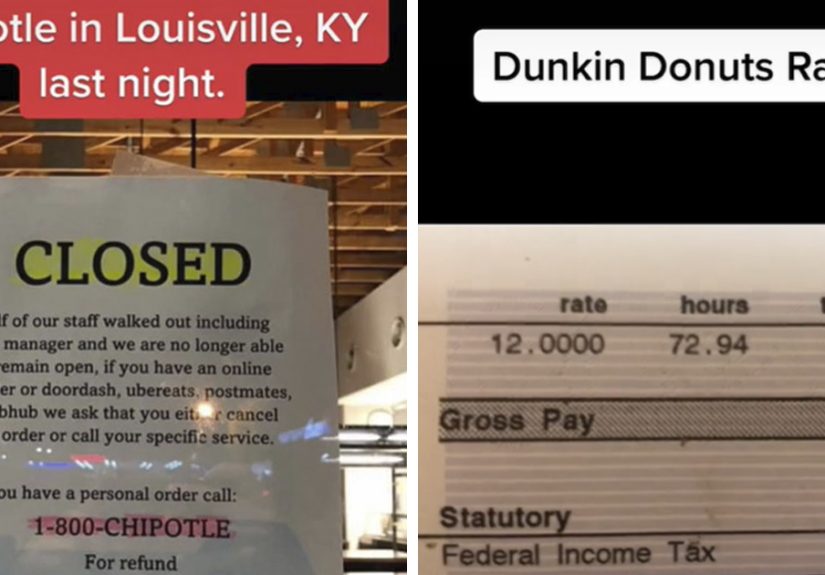
The most viral Chipotle note in this saga came from a Kentucky location that closed after multiple employees quit at once. The sign’s message was simple and startlingly direct:
“Closed. Half of our staff walked out including the manager and we are no longer able to remain open.”
What made it travel wasn’t just the drama of a walkoutit was the rare feeling that you were reading the unedited version of events.
Not “temporarily unavailable.” Not “system outage.” Not “unforeseen circumstances.” Just: the people left.
The context: staffing pressure, safety, and the human cost
Follow-up reporting described a fast-food reality that often gets flattened into memes:
a scramble to keep shifts covered, resignations piling up, and the ripple effect of safety concerns and customer behavior.
A former manager who commented publicly described being pushed to “breaking points,” including accounts of verbal abuse and even food being thrown.
The general manager also described how hard it can be to staff nights while staying compliant with labor rules for younger workers.
The corporate response: reopen, investigate, repeat
Chipotle reopened soon after, and corporate statements encouraged employees to report concerns through internal channels.
That’s a familiar pattern: a viral incident happens, the store reopens, and the larger structural issuespay, staffing levels, scheduling, safety, customer behaviorremain stubbornly hard to “fix” with a single email.
What These Viral Walkout Notes Reveal About the U.S. Labor Story
1) It wasn’t just a “labor shortage.” It was a leverage moment.
When quitting levels hit record territory during the pandemic-era churn, workers had more options and more bargaining power.
That doesn’t mean everyone had a dream job waitingjust that many people decided the current deal wasn’t worth the cost.
The signs are evidence of that calculation happening in public.
2) Understaffing turns every shift into a physics problem
If a restaurant is supposed to run on 12 people and it has 6, the menu doesn’t politely shrink itself.
Someone ends up doing multiple roles at once: cashier + expeditor + mop captain + emotional-support human for the line of hungry adults.
A “short-staffed” sign is often a warning label for what happens when that math breaks.
3) Customer behavior shows up in the quit rate
A lot of viral notesand the stories around themcircle back to the same point: pay matters, but so does how people are treated.
Abuse, threats, and daily hostility accelerate burnout fast. A “be kind” sign isn’t a motivational poster. It’s a safety request.
4) Social media made the breakroom visible
A walkout used to be local. Now it’s content. A handwritten sign becomes a screenshot, which becomes a debate, which becomes a headline.
For better or worse, the front door has become the public comment section.
Plus 22 More Similar Signs From Other U.S. Businesses
Below are 22 sign “greatest hits” seen across U.S. businesses. Some are documented viral examples reported by news outlets.
Others are common sign formats that repeatedly show up in these stories (the “genre conventions,” if you will).
The goal isn’t to dunk on any one storeit’s to show the patterns that keep repeating on America’s glass doors.
- Documented: A Burger King marquee message in Nebraska that boiled the whole situation down to a tiny apology: employees quit, store can’t operate, sorry about your lunch plans.
- Documented: A Wendy’s note in North Carolina declaring the staff had quit and the store was closedcomplete with a cheeky goodbye that felt like a season finale.
- Documented: A Wendy’s drive-thru message where employees announced they’d quit by posting a sign right where the orders come inmaximum visibility, minimum subtlety.
- Documented: A Subway in Texas where employees taped up a blunt resignation note: they quit because the pay wasn’t enough.
- Documented: A Subway in Ohio that posted a sign blaming reduced hours on the idea that “no one wants a job,” sparking the usual internet firestorm.
- Documented: A McDonald’s drive-thru sign asking for patience because they were short-staffedthen adding a line that made the whole internet argue about why.
- Documented: A Sonic in Ohio where a note posted to the window claimed the entire store quit due to management.
- Documented: Another Sonic note from the same Ohio wave that delivered its exit message with pop-culture timing: “Thank you, next.”
- Documented: A pizzeria in Alabama that hung hiring signage so desperate it became iconiceffectively: “Yes, you. Please apply.”
- Common format: “Lobby closed. Drive-thru only.” (Translation: we’re triaging operations with the people we have.)
- Common format: “Temporary hours.” (Translation: the schedule is now a living document.)
- Common format: “Closed today due to staff shortage.” (Translation: we ran out of humans before we ran out of demand.)
- Common format: “Please be patient.” (Translation: the line is long because the team is small, not because they forgot how clocks work.)
- Common format: “We’re hiring.” (Translation: if you’re upset, there’s an application with your name on it.)
- Common format: “Reduced menu.” (Translation: we’re cutting complexity so we can survive the rush.)
- Common format: “Online orders paused.” (Translation: the printer was about to start a war.)
- Common format: “Cash only.” (Translation: the system is down, and yes, it’s as annoying for us as it is for you.)
- Common format: “Closed early.” (Translation: the late shift fell apart, and the remaining staff deserves to go home.)
- Common format: “One person on shift.” (Translation: please do not treat this like a speedrun.)
- Common format: “We’re doing our best.” (Translation: that’s not a slogan; it’s a boundary.)
- Common format: “Be kind to the staff who showed up.” (Translation: the people here are not responsible for the people who aren’t.)
- Common format: “Training in progress.” (Translation: a brand-new employee is learning while you watchplease don’t make this their origin story.)
Notice what’s missing from almost all of these signs: detailed blame, long explanations, and corporate polish. What’s present instead is real-time operational truth.
And honestly? That’s why they spread.
What Smart Readers Can Learn From a Piece of Tape and a Sharpie
If you’re a customer
- Assume the person in front of you is covering two jobs. Your patience is not charity; it’s basic decency.
- Don’t “punish” the staff for the system. Complaints belong to corporate channels, not to a worker making $X/hour.
- If you want fast, vote with your wallet for places that staff well. The market responds to what customers consistently reward.
If you run a business (or manage one)
- Pay is not the only lever, but it’s the loudest one. If wages don’t match expectations, you’ll keep training new people forever.
- Scheduling stability is a benefit. Predictable hours can beat a tiny raise if the alternative is chaos.
- Safety matters. If staff doesn’t feel safe, you can’t “motivate” your way out of turnover.
- Don’t wait for a viral sign to learn something. The sign is the symptom; the culture is the cause.
Conclusion: The Door Sign Is the New Press Release
The viral Chipotle walkout sign wasn’t just a trending momentit was a snapshot of a bigger reality: service work is essential, exhausting, and too often treated as disposable.
The reason these signs go viral isn’t because America loves workplace drama (okay, not only because of that). It’s because the signs feel honest.
And when honesty shows up in the wildtaped to a door, written in marker, saying the quiet part out loudthe internet does what it does best:
it points, reposts, debates, and accidentally documents a labor story in real time.
Extra: of Real-World “Been There” Experiences Around Walkout Signs
You don’t have to be inside a restaurant to understand what leads to a sign like “staff walked out.” You just have to picture a normal rush hourthen remove half the crew.
The grill is hot, the ticket printer won’t stop screaming, and someone’s app order just arrived as a 17-item surprise that needs to be ready yesterday.
That’s when service work turns into a series of tiny emergencies, stacked so close together they feel like one long, unbroken problem.
One common experience workers describe is “the triple-duty shift.” You’re on register, but you’re also bagging orders because the expeditor called out,
and you’re also restocking because the back line is drowning. Customers see a line and assume laziness. Staff sees a line and thinks, “If we move any faster,
we’ll achieve liftoff.” When a customer snaps, the worker can’t snap backso the stress has nowhere to go. That pressure doesn’t vanish; it accumulates.
Another recurring experience is the whiplash between corporate expectations and store reality. Headquarters wants perfect speed metrics, full menu availability,
and cheerful hospitality. The store has three people, one new hire, and a fryer that’s making a noise that suggests it yearns for the afterlife.
Managers get squeezed from both sidescustomers demanding answers, corporate demanding resultsand the team feels it every minute.
A walkout sign is what happens when “figure it out” becomes physically impossible.
Customers have experiences toousually starting with confusion. You drive over, you see a note, and your first thought is, “Is this real?”
Your second thought is, “So… what do I eat now?” And if you’re honest, your third thought might be sympathy: “That must’ve been bad.”
For a lot of people, these signs have become the first time they’ve considered what it takes to keep a “quick-service” place running.
It’s not magic. It’s laboroften underpaid, frequently stressed, and regularly taken for granted.
The most hopeful experience tied to these signs is what comes after: sometimes businesses adjust. Maybe they raise wages, simplify operations,
tighten scheduling, or add safety measures. Sometimes workers move on to something better. Either way, the sign forces a moment of truth.
It says: a restaurant is not just a building and a menu. It’s people. And if the people can’tor won’tkeep doing it under those conditions,
the whole machine stops. That’s not a tantrum. That’s leverage. And it’s a reminder that the most important ingredient in fast food is not the sauce.
It’s the staff.