Table of Contents >> Show >> Hide
- Why Comedy in VR Is Harder Than It Looks
- From Rick and Morty Energy to VR Weirdness
- Squanch Games and the Case for Comedy as Gameplay
- Trover Saves the Universe: Sitting Down for Maximum Chaos
- Why Roiland’s VR Humor Often Lands
- The Risk: Not Everyone Wants a Comedian in Their Face
- What VR Comedy Can Learn from Roiland’s Experiments
- Can Humor Work on VR? The Answer Is Yeswith Conditions
- Experience Section: What Playing VR Comedy Actually Feels Like
- Conclusion
Virtual reality has always been excellent at making people say, “Whoa.” The harder question is whether it can make them say, “Wait, why am I laughing at a purple alien while sitting in a fake chair?” That is where Justin Roiland’s VR comedy experiments become interesting. Best known as a co-creator of Rick and Morty, Roiland pushed into games through Squanch Games with a very specific belief: VR should not only be a place for lasers, zombies, workout apps, and serious sci-fi helmets. It should also be a place where a character can insult you from three inches away while you awkwardly wave your virtual hands like a confused raccoon.
The idea sounds silly, but it is a real design challenge. Comedy depends on timing, surprise, personality, rhythm, and the audience’s willingness to play along. VR adds another layer: the audience is no longer just watching the joke. They are standing inside it. Games like Accounting, Accounting+, Rick and Morty: Virtual Rick-ality, and Trover Saves the Universe helped prove that humor in virtual reality can workbut only when developers treat VR as its own stage, not as a flat-screen game wearing goggles.
Why Comedy in VR Is Harder Than It Looks
Comedy is already a tricky machine. One weak pause, one over-explained joke, or one gag that lands three seconds late can turn a laugh into the sound of a digital tumbleweed. In movies and television, creators control the frame. In a traditional video game, designers can still push the player toward a scene, trigger a line, or lock the camera. In VR, the player might be staring at the wrong object, crouching under a desk, throwing props into the corner, or trying to poke a button that is not actually important.
That freedom is thrilling, but it creates a nightmare for joke timing. If a character delivers a punchline while the player is busy admiring a trash can, the joke does not fail because it is badly written. It fails because VR lets the audience wander away from the setup. Comedy in VR has to be flexible, reactive, and patient. It needs to notice the player without making the experience feel like a scolding tutorial.
This is one reason Roiland’s style fits the medium surprisingly well. His comedy often thrives on rambling dialogue, uncomfortable pauses, surreal interruptions, and characters who keep talking long after a normal person would stop. In VR, that looseness becomes useful. A character can fill dead air, comment on your behavior, or make the world feel alive while you are busy experimenting with objects. The joke does not always need a clean setup and punchline. Sometimes the joke is that the alien is still talking, and somehow it keeps getting worse in the funniest possible way.
From Rick and Morty Energy to VR Weirdness
When people hear “Justin Roiland” and “VR,” they usually expect something close to Rick and Morty: fast dialogue, sci-fi nonsense, grotesque creatures, improvised-feeling jokes, and characters who treat cosmic disaster like a customer-service inconvenience. But translating that energy into VR is not as simple as placing Rick in a garage and letting fans pick up a Plumbus. VR changes the relationship between performer and audience.
On television, the viewer is invisible. In VR, the player has a body, hands, a position in the room, and the power to disobey. That creates a new kind of comedy: interactive comedy. Instead of only hearing a joke, the player becomes the cause of the joke. A character might react because you touched something you should not have touched. A scene might become funnier because you waited too long. A room might hide extra dialogue for players who refuse to move on like responsible adults.
Rick and Morty: Virtual Rick-ality, developed by Owlchemy Labs and published by Adult Swim Games, is a strong example of this approach. It turns familiar characters and locations into interactive spaces. Players explore Rick’s garage, solve puzzles, handle strange objects, and become part of the chaos rather than simply watching it. The appeal is not just seeing the show in 3D. It is the feeling of being trapped inside one of its ridiculous errands.
Squanch Games and the Case for Comedy as Gameplay
Squanch Games, co-founded by Roiland and Tanya Watson, leaned directly into the idea of games as comedy vehicles. The studio’s work did not treat jokes as decoration sprinkled over standard mechanics. Instead, the comedy often became the reason to explore, wait, listen, and experiment. That matters because in VR, curiosity is one of the strongest tools a designer has.
Accounting, created with Crows Crows Crows, is a compact but memorable example. It begins with the boring language of office work and then swerves into a bizarre virtual reality nightmare. The joke is not simply that strange things happen. The joke is that VR itself becomes part of the absurdity. You put on a headset inside a headset, enter another reality, and quickly realize the game is making fun of the very idea that VR must be sleek, futuristic, and inspirational. It is less “welcome to the future” and more “congratulations, you have made a terrible administrative decision.”
Accounting+ expanded that formula, adding more rooms, more strange characters, and more opportunities for players to question why they are doing any of this. It works because it understands something important about VR: presence makes absurdity stronger. Seeing a weird character on a monitor is amusing. Having that character occupy your personal space while yelling at you about nonsense is much harder to ignore.
Trover Saves the Universe: Sitting Down for Maximum Chaos
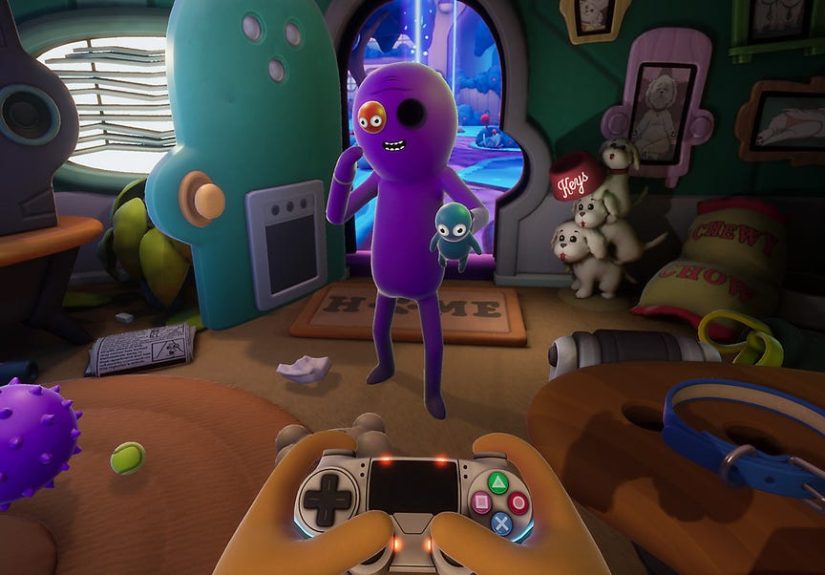
Trover Saves the Universe may be the clearest statement of Roiland’s belief that comedy can work in VR. The game casts the player as a “Chairorpian,” a being who sits in a chair and controls Trover, a purple alien who is not especially thrilled to be your partner. That premise sounds like someone designed a game after losing a bet, but it is actually clever. By making the player seated within the fiction, the game solves one of VR’s biggest comfort problems while turning the limitation into a joke.
Instead of pretending players are athletic space heroes sprinting through alien worlds, Trover Saves the Universe says, “No, you are sitting down. Let’s make that canon.” The result is a VR comedy adventure where the player’s viewpoint, movement, and role all support the humor. You are powerful, but also weirdly passive. You control Trover’s actions, but not his personality. You are important, but characters can still treat you like an inconvenient piece of furniture with opinions.
That tension is funny because it uses VR’s physical reality. Many VR games ask players to become action stars. Trover asks players to become an awkward cosmic supervisor. The difference is huge. The game’s comedy does not only come from dialogue. It comes from the player’s position in the world.
Why Roiland’s VR Humor Often Lands
1. The Player Feels Personally Targeted
VR makes jokes feel more direct. When a character looks at you, talks to you, or reacts to your movement, the joke feels less like a broadcast and more like a personal attack from a cartoon goblin. That kind of intimacy is powerful. It can make a simple insult, awkward silence, or throwaway line feel funnier than it would on a flat screen.
2. The World Rewards Curiosity
Comedy games often fail when players feel like they are just walking between scripted jokes. Roiland-linked VR projects work best when they reward messing around. Pick up an object. Wait too long. Look behind something. Refuse to follow instructions. These small acts can trigger extra lines or reveal hidden gags, making the player feel like a co-conspirator rather than a passive viewer.
3. Improvisational Dialogue Fits Player Chaos
VR players are unpredictable. A tightly scripted scene can break when someone spends two minutes trying to stack virtual items into a cursed tower. Roiland’s loose, improvisational style can absorb that chaos. Characters who ramble, complain, or spiral into absurd commentary help cover the unpredictable pace of VR interaction.
4. Absurdity Feels Bigger in 3D Space
A strange alien on a TV screen is funny. A strange alien standing at your eye level is an event. VR gives scale and proximity to ridiculous designs. Big creatures feel bigger. Small objects feel touchable. Gross jokes, sci-fi gadgets, and bizarre rooms become physical spaces the player must inhabit. That sense of presence turns absurdity into experience.
The Risk: Not Everyone Wants a Comedian in Their Face
Of course, VR comedy has a danger zone. Humor that feels energetic on a TV show can feel exhausting when it is wrapped around your head. A joke style based on yelling, profanity, grotesque visuals, or constant chatter will not work for everyone. In VR, there is less emotional distance. If a character annoys you, you cannot simply glance at your phone. The annoyance is in the room with you, possibly blocking the exit.
This is why pacing matters. The best VR comedy gives players moments to breathe. It lets the environment tell jokes. It uses silence. It understands that not every object needs a punchline and not every character needs to behave like a caffeinated podcast trapped in an alien body. Trover Saves the Universe succeeds most when its comedy is supported by exploration, platforming, strange world-building, and the feeling that the player is discovering jokes rather than being force-fed them through a novelty megaphone.
What VR Comedy Can Learn from Roiland’s Experiments
The biggest lesson is that humor in VR should be designed from the ground up. It cannot simply be imported from television. VR comedy needs spatial awareness, interactivity, player freedom, and layered timing. The funniest moments often happen when the player thinks, “Wait, did the game notice I did that?” That feeling creates a personal connection that traditional media cannot easily match.
Another lesson is that comedy should support gameplay, not replace it. Trover Saves the Universe includes platforming, combat, puzzles, upgrades, and exploration. Some critics found the mechanics simple, but the structure gives the humor a body to live in. Without gameplay, a VR comedy risks becoming a long sketch where the player stands around waiting for the next line. With too much gameplay and too little comedic design, it becomes a standard game with jokes taped to the side like a sticky note that says “laugh here.”
The sweet spot is integration. The player’s role should be funny. The controls should support the joke. The environment should invite playful behavior. Characters should respond in ways that make the world feel aware. When all of those pieces work together, VR comedy can do something rare: make the player feel like the punchline and the co-writer at the same time.
Can Humor Work on VR? The Answer Is Yeswith Conditions
So, can humor work on VR? Yes, absolutely. But it works differently than humor in TV, film, stand-up, or traditional games. VR comedy is not just about writing funny dialogue. It is about building a stage where the audience can touch the props, interrupt the scene, stand too close to the actor, and accidentally discover a better joke than the one planned.
Justin Roiland’s VR projects helped show that the medium can handle absurd comedy, fourth-wall-breaking characters, bizarre sci-fi premises, and player-focused jokes. They also showed the limits. The humor has to be paced carefully. It has to respect player comfort. It has to account for distraction. And it has to be funny enough to survive repetition, because players may hear the same line more than once while trying to figure out how to open a door they were supposed to notice five minutes ago.
At its best, VR comedy feels like being inside a living cartoon with a slightly broken rulebook. It can make players laugh because they are present, not despite it. That is the key. VR is not only a display technology. It is a performance space. And in that space, a good joke can come from a line, a look, a prop, a delay, a bad decision, or the sudden realization that you have been arguing with a purple alien while sitting in your living room wearing expensive goggles.
Experience Section: What Playing VR Comedy Actually Feels Like
The most memorable thing about VR comedy is not always the joke itself. It is the strange feeling of being physically implicated in the joke. In a normal game, you press a button and watch something funny happen. In VR, you reach out, grab the wrong object, drop it, panic, and then get mocked by a character who seems deeply disappointed in your entire family line. That kind of moment sticks because your body participated.
Imagine standing in a virtual room where everything looks interactable. A phone rings. A character gives you instructions. You immediately ignore those instructions because there is a suspicious object on a shelf, and obviously the suspicious object is more important than saving the universe. You pick it up, shake it, throw it, and suddenly the game reacts. Maybe nothing important happens mechanically, but a character comments on your behavior. That tiny response can feel magical. It tells you the game is watchingnot in a creepy surveillance way, but in a “yes, we knew you would do something dumb with that” way.
That is where VR humor becomes different from scripted comedy. The laugh comes from recognition. The player realizes the developers anticipated curiosity, impatience, clumsiness, or rebellion. It feels personal, even when thousands of other players triggered the same moment. Good VR comedy creates the illusion that the joke happened because of you.
Another powerful experience is proximity. In flat-screen games, characters are safely contained inside the display. In VR, they share space with you. A weird creature can lean into your field of view. A tiny object can become strangely important because it is sitting right in front of your virtual hands. A doorway can feel suspicious. A room can feel like a joke waiting to happen. The comedy becomes environmental, not just verbal.
There is also a unique kind of embarrassment in VR comedy. You may know you are alone in your room, but when a game asks you to perform a ridiculous action, part of your brain still says, “This is undignified.” That is funny by itself. VR makes players physically act out nonsense. You are not just selecting “throw item” from a menu. You are actually making the throwing motion. You are bending, reaching, missing, and trying again. The gap between heroic fantasy and awkward reality becomes part of the humor.
However, the best experiences also know when to slow down. Constant noise can flatten the comedy. A great VR joke may need quiet space before and after it. Some of the funniest moments happen when you simply wait and discover that a character has more to say. Other times, the laugh comes from the environment: a ridiculous poster, an unnecessary button, a background detail that rewards players who look around. In VR, looking is an action. Designers can hide jokes above, below, behind, and beside the main path.
For players, VR comedy works best with the right mindset. Do not rush it like a checklist. Treat the world like a comedy playground. Touch things. Pause. Look behind you. Listen to characters who seem like they are finished talking, because they may not be finished at all. Let yourself be part of the bit. The reward is not only progress through the game, but the feeling that the game has turned your curiosity into entertainment.
That is why Roiland’s belief in VR humor makes sense. Comedy thrives on surprise, and VR is basically a surprise delivery machine strapped to your face. When developers combine strong writing, reactive design, memorable characters, and smart comfort choices, VR can be more than immersive. It can be genuinely funny. Not “funny for a tech demo.” Not “funny because VR is awkward.” Actually funny.
Conclusion
Humor can work in VR, but only when creators understand what makes the medium special. Justin Roiland’s VR-related games and collaborations showed that comedy becomes more powerful when players are not just watching the joke unfoldthey are standing inside it, poking it, delaying it, and sometimes ruining it in exactly the way the designers hoped they would. Accounting, Accounting+, Rick and Morty: Virtual Rick-ality, and Trover Saves the Universe all point toward the same answer: VR comedy works when it is interactive, reactive, spatial, and brave enough to be weird.
The future of VR humor will not belong only to louder jokes or stranger aliens. It will belong to creators who can make players feel seen, surprised, and playfully responsible for the chaos around them. In other words, the funniest thing in VR may not be the monster, the gadget, or the sci-fi disaster. It may be you, standing in the middle of it all, holding the wrong object, while a fictional character loses patience in real time.
Note: This publish-ready HTML article is based on real information about Justin Roiland’s VR comedy projects, Squanch Games, Owlchemy Labs, Accounting+, Rick and Morty: Virtual Rick-ality, and Trover Saves the Universe, rewritten in original standard American English for web publication.