Table of Contents >> Show >> Hide
- Quick Specs at a Glance (a.k.a. “Tell me the truth in 10 seconds”)
- What Induction Cooking Really Means (and why it feels different)
- Design and Layout: Why 36 Inches Feels Like a Luxury
- The Features You’ll Actually Use (Not Just Brag About)
- SpeedBoost: when “hungry” becomes a schedule
- AutoChef temperature control: less babysitting, more results
- PotSense / pan detection and SafeStart: the safety net that feels normal fast
- Wipe Protection: because cleaning should not change your settings
- Residual heat indicators and ChildLock: practical for real homes
- Performance in Real Cooking Scenarios (with specific examples)
- Installation Reality Check: The Part Nobody Posts on Instagram
- Cookware Compatibility: Will Your Pots Make the Team?
- Cleaning and Maintenance: Where Induction Wins Hearts
- Who Should Buy the Bosch 500 Series 36-Inch Induction Cooktop?
- Bosch 500 Series vs. Other Induction Options: A Practical Take
- FAQ
- Real-World Experiences : What It’s Like Living With the Bosch 500 Series 36-Inch Induction Cooktop
- Bottom Line
If you’ve ever tried to simmer soup on a “high/medium-ish” burner that behaves like a mood swing, you already understand the appeal of induction.
The Bosch 500 Series 36-inch induction cooktop (commonly referenced as model NIT5660UC) is built for people who want speed, control,
and a kitchen that doesn’t feel like a bonfire audition.
In this guide, we’ll break down what the cooktop actually offerspower, layout, features, installation realities, cookware compatibility, and
what day-to-day use tends to feel likeso you can decide if it’s the right centerpiece for your countertop.
Quick Specs at a Glance (a.k.a. “Tell me the truth in 10 seconds”)
- Size class: 36-inch induction cooktop (actual width about 37″)
- Cooking zones: 5 elements
- Power levels: 17 levels per zone for fine control
- Electrical: 208–240V, typically on a 40A circuit; total connected load around 9,600W
- Design: Frameless black glass (sleek, modern, and very “look at my kitchen remodel”)
- Standout features: SpeedBoost, AutoChef temperature control, pan detection/safety features, cleaning lock
Translation: it’s a serious, built-in induction cooktop designed for fast weekday cooking and picky weekend projectswithout requiring you to
learn the ancient art of “gas flame interpretation.”
What Induction Cooking Really Means (and why it feels different)
Induction doesn’t heat the glass surface first and then “politely ask” your pan to warm up. It uses electromagnetic energy to heat the cookware
itself. That’s why induction cooktops respond quickly, waste less heat into the room, and often feel more precise than standard electric.
Speed: the “pasta water in a hurry” effect
Bosch’s SpeedBoost is designed to push extra power to a zone for faster boiling and rapid preheating. In real life, this is the difference between
“I’ll make tea” and “I’ll make tea, answer two emails, and come back to a rolling boil anyway.” SpeedBoost is especially handy on a 36-inch cooktop
where you may have multiple pots going and still want one burner to do the heavy lifting.
Efficiency: less wasted heat, cooler kitchen
Induction’s efficiency is widely discussed by U.S.-based energy and consumer organizations: because energy goes directly into the pan, you get
more cooking per watt and less ambient heat. Practically, your kitchen can feel less stuffy during long boils, and your ventilation hood doesn’t
have to work overtime just because you decided to cook rice and sauté vegetables.
Control: closer to “turning a dial,” less like “waiting for permission”
Many people switching from radiant electric notice that induction reacts faster when you lower heat. That matters for delicate work: melting
chocolate, holding a sauce below a simmer, or keeping a gravy warm without scorching the bottom like it’s trying to brand itself onto your pan.
Design and Layout: Why 36 Inches Feels Like a Luxury
A 36-inch induction cooktop isn’t just “a little bigger.” It changes how you cook. You can run a stockpot, a sauté pan, and two side dishes
without playing a pan-based game of Tetris. If you entertain, meal prep, or cook multiple components at once, the extra width is a quality-of-life upgrade.
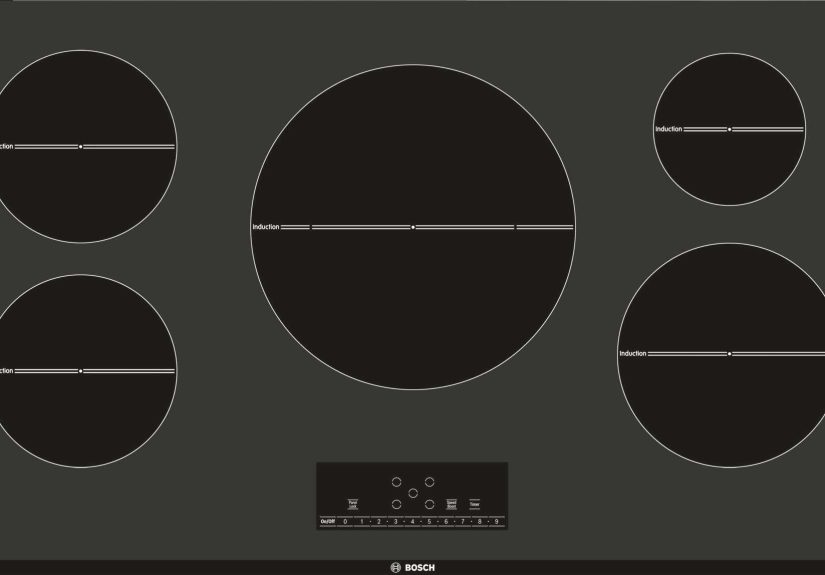
Five cooking zones, including a powerful center option
The Bosch 500 Series 36-inch layout is designed for flexibility: multiple medium zones for everyday pans plus a larger center zone intended for big cookware.
You’ll typically see:
- Two 7-inch zones that are great for saucepans and mid-size skillets
- One large center zone designed to accommodate larger pots and pans (often shown as a dual-size option)
- A 9-inch zone that’s a natural fit for most frying pans
- A smaller zone useful for a butter warmer, small saucepan, or “keep this side dish alive” duty
This mix is the reason many home cooks like 36-inch induction: you can put the “big job” in the middle and still keep sides moving around it.
Frameless black glass: clean look, easy wipe-down
The frameless, built-in look is minimal and modern. The flip side: you’ll want to treat it like the glass it isno sliding cast iron around like you’re
sharpening a sword. Lift, don’t shove. Your future self will thank you.
Touch controls that reward a little familiarity
Bosch includes a direct-selection style interface (often described as PreciseSelect), with 17 power levels. Once you learn where your common settings land
(for example: “3–4 for a gentle simmer,” “7 for a steady sauté,” “Boost for boiling”), it becomes very repeatable. That repeatability is the real gift:
you stop guessing and start cooking.
The Features You’ll Actually Use (Not Just Brag About)
SpeedBoost: when “hungry” becomes a schedule
Boost modes are perfect for boiling water fast, bringing soup to temperature, or preheating a pan for searing. Bosch positions SpeedBoost as a time-saver,
and that’s accuratejust remember that “extra power” is still “extra power.” Use it for bursts, then dial back for the actual cooking.
AutoChef temperature control: less babysitting, more results
AutoChef is designed to regulate temperature for more consistent outcomes. Think of it like a cooking assistant that helps avoid the common induction mistake:
overshooting your desired heat because induction ramps so quickly. For pan-frying, pancakes, and anything where consistency matters, AutoChef can be a quiet win.
PotSense / pan detection and SafeStart: the safety net that feels normal fast
A common induction feature set is pan recognition: the cooktop detects suitable cookware and focuses energy there, rather than heating when you set down a random spoon
(or your phone, whichplease don’t). Safety-focused features like SafeStart are intended to prevent activation without appropriate cookware in place.
Wipe Protection: because cleaning should not change your settings
One underrated feature is the control-panel cleaning lock. If you’ve ever tried to wipe splatters while something is simmering, you know the pain:
suddenly the cooktop beeps, changes power, or turns off because your sponge apparently has opinions. Wipe Protection temporarily locks the controls so you can clean
as you gowithout accidentally turning your simmer into a science experiment.
Residual heat indicators and ChildLock: practical for real homes
Induction is safer than radiant electric in many scenarios, but the glass can still get hot from contact with the pan. Residual heat indicators are there to tell
you what’s still warm. ChildLock helps prevent accidental activation and is especially meaningful in homes with kids, curious guests, or that one friend who touches
everything like they’re touring a museum.
Performance in Real Cooking Scenarios (with specific examples)
Scenario 1: Weeknight pasta + sauté + sauce
On a 36-inch induction cooktop, pasta water can run on the large center zone (often with Boost to reach boil quickly), while a 9-inch zone handles sautéed vegetables
and a 7-inch zone holds sauce at a steady simmer. The advantage isn’t just speedit’s stability. You can drop the sauce to a lower level and it stays there, rather than
cycling wildly like some older electric elements.
Scenario 2: Searing steak without turning your kitchen into a sauna
Induction excels at fast pan preheat. With a heavy skillet (cast iron or induction-friendly stainless steel), you can reach searing temps quickly.
The key is to preheat responsibly: induction can take you from “cold pan” to “restaurant sear” faster than your instincts may expect. Once you’ve got your crust,
dialing back is immediateuseful when you add butter, garlic, or herbs and don’t want them to burn in seconds.
Scenario 3: Keeping chocolate melted (without cooking it)
The 17 power levels matter here. Low settings on induction tend to be more consistent than trying to “feather” a radiant electric coil. For tasks like melting chocolate,
holding a béchamel, or warming milk, the ability to choose a truly gentle setting can save both your ingredients and your nerves.
Installation Reality Check: The Part Nobody Posts on Instagram
A built-in induction cooktop is not a plug-and-play toaster. The Bosch 500 Series 36-inch unit is typically hardwired and designed for 208–240V service,
with a circuit often listed at 40 amps and a total load around 9,600 watts. That’s normal for a serious induction cooktopbut it does mean:
- You may need an electrician (especially if you’re switching from gas or from a smaller electric cooktop)
- Your panel capacity matters (older homes may need upgrades)
- Cutout dimensions must be precise (measure twice, cut once, cry never)
Dimensions and cutout guidance (the numbers that matter)
As a 36-inch class cooktop, the overall width is about 37 inches, and depth is roughly 21 1/4 inches. The cutout is commonly specified around
34 7/8 inches wide by 20 inches deep, with height clearance requirements depending on the installation approach. Always verify with the installation instructions
before countertop work is finalized.
Installing above a wall oven
Many remodelers plan a cooktop-over-oven setup. Bosch documentation commonly references clearance requirements between the cooktop and the oven below.
If you’re pairing appliances, confirm compatibility and required spacing so heat and electronics remain happy long-term.
Cookware Compatibility: Will Your Pots Make the Team?
Induction needs magnetic cookware. The easiest test: stick a magnet to the bottom of the pan. If it grabs, you’re good. If it slides off like it’s embarrassed,
that pan is not making varsity.
Most cast iron works beautifully. Many stainless-steel lines are induction-ready (especially those with magnetic bases). Pure aluminum and pure copper typically don’t work
unless they have an induction-compatible layer. If you’re upgrading your cookware, prioritize flat-bottomed pansinduction rewards good contact.
A note on noise (yes, induction can sing)
Some induction setups produce a faint hum or buzz, especially at high power, and many cooktops use internal fans. This is normal. Heavier cookware and quality construction
can reduce vibration. Think of it as your kitchen’s way of saying, “Physics is happening.”
Cleaning and Maintenance: Where Induction Wins Hearts
Because the cooktop surface doesn’t heat like a traditional radiant element, spills are less likely to bake into a stubborn crust (though the glass can still get hot from the pan).
Most day-to-day messes wipe up quickly once the surface is safe to touch.
- Daily cleaning: a soft cloth + a gentle cooktop cleaner keeps the glass looking sharp
- Stuck-on spots: use a cooktop-safe scraper at a low angle (no aggressive digging)
- During cooking: use the control lock / wipe protection so your sponge doesn’t “reprogram dinner”
If you want your cooktop to keep its showroom look, the biggest habit is simple: lift cookware instead of sliding it.
Who Should Buy the Bosch 500 Series 36-Inch Induction Cooktop?
This cooktop makes sense if you…
- Cook multiple dishes at once and want room to breathe
- Value fast boiling, fast preheating, and quick response when lowering heat
- Want a sleek, built-in look with easier cleanup than gas grates
- Like precision: sauces, simmering, and repeatable results
- Prefer a safety-forward cooking surface (especially in busy households)
You may want to rethink it if you…
- Don’t have (or don’t want to upgrade to) the required electrical capacity
- Have a beloved collection of non-magnetic cookware you refuse to replace
- Strongly prefer physical knobs over touch controls
- Need integrated downdraft ventilation (this model class typically does not include it)
Bosch 500 Series vs. Other Induction Options: A Practical Take
In the 36-inch induction cooktop category, the real differentiators are usually:
cooking-zone layout, power management, ease of control, noise level, and service support.
The Bosch 500 Series tends to position itself as a premium “daily driver” induction cooktop: strong power,
a clean design, and a feature set that focuses on cooking results rather than flashy connectivity.
If you’re comparing brands, pay attention to your most common pan sizes and how they map to the zones.
The best cooktop is the one that fits your cookware like it was meant to be therebecause nothing kills cooking joy faster than a too-small burner under a too-big pot.
FAQ
Is a 36-inch induction cooktop “too much” for a normal household?
Not if you actually cook. The extra width is less about being fancy and more about being functionalespecially if you regularly juggle a main dish, a side, and a sauce.
Even modest households often appreciate the space during holidays or meal prep days.
Will induction work during a power outage?
No. Like other electric cooking appliances, a built-in induction cooktop needs electricity.
If outage cooking is a priority, you’ll want a backup plan (grill, portable burner, or generator setupsafely, of course).
Do induction cooktops scratch easily?
They can, because the surface is glass-ceramic. Good habits help: lift pans, keep cookware bottoms clean, and avoid sliding gritty cast iron.
Many owners find the cleaning convenience worth the small learning curve.
Real-World Experiences : What It’s Like Living With the Bosch 500 Series 36-Inch Induction Cooktop
Let’s talk about the part that never shows up in the product spec sheet: the first week. The “honeymoon period” with induction is realmostly because
boiling water stops being a lifestyle choice and becomes an event that happens whether you’re emotionally ready or not.
Day one usually starts with a confidence boost: you set a pot on the big center zone, hit Boost, and watch bubbles appear with suspicious speed.
It feels like your cookware just discovered caffeine. People often describe induction as “instant,” and while nothing is truly instant in this universe
(except maybe toddlers making messes), induction comes closer than most cooktops. That speed changes your rhythm. You stop turning on a burner “to warm up”
and start turning it on when you’re actually ready to cook.
Around day two or three, you notice the control. Lowering the heat is immediate enough that you can prevent a boil-over before it becomes a countertop waterfall.
Simmering is the other pleasant surprise: once you find the level that holds a gentle bubble, it stays consistent, and you don’t get the same aggressive cycling that
some radiant electric cooktops do. This is where the 17 power levels start to feel less like a marketing bullet and more like a practical tool.
Then comes the “touch controls are different” moment. If you’ve lived your whole life turning knobs, touch panels can feel a little futuristic at first.
Most owners adapt quickly: you learn your common numbers, and muscle memory kicks in. The real-world perk is repeatabilityonce you know what your pan needs for
eggs, stir-fry, or a slow simmer, you can return to it like a favorite playlist. No guessing. No “medium means 7 today, apparently.”
A lot of people also mention the cooktop’s cleanliness factor as a daily mood improver. Because the surface is relatively cool compared with radiant,
splatters are less likely to turn into baked-on artwork. You wipe, you move on with your life, you don’t spend quality time chiseling sauce off a burner.
And when you do need to wipe mid-cook, a cleaning lock (often called Wipe Protection) feels like a tiny miracle: you can clean without the cooktop beeping at you like
an annoyed robot.
There are also a few “normal but surprising” experiences. One is sound: some cookware can buzz at high power, and you may hear a fan during heavy use.
Another is heat behavior: the glass can still be hot from the pan, so residual heat indicators matterespecially if you’re the kind of person who touches the cooktop
to see if it’s hot (please join the “look, don’t touch” club).
Finally, you’ll likely have a cookware moment. Many households discover that most of their pans work just fine, but one or two favorites don’t make the induction cut.
The magnet test becomes a party trick. “Watch thisthis pan is loyal. That one? Emotionally unavailable.” If you do replace cookware, most people end up happier because
induction-ready pans tend to have flatter bottoms and better heat stability anyway.
By the end of the first week, the biggest “experience” is subtle: cooking becomes calmer. Less ambient heat, fewer boil-overs, easier cleanup, and more control.
It doesn’t turn you into a chef, but it does remove a lot of frictionso your skills can actually show up without fighting the appliance.