Table of Contents >> Show >> Hide
- What Does “Ihada” Actually Mean?
- Why Black Uneven Ihada Pendant Lights Are So On-Trend
- Design Details: Finish, Shape, and Light Quality
- Where Black Uneven Ihada Pendant Lights Work Best
- Sizing, Height, and Spacing: Simple Rules That Work
- Styling Tips: How to Make Black Ihada Pendants Look Intentional
- Care, Patina, and Long-Term Maintenance
- Are Black Uneven Ihada Pendant Lights Right for You?
- Real-Life Experiences With Black Uneven Ihada Pendant Lights
- Final Thoughts
If you love interiors that feel a little bit moody, a little bit sculptural, and a lot more interesting than the average “builder-grade” fixture,
black uneven Ihada pendant lights are probably already on your radar. These lights look like tiny pieces of Japanese metal sculpture
casually hanging over your island or dining table, quietly saying, “Yes, I am the main character.”
In this guide, we’ll unpack what “Ihada” actually means, why the uneven texture and black finish are so desirable, where to hang these pendants,
how high to mount them, and how to style and care for them so they age gracefully instead of just looking… tired.
What Does “Ihada” Actually Mean?
“Ihada” comes from Japanese brass casting. Instead of polishing metal into a perfectly smooth, glossy surface, artisans leave the brass in a
more natural, raw state. The texture, tiny pores, and faint casting marks are part of the look rather than “imperfections” to hide.
In traditional workshops, molten brass is poured into fine sand molds. When the piece is released, the surface has a subtle grain and
irregularity from the sand. The edges are smoothed so it’s safe to touch, but the rest is left untreated or minimally finished so the metal can
develop its own patina over time. This is the “Ihada” finish: naked, honest brass with texture and character, not a mirror-polished hotel lobby sheen.
Black versions often use an oxidized treatment over brasssometimes called kuro-murato create a deep, mottled charcoal color.
It’s not a flat, painted black; it usually has tonal variation and a slightly uneven feel that looks more like aged metal than powder-coated steel.
Why the Uneven Texture Is a Feature (Not a Flaw)
That “uneven” quality is intentional. It ties back to Japanese ideas of wabi-sabi: beauty in imperfection, time, and natural change.
Small dimples, soft curves, or subtly irregular edges help these pendant lights feel hand-crafted and one-of-a-kind, even if you bought them
from a design shop rather than a tiny workshop deep in Gifu.
In a world full of perfectly smooth, mass-produced fixtures, black uneven Ihada pendants stand out because they look like they were made by humans,
not a machine on maximum speed. That warmth is exactly what many designers want right now.
Why Black Uneven Ihada Pendant Lights Are So On-Trend
Lighting trends are moving away from harsh, industrial looks and oversize “chandeliers for the sake of drama” toward softer, more sculptural designs.
Designers are favoring aged brass, bronze, and textured metal instead of ultra-shiny finishes, and they love fixtures that look like little works of art
rather than just a light source.
Black Ihada pendants fit that shift perfectly. They:
- Read as sculptural objects even when they’re turned off.
- Bring warmth and patina instead of the cold, industrial vibe of old factory lights.
- Mix easily with multiple stylesminimalist, Japandi, modern farmhouse, or refined industrial.
- Age gracefully as the brass slowly develops more depth underneath the dark surface.
At the same time, statement lighting is having a big moment in living rooms and kitchens. Instead of relying solely on recessed can lights,
homeowners are using distinctive pendants to anchor islands, dining tables, and reading corners. A black uneven Ihada pendant is ideal for that:
bold enough to notice, subtle enough to live with every day.
Design Details: Finish, Shape, and Light Quality
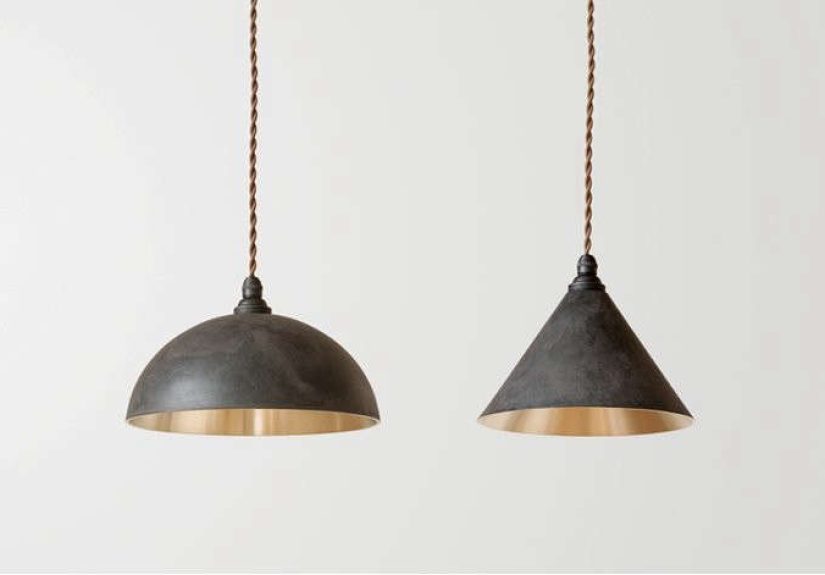
Black Ihada pendant lights come in a few classic shapeshemispheric domes, cones, stars, or softly flared bells. The exterior is usually
a dark, uneven black over brass, while the interior may be:
- Hammered brass that reflects light in a warm, slightly sparkling way.
- Shaved or polished brass for a smoother, more focused glow.
- Matte interior for a softer, more diffused light that feels calm and understated.
That combinationdark outside, warm metallic insidecreates beautiful contrast. From a distance, the fixtures almost disappear into a moody ceiling.
When the lights are on, you get a warm, golden pool of illumination below and a gentle glow inside the shade.
How the Light Actually Feels
Because these shades are typically opaque metal, they direct light downward rather than blasting it all over the room.
That makes them perfect for:
- Task lighting over a kitchen island or bar.
- Focused light over a dining table or breakfast nook.
- Accent lighting over a side table, console, or reading chair.
You’ll usually want to pair them with other lightinglike recessed lights, wall sconces, or floor lampsto avoid a “spotlight-only” effect.
Think of black Ihada pendants as the jewelry, not the only outfit.
Where Black Uneven Ihada Pendant Lights Work Best
Over the Kitchen Island
This is probably the most popular spot. A row of two or three black Ihada pendants instantly makes a kitchen look custom and considered.
Instead of glass globes that show every fingerprint, you get dark, textured shades that hide smudges and look intentionally patinated.
In most homes, designers recommend hanging pendants so the bottom of the shade sits about 30–36 inches above the countertop.
That’s high enough to keep sightlines open but low enough to provide good task lighting for chopping and cooking.
For higher ceilings, you can nudge them up a bit.
Above a Dining Table
A single large uneven Ihada pendant (or a small cluster) over a dining table creates a cozy, cocoon-like atmosphere.
The dark exterior keeps the focus on the food and the people, while the warm inner brass gives everyone that flattering glow we all wish followed us around in real life.
Here, many designers lean toward the same sweet spot: roughly 30 inches above the tabletop, adjusting a few inches up or down depending on
the size of the fixture and the height of the people using the space.
In the Living Room
Use a black Ihada pendant as a sculptural accent in a reading corner, over a side table, or to visually “ground” one end of a sofa.
Because the finish is dark and the shape is usually simple, it won’t fight your TV, art, or fireplace. Instead, it helps layer the light:
overhead glow from a pendant, wash light from floor lamps, plus accent light from a table lamp or two.
Entryways and Hallways
A single uneven Ihada pendant in the entry gives your guests a hint that this house belongs to someone who actually cares about design.
In hallways, a series of smaller pendants can be more interesting than a repetitive row of flush mounts, especially if you use dimmers to keep the mood soft.
Sizing, Height, and Spacing: Simple Rules That Work
You don’t need an architecture degree to get the proportions right. Use these rules of thumb:
Choosing the Right Size
- For a standard kitchen island (around 6–8 feet long), two medium or three smaller pendants typically look best.
- A single large pendant works well over a small round table or compact island.
-
Add the length and width of your room in feet; the sum in inches gives a rough maximum diameter for a single fixture
(for example, 12′ × 14′ ≈ 26-inch max diameter).
Height Guidelines
For islands and tables, start with:
- 30–36 inches above the surface to the bottom of the pendant.
- For ceilings taller than 8 feet, you can raise the fixture by about 2–3 inches for every extra foot of ceiling height.
Spacing Rules
- Leave at least 6 inches from each end of the island to the outer edge of the shade.
-
Space multiple pendants so the distance between shades is roughly equal to their diameter
(if the shade is 12 inches wide, aim for about 12 inches between them). - Make sure you can stand and talk without bumping your head or staring into the bulbwalk the space before committing.
Styling Tips: How to Make Black Ihada Pendants Look Intentional
Pair With Warm, Natural Materials
Black uneven Ihada pendants look amazing with:
- White or off-white walls for a crisp, gallery-like contrast.
- Warm woods like oak, walnut, or ash that echo the warmth of the brass inside.
- Stone countersespecially honed marble, quartzite, or concrete for a modern, textural feel.
- Textured fabrics like linen, bouclé, or wool that play nicely with the imperfect surface of the metal.
Mix Metals (But Do It Deliberately)
You don’t have to match every metal in your space to the pendant. In fact, that can feel flat.
A good approach is:
- Use one dominant metal (for example, stainless appliances and chrome faucets).
- Let the black Ihada pendants be the “accent metal”a darker, moodier contrast.
- Repeat that dark finish once or twice (cabinet hardware, a floor lamp, picture frames) for a cohesive look.
Use Warm Bulb Color
These pendants really shine (literally and figuratively) with warm white LED bulbs around 2700–3000K.
Cooler, bluish light can make the brass interior look harsh instead of golden, and it can kill the cozy mood you were probably going for when you chose these in the first place.
Care, Patina, and Long-Term Maintenance
One of the biggest perks of Ihada-style brass is that it’s meant to change.
Over time, the metal can deepen, darken, and pick up subtle color shifts where hands or cooking vapors touch it.
That’s not damageit’s character.
Everyday Care
- Dust gently with a soft, dry cloth or feather duster.
- For greasy kitchen build-up, use a slightly damp microfiber cloth, then dry immediately.
- Avoid harsh chemicals, abrasive pads, or metal polish that could strip the finish or create bright, uneven spots.
Embracing Patina
If you’re choosing Ihada, you’re choosing a living surface. Expect:
- Subtle darkening in areas that see more humidity, like kitchens.
- Soft shine developing on edges that get touched occasionally.
- Minute color variations that make each shade look more unique over time.
If you want something that looks exactly the same for 20 years, polished chrome might be more your style.
If you like the idea of a light fixture aging along with your home, black uneven Ihada is the right match.
Are Black Uneven Ihada Pendant Lights Right for You?
To decide if this style works for your home, ask yourself:
- Do you like subtle texture and patina more than shiny perfection?
- Does your style lean toward minimalist, Japanese, Scandinavian, or modern rather than ultra-traditional glam?
- Are you okay with a fixture that doesn’t flood the whole room with light but creates focused, warm pools instead?
If you’re nodding along, these pendants will probably feel like the missing piece that pulls your space together.
Real-Life Experiences With Black Uneven Ihada Pendant Lights
So what is it actually like to live with black uneven Ihada pendant lights day to day?
Let’s walk through a few realistic scenariosno staged catalog photos, just how they feel in a real home.
The Small-Apartment Kitchen Glow-Up
Imagine a compact city kitchen: white cabinets, simple slab-front doors, and a narrow peninsula pretending to be an island.
The original light is a sad flush mount that washes everything in a flat, chilly glow.
Swapping it for two small black Ihada pendants instantly changes the vibe.
Suddenly, the peninsula feels like a proper destinationsomewhere you actually want to sit with a laptop or plate of pasta.
The dark shades make the ceiling feel a bit taller because your eye reads them as sculptural dots rather than clunky fixtures.
At night, the warm light bouncing off the brass interior makes the quartz countertop look more expensive (bonus!) and turns late-night ramen into something bordering on romantic.
The Open-Plan Family Room With Layers of Light
In an open-plan living–kitchen–dining space, lighting can easily turn into “giant white box with downlights everywhere.”
Adding a set of black Ihada pendants over the island brings order to the chaos.
They visually separate the kitchen from the sofa zone and dining table without any walls.
During the day, the pendants are quiet but interestingguests often walk in and say, “Where did you get those?” without even realizing why the room feels so pulled together.
At night, you can switch off the recessed cans and leave the pendants and a few lamps on.
The result: a soft, atmospheric glow that makes the space feel cozy instead of overlit.
You still have plenty of light to make popcorn or pour drinks, but the TV area doesn’t feel like a dentist’s office.
The Dining Nook That Finally Feels Intentional
Maybe your dining “room” is really just one end of a long living area.
A single uneven Ihada pendant centered over the table instantly claims that spot and makes it feel like its own zone.
You dim the pendant for dinner, and the brass interior gives everyone a flattering, candlelit warmth without actual candles.
The black exterior helps the fixture disappear when you’re not using it; it becomes more of a silhouette than a big shiny object.
Guests notice the glow first, the fixture secondand that’s usually what you want.
Living With the “Uneven” Part
Day to day, the uneven surface doesn’t feel messy; it feels intentional.
You might notice new tiny changes over timea hint of shine developing on a rim, or a slightly darker patch where steam sometimes rises from a pot.
Instead of stressing about keeping everything pristine, you get to relax and let the fixtures age along with your kitchen.
Cleaning is straightforward. A quick dusting once a week keeps cobwebs and dust away.
If you’re cooking a lot, you might wipe the shades with a dry or slightly damp microfiber cloth once in a while.
As long as you avoid harsh cleaners, the finish will continue to deepen and soften, just as the craftspeople intended.
Over time, many homeowners say the lights become one of their favorite detailssomething they didn’t fully appreciate until they lived with them for a year or two.
They don’t shout for attention like a crystal chandelier; they quietly support the entire mood of the room.
Final Thoughts
Black uneven Ihada pendant lights are not just another trend; they’re part of a broader movement toward lighting that feels crafted, warm, and deeply human.
With their textured surfaces, dark finishes, and soft golden glow, they bring both function and feeling to kitchens, dining spaces, and living rooms.
If you’re craving a fixture that acts like art, respects the principles of Japanese design, and gets better with age, black Ihada pendants are worth a serious look.
Hang them at the right height, pair them with warm bulbs and natural materials, and let them quietly turn your everyday routines into something a little more special.