Table of Contents >> Show >> Hide
- Why this strategy matters now
- Okta’s real PLG lesson: product first, but not product only
- Developer experience is not decoration. It is the engine.
- Why Auth0 was such a strategic fit
- The monetization trick: reduce friction early, monetize complexity later
- How PLG turns into enterprise ARR
- What makes the strategy credible
- The hidden lesson for SaaS teams
- Experience from the field: what this looks like in practice
- Conclusion
If you want to understand how a modern software company grows without turning every customer interaction into a calendar invite and a 47-slide sales deck, Okta is a pretty useful case study. Not because it is a tiny startup making cute “growth hacks” on LinkedIn, but because it has had to solve the much messier problem: how do you build for developers, satisfy security teams, win enterprise buyers, and still grow revenue at scale?
That is where Okta’s playbook gets interesting. The company sits at the crossroads of product-led growth, developer experience, and enterprise expansion. On one side, it has Okta’s workforce identity heritage: the world of IT, governance, compliance, and large-company buying cycles. On the other, it has Auth0: the developer-friendly customer identity platform built for fast implementation, flexible workflows, and self-serve adoption. Put those together and you get a strategy that is less “choose PLG or enterprise” and more “use PLG to make enterprise growth cheaper, smarter, and more durable.”
In plain English: Okta is not betting that developers will magically replace sales teams. It is betting that a great product experience can create trust early, reduce friction in adoption, and hand enterprise sales a much warmer, much more informed buyer. That is a far better setup than cold-calling a skeptical engineering leader who already thinks, “Honestly, we could probably build this ourselves.” Developers say that a lot. Usually right before discovering that identity is a swamp with excellent branding.
Why this strategy matters now
Okta’s financial profile shows why this topic matters. The company finished fiscal 2026 with $2.919 billion in revenue, up 12% year over year, while fourth-quarter revenue reached $761 million. It also ended the year with 5,100 customers generating more than $100,000 in annual contract value, and those larger customers represented more than 80% of total ACV. That is not hobby-project revenue. That is enterprise-grade money with enterprise-grade expectations.
Even more revealing is the mix. Okta reported that in the fourth quarter of fiscal 2026, 59% of ACV came from Workforce Identity and 41% from Customer Identity. That split matters because it shows the company is not just selling internal employee access tools anymore. Customer identity, the area most closely associated with developers and embedded product experiences, is now a meaningful part of the growth story.
So when people talk about Okta’s PLG and developer experience strategy, they are not talking about a side quest. They are talking about a major engine connected directly to enterprise ARR. The lesson is simple: if developer adoption creates product trust, and product trust creates enterprise expansion, then developer experience stops being a “nice-to-have” design issue and becomes a revenue lever.
Okta’s real PLG lesson: product first, but not product only
A lot of companies treat product-led growth like a magic spell. Add a free plan, throw in a dashboard, whisper “self-serve,” and wait for the ARR fairy. Okta’s framework is a lot more disciplined than that.
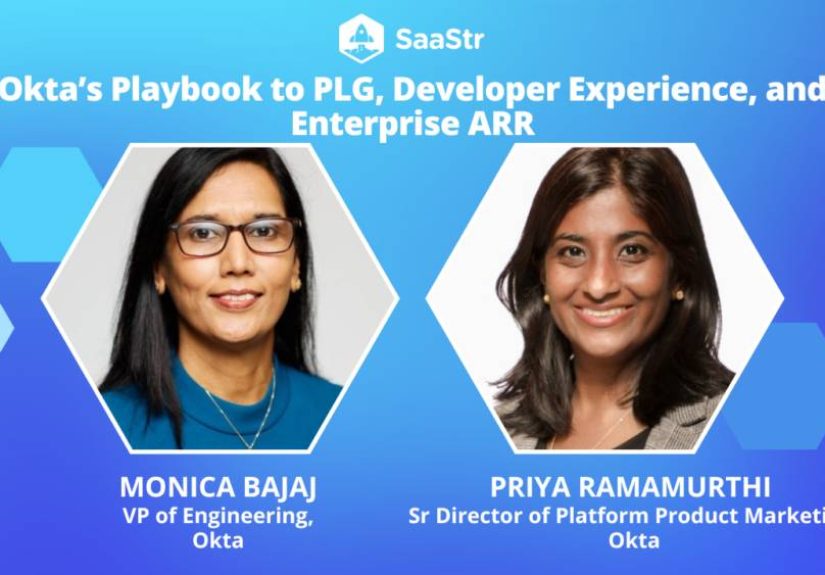
In the SaaStr breakdown of Okta’s playbook, the company frames PLG around a lifecycle: assess, activate, adopt, amplify. That sequence is useful because it forces teams to think about how a user actually behaves. First, a user tries to understand what the product does. Then they start experimenting. If the product solves a real problem, they adopt it. If it keeps delivering value, they expand usage and advocate for it internally. That last stage is where enterprise revenue often starts to appear.
This is the clever part: Okta’s PLG model does not end at the free user. It is designed to create a healthy funnel that can move from self-serve exploration to paid usage to large-account expansion. In other words, PLG is the on-ramp, not the final destination.
That matters especially in identity, where a solo developer might start the trial, but the eventual deal may involve a VP of Engineering, a CISO, a CIO, procurement, legal, and at least one person whose main job seems to be asking for a longer security questionnaire. Okta’s strategy acknowledges this reality instead of pretending enterprise complexity does not exist.
Developer experience is not decoration. It is the engine.
Okta’s strongest insight is that developer experience is not mostly about looking cool to engineers on social media. It is about removing enough friction that the product can prove value before budget politics show up.
The company’s published framework for developer experience is wonderfully blunt: FEW Fast, Easy, and Works. Not “synergistic.” Not “transformative.” Not “AI-powered frictionless orchestration for tomorrow’s builders.” Just fast, easy, and works. Beautiful.
Fast
Speed matters because developers judge products quickly. If the first integration feels slow, confusing, or over-designed, they bounce. Auth0 leans into this with APIs, SDKs, quickstarts, reusable patterns, and a promise that developers can integrate authentication in minutes. The platform also emphasizes flexibility for different personas: the no-code or one-click builder, the low-code team that wants modest customization, and the pro developer who wants deep control.
Easy
Easy does not mean simplistic. It means the documentation is searchable, the implementation path is obvious, and users can learn without being forced into a sales conversation at minute three. Okta’s own developer guidance emphasizes self-service access, strong documentation, and product learning that does not require hopping on a call. That is especially important for technical buyers who want proof before promises.
Works
This is the part where enterprise buyers perk up. A product that works is not just functional in a demo. It is predictable, scalable, secure, observable, and ready for real-world failure modes. Okta and Auth0 repeatedly position uptime, security operations, extensibility, and enterprise controls as core product requirements. That is not just technical hygiene. It is the bridge from developer joy to enterprise trust.
Said another way: PLG may get you the first login, but reliability gets you the contract renewal.
Why Auth0 was such a strategic fit
Okta’s acquisition of Auth0 for $6.5 billion made strategic sense because it expanded the company’s reach from workforce identity into a broader customer identity and developer-first motion. When the deal closed, Okta positioned the combined company as bringing together developer and enterprise expertise. That phrase sounds corporate, but it is actually the entire story in six words.
Okta’s heritage gave it credibility with large organizations, governance-heavy buyers, and workforce security use cases. Auth0 brought deep credibility with developers building customer-facing apps, embedded authentication flows, and customized identity experiences. Instead of forcing a single go-to-market motion, the combined portfolio lets Okta serve both the admin who wants centralized control and the engineer who wants flexible implementation.
This is why the combined strategy works better than a purely sales-led model. Developers can begin with Auth0’s free entry points, experiment with real integrations, and validate use cases. Then, as the app grows or the buyer moves upmarket, enterprise needs appear: SSO, SCIM, lifecycle management, delegated administration, stronger governance, compliance, and support. Suddenly the conversation is no longer “Should we buy identity?” It becomes “How fast can we standardize this before the next enterprise customer asks for it?”
The monetization trick: reduce friction early, monetize complexity later
Great PLG is not about giving everything away forever. It is about letting users discover real value before you ask them to buy more.
Auth0’s current pricing structure makes that logic visible. The platform offers a free tier for up to 25,000 monthly active users, and that tier now includes features that matter to serious builders, such as one enterprise connection, self-service SSO, and SCIM. That is not random generosity. It is a deliberate attempt to lower the barrier to proof-of-concept work and early B2B product validation.
This matters because one of the biggest killers of developer adoption is the “price cliff.” Teams want to validate enterprise identity requirements before they are forced into a heavy commercial discussion. Auth0’s recent plan updates appear designed to solve exactly that problem: let teams prove the use case, test integrations, and sell the internal vision first. Monetization then grows with scale, complexity, production demands, and governance needs.
In other words, Okta is not trying to monetize curiosity. It is trying to monetize success.
How PLG turns into enterprise ARR
The jump from developer adoption to enterprise ARR does not happen by accident. Okta’s own framework says enterprise funnels and PLG funnels are not mutually exclusive. That is exactly right.
A developer may start with a free self-serve product because it is easy to test. But once the application becomes important to the business, the questions change:
- Will this integrate with the rest of our stack?
- Can we support enterprise SSO and provisioning?
- Can we govern access across internal teams, customers, partners, and contractors?
- Will security and compliance teams approve it?
- Can this scale without becoming a custom-maintenance nightmare?
That is where Okta’s broader platform enters the picture. The company now has a pathway from developer-first customer identity to broader enterprise requirements like lifecycle management, governance, and policy enforcement. The Okta Integration Network, enterprise identity guides, and platform-level features all help move a product from “works for my app” to “works for the company.”
Okta also seems to understand that enterprise buyers are not all motivated by the same thing. Engineering leaders care about speed to market, integration quality, and scalability. CISOs care about security posture, compliance, risk, and data residency. Business leaders care about customer growth, retention, and operational efficiency. The product must create enough value for each group to say yes for different reasons. That is how enterprise ARR gets built without making the developer experience miserable.
What makes the strategy credible
Plenty of companies claim they are “developer-first” right up until the moment you ask for support, pricing clarity, or production-grade controls. Okta’s case is more credible because the strategy shows up in both product design and financial outcomes.
On the product side, Auth0 emphasizes 30+ SDKs and quickstarts, 10 billion+ authentications per month, and 99.99% uptime. On the security side, Auth0 says the broader Okta ecosystem blocks 3 billion+ attacks per month, while Okta’s customer identity reporting says identity attacks remain intense enough that nearly 46% of registration attempts on the Auth0 platform in 2024 met attack criteria. Translation: identity is not just a convenience layer anymore. It is a frontline security and business system.
On the enterprise value side, Okta’s commissioned Forrester study on Identity Governance modeled a 211% ROI, a payback period under six months, and $1.8 million in net present value for a composite organization. That does not mean every customer gets identical results, but it does help explain why governance, lifecycle, and access controls become compelling add-ons once a company moves beyond basic authentication.
The hidden lesson for SaaS teams
The real lesson in Okta’s playbook is not “copy Okta.” Most companies cannot. The lesson is that developer experience, PLG, and enterprise sales should not be run like rival kingdoms.
If the product is easy to try but impossible to govern, it stalls. If it is secure but painful to implement, adoption suffers. If it delights developers but ignores enterprise buyers, revenue gets capped. Okta’s approach tries to solve that triangle by sequencing value correctly:
- Make the product easy to start.
- Make the implementation flexible enough for real builders.
- Make the platform strong enough for enterprise standards.
- Expand monetization when the customer’s complexity grows.
It sounds obvious. It is not. Most software companies are still lopsided somewhere in that sequence.
Experience from the field: what this looks like in practice
Teams working on B2B SaaS products usually do not begin by saying, “Today we shall architect a majestic identity strategy.” They begin with a much more relatable sentence: “We just need login working by Friday.” That is how identity sneaks into the roadmap. First it is authentication. Then it becomes social login, passwordless, MFA, organizations, role management, enterprise federation, provisioning, audit logs, delegated admin, compliance questions, support tickets, and eventually a very serious conversation with a security team that has zero interest in your excuses.
This is where Okta’s playbook feels grounded in reality. The best developer experiences are not the ones that impress people in a keynote. They are the ones that save teams from rewriting brittle identity code six months later. A startup may begin with a simple self-serve motion, but as soon as it lands bigger customers, identity requirements arrive like uninvited relatives who plan to stay for the holidays. Suddenly a prospect wants SAML. Another wants SCIM. Another wants admin delegation. Another wants proof that your platform will not fall over during a product launch. Congratulations: you have entered the enterprise zone.
In that environment, product-led growth works best when it creates evidence. A free plan, a clean trial, great docs, and quick implementation help internal champions prove that a product can work. That proof lowers friction in later sales cycles because the buyer is no longer evaluating an abstract promise. They have seen the product. They have tested the APIs. They know the setup path. The salesperson is not dragging a mystery box into procurement; they are helping formalize a decision that already has technical momentum.
Developer experience also has a compounding effect inside organizations. Clear docs reduce support burdens. Reusable patterns shorten implementation time. Predictable infrastructure improves trust. Security features reduce buyer anxiety. And when those pieces come together, the product stops being “one more tool” and starts becoming infrastructure. That is where enterprise ARR gets sticky.
The other practical lesson is that flexibility matters more than slogans. Some teams want no-code workflows. Some want sensible defaults. Some want total control. A platform that respects those differences is more likely to grow from a single builder to a department, then from a department to an enterprise standard. That path is hard to fake. It requires actual product discipline.
So the lived experience behind Okta’s strategy is not mysterious at all. Developers want speed, clarity, and control. Security teams want confidence. Enterprises want standards, governance, and low-risk expansion. The companies that win are the ones that make all three groups feel like the product was built with them in mind. That is the real playbook. Everything else is just decorative SaaS vocabulary in a nice shirt.
Conclusion
Okta’s playbook to PLG, developer experience, and enterprise ARR works because it respects how software buying actually happens. Developers want to try before they trust. Enterprises want proof before they standardize. Finance wants scalable revenue, not an expensive science experiment. Okta’s combination of self-serve entry points, developer-friendly tooling, identity depth, and enterprise controls gives it a credible way to serve all three.
The company’s growth story is not just about adding more features. It is about aligning the product journey with the revenue journey. Free and flexible entry points create adoption. Strong documentation, APIs, SDKs, and reliability create trust. Enterprise identity features create expansion. And when those stages reinforce one another, PLG stops being a buzzword and starts behaving like a serious commercial strategy.
For software companies watching from the sidelines, the takeaway is refreshingly practical: build something developers can start fast, make it easy to learn, make it actually work at scale, and be ready when the enterprise asks for grown-up features. That is not glamorous. It is just how durable ARR gets made.