Table of Contents >> Show >> Hide
- NATO, in one clear sentence
- Why NATO was created
- The North Atlantic Treaty: the “rulebook” behind NATO
- Who’s in NATO today?
- How NATO makes decisions (spoiler: no one gets outvoted)
- Does NATO have its own army?
- What NATO actually does (beyond headlines)
- What Article 5 doesand doesn’tmean in real life
- NATO and defense spending: why people argue about percentages
- Why NATO still matters (especially now)
- Quick NATO FAQ
- Real-World Experiences: What “NATO” Feels Like Up Close
- 1) The small-town airport that suddenly gets very international
- 2) The service member who learns “interoperability” the hard way
- 3) The student who visits a NATO exhibit and realizes it’s not just history
- 4) The immigrant family conversation that turns into a NATO explainer
- 5) The civics lesson hidden inside a NATO argument
NATO stands for the North Atlantic Treaty Organization. If that sounds like the name of a group project where everyone promised to do their part (and then one person brought cookies), you’re… not totally wrong. NATO is a political and military alliance designed to help its members prevent conflict and defend each other if they’re attacked.
But NATO isn’t a “world police” squad, it doesn’t have a single permanent NATO army, and it’s not a magical button that launches World War III. It’s closer to a security pact with a rulebookand the most famous rule is a single sentence that changed modern history: an attack on one can be treated as an attack on all.
NATO, in one clear sentence
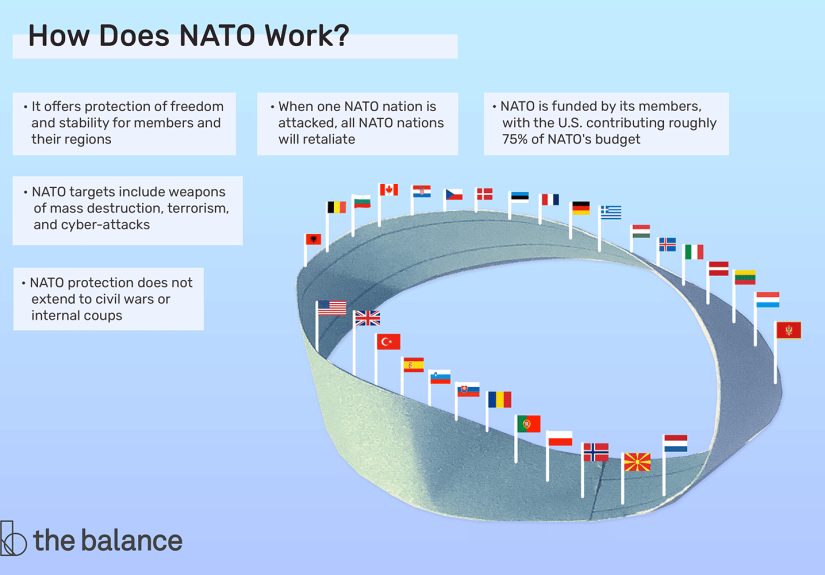
NATO is a 32-country alliance in Europe and North America that protects its members through collective defense, joint planning, and cooperation.
NATO’s core mission is often summarized as “collective defense,” meaning members agree to assist one another if a member is attacked. That promise is written into the alliance’s founding document, the North Atlantic Treaty (often called the Washington Treaty), signed in 1949.
Why NATO was created
NATO was formed in 1949, in the tense years after World War II. Much of Europe was rebuilding, and the Cold War-era rivalry between the Soviet Union and Western democracies was intensifying. The idea behind NATO was straightforward:
- Deter aggression by making clear that attacking one ally could trigger a response from many.
- Prevent another major war in Europe through coordinated defense planning.
- Promote stability by binding North American and European security together.
In other words: NATO was designed to make potential aggressors do the math and decide, “Actually… never mind.”
The North Atlantic Treaty: the “rulebook” behind NATO
NATO is not just a club with flags. It’s built on a treatyan actual legal agreement. A few parts matter most for understanding what NATO is and how it works.
Article 5: the collective defense promise (and why it’s famous)
Article 5 says that if one NATO member suffers an armed attack (in Europe or North America), the allies consider it an attack on them all and will assist the ally that was attacked.
Here’s the key detail people miss: Article 5 doesn’t force every country to respond in the exact same way. The treaty language allows each ally to take “such action as it deems necessary.” That means assistance could include military action, but it could also include other kinds of support depending on what allies agree is needed.
Article 5 has been formally invoked only onceafter the September 11, 2001 terrorist attacks on the United Statesshowing both how serious the commitment is and how rarely the alliance wants to use it.
Article 4: the “we need to talk” clause
Another important (and often more commonly used) tool is Article 4, which allows allies to consult when any member feels its security or territorial integrity is threatened. Think of it as NATO’s emergency group chat: it doesn’t automatically trigger military action, but it can lead to joint decisions.
Article 10: how NATO adds new members
NATO membership can expand. Under Article 10, allies can invite new countries to join if they meet requirements and all members agree. This matters because NATO has grown significantly since the Cold War ended.
Who’s in NATO today?
As of Sweden’s accession in March 2024, NATO has 32 members. It includes the United States and Canada, plus most of Europe. NATO began with 12 founding members in 1949 and expanded in several waves over decades.
If you’re trying to remember the recent additions, here’s the quick timeline many people ask about:
- Finland joined in 2023
- Sweden joined in 2024
Those accessions are especially significant because they reshaped security planning in Northern Europe and the Baltic region.
How NATO makes decisions (spoiler: no one gets outvoted)
NATO is a consensus-based alliance. That means NATO generally does not vote the way many organizations do. Instead, members discuss until they reach an outcome everyone can acceptor they pause, adjust, and keep negotiating.
The main political decision-making body is the North Atlantic Council (NAC). Each member is represented, and the NAC meets regularly (often weekly at the ambassador level) to handle everything from strategy and deterrence to crisis response.
This consensus model is a feature, not a bug: it helps ensure allies remain politically committed to decisions. It can also be slow when members disagreebecause “32 people picking a restaurant” energy is real, even in global security.
Does NATO have its own army?
NoNATO does not have a single, permanent standing army in the way a country does. NATO relies on forces contributed by member countries for operations, exercises, and missions. Those forces can operate under NATO command structures when countries agree to provide them.
So NATO is less like a standalone military and more like a framework for organizing combined defensewith shared standards, planning, command arrangements, training, and interoperability (a fancy word for “our equipment and procedures actually work together”).
What NATO actually does (beyond headlines)
When people hear “NATO,” they often picture jets scrambling or tanks rolling. But much of NATO’s day-to-day work is quieterand that’s the point. Deterrence is strongest when an adversary believes allies are prepared before something happens.
1) Deterrence and defense
NATO’s core responsibility is to protect allied territory and populations. That includes defense planning, readiness, and posturelike where forces are positioned, how quickly they can move, and how allies coordinate in a crisis.
2) Joint training and military exercises
NATO countries run regular exercises so forces can operate together effectively. This includes practicing air defense, maritime coordination, cyber resilience, logistics, and reinforcementbecause in real crises, “we’ll figure it out later” is not a strategy.
3) Crisis management and operations
Over the years, NATO has led or supported missions in places like the Balkans, Afghanistan, and Libya. These missions vary widelysome focus on stabilization, some on enforcement of UN mandates, and some on training and support. NATO’s role and scope depend on allied decisions and the legal/political context.
Importantly, NATO is not “always at war.” Many NATO activities are about prevention, preparedness, and coordination so that war is less likely.
4) Cooperative security (partners, standards, and resilience)
NATO also works with partner countries and organizations to improve security cooperation, build institutional capacity, and strengthen resilience against modern threats like cyberattacks, disinformation, and disruption of critical infrastructure.
What Article 5 doesand doesn’tmean in real life
Article 5 is the heart of NATO’s identity, but it’s often misunderstood. Here are the biggest clarifications:
- Myth: “Article 5 automatically declares war.”
Reality: Allies must consult and agree, and each country decides what assistance it provides. - Myth: “NATO can force a country to send troops.”
Reality: NATO decisions are consensus-based, and national governments control their own forces. - Myth: “NATO is only about Europe.”
Reality: NATO is a North Atlantic alliance, including North America and Europe, with security interests that can extend beyond Europe depending on allied decisions.
If you remember just one thing: NATO is a commitment to help, coordinated through consultationnot a machine that runs on autopilot.
NATO and defense spending: why people argue about percentages
NATO isn’t just a promise; it requires real capabilitiestrained forces, equipment, logistics, and readiness. That’s why defense spending targets are a recurring NATO debate.
For years, a widely discussed benchmark has been the idea that members should spend around 2% of GDP on defense (with variations in how countries define and meet that goal). More recently, allied leaders have discussed higher long-term targets tied to broader security needs, including infrastructure and resilience.
Practically, the spending debate is about burden-sharing: How much does each ally contribute to the shared security umbrella? The answer affects politics inside NATO and perceptions of credibility outside NATO.
Why NATO still matters (especially now)
NATO remains central to European and North American security because the security environment has changedand in many ways become more complicated. Traditional military threats haven’t disappeared, and modern threats (cyber, disinformation, sabotage, gray-zone tactics) have expanded what “defense” even means.
NATO’s value is that it provides:
- A deterrent signal that allies will stand together
- A planning and command framework so responses aren’t improvised in the middle of a crisis
- Interoperability that makes combined operations possible
- Political coordination across democracies with different domestic priorities
You don’t have to agree with every NATO decision to understand why the alliance is influential: it shapes how countries plan for defense, how crises are managed, and how adversaries calculate risk.
Quick NATO FAQ
Is NATO the same as the European Union?
No. The EU is a political and economic union; NATO is a defense and security alliance. Some countries are in both, some are in only one.
Can NATO kick out a member?
The North Atlantic Treaty doesn’t include a straightforward “expulsion” clause. Membership questions are heavily political and would involve complex legal and diplomatic realities.
Where is NATO headquartered?
NATO’s political headquarters is in Brussels, Belgium.
What’s the biggest takeaway?
NATO is a collective defense alliance built on consultation, consensus, and coordinated capability. It’s as much political as it is militaryand its power comes from members agreeing that security is shared.
Real-World Experiences: What “NATO” Feels Like Up Close
NATO can sound abstractlike something that exists only in press conferences, treaties, and maps with arrows. But for millions of people in member countries, NATO shows up in surprisingly human, everyday ways. Here are a few real-world vignettes that reflect common experiences people describe when they encounter NATO in practice (drawn from public reporting, common military-civilian interactions, and how NATO activities typically unfold).
1) The small-town airport that suddenly gets very international
Imagine living near a quiet air base where the loudest thing is usually a baggage cart. Then, for a few weeks, it becomes a mini United Nationspilots from different countries rotating through, aircraft markings you’ve never seen, and local news explaining that there’s a NATO exercise happening nearby. For residents, the experience is a mix of curiosity and reassurance: the whole point is practicing coordination before a crisis ever arrives. You might not learn the name of the operation, but you’ll learn the vibe: preparation is loud, on purpose.
2) The service member who learns “interoperability” the hard way
Ask troops who’ve trained in multinational exercises what stands out, and you’ll often hear the same themes: different languages, different equipment, different habitsand a shared mission that forces everyone to translate, standardize, and adapt. One unit calls it “radio discipline,” another calls it “don’t step on comms,” but the idea is the same. NATO’s magic isn’t a superhero cape; it’s the boring-but-critical stuff: procedures, compatible gear, shared planning, and learning to work with allies you didn’t grow up training with. A lot of it feels like group workexcept the stakes are higher and the PowerPoint slides are usually worse.
3) The student who visits a NATO exhibit and realizes it’s not just history
For students and travelers, NATO can feel like a Cold War museum pieceuntil you see how current it is. Many people have a moment where NATO stops being a textbook acronym and becomes a living institution: a headquarters building, a public exhibit, a lecture, a documentary clip, or a news briefing that connects NATO to events happening now. That shift is often emotional. NATO isn’t just about tanks; it’s about the idea that democracies can commit to mutual support, even when it’s politically inconvenient.
4) The immigrant family conversation that turns into a NATO explainer
In many communities across North America and Europe, NATO is personal. Families with roots in countries that once worried about being “on the edge” of conflict often talk about NATO as a safety netimperfect, debated, but meaningful. The conversation usually goes like this: someone says, “So what does NATO actually do?” and a relative replies, “It’s why some countries sleep a little easier.” That’s not a slogan; it’s a reflection of how collective defense changes the psychology of security. Deterrence isn’t only militaryit’s also the confidence that you won’t face a threat alone.
5) The civics lesson hidden inside a NATO argument
Even the arguments about NATO can be educational. When people debate defense spending targets, burden-sharing, or whether NATO should take on certain missions, they’re often debating deeper questions: What do allies owe each other? What counts as a threat? How do democracies commit to long-term security when elections happen every few years? In that sense, NATO is also a civics classroomone where the homework is complicated and the grading rubric is called “geopolitics.”
If NATO feels big and distant, that’s normal. But zoom in, and you’ll see it’s also made of very human things: planning meetings, shared training, hard compromises, and a promisewritten in treaty languagethat security is a team sport.