Table of Contents >> Show >> Hide
- What Is a Three-Point Turn (and When Should You Use It)?
- Before You Start: Set Yourself Up for a Safe Turn
- How to Make a Three Point Turn: 12 Steps
- What Good Looks Like (So You Know You Nailed It)
- Common Mistakes (and How to Fix Them Fast)
- Practice Tips That Actually Work
- Three-Point Turns on a Driving Test: How to Impress Without Overthinking
- Real-World Experiences: What It Feels Like to Learn a Three-Point Turn (and Finally Get It Right)
- Conclusion
A three-point turn (also called a K-turn or turnabout) is the classic “I need to go the other way but the road is too skinny”
maneuver. Done right, it’s smooth, safe, and kind of satisfyinglike folding a fitted sheet correctly (rare, but glorious). Done wrong, it’s a slow-motion
chaos parade involving curb kisses, confused drivers, and your passenger suddenly becoming a professional driving coach.
This guide breaks down exactly how to do a three-point turn in 12 clear steps, plus real-world tips for staying calm, avoiding common mistakes,
and practicing in a way that actually makes you better (instead of just “more familiar with panicking”).
What Is a Three-Point Turn (and When Should You Use It)?
A three-point turn is a method of turning your vehicle around on a narrow road using a sequence of forward and reverse movements. The goal is to reverse your
direction without making a wide U-turn (because the street, traffic, or space won’t allow it).
Common times a three-point turn makes sense
- You’re on a dead-end street and don’t have room to loop around.
- You missed a turn and “go around the block” would add ten minutes (and five new regrets).
- A driveway isn’t available for a two-point turn.
- You’re practicing for a driving test that includes turnabouts/K-turns.
When you should NOT do a three-point turn
- On or near a curve where oncoming drivers can’t see you early.
- On hills where visibility is limited or your car may roll unpredictably.
- On highways or high-speed roads where slower maneuvering is dangerous.
- Anywhere signs or markings indicate you can’t turn around (or where it would disrupt traffic).
Before You Start: Set Yourself Up for a Safe Turn
1) Pick the right spot
Your ideal location is a quiet residential street with good visibility in both directions and enough room to swing the front of your vehicle
toward the opposite curb without jumping it. If traffic is heavy, pick a better spot. Being “technically correct” is not the same as being safe.
2) Do a quick safety scan (yes, every time)
Check mirrors, look over both shoulders, and pay attention to pedestrians, cyclists, parked cars, pets, and driveways. A three-point turn is slow and
attention-demanding by natureso distractions are your enemy.
3) Understand the “three points” (so the steps make sense)
The maneuver is basically:
forward turn across → reverse turn back → forward to complete.
The “12 steps” below simply break that sequence into smaller actions so you can execute it cleanly and consistently.
How to Make a Three Point Turn: 12 Steps
-
Slow down early and commit to safety, not speed.
Ease off the accelerator well before your turning spot. Smooth and controlled beats fast and frantic. -
Signal right and pull over close to the curb (or road edge).
Move to the right side to maximize space for the turn. Stop when you’re parallel to the curb and not blocking driveways. -
Stop fully and check traffic in all directions.
Use mirrors and shoulder checks. Look for cars approaching from behind, oncoming traffic, and anyone stepping off a sidewalk. -
Signal left and wait for a safe gap.
Your car is about to occupy more of the road than usual. Don’t “squeeze it in.” If you’d feel weird doing it in front of a driving examiner, don’t do it. -
Turn the steering wheel all the way left.
Turning fully reduces how far you need to travel forward. Keep your speed walking-pace slow. -
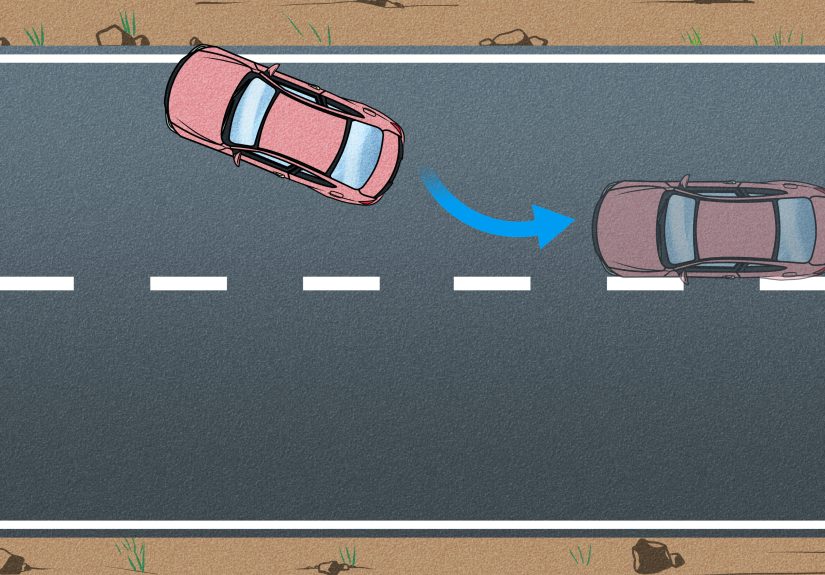
Move forward across the road toward the opposite curb/edge.
Aim to stop when your front end is close to the opposite curb without hitting it. Your car will end up angled, pointing left. -
Stop again (completely), then shift into reverse.
This is not a “rolling shift” moment. Come to a full stop first. Keep your foot on the brake as you change gears. -
Check behind you the correct way: turn your head and look through the rear window.
Mirrors help, but your primary view while reversing should be over your shoulder through the back window. Watch for pedestrians and approaching cars. -
Turn the steering wheel all the way right.
This swings your rear end toward the right side of the road and pivots the vehicle into position to finish the turn. -
Reverse slowly until you’re close to the right curb/edgethen stop.
Stop before the curb, a mailbox, a parked car, or the world’s most inconveniently placed trash can. (They travel in packs.) -
Shift into drive, check traffic again, and steer left.
Take another full scan. If traffic appeared while you were reversing, let it pass. Then turn the wheel left to complete the final arc. -
Pull forward into your new lane and straighten out smoothly.
Accelerate gently, center your vehicle in the correct lane, cancel the turn signal, and continue driving like a calm, competent person who definitely didn’t
just sweat through their hoodie.
What Good Looks Like (So You Know You Nailed It)
- You maintained slow, controlled speed the entire time.
- You made complete stops before shifting between drive and reverse.
- You checked traffic repeatedly, not just once at the start.
- You finished in the proper lane, centered and stable.
- No curb contact. No sudden corrections. No angry honks from someone who “wasn’t even close,” according to them.
Common Mistakes (and How to Fix Them Fast)
Turning too early and clipping the curb
Fix: In Step 6, creep forward a bit more before stopping. You want the front end close to the far curb, but not over it. If you stop too soon, you’ll run out
of angle later.
Not turning the wheel fully
Fix: Unless your vehicle is huge or the road is wide, you usually need full steering lock for both the forward-left and reverse-right parts. Partial turns eat
space.
Rushing the reverse portion
Fix: Reverse is where things get awkwardso go slower, not faster. Keep braking gentle and steady, and turn your head to look behind you.
Forgetting to signal (or signaling once and assuming it “covers the whole event”)
Fix: Use your signals intentionally: pull over to the right, then signal left before moving across. Signals are communication, not decoration.
Trying it on a busy road
Fix: If you can’t do it without pressuring traffic, it’s the wrong place. Find a safer street, use a driveway for a two-point turn, or simply keep driving and
turn around later.
Practice Tips That Actually Work
Start in a low-stakes environment
Before you try it on a real street, practice the steering and timing in an empty parking lot so you can learn how your vehicle “swings” when the wheel is fully
turned. Then graduate to a quiet street with a licensed adult/instructor supervising, following local laws.
Use reference points
Every car turns differently. Pick simple cues like:
“When my front bumper reaches that driveway line, I stop.”
Consistent cues create consistent results.
Practice both directions
Some streets slope or crown, and some drivers feel more confident turning one way than the other. Practice both so your brain doesn’t treat the “other side”
like a new species.
Three-Point Turns on a Driving Test: How to Impress Without Overthinking
- Exaggerate your head checks (in a normal way). Examiners need to see that you’re looking.
- Stop fully before shifting. This is a big scoring area in many road tests.
- Control the speed. Jerky throttle and braking makes the maneuver look sloppy (and risky).
- Stay calm if you need a small correction. Some situations require a tiny extra adjustmentwhat matters is that you do it safely.
Real-World Experiences: What It Feels Like to Learn a Three-Point Turn (and Finally Get It Right)
Most new drivers don’t struggle with the concept of a three-point turnthey struggle with the moment. It’s a maneuver that asks you to do three things
at once: steer decisively, manage gears and speed, and constantly scan for hazards. That’s a lot for a brain that’s still busy remembering where the wipers are.
A super common first experience goes like this: you pull over, signal left, start turning, and suddenly your brain goes quietlike it just left the chat.
You either stop too early (leaving you angled with nowhere to go) or you creep too far and feel like you’re about to park your front tires on the opposite curb.
The fix almost always comes from repetition, not genius. After a handful of tries, drivers learn the “shape” of the turn their car makeshow quickly the nose
swings, how much space it needs, and how slow is slow enough.
Another shared experience is the reverse portion feeling strangely intense. Even people who are fine backing out of a driveway can get tense reversing during a
three-point turn, because the stakes feel higher: you’re partly blocking the road, you’re steering sharply, and you’re trying not to drift into the curb.
Drivers who improve fastest tend to adopt one habit: they pause and look before moving the car. That half-second resetfull stop, head turn,
scanprevents the “oops, someone was there” problem and builds confidence quickly.
Then there’s the social pressure factor. Many learners report that the maneuver feels easy when the street is empty and suddenly feels impossible when one car
appears in the distance. The best antidote is a simple rule: if you wouldn’t start the turn with a driving instructor watching and a clipboard involved, don’t
start it at all. Wait. Let the car pass. Give yourself the gift of time. Safe driving is not a timed event, even if your nerves insist otherwise.
Finally, most people have a “click” moment where the three-point turn stops being twelve steps and starts becoming one smooth sequence. They realize the turn is
less about being perfect and more about being predictable: clear signals, slow movement, full stops, obvious head checks, and gentle steering.
Once that happens, the maneuver becomes what it was always meant to bejust a practical way to turn around, not a dramatic performance worthy of a soundtrack.
Conclusion
A three-point turn is one of those essential driving skills that feels awkward until it suddenly doesn’t. Focus on choosing the right location, communicating
with signals, moving slowly, and checking traffic repeatedly. With a little practice, you’ll be able to turn around on narrow streets confidentlywithout
turning it into a three-act tragedy.