Table of Contents >> Show >> Hide
- What This Triangle Tile System Actually Is
- Why Triangles Work So Well for Modular LED Art
- The Real Star: Clever Interconnects
- How the Blinky Network Comes to Life
- Diffusion, Hot Spots, and the Battle Against “Three Bright Dots”
- Why This Design Feels Smarter Than a DIY Copycat Wall Light
- Design Lessons Makers Can Borrow Right Now
- Where Triangle Blinky Networks Could Go Next
- What It Feels Like to Build and Live With a Triangle Tile Network
- Conclusion
- SEO Tags
Some projects glow. Some projects click together in a way that makes your brain whisper, “Well, that’s annoyingly elegant.” This one does both. Triangle LED tiles are one of those rare maker ideas that feel playful, practical, and just a little smug in the best possible way. They turn ordinary electronics into something architectural: a modular light system that can grow leaf by leaf, tile by tile, blink by blink.
At first glance, the concept sounds simple enough. Take triangular circuit boards, add addressable LEDs, put a diffuser on top, and connect the pieces into a larger illuminated pattern. But the magic is not just in the glow. The real story is in the interconnects. Instead of relying on a bird’s nest of jumper wires, these systems use cleverly designed connector boards, pressure contacts, plated pads, and compact mechanical fasteners to combine structure and signal routing in the same move. In other words, the hardware is doing a neat trick: the same pieces that hold the sculpture together also help it light up.
That is what makes this style of modular LED design so appealing. It sits at the intersection of lighting design, PCB engineering, and kinetic toy energy. It looks like wall art, behaves like a network, and teaches electronics without giving off “textbook in a beige sweater” vibes. For anyone interested in DIY lighting, modular PCB design, or interactive LED art, triangle tiles are a smart reminder that good engineering often looks suspiciously like good design.
What This Triangle Tile System Actually Is
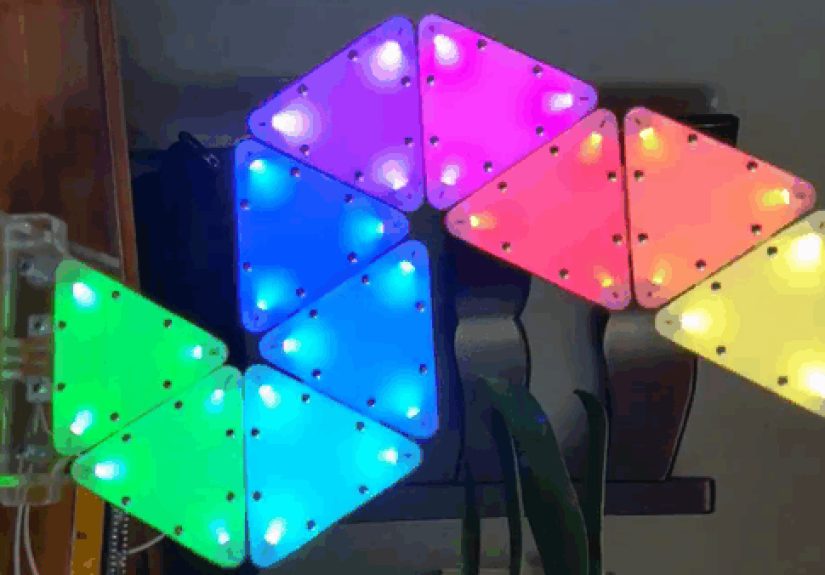
The project behind this idea uses triangular printed circuit boards as self-contained light panels. Each tile carries several side-firing RGB LEDs aimed inward so the light spreads across the face of the triangle instead of beaming straight outward like a tiny interrogation lamp. A translucent acrylic cover softens the light, while the reflective PCB surface helps bounce color around the interior of the tile. The result is bright, clean, geometric illumination that feels more polished than a bare LED board and more interesting than a plain strip light.
What makes the design especially clever is its modularity. These are not isolated light panels. They are meant to connect. Each triangle becomes a node in a larger blinky network, allowing the maker to expand the shape organically. Want a small cluster? Great. Want a wall-sized glowing vine, a branching sculpture, or a futuristic art piece that looks like it escaped from a very stylish spaceship? Also great.
That flexibility matters because rectangular LED matrices, while useful, naturally push you toward grids. Grids are wonderful if you are building signs, scoreboards, pixel art, or something that wants to pretend it is a tiny Times Square billboard. Triangles, by contrast, invite composition. They let you branch, taper, flare, and form irregular shapes that feel more organic and less spreadsheet-like.
Why Triangles Work So Well for Modular LED Art
Triangles are excellent building blocks because they are structurally stable, visually dynamic, and easy to combine into larger patterns. In lighting design, that means you get freedom without chaos. The shape feels mathematically tidy, but it does not trap you in a rigid rectangle. A few connected triangles can resemble leaves, shards, constellations, or folded paper. Add enough of them, and the whole installation starts feeling alive.
That matters for makers who want something that feels custom without becoming a wiring nightmare. A triangular tile system provides repeatability at the component level and variety at the layout level. You manufacture one tile design repeatedly, but the finished arrangement can still look unique. That is a beautiful compromise between engineering sanity and artistic freedom.
It also makes the project more approachable. Once one tile works, the next tile is not a whole new invention. It is a repeat. That kind of repetition is where modular electronics shine. You solve power, data, mounting, and diffusion once, then scale. And because addressable LEDs already support chained control, the visual payoff increases far faster than the design complexity. It is the electronic equivalent of planting one good seed and discovering it has friends.
The Real Star: Clever Interconnects
If the LEDs are the charisma, the interconnects are the brains. Traditional prototypes often use jumper wires and headers because they are convenient, cheap, and readily available. They are also the aesthetic equivalent of leaving your socks on the ceiling fan. They work, but they do not exactly whisper refinement.
In the triangle tile approach, the connectors do much more than move electricity from point A to point B. Small secondary connector boards bridge adjacent triangles. Pressure contacts and plated pads allow signal and power to pass between tiles without requiring dangling wires between every node. Mechanical fasteners then clamp the assembly together so the connection is not just electrical, but structural.
This is a smart design move for several reasons. First, it reduces clutter. The viewer sees a glowing geometric object, not a wiring harness auditioning for a disaster documentary. Second, it improves modularity. A tile can be added, removed, or rearranged with far less rework. Third, it merges the mechanical and electrical design into one integrated system, which is exactly the sort of trick that separates “cool prototype” from “convincing product concept.”
There is also a broader engineering lesson here. Spring-loaded contacts, pogo-style interfaces, castellated edges, and small board-to-board connector strategies are not just maker hacks. They appear across commercial electronics because they save space, simplify assembly, and support repeated mating when designed well. In a project like this, that idea gets distilled into something easy to understand: every connection should earn its place. If a connector can hold, align, and route at the same time, it is doing real work.
How the Blinky Network Comes to Life
The lighting side of the system benefits from individually addressable LEDs, the kind that bundle RGB emitters and driver logic into compact packages. That is why one microcontroller pin can control long chains of pixels. Each LED receives data, uses the portion meant for it, and passes the rest downstream. In practical terms, that lets a tile network behave like a programmable canvas instead of a single on-off lamp.
Once you have that, animation becomes the fun part. A maker can create waves that ripple across the triangular mesh, pulse colors from one edge to another, or make the whole structure breathe like a sleeping robot that dreams in gradients. You can map each tile as a node, each LED as a pixel cluster, and each physical arrangement as a custom topology. Suddenly, this is not just decorative lighting. It is spatial computing with extra sparkle.
That is also where tile layout matters. In tiled LED systems, physical wiring order and visual arrangement are not always the same thing. Anyone who has worked with matrices knows the pain of trying to remember whether your layout is progressive, zigzag, row-major, column-major, upside down, or apparently cursed. Triangle networks add another layer of complexity, but also more visual reward. Good mapping software or careful firmware design turns that challenge into a creative tool.
Diffusion, Hot Spots, and the Battle Against “Three Bright Dots”
Let us talk about one of the eternal truths of LED projects: LEDs are enthusiastic, but not subtle. Left alone, they produce hot spots, glare, and the sort of harsh brightness that makes a prototype look unfinished. That is why diffusion matters so much in a project like this.
By placing translucent acrylic over the tile face and using reflective surfaces inside the assembly, the design spreads the light more evenly across each triangle. It does not just hide the hardware. It upgrades the whole visual experience. The glowing tile starts to look like a luminous object rather than a board with parts on it.
Still, diffusion is a balancing act. Too little, and you see the LEDs as obvious points. Too much, and the tile loses brightness and punch. Distance between the LEDs and the cover panel matters. Surface finish matters. Material thickness matters. Even the angle of the emitters matters. This is where lighting projects stop being only electrical and become material science with prettier photos.
The lesson for builders is simple: never treat the diffuser as an afterthought. In modular LED art, it is part of the circuit’s visual output. The LEDs provide the photons, but the diffuser decides whether those photons look premium or merely loud.
Why This Design Feels Smarter Than a DIY Copycat Wall Light
It is easy to look at triangular LED tiles and think, “Ah yes, a DIY version of expensive consumer wall panels.” That is not wrong, but it is incomplete. The deeper value here is not just saving money. It is understanding how modular lighting can be built from first principles.
Commercial smart light panels often hide their design intelligence behind polished plastic and proprietary connectors. A maker-built triangle tile system exposes the thinking. You can see how power moves. You can understand how data chains. You can modify the connector board, change the acrylic, swap the controller, adjust the number of LEDs, or redesign the geometry entirely. That turns the project from a decorative object into a platform.
And once a project becomes a platform, interesting things happen. You can integrate sensors. You can make the network respond to sound, touch, temperature, or motion. You can build educational kits where every tile teaches a lesson about interconnects and PCB assembly. You can turn the wall art into a visualization device, a game interface, or an interactive installation. Suddenly the triangles are no longer just triangles. They are endpoints in a responsive system.
Design Lessons Makers Can Borrow Right Now
1. Combine functions whenever possible
The connector board in this concept does not just connect. It aligns, bridges, and helps support the assembly. That kind of multifunctional design reduces parts count and makes the whole build feel more intentional.
2. Build one good module, then repeat it
Modular electronics become manageable when the base unit is well designed. A stable tile, a reliable connector, and a repeatable fastening method make scaling far less painful.
3. Treat wiring as part of the product experience
Messy wires are not merely ugly. They complicate assembly, maintenance, and expansion. Cleaner interconnects make projects easier to use and easier to trust.
4. Prototype the optics, not just the circuit
An LED project lives or dies by how it looks in the room. Test diffuser materials early. The prettiest firmware in the world cannot rescue an ugly light path.
5. Design for growth
The best modular systems do not stop at version one. They leave room for more tiles, more effects, and more ambitious layouts without requiring a total redesign.
Where Triangle Blinky Networks Could Go Next
This style of project has plenty of room to evolve. Magnetic connectors could make assembly faster. Smarter tile discovery could help the controller understand layout automatically. Alternate tile sizes could create mixed-scale installations. Edge sensing or capacitive touch could make each node interactive. More advanced controllers could drive richer animation or network multiple tile groups together.
There is also a strong educational angle. Triangle tiles are a wonderful teaching tool because they make abstract electronics concepts visible. Board-to-board interconnects, signal flow, mechanical constraint, diffusion, and modular architecture all become tangible. A student can literally hold one node of the system in their hand and understand how it contributes to the larger whole.
That is part of why the project resonates. It does not just blink. It explains itself. Good maker work often has that quality. It rewards the casual viewer with beauty and rewards the curious builder with ideas.
What It Feels Like to Build and Live With a Triangle Tile Network
There is a particular kind of satisfaction that comes from building a modular light system one triangle at a time. The first tile is mostly nerves. You are checking solder joints, wondering whether the side-firing LEDs are aligned correctly, hoping the acrylic fits, and pretending you are absolutely calm while internally bargaining with the universe. Then the first panel lights up, and suddenly the whole project changes personality. It stops being a PCB and starts being an object.
The second and third tiles are where the experience gets addictive. You connect one panel to another, tighten the hardware, and see the structure begin to spread like a glowing crystal garden. That is the moment the clever interconnects really prove their worth. You are not wrestling a bundle of jumper wires or trying to remember which lead goes where. You are assembling something that feels intentional. The connectors guide the process. The tiles line up. The system starts behaving less like a prototype and more like a kit from the future that forgot to charge you extra.
Once several tiles are joined, the experience becomes half electronics project and half interior design experiment. You start moving pieces around just to see how the composition changes. A straight chain feels sleek. A branching pattern feels organic. A clustered arrangement looks like some sort of science-fiction blossom. The geometry changes the mood more than most people expect. That is one of the real joys of triangle tile networks: they let the builder compose with light the way another person might compose with frames, shelves, or wall art.
Animation adds another layer of delight. Static color is nice, but motion is where the system starts showing off. A slow ripple passing from one tile to the next makes the whole network feel connected. A color wave moving through a forked arrangement makes the shape itself visible in time, not just space. Even simple effects feel richer because the physical layout is irregular. The eye follows the structure. The structure answers back with light.
Living with a finished piece is different from admiring a completed electronics project on a workbench. It changes the room. During the day, it looks like geometric sculpture. At night, it becomes ambient architecture. It can feel playful, calm, dramatic, or downright theatrical depending on the color palette. Warm white makes it look refined. Saturated pinks and blues make it feel like a boutique hotel accidentally became a spaceship. Soft greens and golds can make it feel almost botanical, as if the wall decided to photosynthesize.
There is also an emotional side to the build that many makers recognize. Because the system grows incrementally, every added tile feels like progress you can see. You are not staring at a giant half-finished machine wondering when it will finally reward you. You get little victories all the way through the process. One tile works. Then three. Then eight. Then a whole network starts to glow, and the project seems to thank you for your patience by becoming impossible to ignore.
Perhaps the best part is that the network invites revision. You can rearrange it, expand it, or improve it later. That gives the project a kind of openness that fixed builds do not have. It never feels fully closed. It feels alive, adaptable, and a little mischievous. Which, honestly, is exactly what you want from a blinky network made of triangles and clever interconnects.
Conclusion
Triangle tiles form blinky networks in a way that is both technically smart and visually irresistible. The shape gives the system flexibility. The addressable LEDs give it personality. But the clever interconnects are what elevate the whole idea from flashy DIY décor to thoughtful modular engineering. They reduce clutter, support scaling, and make the physical build as elegant as the light patterns themselves.
That is why this project stands out. It is not just about making LEDs blink in a triangle. It is about designing a lighting system where structure, signal, and style all work together. For makers, artists, educators, and hardware tinkerers, that is a very exciting recipe. Also, let us be honest, it looks cool enough to make visitors ask where you bought it. Telling them you built it yourself is half the fun.