Table of Contents >> Show >> Hide
- What plantar fasciitis is (and why mornings feel personally offensive)
- Before you stretch: a 60-second setup (so it actually works)
- The main event: 7 plantar fasciitis stretches for heel pain relief
- Stretch #1: Seated plantar fascia “toe pull”
- Stretch #2: Towel stretch (classic, reliable, mildly unglamorous)
- Stretch #3: Wall calf stretch (gastrocnemius)
- Stretch #4: Bent-knee calf stretch (soleus)
- Stretch #5: Stair or step stretch (controlled heel drop)
- Stretch #6: Ball roll (gentle plantar fascia release)
- Stretch #7: Seated hamstring + calf stretch (the chain reaction fix)
- A simple daily routine (so you don’t “forget” for three weeks)
- What else helps heel pain relief (besides stretching)
- Mistakes that keep plantar fasciitis hanging around
- When to see a professional
- FAQ
- Real-world experiences related to “7 Plantar Fasciitis Stretches for Heel Pain Relief” (what people commonly notice)
- Conclusion
If your heel pain greets you every morning like a tiny gremlin with a tiny hammer, welcome to the club nobody asked
to join. Plantar fasciitis is one of the most common reasons for sharp heel painespecially those “first steps out of
bed” steps that feel like you’re walking on a LEGO you never owned.
The good news: most cases improve with consistent, boring-but-effective basicsespecially stretching the plantar fascia
and the calf/Achilles complex. The even better news: you can do a lot of this at home with nothing fancier than a towel,
a wall, and the willingness to be mildly inconvenienced for a few minutes a day.
Quick note: This article is educational, not medical advice. If your pain is severe, you can’t bear weight,
you have numbness/tingling, or symptoms aren’t improving, get evaluated by a healthcare professional.
What plantar fasciitis is (and why mornings feel personally offensive)
The plantar fascia is a thick band of connective tissue that runs along the bottom of your foot, from your heel
toward your toes. Its job is part shock absorber, part arch support, part “why am I doing this?” when it gets irritated.
When that tissue is overloadedoften from repetitive stress, tight calves, sudden activity changes, long hours standing,
or unsupportive footwearyou can develop heel pain that’s typically worst after rest (hello, mornings) and may ease a bit
as you move around.
Stretching helps because it targets the two biggest tension “neighbors” that tug on your heel:
(1) the plantar fascia itself and (2) the calf/Achilles. Loosen those up, and you often reduce the pull on
the heel bone where the pain likes to set up camp.
Common “yep, that’s me” triggers
- Suddenly increasing walking, running, or standing time
- Tight calves or Achilles tendons (even if you’ve never felt “tight”)
- Wearing shoes with minimal support or going barefoot on hard floors
- High-impact exercise on hard surfaces
- Higher body weight or major changes in weight
- Foot mechanics like very high arches or flatter arches (not a character flawjust biomechanics)
Before you stretch: a 60-second setup (so it actually works)
1) Warm the tissuedon’t ambush it
Cold tissue stretches like cold taffy: technically possible, emotionally risky. Do 30–60 seconds of gentle ankle circles,
a short walk around the house, or a warm shower first.
2) Use the “good pain” rule
Stretching should feel like a strong pull, not a sharp stab. Aim for discomfort around a 3–4 out of 10.
If it spikes or lingers worse afterward, back off.
3) Hold, don’t bounce
Most programs use 15–30 second holds (sometimes longer), repeated a few times. Gentle and consistent wins.
Bouncing just adds dramaand your plantar fascia already has enough of that.
The main event: 7 plantar fasciitis stretches for heel pain relief
You can do these as a set, or pick your top 3–4 and rotate. If you’re short on time, prioritize:
Plantar fascia stretch + calf stretches (that combo is the heel-pain equivalent of brushing and flossing).
Stretch #1: Seated plantar fascia “toe pull”
Why it helps: Targets the plantar fascia directlyespecially helpful before your first steps in the morning.
- Sit down and cross the sore foot over the opposite knee.
- Grab the base of your toes and gently pull them back toward your shin.
- You should feel a stretch along the arch/bottom of the foot.
- Hold 20–30 seconds. Repeat 2–4 times.
Tip: While holding the stretch, lightly massage the arch with your other hand if it feels good. Skip aggressive diggingyour foot isn’t dough.
Stretch #2: Towel stretch (classic, reliable, mildly unglamorous)
Why it helps: Stretches the calf/Achilles and indirectly reduces strain through the heel and plantar fascia.
- Sit with your leg straight out in front of you (floor or bed works).
- Loop a towel (or strap) around the ball of your foot.
- Keep the knee straight and gently pull the towel toward you.
- Hold 15–30 seconds. Repeat 2–4 times.
Mistake to avoid: Bending the knee too much. If your knee bends, you may miss the calf/Achilles stretch you’re trying to get.
Stretch #3: Wall calf stretch (gastrocnemius)
Why it helps: Tight calves can increase the pull on the heel. This stretch targets the larger calf muscle.
- Face a wall. Place your hands on it for support.
- Step the sore side back, keeping that knee straight and heel on the floor.
- Bend the front knee and gently lean forward until you feel the stretch in the back calf.
- Hold 20–30 seconds. Repeat 2–4 times.
Form cue: Keep your back foot pointed mostly forward. If it turns out too much, the stretch can drift away from where you need it.
Stretch #4: Bent-knee calf stretch (soleus)
Why it helps: The deeper calf muscle (soleus) also feeds into Achilles tension. If your heel pain persists despite “regular” calf stretching, this one is often the missing piece.
- Same wall setup as Stretch #3, but this time slightly bend the back knee.
- Keep the back heel down and lean forward gently.
- You should feel the stretch lower in the calf, closer to the Achilles.
- Hold 20–30 seconds. Repeat 2–4 times.
Pro tip: If your heel lifts, you’re negotiating with gravity instead of stretching. Move closer to the wall and try again.
Stretch #5: Stair or step stretch (controlled heel drop)
Why it helps: A strong calf stretch using body weightgreat for people who “don’t feel it” against the wall.
- Stand on a step with the balls of your feet on the edge and hold a railing.
- Slowly lower your heels until you feel a stretch in the calf/Achilles.
- Hold 15–30 seconds, then return to neutral.
- Repeat 2–4 times.
Safety note: Keep it controlled. No bouncing. If you have balance issues, skip this and stick to the wall stretches.
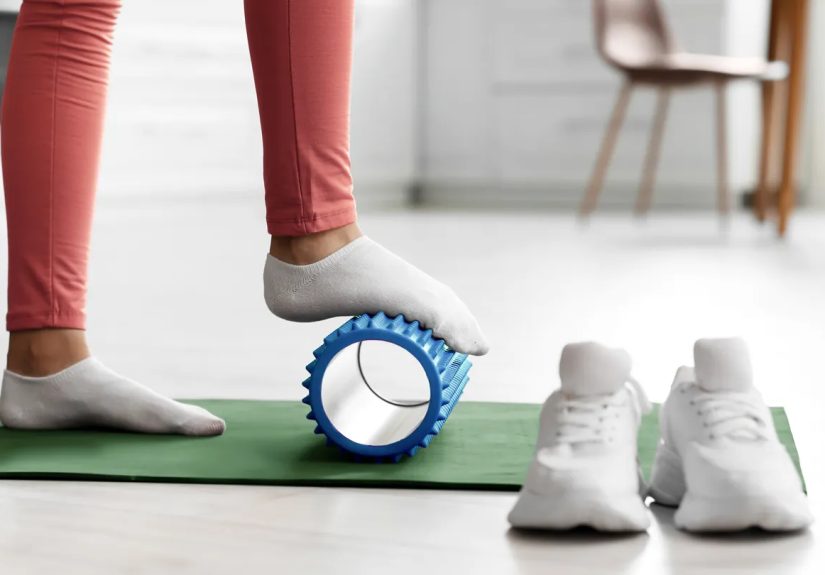
Stretch #6: Ball roll (gentle plantar fascia release)
Why it helps: This isn’t a “stretch” in the traditional senseit’s more of a soft-tissue release. Many people find it reduces that tight, glued-down feeling under the arch.
- Sit in a chair and place a tennis ball, lacrosse ball, or frozen water bottle under your foot.
- Slowly roll from the ball of the foot to the heel and back.
- Spend extra time on tender areas, but keep pressure tolerable.
- Roll for 1–2 minutes, once or twice a day.
Rule: “Hurts so good” is fine. “Hurts so bad I’m seeing colors” is not.
Stretch #7: Seated hamstring + calf stretch (the chain reaction fix)
Why it helps: Tight hamstrings and calves can alter foot mechanics and increase stress through the heel. This stretch targets the whole back-of-the-leg chain.
- Sit on the floor with one leg straight, the other bent comfortably.
- Loop a strap/towel around the ball of the straight leg’s foot.
- Keep your back tall and gently pull your toes toward you while hinging slightly forward at the hips.
- Hold 20–30 seconds. Repeat 2–3 times per side.
Check: You should feel this in the hamstring and calfnot as a sharp pull in the heel. If it lights up your heel pain, reduce intensity.
A simple daily routine (so you don’t “forget” for three weeks)
Morning (2–4 minutes)
- Stretch #1 (toe pull): 2–4 holds
- Stretch #2 (towel stretch): 2–4 holds
- Optional: Stretch #6 (ball roll): 1 minute
Midday (3–5 minutes)
- Stretch #3 (wall calf): 2–4 holds
- Stretch #4 (bent-knee calf): 2–4 holds
Evening (3–6 minutes)
- Stretch #5 (step stretch) or repeat wall stretches
- Stretch #7 (hamstring + calf): 2–3 holds
- Optional: Stretch #6 (ball roll): 1–2 minutes
Consistency beats intensity. If you do “a little” every day, you usually win. If you do “a lot” once a week,
your plantar fascia will file a complaint with HR.
What else helps heel pain relief (besides stretching)
Supportive footwearyes, even at home
One of the most common reasons plantar fasciitis won’t calm down: people stretch faithfully… then walk barefoot on hard floors
like they’re auditioning to be a penguin. Choose supportive shoes or supportive house sandals indoors.
Ice (strategic, not dramatic)
If symptoms flare after activity, try 10–15 minutes of ice on the heel or rolling on a frozen bottle.
It’s not glamorous, but neither is hobbling to the coffee maker.
Activity tweaks
You usually don’t need total restjust smarter loading. Temporarily reduce hills, speed work, long walks on hard surfaces,
and high-impact workouts. Swap in cycling, swimming, or strength training while you calm things down.
Night splints (optional, but sometimes a game-changer)
Some people get big relief by keeping the foot gently stretched overnight, which may reduce that “first steps” pain.
If mornings are your worst time, this can be worth discussing with a clinician.
Mistakes that keep plantar fasciitis hanging around
- Only stretching when it hurts. Most routines work better when done daily, not randomly.
- Stretching too aggressively. More force isn’t more healing.
- Ignoring calf tightness. If you only stretch the foot, you may miss the main driver.
- Going barefoot on hard floors. Your heel doesn’t need “tough love.”
- Keeping the same training load. You can’t out-stretch a workload problem.
When to see a professional
Get checked out if you have any of the following:
- Pain that’s severe, worsening, or persists despite a few weeks of consistent home care
- Numbness, tingling, spreading pain, or significant swelling
- Inability to bear weight, or pain after an acute injury
- Diabetes, circulation issues, or other conditions that make foot problems higher-risk
A physical therapist or clinician can confirm the diagnosis, tailor exercises, address footwear/orthotics, and help you load the tissue safely.
Sometimes what feels like plantar fasciitis can be something else (like nerve irritation or a stress injury), and getting the label right matters.
FAQ
How often should I do plantar fasciitis stretches?
Many common programs use stretching 2–3 times per day, especially early on. If that’s unrealistic, do once daily consistentlythen build up.
Should I stretch before getting out of bed?
If mornings are brutal, yes. Doing Stretch #1 and/or #2 before your first steps often helps reduce that initial pain spike.
How long does it take to feel better?
Some people feel improvement within a couple weeks of consistent stretching and footwear changes, but full recovery can take longer.
If you’re not trending better, don’t just “power through”get guidance.
Real-world experiences related to “7 Plantar Fasciitis Stretches for Heel Pain Relief” (what people commonly notice)
When people start working on plantar fasciitis, the first thing they usually discover is that healing is less like flipping a switch
and more like teaching a stubborn toddler to share. Progress tends to come in patterns: a few good days, one confusing flare-up,
then a slightly better baseline.
The morning reality check. A very common experience is that the first steps still feel sharp even after you’ve “been stretching.”
That doesn’t always mean the stretches aren’t working. It often means the tissue is still sensitive after being shortened overnight.
People who add a quick pre-stand routinelike the seated toe pull (Stretch #1) or towel stretch (Stretch #2)often report that the pain
goes from “why is my foot betraying me?” to “okay, I can function.”
The surprise calf connection. Another frequent “aha” moment: the foot might hurt, but the calf is secretly driving the situation.
Many people don’t think they have tight calves until they do the wall stretch (Stretch #3) correctly and suddenly realize they’ve been walking
around with ankles that move like rusty door hinges. When people commit to both calf variationsstraight-knee and bent-knee (Stretches #3 and #4)
they often notice a reduction in that pulling sensation at the heel during long standing or after workouts.
The footwear plot twist. Stretching helps, but people often describe the biggest day-to-day improvement coming from a boring change:
wearing supportive shoes inside the house. A lot of heel pain flares are linked to walking barefoot on tile, hardwood, or concrete-like surfaces.
Many people are shocked that they can do all the stretches and still stay irritated if they spend the rest of the day “raw-dogging” hard floors.
Once they switch to supportive indoor footwear, the stretches seem to “stick” better.
The good kind of soreness. It’s common to feel mild soreness in the arch or calf after starting a routineespecially the step stretch
(Stretch #5) or ball roll (Stretch #6). People often do best when they treat soreness as feedback, not failure:
keep the intensity gentle, avoid bouncing, and aim for “I feel worked” rather than “I feel injured.”
If a technique leaves the heel angrier for the next 24 hours, backing off pressure usually helps.
The setback trap. A classic story goes like this: the pain improves, someone celebrates by doing a long walk, a hill workout, or a run,
and the heel pain returns like it never left. This isn’t moral punishmentit’s load management. Many people learn that the sweet spot is
gradually returning to activity while keeping daily stretching steady. The hamstring + calf stretch (Stretch #7) often becomes a favorite during
this “return to normal” phase because it helps the whole chain feel less tight and reactive.
The mental side. People also report that plantar fasciitis is oddly draining because it’s not dramaticjust persistent.
The most successful routines tend to be short and automatic: a couple stretches in the morning, a wall stretch break midday,
and a wind-down set at night. It’s not exciting, but it’s the kind of boring that gets you your life back.
Conclusion
Plantar fasciitis can be painfully stubborn, but it’s also surprisingly responsive to the right basics: stretch the plantar fascia,
loosen the calves/Achilles, manage activity load, and support the foot with decent footwear. Pick a routine you can actually do,
stay consistent, and let gradual progress be the goal.