Table of Contents >> Show >> Hide
- What Does It Mean to Divide Square Roots?
- Way 1: Divide Square Roots Using the Quotient Rule
- Way 2: Simplify Each Square Root Before Dividing
- Way 3: Rationalize the Denominator
- Way 4: Divide Square Roots with Variables
- How to Choose the Best Method
- Common Mistakes When Dividing Square Roots
- Practice Problems
- Experience-Based Tips for Learning How to Divide Square Roots
- Conclusion
Dividing square roots can look like algebra decided to wear a tiny roof over its head and make everyone nervous. The good news? Square roots follow patterns, and once you learn those patterns, the whole thing becomes much less mysterious. Whether you are simplifying homework problems, preparing for a test, or trying to remember why your teacher keeps saying “rationalize the denominator,” this guide will walk you through the four most useful ways to divide square roots.
The main idea is simple: square roots can often be divided, simplified, rewritten, or cleaned up using a few reliable rules. You do not need to memorize a mountain of formulas. You just need to understand what the radical sign means, how fractions work, and when to simplify before or after dividing. Think of this as giving your radical expressions a tidy haircut.
In this article, you will learn how to divide square roots using the quotient rule, how to simplify before dividing, how to rationalize denominators, and how to handle square roots with variables. Each method includes examples, explanations, and practical tips so the steps feel logical instead of like math magic pulled from a suspiciously dusty hat.
What Does It Mean to Divide Square Roots?
A square root asks, “What number multiplied by itself gives this value?” For example, the square root of 25 is 5 because 5 × 5 = 25. When you divide square roots, you are comparing or simplifying two radical values. A basic example is:
√36 ÷ √9 = 6 ÷ 3 = 2
That one is friendly because both square roots are perfect squares. But algebra is not always that polite. Sometimes you see expressions like:
√48 ÷ √3
At first glance, this may look less charming. But using the right rule, you can combine the square roots:
√48 ÷ √3 = √(48 ÷ 3) = √16 = 4
That is the heart of dividing square roots: when the roots have the same index, you can often divide the numbers inside the radical and then simplify.
Way 1: Divide Square Roots Using the Quotient Rule
The most direct way to divide square roots is to use the quotient rule for radicals. The rule says that for nonnegative numbers, and as long as the denominator is not zero:
√a ÷ √b = √(a/b)
In plain English: if two square roots are being divided, you can place the division inside one square root. This method is especially helpful when the numbers divide evenly.
Example 1: A Clean Division
Simplify:
√75 ÷ √3
Use the quotient rule:
√75 ÷ √3 = √(75/3)
Now divide inside the radical:
√(75/3) = √25
Finally, simplify:
√25 = 5
So, √75 ÷ √3 = 5.
Example 2: When the Result Is Still a Radical
Simplify:
√50 ÷ √2
Combine the radicals:
√(50/2) = √25
Simplify:
√25 = 5
Now try one that does not become a perfect square right away:
√45 ÷ √5 = √(45/5) = √9 = 3
The quotient rule often turns a scary-looking expression into a very manageable one. It is like discovering the monster under the bed is actually just a laundry pile.
When to Use This Method
Use the quotient rule when both the numerator and denominator are square roots and the radicands divide nicely. This method works best when the two radicals have the same index. Since we are focusing on square roots, the index is 2, even though it is usually not written.
Way 2: Simplify Each Square Root Before Dividing
Sometimes dividing square roots is easier if you simplify each radical first. This is especially useful when the radicands contain perfect square factors such as 4, 9, 16, 25, 36, 49, 64, or 100.
The goal is to break the number inside the square root into factors, pull out perfect squares, and then divide what remains.
Example 1: Simplify First, Then Divide
Simplify:
√72 ÷ √8
You could use the quotient rule immediately:
√(72/8) = √9 = 3
That works beautifully. But you can also simplify each radical first:
√72 = √(36 × 2) = 6√2
√8 = √(4 × 2) = 2√2
Now divide:
(6√2) ÷ (2√2) = 6/2 = 3
The √2 terms cancel because they appear in both the numerator and denominator.
Example 2: Simplifying Helps You See the Answer
Simplify:
√98 ÷ √2
Simplify the numerator:
√98 = √(49 × 2) = 7√2
The denominator is already:
√2
Now divide:
7√2 ÷ √2 = 7
This method is useful because it teaches you to recognize hidden perfect squares. Once you spot them, radicals become much less dramatic.
Common Perfect Squares to Memorize
You do not need to memorize every square number in the universe, but knowing the common ones helps a lot. The most useful perfect squares include:
- 1 = 1 × 1
- 4 = 2 × 2
- 9 = 3 × 3
- 16 = 4 × 4
- 25 = 5 × 5
- 36 = 6 × 6
- 49 = 7 × 7
- 64 = 8 × 8
- 81 = 9 × 9
- 100 = 10 × 10
These numbers are your radical simplification shortcuts. They are the VIP guests at the algebra party.
Way 3: Rationalize the Denominator
Rationalizing the denominator means rewriting a fraction so there is no square root in the denominator. In many math classes, final answers are expected to have rational denominators. In other words, the bottom of the fraction should not be wearing a radical hat.
For example, the expression:
1/√2
is often rewritten as:
√2/2
Both expressions have the same value, but the second form has a rational denominator.
Example 1: Rationalizing a Simple Radical Denominator
Simplify:
5/√3
To rationalize the denominator, multiply the top and bottom by √3:
5/√3 × √3/√3 = 5√3/3
Why does this work? Because:
√3 × √3 = 3
So the denominator becomes a regular number.
Example 2: Dividing One Square Root by Another
Simplify:
√5/√2
Multiply the numerator and denominator by √2:
√5/√2 × √2/√2 = √10/2
So:
√5 ÷ √2 = √10/2
This is a clean final answer because the denominator is 2, not √2.
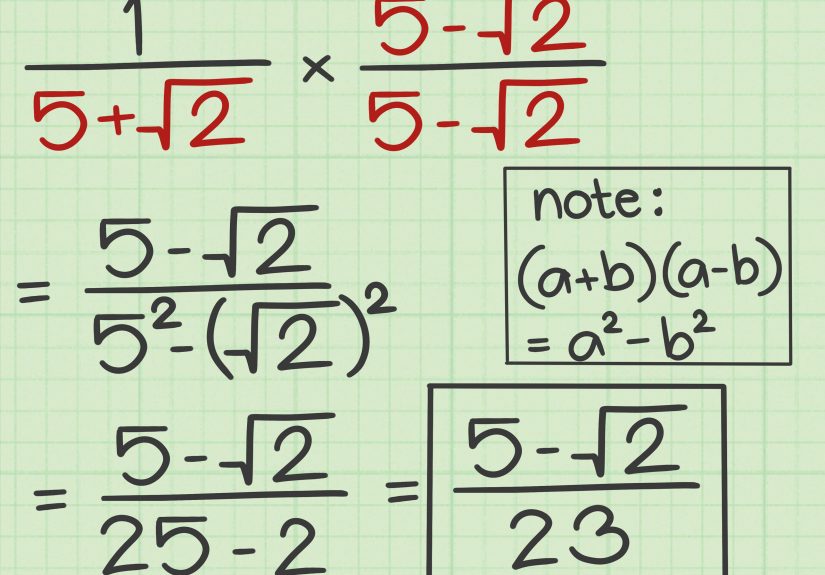
Example 3: Rationalizing with a Binomial Denominator
Sometimes the denominator has two terms, such as:
1/(3 + √2)
In this case, you use the conjugate. The conjugate of 3 + √2 is 3 – √2. Multiply the top and bottom by that conjugate:
1/(3 + √2) × (3 – √2)/(3 – √2)
The denominator becomes:
(3 + √2)(3 – √2) = 9 – 2 = 7
The numerator becomes:
3 – √2
So the simplified result is:
(3 – √2)/7
The conjugate method is one of those algebra tools that seems fancy until you use it a few times. Then it becomes satisfyingly predictable, like a vending machine that actually gives you the snack you paid for.
Way 4: Divide Square Roots with Variables
Dividing square roots becomes more interesting when variables enter the scene. The same basic rules still apply, but you must be careful with simplification and restrictions. In many algebra problems, variables under square roots are assumed to represent nonnegative values unless otherwise stated.
Example 1: Divide Radicals with the Same Variable
Simplify:
√(18x) ÷ √(2x)
Use the quotient rule:
√(18x / 2x)
Cancel the common factor:
√9 = 3
So:
√(18x) ÷ √(2x) = 3
This works as long as the denominator is not zero. Since the denominator contains √(2x), x cannot be 0 in the original expression.
Example 2: Simplify Variable Radicals Before Dividing
Simplify:
√(50x²) ÷ √2
First simplify the numerator:
√(50x²) = √(25 × 2 × x²) = 5x√2
Now divide:
5x√2 ÷ √2 = 5x
So the simplified answer is:
5x
In advanced algebra, you may need absolute value signs when simplifying even powers, such as √x² = |x|. However, many classroom problems specify or assume that variables are nonnegative, which allows √x² to simplify to x.
Example 3: Dividing Expressions with Different Variables
Simplify:
√(12a²b) ÷ √3b
Use the quotient rule:
√(12a²b / 3b)
Cancel common factors:
√(4a²)
Simplify:
2a
So:
√(12a²b) ÷ √3b = 2a
Again, this assumes the variables are positive or nonnegative where needed. Always check the original denominator so you do not accidentally divide by zero.
How to Choose the Best Method
There is no single “best” method for every square root division problem. The smartest approach depends on the shape of the expression. If both radicals divide neatly, use the quotient rule. If you see obvious perfect square factors, simplify first. If the denominator contains a square root, rationalize it. If variables are involved, combine the rules carefully and check restrictions.
Here is a quick decision guide:
- If the radicands divide evenly: Use the quotient rule.
- If each radical has perfect square factors: Simplify first.
- If a radical remains in the denominator: Rationalize the denominator.
- If variables appear: Simplify carefully and watch for zero denominators.
Many problems can be solved more than one way. That is not a mistake; it is actually good news. Algebra often gives you multiple roads to the same answer. Some roads are just less bumpy.
Common Mistakes When Dividing Square Roots
Mistake 1: Dividing Only One Part of the Radical
A common error is dividing part of a radicand while ignoring the rest. For example, if you see √(48/3), you must divide the full expression inside the radical, not just whichever number looks convenient. The entire radicand matters.
Mistake 2: Forgetting to Simplify the Final Answer
If your answer is √20, you are probably not done. Since 20 = 4 × 5, you can simplify:
√20 = √(4 × 5) = 2√5
Always check whether the number under the radical contains a perfect square factor.
Mistake 3: Leaving a Radical in the Denominator
Depending on your class or test instructions, an answer like 4/√5 may not be considered fully simplified. Rationalize it:
4/√5 × √5/√5 = 4√5/5
Mistake 4: Canceling Across Addition or Subtraction
You can cancel common factors in multiplication and division, but be careful with addition or subtraction. For example, you cannot simply cancel √2 from an expression like:
(√2 + 3)/√2
The numerator has two terms, and only one of them contains √2. Algebra is picky about this, and frankly, it has a point.
Practice Problems
Try these examples to strengthen your skills:
- √80 ÷ √5
- √108 ÷ √3
- 6/√7
- √(45x²) ÷ √5
- √11/√3
Answers
- √80 ÷ √5 = √16 = 4
- √108 ÷ √3 = √36 = 6
- 6/√7 = 6√7/7
- √(45x²) ÷ √5 = √(9x²) = 3x, assuming x is nonnegative
- √11/√3 = √33/3
Experience-Based Tips for Learning How to Divide Square Roots
After working with square roots for a while, one thing becomes clear: the hard part is rarely the division itself. The hard part is deciding which move to make first. Students often stare at a radical expression like it is a locked door, when really it is more like a messy closet. You do not need a crowbar. You need organization.
The first helpful habit is to look for perfect squares before doing anything else. Numbers like 4, 9, 16, 25, 36, and 49 are clues. If you see √72, do not panic. Ask yourself, “Does 72 contain a perfect square factor?” Yes, it does: 36 × 2. That means √72 becomes 6√2. Once you train your eye to catch these factors, simplifying radicals gets much faster.
Another useful habit is to compare the numerator and denominator before simplifying. For example, in √98 ÷ √2, you could simplify √98 first. But if you notice that 98 divided by 2 equals 49, the quotient rule gives you √49 immediately, which equals 7. That is a beautiful shortcut. Math does not always hand out gifts, so when it does, accept politely.
When rationalizing denominators, remember that you are not changing the value of the expression. You are multiplying by a clever form of 1. For example, √3/√3 equals 1, so multiplying 5/√3 by √3/√3 keeps the value the same while cleaning up the denominator. This idea matters because rationalizing can feel like a random ritual at first. It is not random. It is just a way to rewrite the answer in a more standard form.
One experience that helps many learners is checking answers with decimals after simplifying. Suppose you simplify √5/√2 to √10/2. If you are unsure whether the two expressions are equal, approximate them. √5 is about 2.236, and √2 is about 1.414, so √5/√2 is about 1.581. √10 is about 3.162, and 3.162/2 is about 1.581. Same value. This quick decimal check can build confidence, especially when your answer looks different from the original problem.
It also helps to write out more steps than you think you need. Many algebra mistakes happen when students try to do three things at once in their heads. Dividing radicals, simplifying factors, and rationalizing denominators are all manageable separately. Stack them on top of each other too quickly, and suddenly the problem turns into algebra soup. Write the quotient rule step. Then simplify the fraction inside the radical. Then reduce the radical. Then rationalize if needed.
Finally, do not treat square roots as decorations. The radical sign has meaning. It applies to everything underneath it, and that little horizontal bar matters. A problem like √(36/4) is not the same as √36/4. The first equals √9, or 3. The second equals 6/4, or 3/2. Parentheses and radical bars are tiny details with big consequences, like forgetting one ingredient in a cake and discovering you made a pancake instead.
The best way to become comfortable with dividing square roots is to practice a mix of problem types. Do some that use the quotient rule. Do some that require simplifying first. Do some with denominators that need rationalizing. Do a few with variables. Over time, you will start recognizing patterns automatically. Once that happens, square root division stops feeling like a trick and starts feeling like a tool.
Conclusion
Dividing square roots becomes much easier when you know which strategy to use. The quotient rule helps you combine radicals into one square root. Simplifying first can reveal perfect square factors and make the division cleaner. Rationalizing the denominator gives your final answer a standard form. Variable expressions follow the same rules, but they require extra attention to restrictions and assumptions.
The big takeaway is this: do not rush. Look for perfect squares, reduce fractions when possible, and clean up the denominator if your teacher or assignment expects it. With practice, dividing square roots becomes less like decoding secret algebra symbols and more like following a reliable recipe. And unlike some recipes, this one does not require preheating anything.