Table of Contents >> Show >> Hide
- What “Quickly” Really Means in a Tight Turn
- Why Tight Turns Feel Harder Than They Should
- Way #1: Use a Slow-In, Smooth-Out Setup
- Way #2: Use Proper Steering Technique at Low Speed
- Way #3: Use a Three-Point Turn or Controlled U-Turn When One Sweep Will Not Fit
- How Vehicle Size Changes Everything
- Tips That Make Tight Turns Easier
- Mistakes That Instantly Make a Tight Turn Worse
- Real-World Examples of Tight Turns
- of Practical Experience: What Drivers Learn From Real Tight Turns
- Conclusion
If you have ever tried to swing into a cramped driveway, snake through a parking garage, or pull a neat U-turn without looking like you are wrestling an angry shopping cart, you already know the truth: tight turns are less about speed and more about precision. The word “quickly” in this context should never mean “fast and reckless.” It should mean efficient, smooth, and confident.
That is the sweet spot. A tight turn done well feels almost effortless. A tight turn done badly feels like you are one second away from curbing a wheel, kissing a traffic cone, or inventing a brand-new parking-lot incident report. The good news is that this is a skill, not a magic trick. With the right setup, steering technique, and judgment, most drivers can make tight turns more cleanly and with less hesitation.
In this guide, we will break down three safe ways to make a tight turn quickly in a car, explain when to use each one, and show you how to avoid the classic mistakes that make these maneuvers awkward or risky. Think of this as the difference between slicing through a turn like a pro and turning your car into a confused refrigerator on wheels.
What “Quickly” Really Means in a Tight Turn
Before getting into the techniques, let’s clear something up. A tight turn quickly in a car should mean completing the maneuver efficiently with minimal correction, not charging into the turn at high speed. In real driving, the fastest safe turn is usually the one that starts with proper positioning, controlled steering, and good visibility.
Drivers often waste time by doing one of two things: turning too early or trying to force the car around without giving it enough room. That leads to mid-turn braking, extra steering corrections, or the dreaded backup shuffle. A better approach is to slow down early, set the car up well, turn smoothly, and exit cleanly.
This matters in everyday situations like:
- Turning into a narrow driveway
- Making a U-turn where it is legal and safe
- Navigating a parking garage ramp
- Entering a tight parking-lot aisle
- Making a three-point turn on a quiet street
Why Tight Turns Feel Harder Than They Should
Tight turns challenge three things at once: your steering timing, your sense of space, and your patience. Modern vehicles also vary a lot. A small sedan may pivot neatly, while a long SUV may need more room than your brain guessed in the moment. Add pedestrians, curbs, poles, or oncoming traffic, and suddenly a simple turn feels like a geometry test with consequences.
The most common reasons drivers struggle with tight turns include:
- Entering too fast
- Turning the wheel too early
- Not using the full available space
- Looking too close to the hood instead of through the turn
- Forgetting about blind spots, cyclists, or pedestrians
- Trying to do a one-sweep turn when a multi-point turn is safer
Once you fix those habits, tight turns become much more manageable.
Way #1: Use a Slow-In, Smooth-Out Setup
The basic idea
The first and most useful technique is the simplest: slow down before the turn, position the car correctly, and follow a smooth arc. This is the best method for most everyday right turns, left turns, driveway entries, and parking-lot corners.
Many drivers think the secret to a quick tight turn is aggressive steering. It is not. The real secret is setup. When your approach is clean, the turn itself becomes easy.
How to do it
- Scan the area early. Check mirrors, the road ahead, pedestrians, cyclists, and any curb or pillar that could tighten the turn.
- Signal in advance so other drivers know what you are doing.
- Reduce speed before you begin turning. Finish most of your braking while the wheel is still mostly straight.
- Position your vehicle to maximize turning space. For a right turn, stay properly in your lane and avoid hugging too tightly too soon. For a left turn, stay centered and do not cut across too early.
- Look where you want the car to go, not at the thing you are afraid of hitting.
- Turn in smoothly, then gently accelerate once the car is pointed where it needs to go.
Why it works
This method reduces unnecessary steering correction. By slowing first and steering second, you keep the tires more settled and the car easier to control. It also helps prevent understeer in slippery conditions and reduces the chance of clipping a curb.
Best situations for this method
- Turning into a residential street
- Entering a driveway
- Taking a tight corner in a parking lot
- Approaching a garage entrance
Common mistake to avoid
The biggest mistake is turning too early. That is how drivers swing wide, clip inside corners, or drift into the wrong lane. Let the car travel far enough before you rotate the wheel. In plain English: do not start dancing before the music does.
Way #2: Use Proper Steering Technique at Low Speed
The basic idea
The second way to make a tight turn quickly in a car is to use the steering wheel correctly. This sounds obvious, but it is where many low-speed turns fall apart. Sloppy hand placement creates jerky inputs. Jerky inputs create messy turns. Messy turns create that little wave of panic no one enjoys.
For low-speed tight turns, controlled steering matters more than raw speed. A good steering technique lets you reach a tighter angle cleanly without overcorrecting halfway through.
How to do it
- Start with both hands in a balanced position, usually around 9 and 3 or slightly lower.
- As you enter the turn, use a smooth push-pull or controlled hand-over-hand motion, depending on how much steering angle is needed.
- Do not yank the wheel suddenly to full lock unless the situation truly requires the smallest possible turning radius.
- Keep your eyes moving through the turn and let your hands follow that visual path.
- As the car straightens, unwind the wheel smoothly instead of letting it snap back uncontrolled.
Why it works
At low speed, the steering wheel is your main tool for shaping the turn. A driver who feeds the wheel smoothly can often make a tighter turn with less drama than someone who rushes the input. You are not trying to impress the steering column. You are trying to place the car accurately.
When to use full steering lock
Full steering lock can help in very tight spaces, such as a cramped parking garage or a narrow driveway entrance, but it should still be used gently and at very low speed. If you crank the wheel too soon or too hard, the car may pivot awkwardly and force a correction on exit.
Best situations for this method
- Parking garages
- Narrow residential driveways
- Compact urban turns
- Sharp turns in lots with painted islands or concrete curbs
Common mistake to avoid
Do not stare at the curb. Drivers tend to steer toward what they fixate on. If your eyes lock onto the curb, your car may head toward it like it just received a very bad idea. Look through the turn instead.
Way #3: Use a Three-Point Turn or Controlled U-Turn When One Sweep Will Not Fit
The basic idea
Sometimes the smartest way to make a tight turn quickly is to stop pretending the car can do it in one move. That is where the three-point turn or a legal, well-planned U-turn comes in. A quick multi-point maneuver is still faster than a bad one-sweep attempt followed by embarrassment, reversing, and silent self-judgment.
If the space is too tight for one smooth arc, use the road space you have and turn the car around deliberately.
How to do a three-point turn safely
- Choose a quiet, low-traffic area with good visibility.
- Signal and check mirrors and blind spots.
- Pull toward the side of the road and stop.
- Turn the wheel fully toward the opposite side and move forward slowly across the roadway.
- Stop before the curb or edge.
- Shift to reverse, check all directions again, and back up while steering the opposite way.
- Stop once the car is lined up to move forward in the new direction.
- Shift to drive and continue safely.
How to do a controlled U-turn
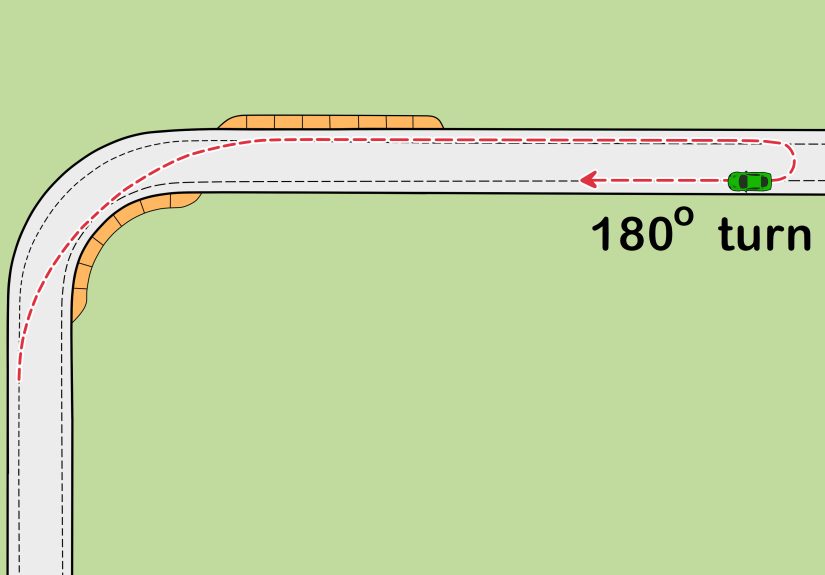
If U-turns are legal where you are and visibility is clear, a controlled U-turn can be efficient. Approach slowly, judge the available turning radius, check for traffic and pedestrians, and complete the turn only if your vehicle can clear the space without forcing other drivers to brake or swerve.
Best situations for this method
- Dead-end streets
- Quiet residential roads
- Missed turns where a safe turnaround point is available
- Spaces where one-sweep turning is unrealistic
Common mistake to avoid
Never force a hurried U-turn in traffic just because you missed a street or an entrance. That is how a “quick fix” turns into a terrible decision. If the area is busy, keep going and turn around somewhere safer.
How Vehicle Size Changes Everything
Not all cars make tight turns equally. Compact cars generally have an easier time in narrow spaces, while long-wheelbase SUVs, trucks, and large sedans need more room. If you switch vehicles often, do not assume your usual turn timing will work the same way every time.
A few examples:
- Small sedan: Easier to rotate in parking lots and narrow neighborhood streets.
- Mid-size SUV: Better visibility, but often needs a wider approach.
- Pickup truck: Requires more space and more patience, especially in older parking garages.
- Electric vehicles: May feel quick off the line, so gentle throttle use is especially important during low-speed turns.
The lesson is simple: know your turning radius, and do not let confidence outrun geometry.
Tips That Make Tight Turns Easier
Look far enough ahead
Your hands tend to follow your eyes. Look through the turn, not just at the space immediately in front of the hood.
Brake first, then turn
Finishing most of your braking before the turn keeps the car stable and makes the steering more predictable.
Use all the legal space you have
A slightly better approach angle can make a huge difference. Just stay in your lane and avoid cheating into another lane or shoulder.
Go slower in rain or on slick pavement
A turn that feels easy on dry pavement may feel much tighter in wet conditions. Smooth inputs become even more important.
Do not forget pedestrians and cyclists
Tight turns often happen at intersections, parking-lot entrances, and driveways, which are exactly where people can appear suddenly. Always check twice.
Mistakes That Instantly Make a Tight Turn Worse
- Entering the turn too fast
- Accelerating in the middle of the turn
- Turning the wheel too early
- Letting the wheel spin back uncontrolled
- Ignoring blind spots
- Trying to “save time” with a risky U-turn
- Choosing pride over a perfectly normal three-point turn
That last one matters. There is no trophy for forcing one sweeping turn in a space that clearly wants two or three motions. Calm beats flashy every time.
Real-World Examples of Tight Turns
Example 1: The narrow coffee shop driveway
You are approaching a driveway entrance that sits just after a curb cut with almost no extra room. The best move is a slow approach, a wide enough setup within your lane, and a smooth low-speed turn with steady steering. If you dive in too early, your rear wheel may meet the curb like it owes it money.
Example 2: The downtown parking garage
The ramp is tight, visibility is not great, and everyone behind you appears to be late for something dramatic. Stay calm. Slow down, use deliberate steering, and look through the ramp. A smooth turn is faster than a rushed correction.
Example 3: The missed street
You pass your turn, feel annoyed, and spot a possible chance to whip around. Bad mood, meet bad decision. The smarter move is to continue to a safer spot and use a legal U-turn or three-point turn with full visibility.
of Practical Experience: What Drivers Learn From Real Tight Turns
Drivers who get good at tight turns usually learn the same lesson the hard way: the turn itself is rarely the problem. The approach is. In real-world driving, people often blame the car, the space, or the road design when the real issue was that they entered too fast, looked too close, or started steering too early. Once those habits change, tight turns become much less stressful.
A common experience happens in parking lots. A driver sees an open aisle, turns in with a little too much speed, and then has to brake mid-turn because the angle tightened more than expected. The car is still perfectly capable of making the turn, but the rushed entry makes everything feel clumsy. After a few repetitions, most drivers realize that arriving one second slower saves five seconds of correction. That is the kind of trade that wins every day.
Another frequent experience happens with larger vehicles. Someone who is comfortable in a compact car borrows a crossover, SUV, or pickup and suddenly discovers that their normal driveway turn is not so normal anymore. They begin the turn where they always do, but the bigger vehicle needs more room. The result is a wider swing, a sharper correction, or a backup to reset the angle. It is not a sign of poor driving. It is a reminder that every vehicle has its own footprint, and smart drivers adapt quickly.
Urban driving teaches a different lesson: visibility is part of turning skill. In city streets, a tight turn is not just about the curb. It is about pedestrians stepping into crosswalks, cyclists moving along the right side, delivery vehicles blocking sight lines, and drivers behind you who may be impatient. Experienced drivers learn to treat tight turns like mini decision zones. They slow down, scan early, and give themselves a split second more than they think they need. That tiny pause often prevents the big mistake.
Bad weather adds another layer. A turn that feels easy on dry pavement may feel completely different in rain. Drivers who have experienced this usually become much smoother afterward. They brake earlier, avoid abrupt wheel input, and wait longer before getting back on the accelerator. The turn may feel slower, but it is actually cleaner and safer, which is the whole point.
Perhaps the most useful real-world experience is learning when not to force a one-shot turn. Good drivers stop seeing three-point turns as a failure. They see them as a tool. On a quiet street, a well-executed three-point turn is often the fastest practical way to reverse direction without stress. The same is true of a controlled, legal U-turn in the right place. With experience, drivers stop trying to be clever and start trying to be precise.
In the end, tight turns reward calm more than courage. The drivers who make them look easy are usually not the boldest drivers. They are the ones who prepare early, steer smoothly, and accept what the space allows. That is what real skill looks like behind the wheel.
Conclusion
If you want to make a tight turn quickly in a car, remember this: quick does not mean rushed. It means efficient. The three safest and most practical methods are to set the turn up properly, use smooth low-speed steering, and choose a three-point turn or legal U-turn when one sweep is not enough.
That combination keeps your car more controlled, your turns cleaner, and your stress level much lower. It also keeps your wheels off curbs, your tires happier, and your dignity intact in parking lots everywhere. Which, honestly, is a pretty solid driving goal.