Table of Contents >> Show >> Hide
- Why Ammonia Matters So Much in a Fish Tank
- Signs Your Tank May Have an Ammonia Problem
- Method 1: Use Ammonia Test Strips for a Quick Check
- Method 2: Use a Liquid Ammonia Test Kit for Better Accuracy
- Method 3: Use an In-Tank Ammonia Alert Badge for Continuous Monitoring
- Which Method Is Best for Your Fish Tank?
- How Often Should You Check Ammonia?
- How to Read Ammonia Results Without Panicking
- Common Mistakes When Checking Ammonia
- of Real-World Experience and Practical Lessons
- Final Thoughts
If your fish could talk, they would probably have a lot to say about your feeding schedule, your taste in gravel, and that suspicious plastic castle. But if there is one thing they would definitely beg you to monitor, it is ammonia. In a fish tank, ammonia is the invisible troublemaker. You cannot see it. You usually cannot smell it. Yet it can stress fish, burn gills, wreck the nitrogen cycle, and turn a peaceful aquarium into a tiny underwater emergency room.
The good news is that checking ammonia in a fish tank is not difficult. You do not need a lab coat, a microscope, or a chemistry degree you can dramatically mention at dinner. You just need the right method, a little consistency, and the ability to compare colors without second-guessing yourself into a full-blown existential crisis.
In this guide, you will learn 3 simple ways to check ammonia in a fish tank, how each method works, when to use it, how to read the results, and what to do if your tank starts flashing warning signs. Whether you keep a beginner-friendly betta tank, a busy community aquarium, or a fancy planted setup that seems to have more equipment than a small spaceship, these methods can help you stay ahead of ammonia before your fish start looking offended.
Why Ammonia Matters So Much in a Fish Tank
Ammonia forms from fish waste, uneaten food, decaying plants, and other organic debris. In a healthy, cycled aquarium, beneficial bacteria convert ammonia into nitrite and then nitrate. That is the nitrogen cycle doing its job like a dependable backstage crew. But when the tank is new, overstocked, overfed, poorly maintained, or hit by a filter problem, ammonia can rise fast.
That matters because ammonia is toxic to fish. The most dangerous form is free ammonia, often written as NH3. The less harmful form is ammonium, or NH4+. Here is the annoying chemistry twist nobody asked for: as pH rises, more of the total ammonia shifts into the more toxic form. That means the exact same total ammonia reading can be more dangerous in alkaline water than in acidic water.
For most home aquariums, the target ammonia level is simple: zero. Not “basically zero.” Not “only a little spicy.” Zero. If your test shows ammonia in an established tank, treat that as a warning light, not a decoration.
Signs Your Tank May Have an Ammonia Problem
Testing is the best way to know for sure, but fish sometimes wave red flags before the test kit comes out. Common signs include gasping at the surface, clamped fins, lethargy, loss of appetite, red or irritated gills, hanging near filter outflow, or looking generally miserable in a way that suggests they are writing a formal complaint.
These symptoms do not prove ammonia is the cause, but they absolutely mean it is time to test immediately. This is especially true in a new aquarium, after adding too many fish at once, after a filter crash, after medication, or after a mystery event like “I forgot to remove the zucchini slice and now it is evolving.”
Method 1: Use Ammonia Test Strips for a Quick Check
Test strips are the fastest and easiest way to check ammonia in a fish tank. If convenience had a favorite aquarium tool, this would be it. You dip the strip in tank water, wait the recommended amount of time, and compare the color pad to the chart on the bottle or package.
Why test strips are popular
Test strips are great for beginners, busy tank owners, and anyone who wants a fast reading without playing junior chemist at the kitchen table. They are compact, easy to store, and ideal for routine monitoring. Some ammonia strips produce results in seconds, while others need a minute or two. Always follow the product instructions because timing matters.
How to use ammonia test strips
- Wash and dry your hands so you do not contaminate the strip.
- Remove one strip and close the container right away to protect the rest from moisture.
- Dip the strip into aquarium water as directed.
- Hold or lay the strip flat for the full waiting period.
- Compare the color pad to the chart in good lighting.
Best use cases for strips
Test strips work well for weekly checks, quick spot-testing after feeding mistakes, and checking a tank when fish seem stressed. They are also useful for people managing multiple aquariums because they make it easy to test several tanks without turning the room into a science fair.
Pros and cons of ammonia test strips
Pros: fast, easy, beginner-friendly, portable, low mess.
Cons: often less precise than liquid kits, colors can be tricky to interpret, and strips can become unreliable if stored poorly in humid conditions.
If you are using strips, do not rush the timing and do not read them under weird yellow lighting unless you enjoy guessing between “safe” and “maybe my fish should start packing.”
Method 2: Use a Liquid Ammonia Test Kit for Better Accuracy
Liquid test kits are the classic choice for aquarium hobbyists who want a more detailed reading. They take a little longer than strips, but they are usually more precise and better for confirming whether a problem is minor, moderate, or full-on “cancel your evening plans and do a water change.”
How a liquid test kit works
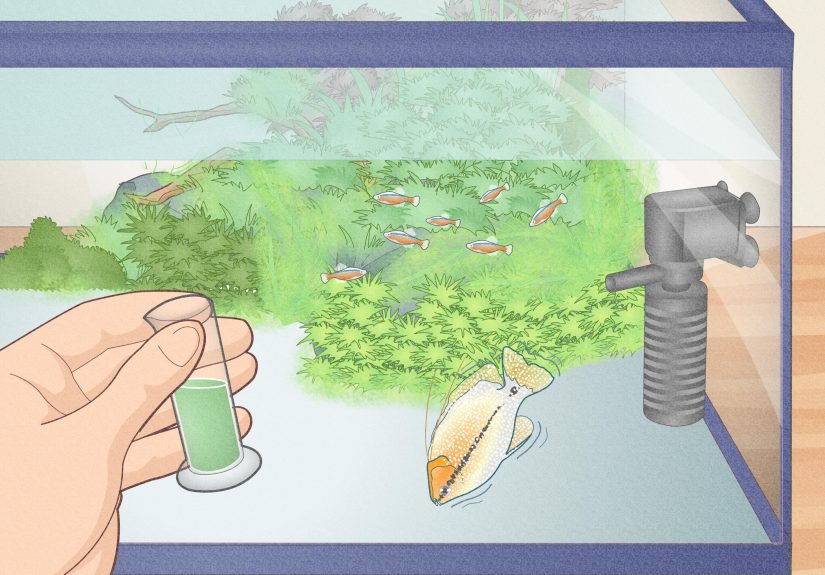
You fill a small test tube with tank water, add reagent drops, shake or mix as instructed, wait for the color to develop, and then compare the sample to a chart. Most kits measure total ammonia, which means both NH3 and NH4+ are included in the reading.
How to use a liquid ammonia test kit
- Rinse the test tube with tank water before the test.
- Fill it to the indicated line, usually 5 mL.
- Add the specified number of drops from bottle one.
- Add the specified number of drops from bottle two if required.
- Cap the tube and shake gently.
- Wait the full development time, often around five minutes.
- Compare the color to the chart on a white background or in natural light.
Why liquid kits are worth the extra effort
Liquid kits are especially helpful during tank cycling, after fish illness, after filter disruption, or whenever you need a clearer picture of water quality. They can help you detect a small ammonia rise before it becomes a major problem, and they are often the preferred option for hobbyists who like data more than vibes.
Pros and cons of liquid kits
Pros: more accurate, better for tracking trends, excellent for cycling a new tank, useful for confirming strip results.
Cons: slower, more steps, more cleanup, easier to mess up if you skip the instructions.
The most common mistake with liquid kits is impatience. If the instructions say wait five minutes, do not decide that two minutes feels emotionally close enough. Aquarium chemistry is not a mood board.
Method 3: Use an In-Tank Ammonia Alert Badge for Continuous Monitoring
In-tank ammonia alert badges are the set-it-and-watch-it option. These devices stay inside the aquarium and change color based on the presence of free ammonia. That makes them handy for continuous monitoring, especially in quarantine tanks, hospital tanks, breeding setups, or new systems where ammonia can swing quickly.
How an ammonia alert badge works
Unlike many liquid kits and strips that measure total ammonia, an alert badge is designed to monitor free ammonia, the more toxic form. That can be useful because it gives you a better sense of immediate danger, not just total nitrogen drama in the water.
How to use an ammonia alert badge
- Place the badge inside the aquarium where it is easy to see.
- Allow it time to equilibrate according to the product directions.
- Check the color regularly during feeding, maintenance, cycling, or treatment periods.
- Clean algae off the surface gently so the display remains readable.
When this method is most useful
This method is ideal if you want passive monitoring between formal tests. It is also useful in tanks where ammonia-binding products may affect how total ammonia is interpreted. Since the badge focuses on free ammonia, it can offer reassurance or warn you sooner when toxic ammonia is actually present.
Pros and cons of ammonia alert badges
Pros: continuous monitoring, no water sample needed, convenient for emergency observation, especially useful in problem tanks.
Cons: less detailed than a full liquid kit, may take time to adjust, should not replace full water testing entirely.
Think of the badge as a smoke detector. It is excellent for ongoing awareness, but you still want a full test kit in the house when something starts smelling suspicious.
Which Method Is Best for Your Fish Tank?
The best method depends on your setup and your personality. If you want speed and simplicity, use test strips. If you want precision and better tracking, use a liquid kit. If you want constant awareness, add an in-tank ammonia badge. Many experienced aquarists use more than one method: strips for quick checks, a liquid kit for confirmation, and a badge for ongoing monitoring.
A practical combo for most tanks looks like this: use a liquid kit during cycling or after any problem, use strips for weekly maintenance checks, and use a badge if the tank is unstable, newly stocked, medicated, or housing sensitive fish.
How Often Should You Check Ammonia?
For a brand-new tank, test ammonia daily or every other day while the nitrogen cycle establishes itself. For an established, stable aquarium, weekly testing is usually a smart routine. You should also test any time fish show stress, after overfeeding, after a dead fish is discovered, after adding several new fish, after deep cleaning the filter, or after using medications that may affect beneficial bacteria.
Smaller tanks generally need closer monitoring because water quality can swing faster. A large, planted aquarium may be more forgiving. A small overstocked tank, on the other hand, can go from “looks fine” to “why is everybody gasping” with terrifying efficiency.
How to Read Ammonia Results Without Panicking
Here is the practical rule: if an established tank shows any measurable ammonia, take it seriously. A reading of 0 ppm is the goal. If you get a low reading, double-check with a liquid kit if you used strips. If you get a moderate or high reading, act fast.
What to do if ammonia is above zero
- Do a partial water change, usually 25% to 50% depending on severity.
- Reduce or temporarily stop feeding for a short period.
- Remove uneaten food, dead plant matter, and debris.
- Check that the filter is running properly.
- Review stocking levels and recent maintenance mistakes.
- Consider beneficial bacteria support or an ammonia detoxifier if appropriate.
If ammonia is severe, larger water changes may be needed. Just match temperature and condition replacement water properly. Saving fish is the goal, not giving them a surprise roller coaster ride.
Common Mistakes When Checking Ammonia
Using expired tests
Old reagents and old strips can produce garbage results. If the kit has been sitting around since your last furniture style phase, replace it.
Ignoring pH
Total ammonia is important, but pH changes how dangerous that reading may be. The higher the pH, the greater the proportion of toxic free ammonia.
Testing at random times without context
A reading means more when you know what changed recently. Did you add fish? Overfeed? Clean the filter too aggressively? Stir up the substrate like you were excavating ancient ruins? Context matters.
Trusting one method forever
If a result seems odd, confirm it with another method. Smart aquarists do not guess when livestock is on the line.
of Real-World Experience and Practical Lessons
One of the most common experiences aquarium owners report is that ammonia problems almost never begin with dramatic music. They begin quietly. A fish skips a meal. Another hangs near the top. Someone notices the water looks fine, which is exactly why ammonia is so rude. It often causes damage before the tank looks obviously bad.
Beginners frequently run into trouble with new aquariums because they assume clear water means safe water. Unfortunately, ammonia does not care how pretty the tank looks on Instagram. A brand-new setup with sparkling glass and expensive décor can still have unstable biology. This is why people who start testing early usually avoid disaster. They catch the ammonia rise before the fish start showing severe stress.
Another common experience happens after overfeeding. Nearly every fish keeper has had one of those generous moments where the fish looked hungry, then somehow got fed like they were training for a marathon. What follows is predictable: leftover food breaks down, waste increases, and ammonia begins creeping upward. Many hobbyists only connect the dots after testing. The lesson is simple and slightly humbling: fish are enthusiastic actors and will often behave like they have not eaten in a century.
Filter maintenance is another major source of accidental ammonia spikes. People mean well. They clean the filter thoroughly, rinse media under tap water, replace too much media at once, and unknowingly wipe out the beneficial bacteria that process waste. Then the tank starts acting strange a few days later. Experienced aquarists learn to clean filters gently, preserve bio-media whenever possible, and avoid turning “maintenance day” into a bacterial eviction notice.
Seasoned fish keepers also talk about the value of patterns. A single ammonia reading is useful, but a testing routine is where the real confidence comes from. Once you know your tank’s normal behavior, you start noticing trouble faster. Maybe ammonia creeps up after adding new fish. Maybe a certain tank gets unstable if you skip a water change. Maybe your quarantine tank behaves beautifully until medication interrupts the cycle. These patterns make you a better caretaker because you stop reacting blindly and start managing proactively.
Many aquarists eventually develop a layered strategy. They keep test strips for fast checks, a liquid kit for confirmation, and a badge in tanks where things can change quickly. That is not overkill. That is experience talking. Fishkeeping gets much easier when you stop seeing water testing as a chore and start seeing it as early-warning protection.
Perhaps the biggest practical lesson is this: ammonia issues are usually fixable if you catch them early. The hobby can feel dramatic when numbers go wrong, but testing gives you control. You do a water change, cut feeding, check the filter, and stabilize the tank. It is not glamorous, and nobody makes a movie trailer about proper biofiltration, but it works. In the end, consistent testing is what separates a tank that merely looks nice from a tank that truly supports healthy fish long-term.
Final Thoughts
If you want a healthy aquarium, learning how to check ammonia in a fish tank is not optional. It is one of the most important habits in fishkeeping. The three easiest methods are simple: use test strips for speed, a liquid test kit for accuracy, and an in-tank ammonia alert badge for continuous monitoring.
None of these tools is complicated, but each can save fish when used consistently. A few minutes of testing can prevent stress, illness, and major losses. So yes, your aquarium may be a peaceful slice of underwater beauty, but behind that beauty is a tiny water chemistry operation that appreciates regular supervision. Check ammonia, stay consistent, and keep the drama where it belongs: in reality TV, not in your fish tank.