Table of Contents >> Show >> Hide
- Why This Series Hits So Hard
- The Artist Behind the Woodland Chaos
- How Pop Culture References Make the Paintings Better
- Why Watercolor Is the Secret Weapon
- What These 27 Paintings Say About Humor Right Now
- Specific Highlights That Make the Collection Memorable
- A 500-Word Experience: What It Feels Like to Spend Time With These Paintings
- Final Thoughts
Some art invites you to whisper. This art invites you to snort-laugh, text your friends immediately, and say, “This raccoon understands me better than most people.” That is the strange, wonderful power of Jennifer Dunn’s watercolor animal series. Under the Mossy Hollow name, she has built a collection that feels like a group chat, a meme archive, and a woodland fever dream all rolled into one very charming stack of painted paper.
Across these 27 watercolor paintings, animals are not just cute subjects. They are tiny emotional messengers. A goose can radiate chaos. A raccoon can embody your unhinged 10:47 p.m. energy. A shrimp can somehow become a friendship icon. And a possum leaning into trash-goblin greatness can feel less like a joke and more like a deeply honest personality assessment. That is what makes this collection work so well. It is funny on first glance, but it sticks because the humor is rooted in something recognizable: stress, defiance, awkwardness, tenderness, and the universal desire to be left alone unless snacks are involved.
Plenty of artists paint animals. Plenty of people make memes. Dunn’s trick is that she lets those two worlds collide without flattening either one. The paintings still feel handmade, soft, and genuinely artful. The jokes still feel sharp, current, and socially fluent. The result is what might be called high-quality emotional nonsense, which is honestly one of the internet’s finest genres.
Why This Series Hits So Hard
The immediate appeal is easy to understand. These paintings are funny. Not “pleasantly amusing” funny. Not “I exhaled through my nose” funny. They are the kind of funny that catches you off guard because watercolor is usually associated with gentleness, light, atmosphere, and maybe a tasteful heron near a pond. Instead, Dunn uses that same tender medium to deliver big moods with the grace of a raccoon kicking open a screen door.
That contrast is everything. Watercolor softens the edges, but the attitude still lands. A delicate animal silhouette paired with a deadpan caption becomes a perfect visual fake-out. Your eyes expect sweetness. Your brain gets sass. That gap creates the laugh.
It also helps that Dunn clearly understands internet humor without making the work feel disposable. These are not lazy references stapled onto animal portraits. The pop culture energy shows up in tone, rhythm, and phrasing. Some paintings read like the best kind of meme: specific enough to feel clever, broad enough to feel instantly relatable. Others lean into the now-familiar online language of overstatement, mild menace, existential fatigue, and oddly wholesome absurdity.
In other words, this is art for people who have ever been slightly overwhelmed, slightly feral, and somehow still trying to be nice about it.
The Artist Behind the Woodland Chaos
Jennifer Dunn does not present these animals as polished mascots or generic inspirational creatures. They feel lived-in. They have flaws, moods, impulses, and tiny bursts of bad judgment. That is a large part of their charm. The series does not ask animals to symbolize abstract virtues in a neat, old-fashioned way. Instead, they become stand-ins for very modern emotional states: overbooked, overstimulated, under-caffeinated, and one inconvenient email away from becoming a legend for all the wrong reasons.
That human connection is what lifts the collection above novelty. Dunn is not just making funny watercolor animals. She is making emotional portraits in disguise. The disguise just happens to be a goose with a weaponized vibe or a raccoon looking like it has accepted mischief as a calling.
There is also a refreshing lack of pretension here. The work feels like it knows exactly what it is doing. It is crafted, but not precious. It is clever, but not smug. It is earnest enough to connect and ridiculous enough to keep from becoming sentimental. That balance is hard to pull off. Too much sweetness, and the work turns sugary. Too much irony, and it becomes cold. Dunn sits right in the sweet spot where humor and affection meet.
How Pop Culture References Make the Paintings Better
Pop culture references can be risky. They can date a piece, make it feel try-hard, or bury the actual art under a pile of “Hey, remember this?” But when they work, they create instant recognition. Dunn uses that recognition like kindling. The reference gets your attention, then the animal expression, pose, and painterly softness do the rest.
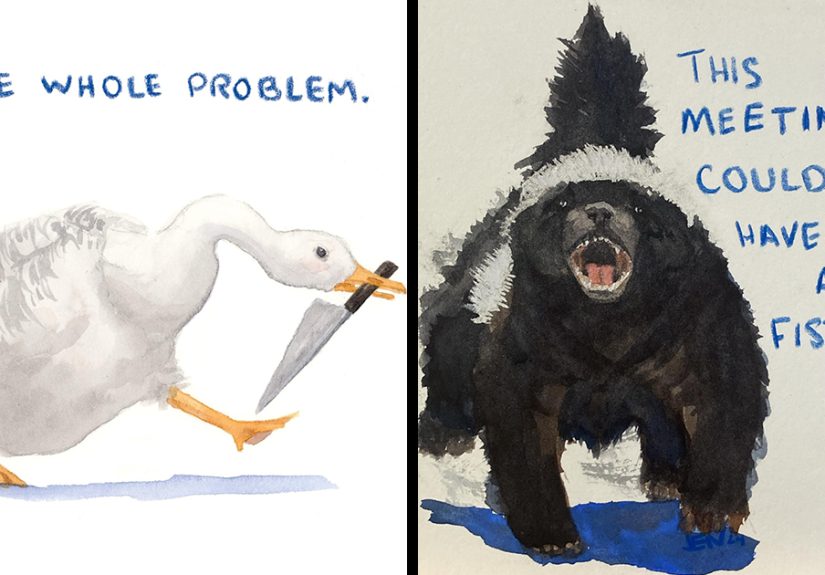
Take the captions people are already repeating back to one another: “Be the whole problem,” “merry crisis,” “friendshrimp,” and “I yearn for mischief.” Each one sounds like it escaped from the internet after stealing everyone’s coping mechanisms. They are compact, quotable, and weirdly revealing. The humor comes from the wording, but the emotional payoff comes from how perfectly the chosen animal wears the line.
A goose becomes an avatar of elegant hostility. A raccoon becomes the patron saint of disreputable ambition. Shrimp somehow become social icons. The joke is not just in the sentence. It is in the casting. Dunn is very good at casting animals the way a great director casts actors.
Animals as Personality Types
This collection works because people already assign personality traits to animals without even trying. Raccoons are chaotic. Geese are confrontational. Possums look like they have seen too much. Shrimp are absurd in a way that borders on poetic. When an artist leans into those associations, the joke arrives almost instantly.
But Dunn does not stop at the obvious. She turns familiar animal stereotypes into emotional shorthand. The animals become personality types you can recognize from your workplace, your family, your friend group, or your own diary if your diary were a lot more honest and a little more feral.
Internet Language Meets Traditional Medium
One of the smartest parts of the series is that the humor lives in contemporary phrasing while the medium feels timeless. Watercolor carries a long tradition of natural subjects, observational beauty, and lyrical looseness. Dunn borrows the visual softness of that tradition, then slips modern punchlines into the frame. It is like hanging a meme in a cottagecore gallery and somehow making it look completely at home.
That tension between classic technique and current voice gives the work extra energy. The paintings feel handmade in the best way, not mass-produced for a feed that will forget them in ten minutes. Even when the joke is quick, the image still has texture, shape, color, and compositional care.
Why Watercolor Is the Secret Weapon
If these same ideas were executed in a harsher digital style, they might still be funny, but they would lose something important. Watercolor brings vulnerability. It leaves room for bloom, blur, and accident. It makes the animals feel tactile and alive. It also creates a softness that amplifies the absurdity. A menacing goose is funnier when rendered like a quiet little poem. A raccoon’s bad decisions look even more lovable when painted in transparent washes and gentle edges.
That is why the collection never feels mean. Even when the captions flirt with chaos, the paintings remain warm. The medium acts like a built-in kindness filter. The sass lands, but the creatures still feel cherished. You laugh at them and root for them at the same time.
Watercolor also helps the paintings avoid visual noise. Many contemporary joke-based images are loud by design. Dunn’s are not. They breathe. The blank paper matters. The small gestures matter. The humor does not need to shout because the concept is already strong.
What These 27 Paintings Say About Humor Right Now
This collection feels especially suited to the current moment because modern humor often lives in contradiction. People want levity, but not fluff. They want sincerity, but not cringe. They want jokes that acknowledge stress without turning every feeling into a dramatic monologue. Dunn’s paintings sit right in that lane.
They are emotionally fluent without becoming heavy. They are silly without being empty. They understand that one of the best ways to survive a weird era is to look at a suspiciously relatable animal and think, “Unfortunately, that is me.”
There is also a democratic quality to this kind of humor. You do not need an art history degree to enjoy it. You do not need context, museum training, or three hours of free time. The painting reaches you quickly, but it is not shallow. That accessibility is part of its intelligence. Great humorous art is not lesser art. It is art that knows timing matters.
The Best Ones Feel Like Emotional Mirrors
The strongest paintings in the set do something sneaky: they shift from joke to mirror in about two seconds. You laugh, then you realize the painting has pinned down a feeling you have had but never phrased so neatly. Not with solemn grandeur. Not with self-help slogans. With a raccoon, apparently. Honestly, that feels correct.
This is why the series travels so well online. People do not just look at the paintings. They identify with them, quote them, send them, and assign them to each other. The work invites participation. It turns viewing into sharing, and sharing into a kind of social bonding. That is a big reason these paintings feel bigger than a simple collection of funny images.
Specific Highlights That Make the Collection Memorable
The goose radiating “I am not the problem, I am the upgrade to the problem” energy is memorable because it weaponizes dignity. The raccoon holiday meltdown image is memorable because seasonal stress has never looked so fuzzy. The shrimp duo works because the pun is ridiculous, but the visual sweetness sells it. The mischief-minded raccoon in the red hat lands because every friend group has one person who would absolutely volunteer to make things worse just for the plot.
Elsewhere, the collection plays with office dread, social awkwardness, and the low-stakes tragedy of being a person in public. A dinosaur can carry email-threat energy. Rabbits can throw off tiny-fighter intensity. Possums can look like the official mascots of beautifully compromised life choices. Dunn keeps proving that the animal kingdom is less a scientific category here and more a cast list for modern existence.
A 500-Word Experience: What It Feels Like to Spend Time With These Paintings
Spending time with these 27 watercolor paintings feels a little like walking into a cozy cabin and discovering that all the woodland creatures inside have Wi-Fi, group chat trauma, and surprisingly strong opinions about social boundaries. The first response is laughter, of course. The jokes are immediate. The animals arrive with such specific emotional weather that your brain instantly assigns them roles. This one is the friend who says “I’m fine” with the energy of a storm siren. That one is the coworker who survives entirely on iced coffee, spite, and suspiciously good timing. Another looks like it would absolutely text “lol” while actively causing problems.
But the longer you sit with the paintings, the more interesting the experience becomes. They stop being just punchlines and start feeling like emotional snapshots. You begin noticing how much personality is packed into a tilt of the head, a tiny paw placement, a bit of blank paper, or a wash of muted color. The watercolor keeps everything soft enough to invite you in. It says, relax, this is charming. Then the caption shows up and says, no actually, this raccoon has seen your browser history of stress and has notes.
There is something very satisfying about the way the series balances tenderness and menace. Not real menace, obviously. More the playful kind. The kind that says, “I love you, but I will absolutely knock over the metaphorical trash can if the mood is right.” That tension makes the paintings feel alive. Cute art can sometimes flatten into decoration. These do not. They have posture. They have timing. They have the emotional rhythm of a joke told by someone who understands exactly how long to pause before the last word.
What really stays with you, though, is how weirdly personal the collection feels. Almost everyone who looks at these paintings will find at least one that feels uncomfortably tailored to their soul. Maybe you are the mischief raccoon. Maybe you are the festive disaster raccoon. Maybe you are the shrimp trying to hold your life together with humor and a tiny cocktail. Maybe you are the goose, striding through the day with unearned confidence and a willingness to escalate. No judgment. In fact, that is the magic: the paintings never judge. They tease, they wink, they observe, but they never punish.
That makes the experience of viewing them surprisingly warm. You are not being told to improve yourself. You are not being sold a life philosophy. You are being offered recognition through absurd little creatures who seem to understand that modern life is both ridiculous and exhausting, and sometimes the healthiest response is to laugh before the group chat gets any worse.
By the end of the collection, the overall feeling is not just amusement. It is affection. You feel fond of the animals, fond of the jokes, and maybe a little more fond of your own daily weirdness. That is harder to achieve than it looks. Anyone can make something random. Far fewer can make something random, funny, painterly, and weirdly comforting all at once. These watercolor animals pull it off. They are sassier than they have any right to be, and somehow that makes them feel even more human.
Final Thoughts
Jennifer Dunn’s Mossy Hollow series succeeds because it understands two things at once: people love animals, and people desperately need better ways to laugh at themselves. These 27 watercolor paintings do not choose between beauty and humor, or between craft and internet fluency. They blend all of it into a collection that feels current without being flimsy, handmade without being precious, and hilarious without losing heart.
That is why these sassy animal paintings work so well. They are not just funny images with captions. They are miniature character studies, cultural snapshots, and emotional release valves in watercolor form. In a crowded online world full of disposable jokes, Dunn’s art actually lingers. It makes you laugh, then sends you back into your day slightly more delighted, slightly more seen, and maybe a little more willing to embrace your inner raccoon.