Table of Contents >> Show >> Hide
- 1. Guernica Was Inspired by a Real Bombing
- 2. Picasso Was Already Commissioned Before the Bombing
- 3. It Was Painted in Paris, Not Spain
- 4. The Painting Is Enormous
- 5. It Is an Oil Painting, Not a Fresco
- 6. Picasso Completed It Very Quickly
- 7. Dora Maar Documented Its Creation
- 8. Its Black, White, and Gray Palette Was Deliberate
- 9. The Bull Is One of the Painting’s Biggest Mysteries
- 10. The Horse May Represent the People’s Suffering
- 11. The Light Bulb Has a Double Edge
- 12. The Woman With the Lamp Adds a Strange Hope
- 13. The Fallen Soldier Holds a Broken Sword and a Flower
- 14. Guernica Shocked Viewers at the 1937 Paris Exposition
- 15. Picasso Refused to Let It Go to Franco’s Spain
- 16. It Still Shapes Modern Conversations About War
- Why Guernica Still Feels So Modern
- Experiences and Reflections: What It Feels Like to Encounter Guernica
- Conclusion
Some paintings decorate a room. Pablo Picasso’s Guernica detonates inside it.
At first glance, the canvas looks like a storm made of broken bodies, screaming faces, sharp triangles, and one extremely stressed horse. Look longer, and the chaos begins to organize itself into a devastating statement about war, civilian suffering, propaganda, memory, and the strange power of art to keep shouting long after the guns go quiet.
Painted in 1937 during the Spanish Civil War, Guernica is one of the most famous anti-war paintings in the world. It is huge, monochrome, politically charged, and still capable of making a museum gallery feel like the most uncomfortable silence on Earth. Here are 16 fascinating facts about Picasso’s Guernicathe masterpiece that turned horror into an image nobody could easily ignore.
1. Guernica Was Inspired by a Real Bombing
The painting responds to the bombing of Guernica, a Basque town in northern Spain, on April 26, 1937. During the Spanish Civil War, German and Italian aircraft supporting General Francisco Franco’s Nationalist forces attacked the town. The raid shocked international observers because it targeted a civilian area and became a grim preview of aerial warfare against cities.
Picasso did not paint a literal news illustration of the event. There are no airplanes, pilots, uniforms, or maps. Instead, he painted the emotional aftermath: terror, grief, confusion, helplessness, and the feeling that ordinary life has been ripped apart in seconds.
2. Picasso Was Already Commissioned Before the Bombing
One of the most interesting facts about Guernica is that Picasso already had a major assignment before the tragedy occurred. The Spanish Republican government had commissioned him to create a large mural for the Spanish Pavilion at the 1937 Paris International Exposition.
At first, Picasso struggled with the subject. Early ideas reportedly centered on an artist’s studio theme, which sounds charming until history barged through the door wearing combat boots. News of the bombing gave the project its urgent purpose. Picasso transformed the commission into a monumental protest against fascist violence and the destruction of civilians.
3. It Was Painted in Paris, Not Spain
Although Guernica is one of the most Spanish paintings ever made, Picasso painted it in Paris. He was living and working in France at the time, using a studio at 7 Rue des Grands-Augustins.
This detail matters because Picasso experienced the bombing from afar, through newspaper reports, photographs, conversations, and political networks. The painting is therefore not eyewitness reportage. It is something more complicated: an exile’s cry, an artist’s response, and a symbolic reconstruction of catastrophe from fragments of information and emotion.
4. The Painting Is Enormous
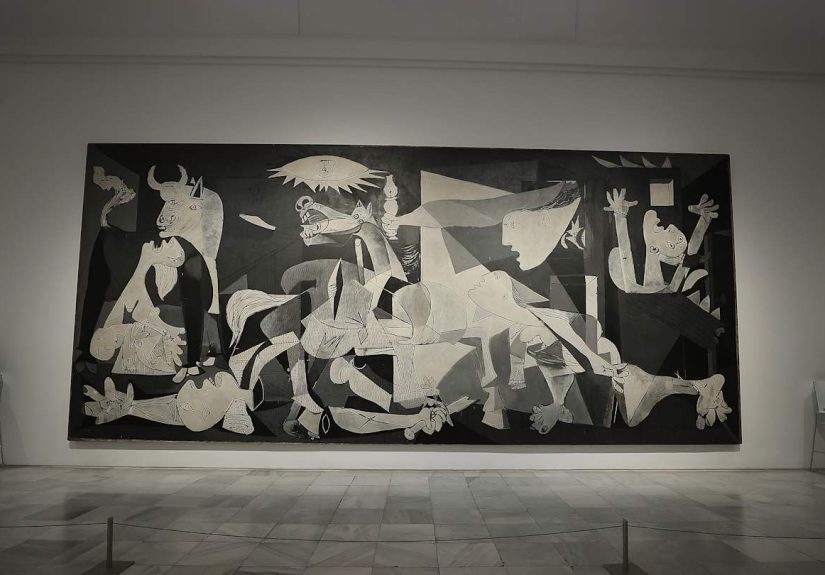
Guernica measures about 11.5 feet high and more than 25 feet wide. In metric terms, it is roughly 349.3 by 776.6 centimeters. That is not a painting you casually hang over a couch unless your couch belongs to a giant with excellent insurance.
The scale is part of the meaning. Viewers do not simply look at Guernica; they are surrounded by it. Its figures are close to life-size or larger, making the suffering feel immediate. The mural format gives the scene public force, as though the wall itself has become a witness.
5. It Is an Oil Painting, Not a Fresco
Because Guernica is often called a mural, many people assume it was painted directly onto a wall. It was not. Picasso painted it in oil on canvas.
This was practical. The work needed to travel to the Spanish Pavilion, and later it toured internationally. Canvas made that movement possible, though the painting’s many journeys would eventually contribute to conservation concerns. Today, its fragility is one reason museums and officials are extremely cautious about moving it.
6. Picasso Completed It Very Quickly
For a painting this famous and complex, Guernica came together at remarkable speed. Picasso began work in May 1937 and completed it in early June, finishing the massive canvas in about a month.
That does not mean it was improvised casually. Picasso produced many studies and changed the composition as he worked. The finished painting may look like a frozen explosion, but it was carefully arranged. Every scream has a location. Every angle earns its place.
7. Dora Maar Documented Its Creation
Photographer and artist Dora Maar played a crucial role in the history of Guernica. She photographed the painting at different stages while Picasso worked on it. These images are invaluable because they show the evolution of the composition: figures appear, shift, disappear, and return in altered form.
Maar’s photographs reveal that Guernica was not born fully formed. It was wrestled into existence. They also remind us that artistic masterpieces often have collaborative ecosystems around them, even when one famous name gets the spotlight.
8. Its Black, White, and Gray Palette Was Deliberate
Guernica is famous for its lack of color. Picasso used a stark range of black, white, and gray, a technique often connected with grisaille. The palette gives the painting a newspaper-like quality, linking it to the printed reports and photographs through which many people learned about the bombing.
The absence of bright color also strips away beauty in the decorative sense. There is no lush red blood, no blue sky, no golden heroic glow. The result feels colder, harder, and more universal. War, in Picasso’s hands, is not cinematic. It is ash, paper, smoke, and bone.
9. The Bull Is One of the Painting’s Biggest Mysteries
On the left side of the canvas stands a bull, calm and strangely watchful beside a grieving mother and dead child. Viewers have interpreted the bull in many ways: brutality, fascism, Spain, masculinity, indifference, or even Picasso himself.
Picasso resisted simple explanations. He sometimes said that the bull was simply a bull and the horse was simply a horse. Of course, when Picasso says “simple,” art historians immediately put on comfortable shoes and begin a 40-year debate. The bull remains powerful because it refuses to settle into one meaning.
10. The Horse May Represent the People’s Suffering
At the center of Guernica is a wounded horse, its mouth open in a cry. A spear-like shape pierces its body, and its twisted form dominates the composition.
The horse has often been read as a symbol of the Spanish people suffering under violence. It may also connect to bullfighting imagery, a recurring theme in Picasso’s work. In Guernica, however, the bullring has become a battlefield, and the ritual of spectacle has turned into mass civilian agony.
11. The Light Bulb Has a Double Edge
Near the top of the painting, a harsh light bulb shines over the scene. It resembles an eye, a sun, an explosion, or a surveillance device. Its rays do not comfort the figures below. They expose them.
The bulb is one of the painting’s sharpest modern symbols. It may suggest technology, bombing, artificial illumination, or the cold gaze of modern warfare. Instead of divine light, we get electricity. Instead of rescue, we get visibility. It is the kind of light that says, “Yes, everyone can see the disaster now,” which is not exactly the same as stopping it.
12. The Woman With the Lamp Adds a Strange Hope
From the right side of the composition, a woman leans into the scene holding a lamp. She appears ghostlike, as if entering from another world or another room. Her lamp contrasts with the electric bulb above.
Some viewers see her as a witness, a figure of truth, or a fragile symbol of hope. Others read her as part of the painting’s general nightmare. That ambiguity is classic Guernica. Even its possible hope arrives looking alarmed, stretched, and underfed.
13. The Fallen Soldier Holds a Broken Sword and a Flower
At the bottom of the painting lies a dismembered soldier. His broken sword suggests defeat, but beside it grows a small flower. This detail is easy to miss because, frankly, the rest of the canvas is very busy screaming.
The flower is one of the painting’s quietest and most moving symbols. It may suggest resilience, mourning, or the possibility that life continues after violence. Picasso does not give viewers an easy happy ending, but he leaves a tiny sign that destruction has not completely won.
14. Guernica Shocked Viewers at the 1937 Paris Exposition
The painting was displayed in the Spanish Pavilion at the 1937 Paris International Exposition. The pavilion itself was politically charged, designed to draw attention to the Spanish Republic’s struggle during the civil war.
Visitors expecting a neat patriotic mural did not get one. Guernica was difficult, fragmented, and emotionally brutal. Some admired its power; others found it confusing. That mixed reaction is important. Great protest art does not always arrive wearing a clear label. Sometimes it grabs the room by the collar and says, “You figure out why this hurts.”
15. Picasso Refused to Let It Go to Franco’s Spain
After the Spanish Civil War, Franco ruled Spain for decades. Picasso did not want Guernica displayed in Spain under the dictatorship. The painting eventually spent many years in the custody of the Museum of Modern Art in New York.
It returned to Spain in 1981, after Franco’s death and the country’s transition toward democracy. For many people, the return of Guernica was more than an art-world event. It was a symbolic homecoming, tied to memory, political change, and Spain’s effort to confront its violent 20th-century history.
16. It Still Shapes Modern Conversations About War
Guernica has never become just “old art.” It continues to appear in protests, political discussions, museum debates, and conversations about civilian suffering in war. A tapestry version once displayed near the United Nations Security Council became famous in its own right, especially when it was covered during a 2003 press event connected to the Iraq War.
That episode proved something Picasso probably understood: an image can be so politically inconvenient that people try to hide it. Guernica does not offer policy advice, but it does ask a question that never gets old: who pays the price when leaders choose violence?
Why Guernica Still Feels So Modern
Part of Guernica’s lasting power comes from the fact that it avoids being too specific. The title points to one place and one atrocity, but the painting’s language is broader. Its figures could belong to many wars. Its grief is not locked in 1937.
Picasso combined Cubist fragmentation, Surrealist intensity, classical tragedy, Spanish visual traditions, and modern media references into one overwhelming scene. The painting feels broken because the world it depicts is broken. It refuses the polished order of heroic war art. There are no noble generals, no flags waving prettily, no brave horses charging toward glory. There is only panic, noise, darkness, and bodies under pressure.
That is why Guernica remains one of the most searched, studied, and discussed Picasso paintings. It is not merely famous because Picasso painted it. It is famous because it still does its job. It disturbs people. It makes viewers slow down. It turns historical violence into a present-tense emotional experience.
Experiences and Reflections: What It Feels Like to Encounter Guernica
Standing before Guernica, whether in person at the Museo Reina Sofía in Madrid or through a high-resolution reproduction, is not like casually scrolling past a pretty painting. It feels more like entering a room where everyone has just screamed and the echo is still hanging in the air. The canvas is so wide that your eyes cannot swallow it in one bite. You move from the grieving mother to the bull, from the horse to the lamp, from the broken soldier to the burning figure, and each stop feels like another witness statement.
One of the most striking experiences is how noisy the painting seems despite being completely silent. The open mouths are everywhere. The horse cries out. The mother wails. The figure trapped in flames raises its arms. Even the shapes seem sharp enough to make sound. Picasso somehow painted volume without using a single musical note, speech bubble, or dramatic caption. The result is visual noiseorganized chaos that keeps pushing against the viewer.
Another powerful experience is realizing how little the painting depends on traditional realism. Nobody looks anatomically comfortable in Guernica. Faces are sideways and frontal at the same time. Bodies are flattened, twisted, and rearranged. Yet the emotional truth is unmistakable. In real life, terror does not feel orderly. Panic fractures perception. Memory arrives in shards. Picasso’s distorted forms capture that psychological reality better than a polished realistic scene might have done.
For writers, students, artists, and history lovers, Guernica also offers a lesson in how to handle difficult subjects. Picasso does not explain the bombing with a tidy moral paragraph. He does not paint villains in one corner and victims in another with helpful labels. Instead, he creates an image that forces viewers to participate. We have to search, interpret, connect, and feel. That is one reason the painting remains so teachable: every generation can approach it with new questions.
There is also something deeply humbling about the painting’s endurance. The event that inspired it happened in a specific town on a specific day, yet the image continues to speak to people facing completely different conflicts. That does not erase the Basque tragedy; it amplifies it. Guernica reminds us that local suffering can become universal when art preserves it with enough force.
Personally, the most unforgettable part of Guernica is not its size, fame, or art-historical importance. It is the small flower near the broken sword. After all the violence, after all the jagged grief, there it is: fragile, almost ridiculous, and still alive. In a painting that gives viewers very few comforts, that tiny bloom feels like a whisper. Not a promise that everything will be fine, because Guernica is too honest for that. More like a stubborn reminder that even after destruction, memory can grow, truth can survive, and beauty can return in forms as small as a flower painted beside a ruin.
Conclusion
Picasso’s Guernica is not an easy painting, and that is exactly why it matters. It was born from a real atrocity, shaped by political urgency, built through artistic experimentation, and preserved through decades of exile, debate, and symbolic use. Its 16 fascinating facts reveal more than the story of a famous artwork. They reveal how art can become a witness, a protest, a historical document, and a moral alarm bell.
Nearly a century after the bombing that inspired it, Guernica still refuses to behave like a relic. It remains tense, uncomfortable, and alive. The horse still cries. The mother still mourns. The lamp still searches. The flower still grows. And viewers are still left with the same difficult question: when the world breaks, who will dare to look?
Note: This article is written as publication-ready HTML body content in standard American English, with SEO metadata included at the end in JSON format.