Table of Contents >> Show >> Hide
- Why Mountains Make Perfect Mystery Factories
- 10. The Dyatlov Pass Incident – Russia’s “Death Mountain”
- 9. The Valley of Headless Men – Nahanni National Park, Canada
- 8. The Forbidden Mountain – Genghis Khan’s Hidden Tomb
- 7. The Snow Saddle of Nepal – A Possible UFO Hideout?
- 6. The Big Grey Man of Ben Macdhui – Scotland’s Mountain Wraith
- 5. Mount Nyangani – The Mountain That Swallows People
- 4. The Mount Lykaion Sacrifice – A Dark Gift to the Gods
- 3. The Berwyn Mountain Incident – Wales’s “Roswelsh”
- 2. The Untersberg Portals – Time Slips in the Alps
- 1. Black Mountain – Australia’s Living Stone Labyrinth
- What These Mountain Mysteries Have in Common
- Real-Life Experiences: What It’s Like to Chase Mountain Mysteries
Mountains look peaceful from a distance – snowcapped, majestic, almost postcard-perfect.
But the higher you climb, the stranger things get. People disappear in broad daylight,
compasses spin for no reason, and ancient legends refuse to die even in the age of GPS
and satellite maps. These creepy, unsolved mountain mysteries remind us that some places
on Earth still haven’t given up their secrets.
Inspired by classic Listverse-style countdowns, this list takes you on a tour of
ten of the most unsettling unsolved mysteries of the mountains – from Russia’s
“Death Mountain” to sacred peaks that may be hiding emperors, aliens, or something
even weirder.
Why Mountains Make Perfect Mystery Factories
Remote terrain, sudden weather shifts, thin air, and limited rescue access create
perfect conditions for both real danger and wild speculation. It’s hard to investigate
thoroughly when rescue teams are dodging blizzards, avalanches, or cliffs. On top of
that, many mountain regions are wrapped in centuries of folklore about spirits,
curses, or gods. Put all of that together and you get the ultimate recipe for creepy,
unsolved mountain mysteries.
10. The Dyatlov Pass Incident – Russia’s “Death Mountain”
In 1959, nine experienced hikers from the Ural Polytechnical Institute set out on a
winter trek through the Ural Mountains of the Soviet Union. They never made it home.
When rescuers finally found their camp at what is now called Dyatlov Pass, the tent
had been slashed open from the inside, supplies were left behind in good order, and
footprints led away into the snow – many of them from people who were barefoot or
wearing only socks.
Bodies were discovered scattered down the slope, some near a makeshift campfire,
others in a ravine. Autopsies found a disturbing mix of causes: most died of
hypothermia, but several had massive internal injuries – crushed ribs, skull fractures –
without corresponding external trauma. One hiker was missing her tongue and eyes.
Some clothing showed abnormal radiation levels. To this day, no single theory fully
explains what happened.
Leading Theories
Theories include a slab avalanche, a violent katabatic wind, secret military tests,
infrasound-induced panic, and, of course, UFOs. Recent research leans toward a
natural but highly unusual snow-slab event combined with poor visibility and
disorientation, but the eerie condition of the bodies keeps the “creepy” factor high.
9. The Valley of Headless Men – Nahanni National Park, Canada
Deep in Canada’s Northwest Territories lies Nahanni National Park, a rugged region of
canyons, hot springs, and razor-backed peaks. It has another, far more sinister name:
the “Valley of Headless Men.” In the early 1900s, prospectors Willie and Frank McLeod
went searching for gold and never returned. Their bodies were later found – decapitated.
Over the next few decades, more grisly discoveries followed. Other prospectors and
trappers turned up dead, sometimes headless, sometimes simply vanished. Local Dene and
other Indigenous stories long warned that the area was haunted or cursed, and place
names like Deadmen Valley and Headless Creek don’t exactly calm the nerves.
Legends and Explanations
Some legends speak of a fierce, vanished mountain tribe that guarded its territory with
ruthless efficiency. Others suggest hidden gold, vengeful spirits, or cryptid-like
beings lurking in the canyons. More grounded explanations point to exposure, violence
between prospectors, and scavenging animals. Still, the repeated pattern of mysterious
deaths has kept this remote valley at the top of unsolved mountain mystery lists.
8. The Forbidden Mountain – Genghis Khan’s Hidden Tomb
In Mongolia’s Khentii Mountains, sections of the landscape are so heavily protected
that outsiders have been kept away for centuries. Many historians believe that somewhere
in this rugged region, possibly near the sacred mountain Burkhan Khaldun, lies the
still-undiscovered tomb of Genghis Khan. Historical records suggest his burial was
intentionally concealed: no marker, no monument, and possibly a mass execution of the
builders to keep the secret.
Today, parts of the area are designated as strictly protected, and local tradition
discourages intrusive digging. High-tech, non-invasive surveys have scanned the region
from above, searching for hidden structures without disturbing the sacred ground.
So far, the mountains have kept their silence.
A Sacred Secret
Is there a huge necropolis filled with treasures and history-altering artifacts? Or did
the conqueror’s grave truly vanish into the anonymity he reportedly wanted? Until
someone uncovers definitive proof – and survives the political and cultural fallout –
the Forbidden Mountain remains one of the world’s most tantalizing mountain mysteries.
7. The Snow Saddle of Nepal – A Possible UFO Hideout?
Kangtega, nicknamed “The Snow Saddle,” rises more than 22,000 feet above sea level in
Nepal’s Himalayas. Climbers know it as a strikingly beautiful but challenging peak.
Online mystery hunters, however, know it for something else entirely: a strange dark
patch on satellite imagery, as if someone censored a section of the mountain.
Various bloggers and UFO enthusiasts have argued that this “blacked out” area might
be hiding a secret base – either human or extraterrestrial. Some claim it aligns with
ridges that are accessible only by air, not by foot, making the conspiracy feel just
plausible enough to go viral.
Glitch or Government Cover-Up?
Skeptics point out that mapping glitches, overlapping image tiles, and cloud cover can
easily create odd-looking patches on tools like Google Earth. No solid evidence of a
base, alien or otherwise, has ever been produced. Still, in the high, thin air of the
Himalayas, where climbers report strange lights, sounds, and sensations, it doesn’t
take much for the imagination to fill in the gaps.
6. The Big Grey Man of Ben Macdhui – Scotland’s Mountain Wraith
Ben Macdhui, the second-highest peak in the British Isles, sits in the Cairngorm range
of Scotland. Hikers here occasionally report something far scarier than bad weather:
a towering, shadowy figure known in Gaelic as Am Fear Liath Mòr – the Big Grey
Man. Witnesses describe the sense of being followed by giant footsteps, seeing an
enormous humanoid form in the mist, or feeling a crushing wave of dread for no obvious
reason.
One early 20th-century mountaineer claimed he heard heavy footsteps that didn’t match
his own and fled the summit in terror. Since then, stories have multiplied, turning the
Big Grey Man into a kind of Scottish yeti – part cryptid, part psychological phenomenon.
Science vs. Supernatural
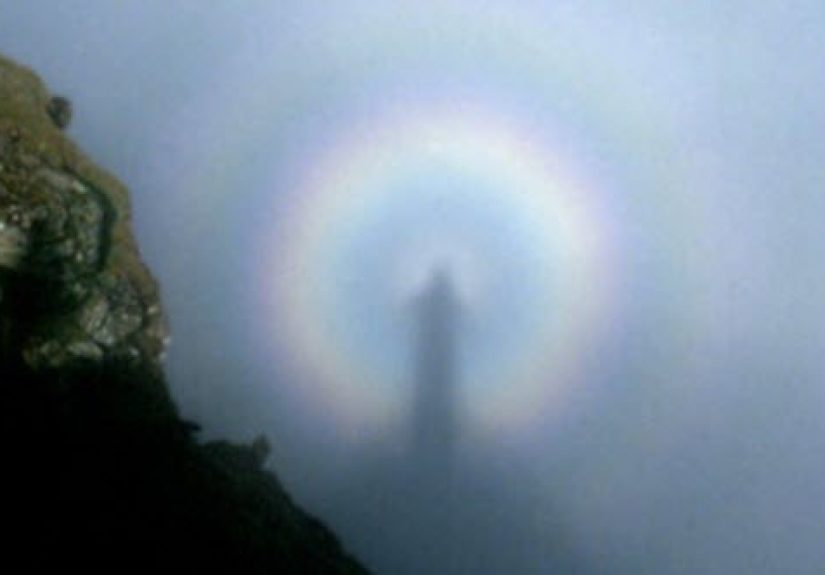
Some explanations suggest a combination of infrasound, isolation, fatigue, and a visual
effect called the Brocken specter, where a hiker’s magnified shadow appears in the mist.
Others believe there really is something out there in the fog – an entity that doesn’t
appreciate company on its mountain.
5. Mount Nyangani – The Mountain That Swallows People
Mount Nyangani, Zimbabwe’s highest peak, has an unsettling reputation. Locals warn
that the mountain “swallows” people, and several high-profile disappearances have
turned that phrase into a chilling metaphor. Over the years, hikers and even children
of government officials have vanished on or near the slopes, sometimes only a short
distance from companions.
Traditional beliefs hold that powerful spirits and ancestral beings inhabit the
mountain. Travelers are advised not to point at certain places, not to shout, and not
to mock the landscape. Break the rules, the legends say, and the mountain might take
offense – and take you.
Rational Risks and Irreducible Mystery
Practically speaking, Nyangani is often shrouded in fog, with cliffs, ravines, and
boggy ground that can hide hazards. It’s easy to become disoriented. Still, the speed
and totality of some disappearances – people stepping away from a group and never being
seen again – keep the supernatural explanations very much alive in local culture.
4. The Mount Lykaion Sacrifice – A Dark Gift to the Gods
Mount Lykaion in Greece was once a major cult site dedicated to Zeus. Ancient writers
whispered about human sacrifice and cannibalism on its slopes, including a legend in
which a boy is killed and eaten, and the guilty are transformed into wolves. For a long
time, historians assumed this was pure myth. Then archaeologists discovered a 3,000-year-old
skeleton of an adolescent buried within the mountaintop sacrificial altar.
The find doesn’t prove human sacrifice conclusively, but the context is eerie: the
remains were found among animal bones at a site described in ancient texts as a place
of dark rites. That discovery has pushed Mount Lykaion from “spooky myth” into the
realm of “creepy, possibly real history.”
History or Horror Story?
Scholars are still debating exactly what happened on Lykaion’s summit. Was it a
one-off burial, a crime scene, or evidence of ritual killing? Until the full story is
uncovered – if it ever is – this mountain remains a chilling crossroads where
archaeology and legend meet.
3. The Berwyn Mountain Incident – Wales’s “Roswelsh”
On January 23, 1974, residents around the Berwyn Mountains in North Wales felt a
powerful tremor and saw a blazing light in the sky and on the hillside. Many assumed a
plane had crashed. Rescue teams searched the mountain, but no wreckage turned up.
That blank space was quickly filled with UFO theories.
Some witnesses reported seeing strange glowing objects low over the mountains. Later,
stories emerged of military vehicles on remote roads and rumors of crashed saucers and
recovered bodies. The media dubbed it “The Welsh Roswell” or “Roswelsh,” and it has
been a favorite case among UFO enthusiasts ever since.
Earthquake, Meteor… or Something Else?
Official investigations concluded that a magnitude 3.5 earthquake occurred at the same
time a bright meteor streaked overhead – a cosmic coincidence that explains both the
shaking and the lights, at least on paper. Skeptics say that’s the end of the story.
Believers argue that the lack of a crater, reported search activity, and ongoing local
folklore point to something much stranger happening on the Berwyns that night.
2. The Untersberg Portals – Time Slips in the Alps
Straddling the border between Germany and Austria, the Untersberg mountain has
accumulated centuries of legends: sleeping emperors, underground cities, and strange
beings living inside the rock. In the modern era, it’s become famous for “time slips,”
where visitors allegedly lose hours or even days and reappear miles away from where
they started.
Some hikers claim that their watches ran fast or slow in specific spots. Others say
they entered a cave or crevice and stepped out into a different part of the mountain
with no memory of how they got there. A few writers and mystics argue that Untersberg
is riddled with portals to other dimensions or timelines.
Between Science and Story
Skeptical explanations lean on the usual suspects: fatigue, dehydration, misreading
terrain, and the unreliability of memory under stress. But Untersberg’s enduring
reputation, from ancient myths to modern New Age tourism, ensures it remains one of
the creepiest “maybe-there’s-a-portal-here” mountains on Earth.
1. Black Mountain – Australia’s Living Stone Labyrinth
Black Mountain, or Kalkajaka, in Queensland, Australia, doesn’t look like other peaks.
Instead of gentle slopes and forests, it’s a jumbled pile of massive black boulders
stacked into a looming heap. Local Indigenous Kuku Nyungkal stories long describe it
as a dangerous, spiritually charged place. Modern tales add vanishings, strange
lights, and eerie, echoing voices.
Over the years, miners, travelers, and even entire herds of livestock are said to have
disappeared in its maze-like interior. Animals reportedly balk at approaching the
mountain, and pilots have complained of instrument anomalies when flying overhead.
Geologists point to the boulder field’s unique acoustics and unstable cavities.
Storytellers point to… something else entirely.
A Mountain Best Admired from Afar
Whether you blame hidden crevices, toxic gases, or an angry spirit world, Black
Mountain has a track record that makes even seasoned locals cautious. It’s the perfect
finale for a list of creepy unsolved mysteries of the mountains: a place that looks
wrong, feels wrong, and refuses to explain itself.
What These Mountain Mysteries Have in Common
Look across these ten cases and a few patterns jump out. First, most of these mountains
are extremely remote or hazardous. When something goes wrong there, it may never be
fully investigated – which means rumors live longer than official reports. Second,
almost every location has deep cultural or spiritual meaning: tombs of emperors,
sacred peaks, or long-feared landscapes. That layered symbolism keeps stories alive
and encourages new ones.
Finally, mountains are great at breaking our illusion of control. A sudden storm, a
wrong turn in the fog, or an unexpected rockfall can completely change a situation.
When survivors are few and evidence is sparse, unsolved mysteries are almost guaranteed.
And humans, being humans, will happily fill in the blanks with everything from time
portals to mountain monsters.
Real-Life Experiences: What It’s Like to Chase Mountain Mysteries
Reading about creepy unsolved mountain mysteries is one thing; walking into those
landscapes is another. Many modern hikers, climbers, and adventure travelers actively
seek out these haunted peaks, hoping for a brush with the unexplained – or at least a
memorable story to tell around the campfire.
People who trek near Dyatlov Pass often describe an unsettling quiet, as if the
landscape itself is holding its breath. They know the history: the slashed tent, the
frozen bodies, the radiation tests. Even when the sky is clear, there’s a sense that
this isn’t just another ski route. Guides emphasize preparation, avalanche awareness,
and respect for winter conditions, but almost everyone still glances over their
shoulder when the wind shifts.
Travelers to Nahanni or other remote northern ranges report something similar: a
feeling of being very small in a very old place. Stories of the headless prospectors
are still shared in lodges and camps. Even if you don’t believe in curses, standing in
a canyon that once hosted real, unsolved deaths has a way of sharpening your senses.
You pay more attention to loose rock, fast-rising water, and the simple fact that help
is a long way away.
In places like Ben Macdhui or Mount Nyangani, the “creepy factor” doesn’t just come
from folklore, but from how fast the environment can turn on you. Mist rolls in, and
suddenly the familiar path looks strange. Your echo bounces weirdly off rock walls.
A gust of wind makes the grass rustle behind you just as your nerves are fraying. It’s
easy to see how hikers, tired and stressed, could interpret those sensations as a
shadowy figure following them or a spirit trying to lure them away.
Some visitors go in deliberately looking for evidence – bringing EMF meters, thermal
cameras, or carefully logging GPS tracks to look for anomalies. Others simply bring a
good pair of boots and a healthy respect for the unknown. Regardless of your approach,
a few practical rules show up again and again in real-world experiences:
- Don’t go alone in remote, hazardous mountain regions, especially those known for sudden weather shifts.
- Tell someone your plan – route, timing, and what to do if you’re late.
- Pack for more than you expect: extra layers, food, a headlamp, and navigation tools.
- Respect local beliefs – even if you’re skeptical, the people who live near these mountains often know the risks best.
- Know when to turn back; the mountain will still be there another day.
Interestingly, many travelers say that the “haunted” parts of their trip turn out to
be the moments when nature is just doing its thing: a sudden whiteout at high altitude,
a thunderstorm echoing through a canyon like a growl, or the disorienting effect of
walking in fog where you can’t see the ground or the sky clearly. Those experiences
can feel paranormal, even when they’re completely natural.
The common thread in these accounts is that mountain mysteries are best appreciated
with a mix of curiosity and caution. You can enjoy the creepy legends, chase the
stories of UFOs and portals, and still recognize that the real danger – and real awe –
comes from the raw landscape itself. Whether or not you ever meet a Big Grey Man or
wander into a time slip, one night on a cold, lonely ridge is usually enough to convince
people that the mountains don’t need any help from the supernatural to be deeply,
profoundly unsettling.
SEO JSON